- 392 pages
- English
- ePUB (mobile friendly)
- Available on iOS & Android
eBook - ePub
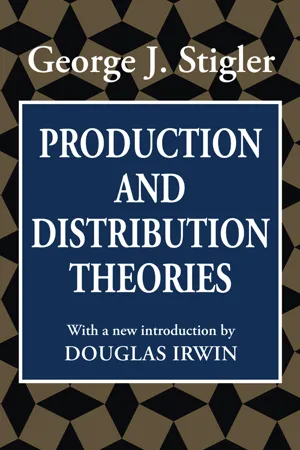
Production and Distribution Theories
About this book
Production and Distribution Theories became a landmark in the study of economics when it was published in 1941. Nobel Laureate Stigler's book was the first to trace the development of theories alongside the history of economic thought. Stigler's pioneering effort remains a classic work on the evolution of distribution theory during a critical juncture in the development of modern industrial capitalism.Stigler examines the writings of major economists during the century, including William Stanley Jevons, Phillip Wicksteed, Alfred Marshall, F.Y. Edgeworth, and Leon Walras. He uses their works in order to show a variety of perspectives on distribution theory. Among the methods of thought he explores are neoclassical price theory and marginal productivity theory.In the new introduction, Douglas Irwin illustrates how this book came into being and notes its continuing significance to the study of economics. Joseph Schumpeter commented in his History of Economic Analysis that this excellent work by a competent theorist is perhaps the best survey in existence of the theoretical work of that period's leaders and is strongly recommended. This judgment still stands. The book will be of great interest to those interested not only in neoclassical economics, but also in the sources of Stigler's economic thought.
Information
Chapter XII
Euler’s Theorem and the Marginal Productivity Theory
THE completion of the marginal productivity theory of distribution was achieved only with the development of the proof that if all productive agents are rewarded in accord with their marginal products, then the total product will be exactly exhausted. This exhaustion-of-product problem is of course unique to the general marginal productivity theory. In this respect previous distribution theories fall into one of two categories. The residual theories form the first group. Distribution theories of this type always premised at least one residual share; in the classical system, rent was accorded this position in a first dichotomy, "profit" in a second. Clearly no problem of the exhaustion of the product can arise when there is a residual claimant. The second general category includes all distribution theories in which the exhaustion of the product by distributive shares is made an explicit assumption. In this class fall the doctrines based on fixed coefficients of production which were advanced by Walras and Wieser, and their more recent followers. Only the marginal productivity theory has determined separately the share of each productive factor.1 Only the marginal productivity theory, consequently, has been confronted by the question, does this method exactly exhaust the total product?
It has been shown that Wicksell had already answered this question in the affirmative in 1893, and that Edgeworth's discussion in 1889 strongly implied the same answer. But it was Philip Wicksteed who first raised the question explicitly, in his magnificent Co-ordination of the Laws of Distribution in 1894. Thereafter almost every important European economist of our period offered contributions to a discussion which did not lack either personalities or arguments.1 Wicksell was Wicksteed's leading contemporary defender; Edgeworth, Pareto, Barone, and Walras led in the attack on the theory (and sometimes on the man). It is this controversy which the present chapter seeks to summarize and evaluate. Valuable though incomplete references to the literature of the controversy have been made by Schultz,2 Hicks,3 Robbins,4 Douglas,5 and Joan Robinson,6 but these writers have neither treated in detail nor evaluated the positions of the various participants in the controversy.
Arthur Berry
Before turning to Wicksteed, it may be in order to note one of the earliest mathematical formulations of the marginal productivity theory, that of Arthur Berry.7 The theory was presented in a paper, "The Pure Theory of Distribution," which was read before Section F of the British Association in 1890.1 The writer has not been able to find a single reference to this paper in the literature, although Marshall and Edgeworth attended the session and delivered papers. Marshall, moreover, acknowledged assistance from Berry on the mathematical appendix to the first three editions of the Principles.2
Berry's analysis deals with the individual entrepreneur. He assumes the prices of the productive services and of the product to be fixed, and further assumes that the entrepreneurial labor does not change with small changes in output. The following symbols are employed:
g1, g2, g3, • • • = yards of land of qualities 1, 2, 3, • • •;
l1, l2, l3, . . . = hours of labor of qualities 1, 2, 3, • • •;
c = capital (in pounds sterling);
pk = rent per yard of land of k quality;
Wj = wages per hour of labor of j quality;
i = interest rate per annum;
p1 = price of the product of entrepreneur 1.
A production function is defined: f1(g1, g2, g3, • • • l1, l2, • • •, c), where "the form of f depends on the entrepreneur's skill, 'opportunity,' etc." 3 The "equations of marginal productivity" are then
and
The return to the entrepreneur is a residual, i.e., p1 •f — Σgp — Σlw — ci.
For the economy as a whole, there are the additional equations that express the full utilization of land, labor, and capital. Allowance for the consumption demand for resources may be added to the demand by entrepreneurs. The supply of labor is determined by the disutility function, i.e.,
where x is the "average" disutility function for laborers of j quality.
Since Berry's theory still contains a residual ("profits"), he avoids the exhaustion-of-product problem. The older English conception of the entrepreneur inhibits the application of marginal productivity analysis in Berry's case as in Edgeworth's. Berry deserves passing credit, however, for his early anticipation of the marginal productivity theory.
Philip H. Wicksteed
Philip H. Wicksteed's Co-ordination of the Laws of Distribution (1894)1 is enough alone to insure for him a place of lasting importance in the history of economic thought. The Co-ordination is a small brochure, a mere fifty-three pages in length, yet its daring and its originality command the highest respect.
The title of the brochure expresses well its major...
Table of contents
- Cover
- Half Title
- Title
- Copyright
- Contents
- INTRODUCTION TO THE TRANSACTION EDITION
- I. INTRODUCTION
- II. WILLIAM STANLEY JEVONS
- III. PHILIP H. WICKSTEED
- IV. ALFRED MARSHALL
- V. FRANCIS Y. EDGEWORTH
- VI. CARL MENGER
- VII. FRIEDERICH VON WIESER
- VIII. EUGEN VON BöHM-BAWERK
- IX. LEON WALRAS
- X. KNUT WICKSELL
- XI. JOHN BATES CLARK
- XII. EULER'S THEOREM AND THE MARGINAL PRODUCTIVITY THEORY
- INDEX
Trusted by 375,005 students
Access to over 1.5 million titles for a fair monthly price.
Study more efficiently using our study tools.
Frequently asked questions
Yes, you can cancel anytime from the Subscription tab in your account settings on the Perlego website. Your subscription will stay active until the end of your current billing period. Learn how to cancel your subscription
No, books cannot be downloaded as external files, such as PDFs, for use outside of Perlego. However, you can download books within the Perlego app for offline reading on mobile or tablet. Learn how to download books offline
Perlego offers two plans: Essential and Complete
- Essential is ideal for learners and professionals who enjoy exploring a wide range of subjects. Access the Essential Library with 800,000+ trusted titles and best-sellers across business, personal growth, and the humanities. Includes unlimited reading time and Standard Read Aloud voice.
- Complete: Perfect for advanced learners and researchers needing full, unrestricted access. Unlock 1.5M+ books across hundreds of subjects, including academic and specialized titles. The Complete Plan also includes advanced features like Premium Read Aloud and Research Assistant.
We are an online textbook subscription service, where you can get access to an entire online library for less than the price of a single book per month. With over 1.5 million books across 990+ topics, we’ve got you covered! Learn about our mission
Look out for the read-aloud symbol on your next book to see if you can listen to it. The read-aloud tool reads text aloud for you, highlighting the text as it is being read. You can pause it, speed it up and slow it down. Learn more about Read Aloud
Yes! You can use the Perlego app on both iOS and Android devices to read anytime, anywhere — even offline. Perfect for commutes or when you’re on the go.
Please note we cannot support devices running on iOS 13 and Android 7 or earlier. Learn more about using the app
Please note we cannot support devices running on iOS 13 and Android 7 or earlier. Learn more about using the app
Yes, you can access Production and Distribution Theories by Richard Harding,George J. Stigler,George Stigler in PDF and/or ePUB format, as well as other popular books in Economía & Historia económica. We have over 1.5 million books available in our catalogue for you to explore.