Mike Woodcock and Dave Francis are two of the most influential writers and designers of materials for team development of the last 30 years. This collection of Team Metrics brings together some of their very best material for measuring aspects of team performance. The collection includes a variety of audits, questionnaires and surveys, which can be used in a training environment or as real-time team interventions. The 27 items in the collection cover team and team leader skills, team development, team motivation, team roles, team culture, climate and communication, making this a must-have collection of team development materials for trainers, facilitators and team leaders. A CD is supplied with every manual which provides a Powerpoint slide presentation for each of the 27 metrics.
- 340 pages
- English
- ePUB (mobile friendly)
- Available on iOS & Android
eBook - ePub
About this book
Metrics for Assessing Team Strengths and Blockages
METRIC 3.1
Team Values Audit
Introduction
This metric provides an opportunity for teams to explore the values that they have adopted. It can lead to a profound reassessment of the team’s way of operating. Team members often develop closer relationships following participation in this audit.
Objectives
- To provide a format for assessing team values.
- To provoke a discussion as to where existing team values are functional or dysfunctional.
Set-up
All participants will need a copy of the ‘Questionnaire’, together with ‘Scoring’, ‘The 12 Values of Teamworking’ and ‘Exercise’.
Method
The facilitator should ensure that participants complete the questionnaire as directed, read the explanatory material and complete the exercise as suggested.
Time required
Approximately 1 hour and 30 minutes.
Questionnaire
This questionnaire asks for your opinions about a specific team or cluster of teams (for example, all of the teams working on a complex project). Before you begin, define the team that you wish to review and write an unmistakable definition in the box below. (When several people from the same team complete the survey together, they should ensure that they are all using the same definition of the unit being assessed.)
The team being assessed is:
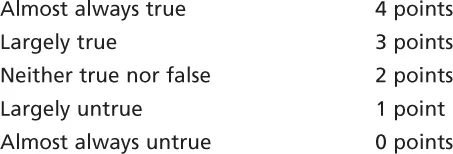
Answer the 60 items on the following pages only in relation to this definition of the team being assessed. Please give your opinion on each item. Even if you do not have enough information to make a definitive judgement, answer each question to the best of your knowledge. Allocate points as shown below.
The statement is:

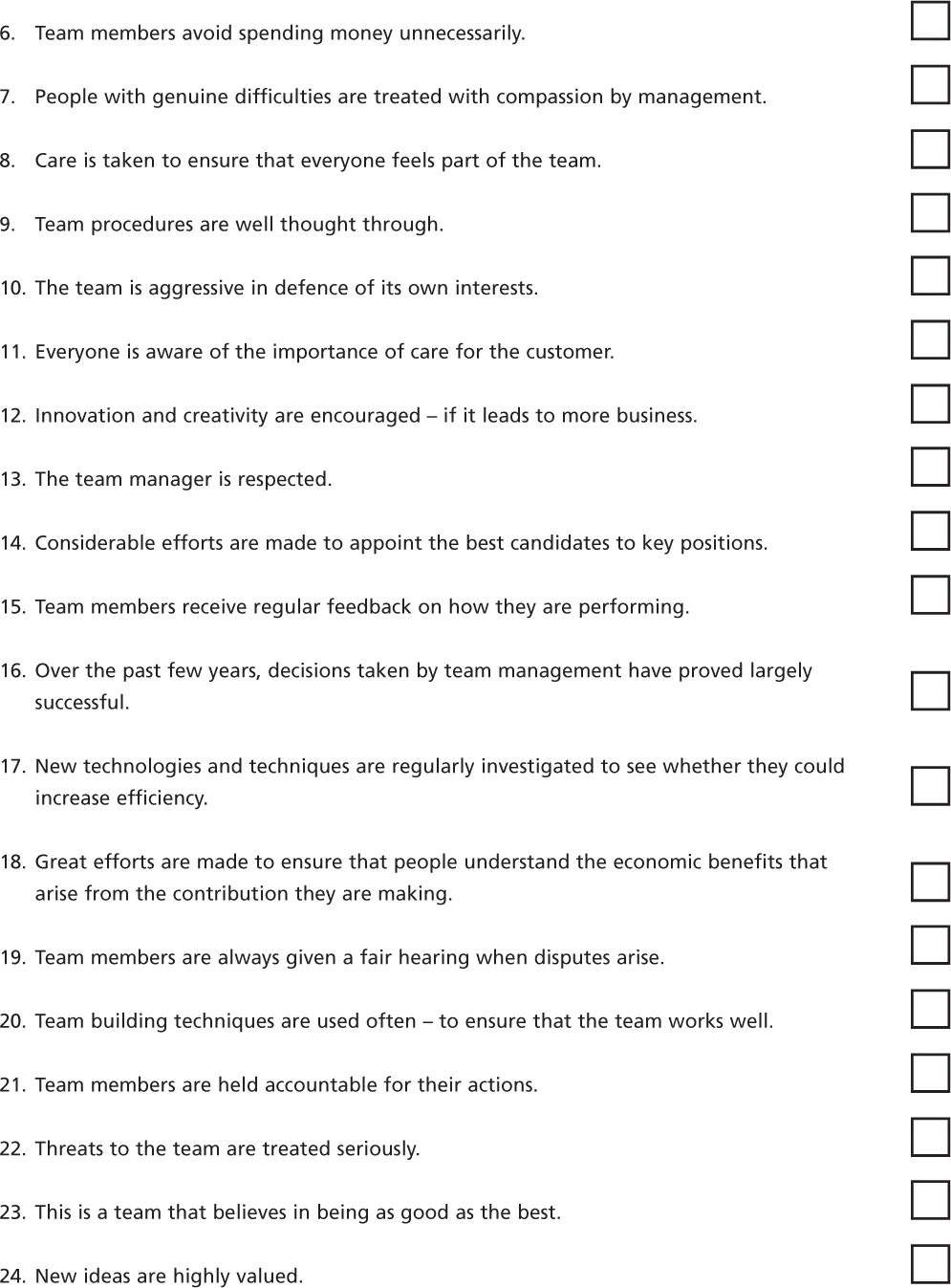
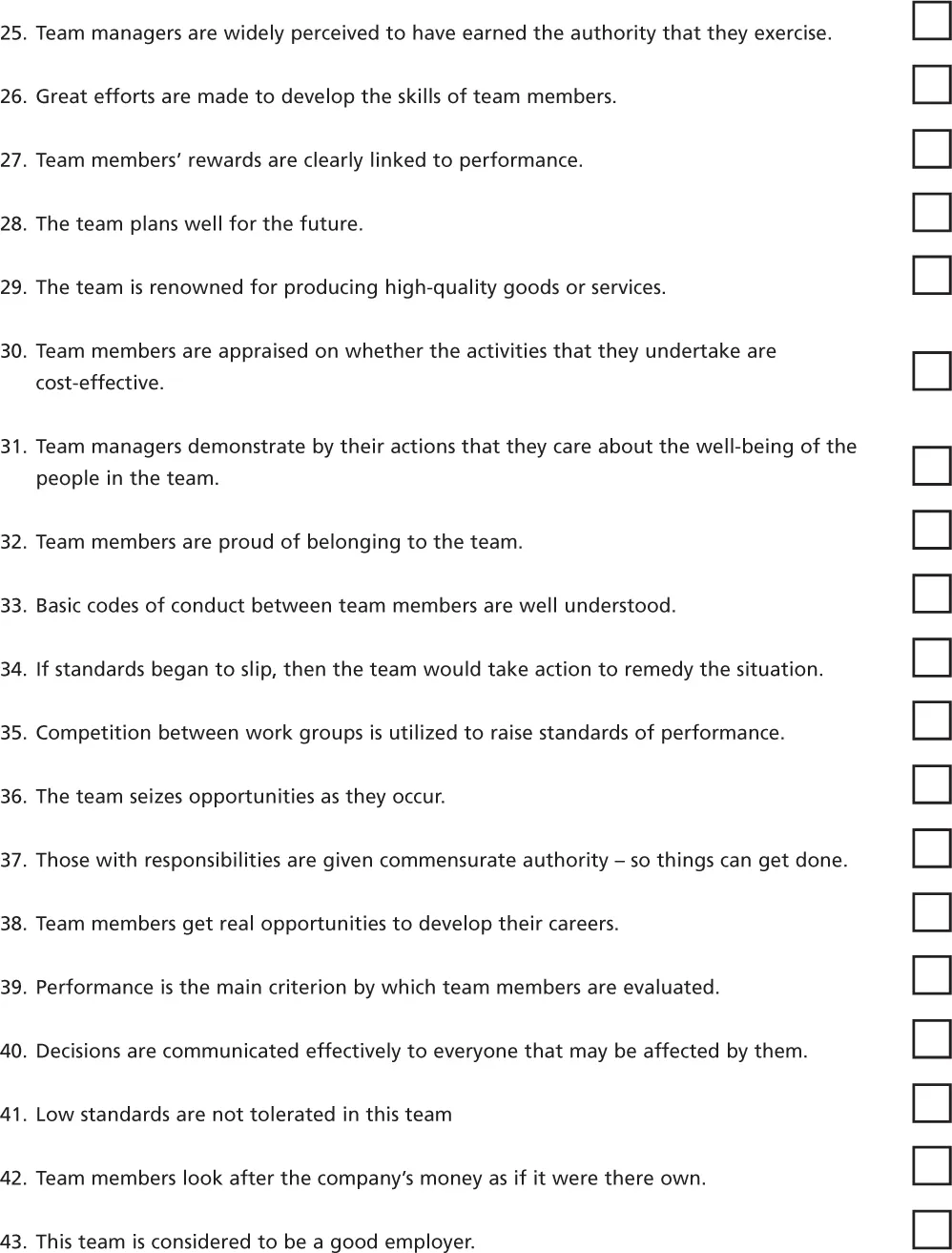
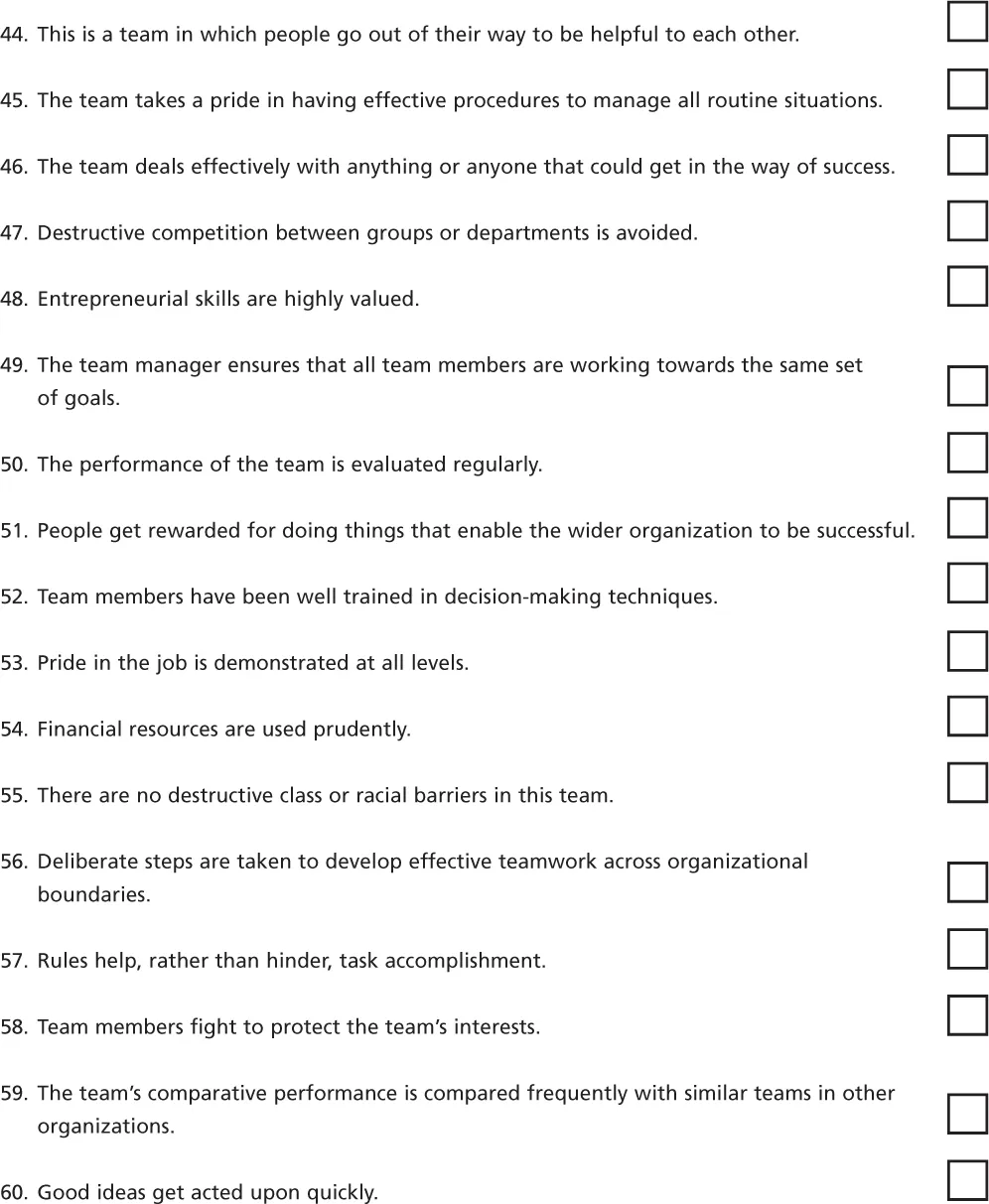
Scoring
On the grid there are 60 squares, each one numbered to correspond to a statement. Copy the scores from a completed questionnaire. Be careful not to miss a statement. When you have copied all 60 scores, total the numbers in each horizontal column.

The 12 Values of Teamworking
Interpreting the questionnaire
Now that you have scored the questionnaire you are, no doubt, wondering what it means. Scores for each of the 12 values are shown on the right-hand side of the answer sheet. High scores suggest a values strength; low scores suggest a blockage. Now you have completed the Team Values Audit you will have an idea about which are the peak values in your team.
The Team Values Audit argues that the foundation of successful teamworking is the active and persistent pursuit of all of the 12 values reviewed by the questionnaire.
The first core issue – team management
Because many teams are multidisciplinary, specialist functions must be integrated in order for the team to operate successfully. Only team management can direct and coordinate the team. To achieve success, team management must be well defined, well selected, well trained and well motivated.
Three sub-issues need to be addressed, as described below.
Use of Hands-On Power
The team manager has the authority and position to decide the mission of the team, shape the way that resources are used and take decisions. The successful team manager understands the inherent power of its position and ensures that the team is well constructed and operates efficiently and effectively. In mature teams, it is not necessary for the team manager to use authority overtly, but it remains necessary to be willing and able to step in if team problems occur. It adopts this value: The team must be managed.
Support for Elitism
The quality of people who fill team roles can be extremely important. An inadequate team member can wreak havoc – both by sins of commission and by sins of omission. The successful team understands the vital importance of getting the best possible candidates into management jobs and of developing their competence continuously. It adopts this value: Only the best will do.
Reward for Excellence
Teams need to perform consistently and energetically in pursuit of the wider organization’s goals. The successful team identifies and rewards success. It adopts this value: Performance is king.
The second core issue – managing the task
Work in teams can be dull, gruelling, demanding, challenging and worrying. In the final analysis, every team should be concerned with output, not with the toughness of the task. This means that the job must be done, and done well. It requires focusing on clear objectives, working efficiently and conserving resources. We call this process ‘managing the task’.
Three sub-issues need to be addressed, as described below.
Emphasis on Effectiveness
Focusing on the right issues must be a constant concern. A successful team is able to focus resources on activities that get results. It adopts this value: We do the right thing.
Pursuit of Efficiency
It has been said that good teamwork is about doing hundreds of little things well. All too often a small error has a disproportionate effect on the quality of the whole. The drive to do everything well gives a sharp edge. The successful team searches relentlessly for better ways to do things, and it builds pride into the job. It adopts this value: We do things right.
Adoption of ‘Economy Everywhere’ Principle
It is a great deal easier to spend money than to make it. Lack of effective cost control is a common cause of waste. The discipline rendered by a profit-and-loss account endows the wise team with the ultimate measure of success. Every activity costs money; someone, somewhere has to pay. The successful team understands the importance of facing economic reality. It adopts this value: There are ‘no free lunches’ here.
The third core issue – managing relationships
Senior management often expect that teams perform to a very high standard; they demand hard work, loyalty, skill, care and honesty. If people are to give their best, they need to be treated with compassion, to feel valued and to feel that they are part of a well-structured process. We call this: ‘managing relationships’.
Three sub-issues need to be addressed, as described below.
Concern for ‘Fairness’
One of the greatest compliments paid to a good teacher is that they are firm but fair. What the members of teams do and how they relate to each other, has a major impact on the quality of life of team members. Adopting an ethic of compassion and fairness builds trust between people and commitment to the team. The successful...
Table of contents
- Cover Page
- Title Page
- Copyright Page
- Contents
- Introduction
- Metrics for Auditing Generic Team Effectiveness
- Metrics for Assessing Team Leadership
- Metrics for Assessing Team Strengths and Blockages
- Metrics for Assessing Top Team Performance
- Metrics for Facilitators
Trusted by 375,005 students
Access to over 1.5 million titles for a fair monthly price.
Study more efficiently using our study tools.
Frequently asked questions
Yes, you can cancel anytime from the Subscription tab in your account settings on the Perlego website. Your subscription will stay active until the end of your current billing period. Learn how to cancel your subscription
No, books cannot be downloaded as external files, such as PDFs, for use outside of Perlego. However, you can download books within the Perlego app for offline reading on mobile or tablet. Learn how to download books offline
Perlego offers two plans: Essential and Complete
- Essential is ideal for learners and professionals who enjoy exploring a wide range of subjects. Access the Essential Library with 800,000+ trusted titles and best-sellers across business, personal growth, and the humanities. Includes unlimited reading time and Standard Read Aloud voice.
- Complete: Perfect for advanced learners and researchers needing full, unrestricted access. Unlock 1.5M+ books across hundreds of subjects, including academic and specialized titles. The Complete Plan also includes advanced features like Premium Read Aloud and Research Assistant.
We are an online textbook subscription service, where you can get access to an entire online library for less than the price of a single book per month. With over 1.5 million books across 990+ topics, we’ve got you covered! Learn about our mission
Look out for the read-aloud symbol on your next book to see if you can listen to it. The read-aloud tool reads text aloud for you, highlighting the text as it is being read. You can pause it, speed it up and slow it down. Learn more about Read Aloud
Yes! You can use the Perlego app on both iOS and Android devices to read anytime, anywhere — even offline. Perfect for commutes or when you’re on the go.
Please note we cannot support devices running on iOS 13 and Android 7 or earlier. Learn more about using the app
Please note we cannot support devices running on iOS 13 and Android 7 or earlier. Learn more about using the app
Yes, you can access Team Metrics by Mike Woodcock in PDF and/or ePUB format, as well as other popular books in Business & Business General. We have over 1.5 million books available in our catalogue for you to explore.