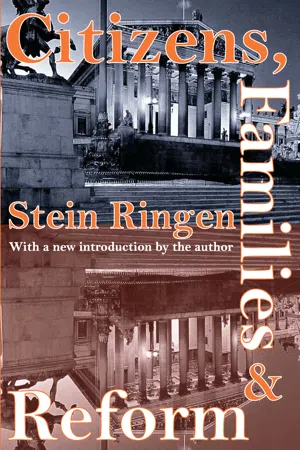
Modern families are economic institutions of great productivity. They contribute as much to a society's economic well-being as does worker productivity in formal markets. In Citizens, Families, and Reform, Stein Ringen shows how long-standing inequalities of income and class are flexible and changing in post-industrial societies. Such inequalities respond to structural changes such as social mobility and to public policies such as those of the welfare state. His book is a study of the process from careful statistical analysis to specific policy recommendations.The book draws on two strands of research, one on children and families and the other on social inequality. Both summarize detailed statistical analysis. Ringen's basic premise is that prudent social policy should start from investment in families. Progress and reform in society, such as extended access to education, tends to modify social divisions and stimulate open opportunity, particularly in the area of higher education. The book addresses the situation of children, who have a surprisingly lower standard of living than adult population groups by most measures of well-being. Ringen attributes this disparity to flaws in the distribution of power, which leads to the disenfranchisement of children as citizens. He addresses this problem by discussing children and voting rights, building a case for realizing the ideal of one person, one vote, by extending the vote to children.Real democracies are necessarily imperfect. Ringen argues for the classical liberal theory of social progress through economic growth and equality of opportunity and warns against the "terrible temptation towards perfection." His new introduction reviews the debates sparked by the book's original publication in 1997 and suggests areas in which his arguments have been vindicated.
- 218 pages
- English
- ePUB (mobile friendly)
- Available on iOS & Android
eBook - ePub
Citizens, Families, and Reform
About this book
Information
PART I
Well-Being
Introduction: Hard Facts About Soft Values
[U]ne sociologie de l’action non confondue avec la tradition ‘militariste’.
Raymond Boudon, Dictionnaire critique de la sociologie
Welfarist approaches to well-being are attractive because they respect preferences; they appear genuinely liberal. However, we cannot redistribute happiness (unless we are willing to accept brain-washing), we can only redistribute goods. If we are egali- tarians and welfarists, we must seek to equalize happiness. Since we can only redistribute goods, we must then give to Peter the goods he requires in order to be as happy as is Paul. If Peter says he needs a Bentley to be happy, while Paul is content to walk, we must give Peter the Bentley. Welfarism gives those who are demanding the power to deprive those who are modest, and is hence libertarian rather than liberal; the principle of due concern for others is thrown overboard.
The chapters in this part are an essay in the analysis of well-being without the concept of utility. This works well. I find that the problem of preferences can be handled through preference neu- trality and without resort to utility. ‘Objectivism’ in the measure- ment of well-being is sometimes said to be dictatorial because it ignores difference in preferences, but this rests on too broad a concept of preferences. Utility is a function not of goods and pref- erences, but of goods and tastes, and tastes depend not only on preferences but also on expectations. You may have a taste for the high life, but you cannot claim the right to any lifestyle by insisting that it is your misfortune that you have expensive tastes. The rest of us are not that potty.
I wish to recapture the excellent liberal notions of equality of opportunity and freedom of choice from the libertarian rascals. I see opportunity, or for that matter freedom, as a function of re- sources with the individual and options in the ‘arenas’ in which individuals are active. This brings me to a broad concept of well-being in which social options are brought directly into the definition. It is not only that well-being is produced in arenas, my well-being is lodged directly, although not exclusively, in the options I am offered in my environment. Well-being is social.
This understanding of well-being is applied to the analysis of children. I open up what has been a black box in the empirical study of well-being: the family, and look into the meaning of within- family processes for family members.
This study was inspired by the question of within-family in- equality. Papers on income distribution have for some time been making the point that we do not know the ‘real’ distribution be- cause we assume there to be equity within families, which everyone knows there is not, at least not always. The study simulates the effects of hypothetical within-family inequities between children and parents, but these simulations reveal that it does not matter much for the measurement of inequality in society whether we assume this or that distribution within families. (It matters only for the composition of the population below poverty lines, but then the head-count method is a crude measure of the extent of poverty. It does not matter much in poverty-gap measures.)
Within-family economies consist not only of distribution, but also of production and co-operation, and these processes turn out to be of a very different methodological importance. Through pro- duction and co-operation, very considerable value is added to the consumption that reaches family members, compared to the vol- ume of goods the family can purchase in the market; it roughly doubles. The twist that makes it possible to estimate this value added in income terms is the absolute interpretation of the equival- ent income parameter. While within-family distributions do not affect measurement results much, production and co-operation change the results dramatically. All results—levels, distributions, trends—are totally different after within-family production and co- operation is considered, compared to the results when these econo- mies are ignored. These differences are so large and so systematic that there is no other conclusion than to see it as established that income method comparisons of well-being which ignore the family, for example per capita comparisons, simply get it wrong. This would be the case for comparisons between groups, for example families with children and families without children, for compari- sons over time, even as relatively a short period as ten years in an industrial society like Britain, and for comparisons between socie- ties, for example developed and underdeveloped economies. From standard international statistics, in which the family is usually con- sidered to be ‘outside’ of the economy, we simply have no idea of relative standards of living in poor and rich countries. Incorporat- ing within-family economies is notoriously difficult and results are strongly assumption-dependent. In comparisons which do consider the family, the final truth may therefore remain elusive, but for the measurement of consumption well-being, such comparisons are more truthful than those in which the family is simply disregarded.
1
Persons
People have different preferences for arranging their lives. Prefer- ences should be respected by researchers who want to compare how well people live and by politicians who want to plan for a good society. The researcher is in no position to decide for people how they ought to live their lives and should not offer criteria for government policy with a built-in dictatorial logic.
Approaches to well-being can be welfarist or non-welfarist. In welfarist approaches, the individual’s experience of how well he or she lives is taken as the criterion of well-being. This is the approach of mainstream theoretical welfare economics and of psychological quality-of-life research. In non-welfarist approaches, well-being is established from the ‘objective’ circumstances within which people live rather than from their ‘subjective’ utility, satisfaction, or happiness. Most empirical research on inequality in economics and sociology is in this sense non-welfarist.
It is often implied that welfarist approaches respect preferences while non-welfarist approaches assume preference agreement. The cost of respecting preferences is taken to be the impossibility of valid interpersonal welfare comparison, while the benefit of ignoring preferences is the possibility of getting on with empirical measurement.
This gives rise to two tensions. On the theoretical level, a tension is seen between welfarist approaches, which are taken to have the virtue of being non-dictatorial, and non-welfarist approaches, which are considered to lack this virtue. The second tension is between theory and measurement; while the non-dictatorial virtue can be preserved in theory, it is sacrificed in measurement, either because experienced well-being (utility) is assumed not to be directly observable or because data are available on people’s cir- cumstances only.
A possible solution is to stick to welfarist approachs in theory, but give up the ambition of developing empirical measures which are at least close to capturing underlying well-being. In this case, a study of income inequality, for example, would be simply a study of income inequality and not of the distribution of well-being. This solution is, however, not only theoretically shallow but has also been overtaken by events in empirical research. For example, when household income is re-estimated to equivalent income, which is now customary, we are no longer studying physical income but well-being as measured by a highly theoretical, adjusted income measure (see Chapter 2). A second solution is to develop methods for measuring experienced well-being directly. This is possible, as demonstrated in quality-of-life research,1 but I have reservations about such measures, for reasons which will be explained below. I propose a third solution in which the welfarist/non-welfarist tensions are resolved without resort to measures of experienced well-being.
I argue along four lines. I start from a notion of well-being as freedom, which I hold to be both ethically sound and methodologi- cally simple in the sense that only modest assumptions are needed about what people seek in order to live well. I introduce the con- cept of arenas between resources and outcomes, and offer a speci- fication of the circumstances of choice as a function of personal resources and arena options. I draw a distinction between prefer- ences and expectations and with the help of that distinction show that welfarist approaches do not have a special quality above non- welfarist approaches of respecting preferences. I offer a typology of approaches to the measurement of well-being and with the help of this typology show that non-welfarist measurement can be or- ganized so as to be neutral with regard to preferences.
I propose to demonstrate that non-welfarist/non-dictatorial approaches to (the measurement of) well-being are possible. The most powerful non-welfarist approaches in the literature are in terms of goods (Rawls and others), resources (Dworkin and others), and more recently capabilities (Sen). All have deficiencies. Goods approaches pay too little attention to preferences. Re- sources approaches pay too little attention to structural constraints on the individual. The capabilities approach has the potential of overcoming these problems, but is shot through with ambiguities which need to be sorted out.
Choice and Well-Being
Welfarist approaches to well-being have their ethical basis in the logic of utility: what determines the goodness or badness of a person’s existence is how good or bad he or she experiences it to be. This is clearly a powerful position. In non-welfarist research, which tends to be mainly empirical and less philosophical in orien- tation, ethical assumptions or implications are not often considered explicitly. There is, however, an alternative ethical principle which is at least as powerful as that of utility and which can underpin non-welfarist approaches, namely the logic of freedom: the good- ness or badness of a person’s existence depends on how free he or she is.
In Sport on 4 (BBC Radio 4), on Saturday 6 February 1993, there was an interview with Miss F. C. Christie who had been a fan of rugby football since 1914 when her father had taken her to see her first game. Since then, she had watched a game almost every Satur- day. She explained that she had lived alone since she was 28 and that her interest in rugby had saved her from turning ‘into a cab- bage’. And then she said, ‘If you have an interest, however silly it may appear to other people, provided it doesn’t upset them or impinge on their things, why not?’ In On Liberty (1859), J. S. Mill wrote: ‘If a person possess any tolerable amount of common sense and experience, his own mode of laying out his existence is the best, not because it is best in itself, but because it is his own mode.’ These two elegant statements contain the perspective on freedom which I adopt here. There is an assumption of common sense and experi- ence. There is the conclusion that there is no need, under normal conditions, for others to be concerned with how individuals lay out their existence. Indeed, since there is no common way of living which is good or bad for all, others should not be concerned with how individuals lay out their existence. Applied to measurement, we need not, indeed should not, measure the good life, since there is no universal good life aspiration common to all; we should meas- ure the circumstances within which people can lay out their own existence. Finally, there is a constraint, that doing your thing does not impinge on others doing their things.
I start from a loose assumption of rational behaviour. People are thought of as actors who seek well-being through the choices they make in life and are assumed, generally, to know what is good for themselves and to try to make the most out of their circumstances in relation to whatever it is they want to achieve. The central element is choice: choice in itself, not what things one chooses but the ability to choose. I say simply that people live well or badly to the degree they themselves can choose how to live, or, conversly, to the degree to which their choices in this respect are limited or constrained. Attention is focused not on how people live, but on how they can live; not on what they choose, but on what they can choose; not on what they do, but on what they have opportunity to do.
This perspective is related to the ‘capabilities approach’ as devel- oped by Sen in its emphasis on freedom.2 It is similar to that on equity suggested by Le Grand in which equity is defined in terms of ‘choice sets’ rather than choice outcomes.3 It derives from a more general social theory in which individual action and choice are the central organizing principles, what Boudon has called la sociologie de l’action.4 It is a sound perspective politically in that it invites political concern for individual well-being but at the same time preserves a domain of personal authority, akin to the ‘pursuit of happiness’ principle in the American Declaration of Independ- ence. It is a liberal perspective in which the whole question of how to live is left to people themselves, and the concern of others—be it the researcher who wants to measure well-being or the politician who wants to advance it—is limited to the domain of opport...
Table of contents
- Cover Page
- Half Title Page
- Title Page
- Copyright
- Dedication
- Table of Contents
- Introduction to the Transaction Edition
- Acknowledgements
- Preface: Reason and Restraint
- Part I Well-Being
- Part II Reform
- Postscript: A Statement on Political Philosophy
- References
- Index
Trusted by 375,005 students
Access to over 1.5 million titles for a fair monthly price.
Study more efficiently using our study tools.
Frequently asked questions
Yes, you can cancel anytime from the Subscription tab in your account settings on the Perlego website. Your subscription will stay active until the end of your current billing period. Learn how to cancel your subscription
No, books cannot be downloaded as external files, such as PDFs, for use outside of Perlego. However, you can download books within the Perlego app for offline reading on mobile or tablet. Learn how to download books offline
Perlego offers two plans: Essential and Complete
- Essential is ideal for learners and professionals who enjoy exploring a wide range of subjects. Access the Essential Library with 800,000+ trusted titles and best-sellers across business, personal growth, and the humanities. Includes unlimited reading time and Standard Read Aloud voice.
- Complete: Perfect for advanced learners and researchers needing full, unrestricted access. Unlock 1.5M+ books across hundreds of subjects, including academic and specialized titles. The Complete Plan also includes advanced features like Premium Read Aloud and Research Assistant.
We are an online textbook subscription service, where you can get access to an entire online library for less than the price of a single book per month. With over 1.5 million books across 990+ topics, we’ve got you covered! Learn about our mission
Look out for the read-aloud symbol on your next book to see if you can listen to it. The read-aloud tool reads text aloud for you, highlighting the text as it is being read. You can pause it, speed it up and slow it down. Learn more about Read Aloud
Yes! You can use the Perlego app on both iOS and Android devices to read anytime, anywhere — even offline. Perfect for commutes or when you’re on the go.
Please note we cannot support devices running on iOS 13 and Android 7 or earlier. Learn more about using the app
Please note we cannot support devices running on iOS 13 and Android 7 or earlier. Learn more about using the app
Yes, you can access Citizens, Families, and Reform by Stein Ringen in PDF and/or ePUB format, as well as other popular books in Politics & International Relations & Politics. We have over 1.5 million books available in our catalogue for you to explore.