Expectations for performance management systems continue to grow in the public sector. Yet few administrators know how to effectively implement and sustain these systems. Performance-Based Management Systems: Effective Implementation and Maintenance supports practical efforts to build and maintain performance management systems in public organizations, explaining obstacles to measurement efforts and providing guidance on how to overcome them.
The book begins by exploring performance measurement as a key element of performance-based management systems. It discusses its legacy and its limitations and offers competing explanations of the factors that constrain its effective use. Next, it focuses on building theory in support of practice through a mixed methods approach. It examines research reconciling the conflicting explanations for the lack of proper use of performance measurement information. Then it offers new insights for developing a context-sensitive model of performance measurement that can lead to effective practices.
The third part develops these insights into a pragmatic model of performance-based management. It provides a realistic explanation of the contributions of performance measurement and gives advice derived from current practice. The author concludes by highlighting the rationale, methods, and findings of two studies that served as the foundation for this book. She also provides final suggestions of how to move practice and theory forward.
This volume explains why performance measurement is not more widely used in the public sector, and explores how implementation of performance measurement can be improved with insights gained from extant literature on public policy, organizational politics and culture, and knowledge utilization. Mastery of this material will enable practitioners to understand how to effectively implement policies that will positively impact their organizations and their employees.
Part I MAKING THE CASE FOR PERFORMACE MEASUREMENT AND PERFORMANCE-BASED MANAGEMENT
Chapter 1 Introduction
Public and nonprofit organizations have been long confronted with the twin pressures of increasing demands for services and decreasing resources. At the same time, they are facing an increasingly complex global, legal, and competitive environment that requires organizations to adopt effective strategies for achieving organizational goals and demonstrating results. For the public sector this emphasis on demonstrating results has been associated with skepticism by and discontent of the American public with how their tax dollars are being spent. For the nonprofit sector the pressure is coming from donors and funding agencies, who want to know if funds are being spent in the most efficient and effective manner.
Paradoxically, as expectations for performance-based management are growing in the public and nonprofit sectors, there still remains little appreciation and acknowledgment in practice of these and other challenges managers face in implementing performance-based management (PBM) systems. Current research continues to show a gap between developing performance measurement systems and actually using the information (Poister and Streib, 2005; Melkers and Willoughby, 2005; Behn, 2003; Wang, 2000; Joyce, 1997). Assessing this gap is complicated by the lack of agreement as to what constitutes use. For example, does the simple fact that performance measurement information is discussed during the budget allocation process constitute use? Are there different types of use?
In this book I will explain these challenges, the meaning of using performance measurement information, and suggest strategies to improve performance measurement, and hence support performance-based management. To be sure, anything that constitutes change from how the organization is used to doing things will have its setbacks. However, as stated by Heinrich (2002), the “setbacks confronted in implementing outcomes-based performance management in government should not discourage efforts to improve government performance.”
Responding to Multiple Demands
Although there are a variety of responses to each of the pressures mentioned above, performance-based management holds promise as a strategy for responding to these multiple demands. As defined by Wholey (1999), PBM refers to the “purposeful use of resources and information to achieve and demonstrate measurable progress toward agency and program goals.” As a concept, PBM enjoys broad acceptance. However, as will be discussed in this book, in practice it raises many questions that need to be addressed to fulfill its promise.
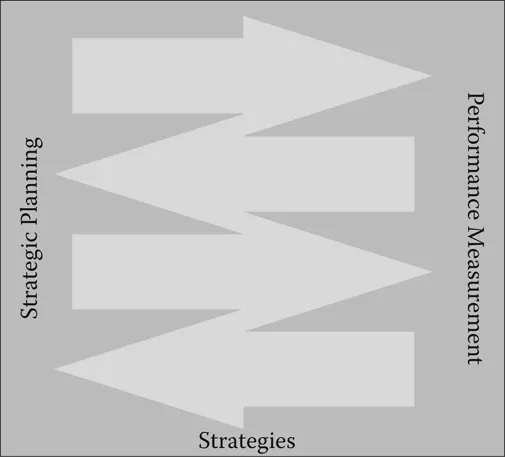
What makes PBM an ideal approach to meet the multiple demands outlined above is that it has two intimately related components: (1) performance measurement and (2) strategic planning. Performance measurement is the regular and careful monitoring of program activities, implementation, and outcomes. A quality performance measurement system produces timely, reliable, and relevant information on indicators that are linked to specific programs and goals and objectives. Strategic planning, a systematic management process that includes identifying an agreed upon mission, developing goals and objectives that are linked to the mission, and formulating strategies for achieving goals and objectives, provides the direction and the basis for measuring. Therefore, performance-based management should be seen as a system where performance measurement and strategic planning support and complement each other. This book focuses on the performance measurement component of performance-based management.
Performance measurement seeks to answer the following questions: “What are we doing?” and, to some extent, “How well are we doing it?” Managers can then use this information to improve the quality, efficiency, and effectiveness of programs delivered. Kopcynski and Lombardo (1999) argue that performance measurement can help to enlist support and build trust, identify performance targets, and build a culture of accountability. Behn (2003) adds that the information can be used “to evaluate, control, budget, motivate, promote, celebrate, learn, and improve.”
Inherent in some of these roles is that performance measurement can serve as a tool for improving the communication between government and citizens. Performance indicators provide a common language for effective communication between service providers and stakeholders (Dusenbury et al., 2000). Furthermore, the process of developing performance measures provides the opportunity for government and other service providers to engage citizens and stakeholders in deliberation about programs, their implementation, and expected outcomes. Ultimately, the goal of performance-based management is to improve performance and increase satisfaction among citizens and other stakeholders with the services they receive.
Figure 1.1 is a graphical representation of performance-based management. The figure suggests several assumptions that are necessary for implementing performance-based management in an organization. It presumes:
There is agreement on what the goals and objectives of the programs are (Wholey, 1999).
There is agreement on the strategies for achieving goals.
The appropriate indicators of performance—what and how we are doing— have been developed.
The mission, goals, objectives, and measures or indicators are aligned.
A quality measurement system is in place.
Organizational learning will lead to the refinement of strategies, goals, and objectives.
The organization is willing to take risks.
For reasons that will be explained ahead, turning these presumptions into fact tends to be a struggle for many organizations.
Figure 1.1 Performance-based management
Furthermore, some of the assumptions made above are likely to evoke criticism. An implicit assumption of the performance-based management framework is that actions lead to results. That is, our expectation is that the activities of the agency in question will lead to some desired outcome. According to some critics, performance measurement is an inadequate tool for claiming program results (Greene, 1999; Ryan, 2002). Critics contend that information collected on a regular basis cannot be used to show cause and effect, and only rigorously conducted program evaluations can be used for this purpose. That is, some claim that performance measurement information (e.g., outcomes, outputs, inputs) does not answer why we are getting the outcome being observed. It does not tell us why we have or have not made progress toward stated goals. This critique has some merit. However, as will be explained later, there are ways to overcome the limitations of performance measurement so that managers can have confidence in their performance-based management system.
Performance-Based Management among Recent Alternatives
One way to clarify PBM is to relate it to other approaches familiar to the reader. Three recent developments are briefly addressed.
The Balanced Scorecard
At this point, some may be wondering if the model proposed above (Figure 1.1) has anything to do with the increasingly popular balanced scorecard approach developed by Kaplan and Norton (1992) based on the private sector’s experience. The answer is yes. The model can be viewed as an encompassing approach that incorporates the balanced scorecard. PBM systems recognize the necessary linkage between the organization’s internal processes and internal and external environment in order to deliver quality services. PBM is a systematic approach that relies to a large extent on information.
Also, as shown in the model depicted in Figure 1.1, like the balanced scorecard, PBM is a continuous process that involves setting strategic performance goals and objectives, measuring performance, collecting, analyzing, and reporting data, and using the information to inform decisions aimed at improving performance. Thus performance measurement is central to both the balanced scorecard approach and performance-based management. In addition to PBM encompassing elements included in the balanced scorecard system, there are other major differences. The PBM framework presented here is grounded in the more complex environment of public and nonprofit organizations. The framework also makes finer distinctions about the use of performance measurement information. These grounding and distinctions provide a richer context for understanding the results of performance improvement systems. They also offer a greater array of strategies to choose from when promoting organization innovations such as performance measurement systems and balanced scorecard systems. Therefore, the topics and strategies discussed here will be useful to organizations that are looking to implement a balanced scorecard system.
Benchmarking
In the context of performance measurement, the term benchmarking refers to comparing performance against a standard. Without being able to make such comparisons, argues Ammons (2001), the whole exercise of performance measurement becomes futile. There are several ways in which such comparisons can be made. These, suggest Ammons, include comparing current performance marks with those from earlier periods, other units in the organizations, peer organizations, preestablished targets, or existing standards, as well as reporting year-to-year comparisons of performance indicators.
As can be deduced, performance measurement is a critical component of benchmarking because the measures become the vehicle for comparison. The information allows putting the organization in context, helping to identify deviations from expected performance, and, in the cases when the comparisons are with others, to identify best practices. But what is done with the information is also the domain of performance-based management. For, as suggested by Ammons (2001), the identification of gaps may suggest additional analysis of processes and adoption of practices to improve the agency’s performance.
Performance-Based Budgeting
Efforts to include performance information into the budget process and deliberation are often termed performance-based budgeting (though we may also find terms such as results-based budgeting, results budgeting, or outcome budgeting, referring to these efforts). The idea behind performance-based budgeting is that it can help to improve the allocation of resources by focusing the dialogue on program outcomes and results rather than on program inputs and outputs (de Lancer Julnes and Holzer, 2008).
As described by Barnett and Atteberry (2007), unlike other approaches to budgeting, this is an interactive and inclusive approach that begins with a set of results that matter to citizens and encourages creativity in achieving those results. Performance measurement is at the core of this approach. Performance-based budgeting requires a quality measurement system that can help monitor results to determine what was achieved. This information is important in budget deliberations as it can help identify the opportunities to make better use of resources and accomplish agency goals (U.S. General Accounting Office, 2001).
Down to the Core: Performance Measurement
Regardless of what agencies call their performance management system, the bottom-line assumption is that managers and other decision makers need adequate information. To respond to current demands for getting and showing results, whether in the public, nonprofit, or private sectors, administrators need evidence. As shown in the three examples above, performance measurement is a tool that can provide the needed evidence. But in order for any performance management system to be successful, we must recognize that it is a complex and long-term process that must be supported by a commitment to develop performance measures, actually use them, and continuously refine them.
Indeed, this need for continuous effort, which by design results in delayed payoffs, is one of the main obstacles to success for performance-based management systems. As we find with any policy for change, there are two sides to the continuity coin. On the other side of this coin is the need for stability. As discovered by one practitioner at the federal level, after the initial identification and selection of new measures, there is a very difficult and lengthy process of implementation. This implementation process can involve altering data systems, changing reporting requirements, and compelling managers to use the performance data to manage. Therefore, while this process requires stability and determination, it also requires learning and making adjustments as needed. The process requires that the performance measurement system itself be flexible enough to adjust to changes, yet be stable enough to provide usable information over time (Grizzle, 1982). For example, there may be a change in the value system of the organization, sometimes prompted by the measures themselves, which may lead to changes in the perception of what is important to measure. The system must be responsive to this need. At the same time, it should still be able to provide consistent information that can be used to compare performance from one year to the next.
Box 1.1 illustrates the different types of measures that a typical PBM system should include. In the rest of this chapter I discuss why managers should be interested in performance measurement, and how performance measurement can contribute to informing and improving management. I also discuss the perceived limitations of performance measurement and ways to overcome those limitations.
Performance Measurement Is Here to Stay
During a recent interview, a local government employee told me that performance measurement is a fad. Although some may think this way, the systematic measurement of performance to promote better government has a long legacy in the United States. The focus of early performance measurement efforts was to improve efficiency, obtaining more outputs for the inputs in a shorter period of time— managerial efficiency. This focus later evolved to also include effectiveness—then defined in terms of the effect of service delivery. Financial concerns have also been a driving force in performance improvement efforts, and more recently, though by no means new, accountability for results has taken center stage.
The following is a brief review of the historical context of performance measurement. The purpose is to show that although it has taken many forms, and although the incentives may have varied, performance measurement has been at the core of American management practice for a long time, and the goal has always been to achieve good government performance.
Box 1.1. TYPES OF MEASURES IN A PERFORMANCE-BASED MANAGEMENT SYSTEM
Inputs: refer to the amount of resources used. It may include dollar amounts, and number of employees.
Outputs: refer to product or services delivered. Examples include number of senior citizens receiving the flu vaccine; miles of paved road; tons of garbage collected; number of women receiving prenatal care; number of students trained; and number of calls answered.
Outcomes: refer to results or consequences of program activity. This type of performance measure reflects a change in condition, behavior, or attitude in the target population as a result of the program. Outcome is further divided into:
− Intermediate outcome: this is not an end in itself but it is expected to lead to a desired result. An example would be the number of people not getting the flu after receiving the flu vaccine.
− End outcome: the desired end result. Examples of this include the percent decrease in the number of flu-related visits to the doctor and the percent decrease in job absenteeism due to flu-related illnesses.
Processes (or the throughputs): refer to the performance of activities prior to the service or product being delivered. They measure the steps taken to produce the outputs. Indicators of process measures might include the waiting period between getting the appointment for the flu shot and actually getting the flu shot; the amount of time it takes between a water main break and getting it repaired; number of training materials prepared; or number of hours of training provided.
...
Table of contents
Cover
Half Title
Series Page
Title
Copyright
DEDICATION
Contents
Acknowledgments
Prologue
PART I: MAKING THE CASE FOR PERFORMACE MEASUREMENT AND PERFORMANCE-BASED MANAGEMENT
PART II: BUILDING THEORY IN SUPPORT OF PRACTICE THROUGH A MIXED METHODS APPROACH
PART III: LETTING PRACTICE INFORM THEORY
PART IV: SUMMING UP AND MOVING FORWARD
Appendix A
Appendix B
References
Index
Trusted by 375,005 students
Access to over 1.5 million titles for a fair monthly price.
Study more efficiently using our study tools.
Frequently asked questions
Yes, you can cancel anytime from the Subscription tab in your account settings on the Perlego website. Your subscription will stay active until the end of your current billing period. Learn how to cancel your subscription
No, books cannot be downloaded as external files, such as PDFs, for use outside of Perlego. However, you can download books within the Perlego app for offline reading on mobile or tablet. Learn how to download books offline
Perlego offers two plans: Essential and Complete
Essential is ideal for learners and professionals who enjoy exploring a wide range of subjects. Access the Essential Library with 800,000+ trusted titles and best-sellers across business, personal growth, and the humanities. Includes unlimited reading time and Standard Read Aloud voice.
Complete: Perfect for advanced learners and researchers needing full, unrestricted access. Unlock 1.5M+ books across hundreds of subjects, including academic and specialized titles. The Complete Plan also includes advanced features like Premium Read Aloud and Research Assistant.
Both plans are available with monthly, semester, or annual billing cycles.
We are an online textbook subscription service, where you can get access to an entire online library for less than the price of a single book per month. With over 1.5 million books across 990+ topics, we’ve got you covered! Learn about our mission
Look out for the read-aloud symbol on your next book to see if you can listen to it. The read-aloud tool reads text aloud for you, highlighting the text as it is being read. You can pause it, speed it up and slow it down. Learn more about Read Aloud
Yes! You can use the Perlego app on both iOS and Android devices to read anytime, anywhere — even offline. Perfect for commutes or when you’re on the go. Please note we cannot support devices running on iOS 13 and Android 7 or earlier. Learn more about using the app
Yes, you can access Performance-Based Management Systems by Patria de Lancer Julnes in PDF and/or ePUB format, as well as other popular books in Politics & International Relations & Management. We have over 1.5 million books available in our catalogue for you to explore.