- 179 pages
- English
- ePUB (mobile friendly)
- Available on iOS & Android
eBook - ePub
Reflections on the Revolution in Europe
About this book
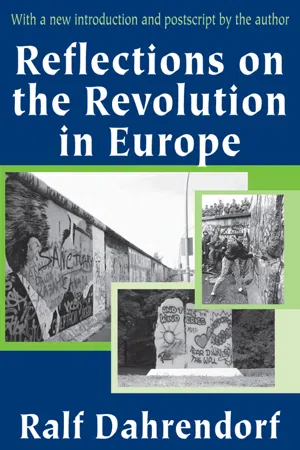
The fall of the Berlin Wall in 1989 effectively ended the division of Europe into East and West, and the features of our world that have resulted bear little resemblance to those of the forty years that preceded the Wall's fall. The rise of a new Europe prompts many questions, most of which remain to be answered. What does it all mean? Where is it going to lead? Are we witnessing the conclusion of an era without seeing anything to replace an old and admittedly dismal way of life? What will a market economy do to the social texture of various countries of Central Europe? Will it not make some rich while many will become poorer than ever? How can the rule of law be brought about?In this incisive and lucid book, Ralf Dahrendorf, one of Europe's most distinguished scholars, ponders these and other equally vexing questions. He regards what has happened in East Central Europe as a victory for neither of the social systems that once opposed each other across the Iron Curtain. Rather, he views these events as a vote for an open society over a closed society. The continuing conundrum, he argues, which will plague peoples everywhere, will be how to balance the need for economic growth with the desire for social justice while building authentic and enduring democratic institutions.Reflections on the Revolution in Europe, which includes a new introduction from the author, is a humane, skeptical, and anti-utopian work, a manifesto for a radical liberalism in which the social entitlements of citizenship are as important a condition of progress as the opportunities for choice. A fascinating study of change and geopolitics in the modern world, Reflections points the way towards a new politics for the twenty-first century. Ralf Dahrendorf, born in Hamburg, Germany in 1929, is a member of Britain's House of Lords. He was professor of sociology at Hamburg, Tobingen and Konstanz from 1957 to 1968, and in 1974 moved to Britain. He has been the director
Information
REFLECTIONS ON THE REVOLUTION IN EUROPE
DEAR MR. J.,
When at the end of my recent trip to your country I came to see you on that sunny morning in early March, I expected us to sit down to a cup of coffee and chat a little about current affairs in the manner of what the French sometimes call café de commerce. The winter was odd, was it not? Stormy, but mild. The “greenhouse effect,” no doubt. In fact, it may have saved Gorbachev. At any rate, it reduced his energy bill…. But you never allowed such small talk to begin. Instead, you showered me with questions about the riddles of Poland and Europe after the revolution of 1989 until I was too dazed to answer any of them properly. Only now, in the quiet of my Oxford study, surrounded by books and papers and gazing out at the friendly motley of the buildings of St. Antony’s College, do I find the resources to try to respond to you properly.
What does it all mean, and where is it going to lead (you wanted to know)? Are we not witnessing a process of dissolution without anything taking the place of the old and admittedly dismal structures? How can political parties emerge (you asked, for example) when the old ones of 1946 and of the interwar years have become irrelevant, and new parties are unable to find a social base to sustain them? And why (you added almost anxiously) had I written some time ago that not only socialism, but social democracy was on the way out? What is the market economy going to do to the social texture of the country? Will it not make some rich while the many get poorer than ever? What will happen to cultural life? Do we have to read and watch trash now that we are free and no longer have inexpensive books and subsidized quality films? How can we bring about the rule of law? Have not the old judges lost all credibility, while we cannot find new ones who guarantee independence and objectivity? And what about the German menace? Are we not going to see a balkanized Europe dominated by the one power which is uniting rather than disintegrating? Was I (you inquired) on balance hopeful so far as the new Europe is concerned, or anxious and worried like many of your compatriots, and as you gathered, others in East Central Europe as well?
Hopes and fears depend, of course, on expectations. Your sense of apprehension may be caused by the very things which make me feel optimistic. Did I detect, somewhere behind all those questions, a vision of the future of your country and others in a similar position which is as understandable as it is unreal and therefore misleading? You seemed to envisage a society which is both constrained by strict precepts of public and private morality, and economically vigorous and thriving, one that is both dominated by a sense of order and discipline, and politically pluralistic—a “Sweden,” perhaps. You will note the quotation marks. “Sweden” is not Sweden; it is a dream with no base anywhere on the map of Europe. What is more, we must thank our lucky stars that there is no “Sweden” in the real world, for if it existed, it would be located somewhere between Lee Kwan Yew’s Singapore, which finds it difficult to accept even one opposition member in its “parliament” and charges a penalty of two hundred dollars for dropping litter in the street, and Plato’s Republic, in which philosopher-kings see to it that dissidence cannot arise because they alone are in possession of the truth. The real Sweden, fortunately, is a free country, with much (though perhaps not enough) of the untidiness and multifariousness, disorderliness and heterogeneity, conflict and changeability which allows the blossoming of human life chances, and of humans with them.
But your questions deserve more than a simple defense of Sweden against “Sweden.” Moreover, it is not my intention to attack you for your views. As a Pole, you have seen more, and felt more of the pain, of the vagaries of this century than one would wish on any person. Your views deserve respect even if one does not share them. Above all, your questions deserve answers. As I began to put my two fingers to the typewriter, it soon became clear that my response would exceed the normal dimensions of a letter. I hope you will bear with me nevertheless, though there is one inconvenience which must be dealt with. A letter allows of a certain informality of style, of digressions and overlaps and imbalances of many kinds which would be less acceptable in a treatise. At the same time, I have chosen a halfway house (despite the argument against a “third way” which lies at the heart of my reply) and identified four major sections of this missive. None of them fits tidily under a simple heading, but it would be true to describe the first as being mostly about revolutions and the open society; the second mostly about the strange death of socialism and the mirage of a “third way”; the third mostly about politics, economics, and the road to freedom; and the fourth mostly about Germany and the new architecture of Europe.
MOSTLY ABOUT REVOLUTIONS AND THE OPEN SOCIETY
The person to whom you addressed your questions is one of those who will forever cherish the memory of the events of 1989. What a time to be alive! Yes, there were tears, bitter tears at the massacre of Tiananmen Square which brutally ended the “democracy movement” of students and workers and even soldiers in China, tears for the victims of securitate brutality in Timisoara and elsewhere in Romania six months later. But most of the tears of 1989 were tears of joy. Who can ever forget the moment when your first non-Communist prime minister, Tadeusz Mazowiecki, took his seat on the government benches in the Sejm on 24 August, looking slightly forlorn with his sad and pensive expression, but quite obviously not a dictator or a nomenklatura bureaucrat? What could erase from memory the jubilation at the breaching of the Berlin wall on 9 November, with those who had been separated for twenty-eight years embracing each other and their erstwhile guards joining in the celebrations? Who could hold back emotions when Vaclav Havel emerged, in what was probably his only suit and tie, as the new president of Czechoslovakia on 29 December? And talking about images (for it was a year of television too), anyone who watched the slipping countenance of the Romanian dictator Nicolae Ceau§escu during the mass meeting organized by his agents on 21 December, which turned into an angry demonstration against him as he was speaking, will forever know what it means that the rulers lose their nerve before the people get their way.
There is no need for me to remind you of the sequence of events in that annus mirabilis, 1989. In any case, their memorable history has now found a chronicler, Timothy Garton Ash, who combines passion and insight like few other instant historians before him. (I have benefited from his advice in setting out to answer your questions.) In his book The Magic Lantern, he keeps alive “the revolution of '89” as he witnessed it in Warsaw, Budapest, Berlin, and Prague. Was it really a revolution? The question may seem academic, of more interest to university students than to those involved. Garton Ash himself has coined the term refolution for the events of Warsaw and Budapest, because they were in essence reforms from above in response to the pressure for revolution from below, though he uses revolution freely for what happened in Prague, Berlin, and Bucharest. Clearly, the changes brought about by the events of 1989 were both extremely rapid and very radical (which is one definition of revolutions). At the end of the day, they led to the delegitimation of an entire ruling class and the replacement of most of its key members, as well as a constitutional transformation with far-reaching consequences.
Most of the time it does not matter what name we give to historical events. But for once the academic is of considerable practical significance. Crane Brinton has taught us, by comparing the events of England in 1688, America in 1776, France in 1789, and Russia in 1917, that revolutions have their own “anatomy.” Not only their causes can be traced but also their course. They all begin with a honeymoon after the victory over the old regime is achieved without serious bloodshed, as “the way is open to the regeneration men have been so long talking about, so long hoping for.” Brinton quotes Wordsworth:
France standing on the top of golden hours, And human nature seeming born again.
Not all have shared this sentiment, notably not the author of whom more will have to be said in this letter, Edmund Burke. But in the countries concerned, the honeymoon was a time of rejoicing. It was also short. Some of Brinton’s statements sound ominous today: “In the first stages, and at the critical moment when the test of force comes, the old regime is faced by solid opposition. [But] the opposition is indeed composed of various groups, is never quite that oversimplification, a ‘united people.’” This soon becomes evident as the “rule of the moderates” commences. The old opposition falls apart; it never really manages to combine the task of constructing a new constitution with that of governing; some radicals begin to claim that the moderates have betrayed the revolution and are not going far enough. As the moderates fail to get a grip on things, the extremists sense their hour. They are a minority, but they are organized and fighting fit. Finally, they overthrow the ineffectual moderates, and the “reigns of terror and virtue” begin. They are terrible. By the time the Thermidor puts an end to them—as the fall of Robespierre in July 1794 led to more “normal” though hardly much more agreeable conditions, that is, to Napoleon—societies have reached the limits of their endurance. Dictators take over a scene of decline, destruction, and demoralization.
Many have doubted whether Crane Brinton’s gloomy analysis applies even to “his” revolutions, and notably to the “Glorious Revolution” in England and the revolutionary acts which created the United States of America. Edmund Burke argues eloquently that the whole point of 1688 was to prevent a revolution like that in France in 1789, and George Washington was hardly a Napoleon, let alone a Stalin. Some parallels of anatomy are nevertheless unmistakable in 1989 and 1990. For a while, if sometimes a short while, opposition groups like Solidarity in Poland, the Civic Forum in Czechoslovakia, even Ecoglasnost in Bulgaria and the early Committee for National Salvation in Romania were internally united. They wanted to replace an old regime, and they did so. But the honeymoon did not last. It could not last. Once the common enemy had disappeared, more normal divisions within the hitherto united opposition emerged, such as industrial and rural Solidarity, and other groups of Christian Democratic and nationalist persuasion, or the political parties which emerged alongside the Civic Forum in Czechoslovakia and the New Forum in East Germany. Also, the sudden rise to power changes the complexion of things. Government requires different talents from opposition, and even different virtues, a practical “ethics of responsibility” instead of the pure ethics of conviction. To make matters worse, the removal of the old regime leaves a vacuum. Unlike the winners of a democratic election, revolutionary leaders have to start from scratch. Seeking legitimacy by elections and accepting certain checks and balances is all very well, but with the demise of the monopoly of the party, the whole structure of government has collapsed. Who removes and appoints officials at all levels, and how are the new people found? How are taxes levied? How is a new policy of ownership implemented? How do new curricula reach every school in the country? You raised the question of what takes the place of the dismantled structures of yesterday, and the answer is that to begin with there is little more than enthusiasm and hope.
Brinton is a trifle unkind to the moderates who take over during the revolutionary honeymoon. Their failure, he argues, is not so much a tragedy as their own fault; they do not have the courage of their convictions: “They used grand words and phrases grandly as a consolation and joy to their listeners and to themselves. But they did not believe in them as the radicals believed in them; they did not intend to try to pursue them to their logical conclusions in action.” Somehow this does not ring true with respect to President Havel, or your own prime minister and his finance minister, Leszek Balcerowicz. Yet the collapse of the center is characteristic of several post-Communist countries in Europe. They have shed the monopolistic party, the security police, the claims of the nomenklatura, and of course the ever-present threat of Soviet intervention, but with few exceptions they have not been able to put much more than good intentions in their place. As a result, old regional, ethnic, religious rivalries reappear, and new cleavages threaten to disrupt the unity of purpose which brought about change.
Democracy, in the sense of asking the people to decide, will not fill this vacuum. “We the people” can rise against an abhorrent regime of exploitation and suppression, but “we the people” cannot govern. The democratic illusion that there is such a thing as government by the people has always been an invitation to usurpers and new monopolies. Beware of the errors of an earlier generation, which included men like Robert Michels! He was one of those who believed that socialism would change everything, including the government of the many by the few. Then he discovered that socialist parties were just as likely to generate ruling minorities as all other parties. In his dismay, he formulated (in 1911, borrowing heavily from an earlier work by Ostrogorski) the “iron law of oligarchy”: “Whoever says organization, states a tendency towards oligarchy.” As a result, Michels first despaired of socialist parties, then of human nature, and finally fell for the fascist cult of the leader, albeit of the Mussolini variety, as a way out. There is truth in the “iron law” but no reason for despair. The important point is to check and balance ruling groups, and to replace them from time to time by peaceful means, such as elections. More than that, these groups are needed. Democracy is a form of government, not a steam bath of popular feelings. It needs those who lead as much as those who put a halt to apparent errors of policy and to the arrogance of power.
It was clear that the euphoria of 1989 would give way to a more sober mood in 1990. Breaching and breaking up the wall, and selling its pieces for hard currency, is a wonderful and even lucrative experience, but building a new city takes time and a heavy toll of emotions, energies, and resources. Also, as history slows down, there are risks. Driving a car on an icy road is all right as long as the road is dead straight and one does not change gear. One can drive quite fast, in fact, and the revolution of 1989 recognized no speed limits at all. Now, however, we encounter curves and tricky traffic conditions, and we have to change gear. It requires unusual skill not to swerve and crash into others or be thrown off the road altogether.
But let me contain such doubts for a little while yet and note the assets which 1989 has created. One of them in particular deserves notice, because without it I could not even have started this letter to you. It has been called the reunification of language. I heard André Fontaine, the thoughtful editor of Le Monde, speak about the three unifications which we are experiencing: the reunification of Germany, which, as I know, is for you more a headache than a source of delight; the reunification of Europe, which is central to my replies to your questions; and “a reunification in our language.” Fontaine reminds us of “the hollow rhetoric of the past,” the many dialogues of the deaf, the exchange of platitudes in political negotiations, scholarly conferences, and even personal encounters. He could have spoken also of the absurd balance sheets drawn up between systems: You have no censorship, but we have no unemployment. Social rights compensate for the absence of political rights. All this cant is suddenly swept away like a bad dream by the light of day. Fontaine tells of an East-West seminar with dissidents, émigrés, and some who had stayed in their academies and institutes, “and they all used the same words and concepts and spoke of the same things.”
The reunification of language encapsules the story which needs to be told. Two systems based on two ways of looking at the world needed two languages. How did George Orwell introduce New-speak? “The purpose of Newspeak,” he wrote in Nineteen Eighty-four, “was not only to provide a medium of expression for the world-view and mental habits proper to the devotees of Ingsoc [the ruling ideology], but to make all other modes of thought impossible.” By accepting that the other side uses its own concepts and phrases, the two systems were stabilized. As long as the two languages held, nothing would change. We had got used to the fact that even valued notions like democracy or human rights had different meanings on the two sides of the Iron Curtain. One tried to read between the lines, listened to the slightest nuance to detect signs of change, went for walks on the beach or even in the woods, but usually the most that would emerge was a stilted joint declaration. Distance had to be emphasized. People read my books, but they never commented on them without calling me a “bourgeois author,” and many on this side of the fence found it necessary to apply analogous epithets to authors from the other side. Suddenly, all this is gone. We meet, and we talk as we would anywhere. We may need interpreters, but we do not need what Orwell called “ideological translation.” This means that language no longer serves to stabilize two systems. Conversation, discussion can actually change views. We have entered an era of change. A dreadful wall has crumbled and is in the process of being removed altogether.
How did this happen? Why did the revolution occur? And why did it occur in 1989? Many reasons can be given, some proximate, some remote. “It took a generation which did not know that it could not be done,” said one of your countrymen with a neat paradox. Older people had been discouraged by the experiences of 1956 and 1968 and other, smaller revolts; the young had a go at it because they did not realize that it was impossible to dislodge regimes, and so they dislodged them. Each country in East Central Europe has its own history and political culture. One of the delights of 1989 is the rediscovery of these differences. Thus, every country deserves its own explanation. Yet when all is said and done, three points can be made for all Communist countries in Europe.
The first has a name—Mikhail Gorbachev. You may wonder why I have not mentioned him since the first paragraph of this letter. One reason is that the European house which you and I want to turn into our common home ends where the Soviet Union, or whatever succeeds it, begins. This is a consequential statement, and the case for it has to be made. But I do not mean to detract from Gorbachev’s role in the events of 1989. They would not have happened then and in the particular way in which they occurred had it not been for the president of the Soviet Union and his remarkable approach. So far as East Central Europe is concerned, it is best summed up in the words of Gorbachev’s Foreign Ministry spokesman, the ever-alert Gennady Gerasimov. On 25 October 1989, when asked whether the Soviet Union still adhered to the Brezhnev Doctrine, which threatened recalcitrant allies with military intervention, Gerasimov replied by introducing (on the spur of the moment?) the Sinatra Doctrine: “Sinatra had a song, ‘I did it my way….’So every country decides in its own way which road to take.” Sinatra’s song was actually a sad little piece about an old man’s “final curtain” when “the end is near,” but never mind. They do “it” their way. Two aspects of “it” are relevant. One is that the Soviet army will no longer intervene when its allies go their own way; the other is that the Soviet party will not insist on the monopoly of the Communist Party in these countries. In fact, this means the release of the satellites into independence (though, sadly, it is not applied in the same way to the Baltic republics or to the other parts of the Soviet Union).
What made Gorbachev take this line? What indeed makes him tick? Professor Archie Brown, a man who has followed Gorbachev’s career from its earliest stages, and who predicted his unique significance before he even became general secretary, has examined various theories. It is true, he says, that Gorbachev has learned very quickly on the job; it is also true that he has increased his power systematically, even as he was in part undoubtedly swept along by events. The critical fact, however, is his frame of mind: “One of Gorbachev’s most important characteristics is a relatively open mind…. Gorbachev is the most ...
Table of contents
- Cover
- Half Title
- Title Page
- Copyright Page
- Table of Contents
- Introduction to the Transaction Edition
- Reflections on the Revolution in Europe
- Ten Years After: A Postscript in 1999
Trusted by 375,005 students
Access to over 1.5 million titles for a fair monthly price.
Study more efficiently using our study tools.
Frequently asked questions
Yes, you can cancel anytime from the Subscription tab in your account settings on the Perlego website. Your subscription will stay active until the end of your current billing period. Learn how to cancel your subscription
No, books cannot be downloaded as external files, such as PDFs, for use outside of Perlego. However, you can download books within the Perlego app for offline reading on mobile or tablet. Learn how to download books offline
Perlego offers two plans: Essential and Complete
- Essential is ideal for learners and professionals who enjoy exploring a wide range of subjects. Access the Essential Library with 800,000+ trusted titles and best-sellers across business, personal growth, and the humanities. Includes unlimited reading time and Standard Read Aloud voice.
- Complete: Perfect for advanced learners and researchers needing full, unrestricted access. Unlock 1.5M+ books across hundreds of subjects, including academic and specialized titles. The Complete Plan also includes advanced features like Premium Read Aloud and Research Assistant.
We are an online textbook subscription service, where you can get access to an entire online library for less than the price of a single book per month. With over 1.5 million books across 990+ topics, we’ve got you covered! Learn about our mission
Look out for the read-aloud symbol on your next book to see if you can listen to it. The read-aloud tool reads text aloud for you, highlighting the text as it is being read. You can pause it, speed it up and slow it down. Learn more about Read Aloud
Yes! You can use the Perlego app on both iOS and Android devices to read anytime, anywhere — even offline. Perfect for commutes or when you’re on the go.
Please note we cannot support devices running on iOS 13 and Android 7 or earlier. Learn more about using the app
Please note we cannot support devices running on iOS 13 and Android 7 or earlier. Learn more about using the app
Yes, you can access Reflections on the Revolution in Europe by Ralf Dahrendorf in PDF and/or ePUB format, as well as other popular books in Politics & International Relations & European History. We have over 1.5 million books available in our catalogue for you to explore.