- 228 pages
- English
- ePUB (mobile friendly)
- Available on iOS & Android
eBook - ePub
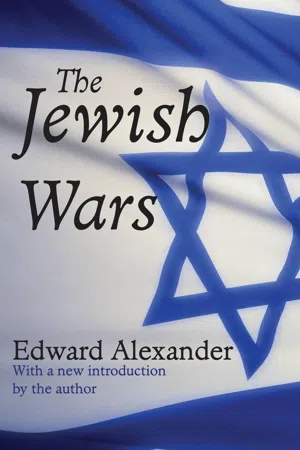
The Jewish Wars
About this book
Edward Alexander launches a counterattack in the war of ideas over Zionism, very much a warrior using words and ideas as his weapons. This book begins with a dissection of the first (1987) Intifada and deals with people and events through 1994, when Israel, having embraced the PLO, began their withdrawal from the disputed territories. Alexander shows how the Intifada proved to be a potent propaganda tool for its organizers. The spectacle of young Palestinians facing Israeli soldiers won for Arabs precisely the victory they had sought: it moved liberal, especially Jewish liberal, sympathy decisively to the side of the Palestinians.Alexander criticizes prominent figures in politics, journalism, education, and literature who express hatred of Jews, Judaism, and Israel. He gives special attention to major combatants in the Jewish wars such as the late Edward Said, Desmond Tutu, Patrick Buchanan, Alexander Cockburn, Michael Lerner, Noam Chomsky, and still more to certain personality types: the timorous Jew cloaking his timidity in the robes of the biblical prophet; the treacherous Jew presenting betrayal of his own people as ethical idealism; the Israelophobe parading as a dispassionate "critic of Israeli policies," the journalist exploiting the full public address and public relations systems provided by his profession.The recurring themes in Alexander's essays are the relations between American and Israeli Jews and the incorporation of anti-Zionism into liberalism, multiculturalism, and literary criticism. He analyzes the politically motivated distortion and exploitation of the Holocaust, the strategies of moral and political discrimination used against Israel, the self-deceptions by which prominent American and Israeli Jews evade the implications of such discrimination, and the growing impunity with which antisemitic tropes can be employed at both ends of the political spectrum. The author's new introduction traces these developments into the twenty-f
Chapter 1 Making Arabs into Jews: David Grossman’s The Yellow Wind*
The Yellow Wind is David Grossman’s account, written for the Israeli weekly Koteret Rashit, of his “seven-week journey through the West Bank” in 1987. It was undertaken in order to understand “how an entire nation like mine, an enlightened nation by all accounts, is able to train itself to live as a conqueror without making its own life wretched.”1 Among the eighteen chapters, unequal in length and not logically parallel, are accounts of the Deheisha refugee camp, of a professional study of the dreams of Arab and Jewish children, of the Jewish settlement at Ofra, of Bethlehem University, of a village to which refugees were allowed to return in 1972, of proceedings in the Nablus military court, of a village divided in 1949 by the newly drawn Israel-Jordan border, of travelers crossing the Allenby Bridge, of illegally employed Arab laborers in Holon (near Tel Aviv), and of settlers’ reactions (and Arab lack of them) to the burning of the Moses family of Alfei Menashe. There are also interviews with a nonreligious leader of the Jewish settlement movement, Moni Ben-Ari, with Raj’a Shehade, Arab lawyer and author, and with the father of an Arab who took part in the murder of two Jewish couples. One chapter is a fictional inside view of an Israeli intelligence officer in the civil administration; it serves as a reminder (just in case the rest of the book should fail to do so) that Grossman is not merely a journalist but a novelist of solid achievement and high reputation.
The great English novelist George Eliot once said that, since opinions were a poor cement between human souls, the novelist’s task should be the creation and diffusion of imaginative sympathy among those who differed from each other in everything except their shared suffering and their human status. Grossman too eschews opinions and aspires “to display wide-hearted humanism,” but he does so by means of an inversion that directs all sympathy to one party while turning the other into a metaphor. Grossman leaps across the divide between Jews and Arabs by making his Arabs into Jews. In Deheisha, impressed by the insistence of Arab children that their homes are in Jaffa, Lod, and other Israeli towns that neither they nor their parents have ever seen, Grossman thinks of the lyrically expressed longings of Yehuda Halevy for the sweetest land he had never seen. He listens to an Arab grandmother singing the praises of her original village, and “discovers that she reminds me of my grandmother, and her stories about Poland” (6). He sees a boy on the roof of a Deheisha house playing on a comb wrapped in paper as “fiddler on the roof” (20). He tells of an Israeli friend who has devoted himself to studying the material culture of the Arabs in the area because “they remind him entirely of his forefathers” (111). What may at first appear to be an act of imaginative identification soon becomes cloying and eventually, especially when Grossman’s fictional Israeli, Gidi, sees in an Arab notable “something which reminded him of his father” (142), reveals itself, after all, as ideology, in all its formulaic staleness, triteness, and falsehood.
Grossman maintains that the Palestinians “are making use of the ancient Jewish strategy of exile, and have removed themselves from history. They close their eyes against harsh reality, and . . . fabricate their Promised Land.” Like the Jews in exile, they are “not willing to compromise” or to “try to improve [their] lives” (7—9). Where, in this licentious equation between Palestinian Arabs and Diaspora Jews (by no means original with Grossman), is the Jews’ belief that they were exiled be cause of their own sins? Where, in this desperate attempt to decorate the Arabs with the tattered coattails of Jewish suffering, is the equivalent of the Jews’ enrichment of their life in exile by the elaborate pretense that they were already living in the Holy Land? Where, among the Arabs of Deheisha and Balata, is the equivalent of the Torah that sustained the Jews in Exile—unless it be what Grossman refers to as “the oral law” (26) of Jew-hatred now passed from Arab mouth to Arab ear in the absence of antisemitic textbooks confiscated by Israeli soldiers? When Grossman—who was born in 1954—claims that Arab children who chant, “By throwing stones and burning tires we will free the motherland” remind him of Jewish children “who sang patriotic songs when British soldiers passed by” (26—27), he does not merely mock memory and history, he comes perilously close to those Israelis—like the fifteen who signed up for passage on the PLO ship intended “to echo the voyage of the Exodus”—who can discover their Jewish identity only by pretending to be Arabs who are themselves pretending to be Jews. When Grossman walks down the Ben-Yehuda mall in Jerusalem he succumbs to the illusion that he sees behind every Jew “a sort of double peeking out... his double from Nablus” (28).
Thomas Macaulay, that lover of paradox, insisted that if James Boswell had not been such a toady and sycophant, he could not have written so great a book as The Life of Johnson. To Dr. Johnson, famously contemptuous of Scotsmen, Boswell pleaded that he could not help being a Scotsman. To which Johnson replied: ‘That, sir, is what a great many of your countrymen cannot help.” In reading this eloquent, and (compared, say, with such productions as David Shipler’s Arab and Jew) relatively honest book, one thinks too often of this famous exchange. Grossman is a model of self-effacement as he listens submissively to Arabs who tell him that “the Jordanians took only our national identity from us, and you took everything” (12), or expound on “Israeli rudeness, cynicism, idiocy, and arrogance,” or regale him with the tale of the yellow wind that comes hot from hell to seek out “those who have performed cruel and unjust deeds”—by which they mean his Israeli countrymen—and “exterminate them, one by one” [italics mine] (76). Raj’a Shehade tells Grossman that although the Arab world is one of oppression, he is confident that the emergent Palestinian nation can be entirely free of the faults of Israel because he has seen that such great nations as England, America, and France are proud and nationalistic without oppressing their minorities. To such arrant nonsense, the author—who must somewhere in the course of his Hebrew University education have heard about the internment of innocent Japanese citizens in America and German Jews in England during World War II—cannot find the means to reply.
Susceptibility to balderdash disappears, however, and self-effacement turns to strident self-assertion when Grossman finds himself among the Jews. Among the Arabs, even when he sees children receiving “education in blind hatred,” he tries “to be neutral. To understand. Not to judge” (25). He entered Deheisha as if returning to the land of his ancestors. But he comes to the Jewish settlement of Ofra fully armed with suspicion, hostility, and partisanship, a “wary stranger” among people who remind him neither of his grandmother nor of anything human, especially when they are “in the season of their messianic heat” (52). (Later in the book, Grossman makes much ado about an Israeli child’s reference to an Arab cleaning woman bent over a pail as “a little bit a person, a little bit a dog” [214].) In Ofra, Grossman does not want “to let down his guard” and be “seduced” by the Sabbath “warmth” and “festivity” of these wily Jews. (34) Although most of his remarks to Arabs in conversations recounted in the book are the perfunctory gestures of a straight man to whom his interlocutors pay no serious attention, he angrily complains that the Jewish settlers don’t listen to or “display a real interest” in him. He asks them to “imagine themselves in their Arab neighbors’ places” (37), and is very much the angry schoolmaster when they don’t dance to his tune or accept his pretense that this act of sympathetic imagination is devoid of political meaning. Neither are the settlers, despite their experience in creating a “well oiled publicity machine” (a rich joke, this) nimble enough to make the appropriate reply: “My dear fellow, we will imagine ourselves as Arabs if you will imagine yourself as a Jew.” But Grossman has no intention of suspending his own rhythms of existence long enough to penetrate the inner life of these alien people. “What have I to do with them?” (48). Grossman’s American promoters who have likened him to Agnon—an extravagance that may have just a little to do with their sympathy for his politics—would do better to compare this chapter with its analogue called “Judea” in Philip Roth’s Counterlife to see the real meaning of imaginative sympathy in a novelist.
Grossman’s resentment of the Jewish settlers is at least as much “cultural” as it is political. In Deheisha he had been much taken with the elderly Arab woman who told him: “We are people of culture! . . . You can’t understand this culture. It’s not a culture of television!” (15). But in Ofra he complains that the settlers have “little use for culture,” speak bad Hebrew, indulge in “Old Diaspora type” humor, and own no books, “with the exception of religious texts” (46). And these, far from mitigating the barbarity of their owners, aggravate it. The final image of the Jews in this long chapter is of “potential terrorists now rocking over their books” (51).
The succeeding chapter also treats of culture and books, including religious ones. Grossman has come to Bethlehem University, one of several universities in the territories that have been punningly described as branches of PLO State. Here Grossman, though he acknowledges the school to be “a stronghold of the Democratic Front for the Liberation of Palestine,” sees no terrorists rocking over books, but rather idyllic scenes that remind him of “the pictures of Plato’s school in Athens” (57). Bubbling with affection, eager to ascribe only the highest motives, Grossman is now willing to forgive even readers of religious books. He has not so much as a snort or a sneer for the Bethlehem English professor who ascribes Arabs’ supreme sensitivity to lyric rhythm in English poetry to the “rhythm of the Koran flow[ing] through their blood” (59). The author’s ability to spot racism at a distance of twenty miles when he is among Jews slackens when timeless racial categories are invoked in Bethlehem.
Yellow Wind is, however, by no means lacking in harsh criticism of Arabs; but these are almost always made by other Arabs. A schoolteacher is “against Arafat, because Arafat wants peace” (22). A mukhtar from the Israeli side of the divided village of Barta’a recalls the self-abasement required of Palestinian Arabs by Jordanian soldiers. A resident of the Jordanian side of the same village excoriates Israeli Arabs for lack of honor, taking everything from their country and giving nothing in return: “While you do reserve duty forty-five days a year,” he tells Grossman, “they go to the beach” (123). One Arab moderate, a businessman educated at Hebrew University, seconds the view of another Arab that if the Israelis were to leave the territories there would be a “second Beirut.” Unlike the author, who believes in truth even though the heavens fall, this man speculates on the likely consequences of Israeli withdrawal: “There will be a great slaughter. . . . First they will kill whoever had any connection with Israel, and those who did business with Israel. . . . And after they kill half of the population here, they will, begin killing each other in a struggle for power” (91).
Grossman himself remains aloof from such vulgar imaginings about the years to follow the realization of “peace now,” though it seems clear that a “second Beirut” in the immediate vicinity of Jerusalem and Tel Aviv would be a catastrophe for Israel infinitely greater than the original, Lebanese version, a very hot yellow wind indeed. Despite the obvious political implications of what he writes about the Israelis and those Arabs who make themselves “a partner in my crime” (94-95), Grossman does not wish to appear to assign his own, explicitly political meaning to the people and events he describes. Therefore he talks with no politicians, Jewish or Arab, and claims that “it is not a question of who is right,” but strictly of “facts and numbers” (215). It is true that for many of the “facts” that he does not get from personal observation he relies on sources that are profoundly entangled in politics. On three separate occasions he reports that he “checked the facts with Dr. Meron Benvenisti” (12), confidently withdrawing from the latter’s “data bank” some of the most debased currency in Israel. Yet there is also much evidence that Grossman really is as innocent of politics as he claims to be.
It is characteristic of Yellow Wind to remove facts from their history in such a way as to suggest the author is either massively ignorant of politics or fiendishly mischievous. After describing the terrible conditions of the Deheisha camp he casually remarks that “It doesn’t matter at all who is really guilty of the refugee camps ...” (26). For Grossman to have explained how and why the Arab nations are guilty of the camps might have been boring work for a novelist, and might have made the book less palatable to the New Yorker, which published excerpts from it after the intifada began in December 1987; but it would have been appropriate for someone who professes to believe that “to become human” is to pass “from speech to moral action.” Grossman is guilty of similar irresponsibility when he declares that “the hard kernel of the entire conflict” is “two nations which still don’t recognize each other’s legitimacy” (110). But the UN plan of 1947 envisaged a Jewish state and an Arab state in western Palestine; the Jews recognized the Arab state, but the Arabs did not recognize the Jewish state—or, for that matter, the Arab state (any more than they had done in 1937, when the Peel Plan would have given the Arabs nearly all of Palestine except for the coastal plain between Tel Aviv and Haifa). For whatever reasons the Arabs started the war on November 30, 1947, Israel’s refusal of recognition of Palestinian Arab sovereignty was not one of them. Granted, it is a tedious business to keep repeating these things, almost as pedestrian a task, especially for a novelist, as locating the Jordan River in the same place every time you draw a map.
The Yellow Wind concludes with two chapters ostensibly about the murders of Jews, members of the Moses family whose car was fire-bombed near Alfei Menashe and two couples killed by a gang of Arab terrorists. These terrible stories afford Grossman an opportunity to display his wide-ranging “humanism” and generous inability to curb his benevolence. But the benevolence is directed toward the father of the captured terrorist because his house had been destroyed, and the anger reserved for Gush Emunim activists accused of exploiting the sorrow of the Moses family and friends. And what of the families of the victims? Grossman says that he cannot begin to measure their sorrow. Yet he also cannot resist the itch to speculate darkly about these people whom he has not bothered to meet: “I do not know if the families of the victims find any comfort in fostering hatred of the murderer, his family, his nation. How can we judge them if that is how they feel?” (195-96). How generous of Grossman to forgive these people for sins they have yet to commit! There is such a thing as a heart too full for weeping, a silence more eloquent than speech; but David Grossman cannot, in The Yellow Wind, demonstrate these qualities of the sympathetic imagination when he is dealing with Jews.
*Reprinted from Commentary, June 1988, by permission; all rights reserved.
Chapter 2 To Mend the Universe or Mind the Vineyard?
Part One: Leonard Fein, David Novak, and American Jewry*
American Jews have been conspicuously absent from Israel during the six months since the Arab uprising (intifada) began in December 1987. Virtually every tourist one sees here in Jerusalem is a Christian; and some hotels report cancellation rates by American Jewish groups approaching 100 percent. One touching item in the press reported that numerous Conservative rabbis, planning to attend the Rabbinical Assembly here in July, will be forced to cancel their visits because “many rabbis were planning to come with tour groups from their congregations to help cover expenses. But. . . many of these tours are not coming.” The few prominent Jewish intellectuals who do keep their commitments to participate in conferences or performances are received with a beggar-like gratitude in no way diminished by their compulsive desire to bite the hand that feeds them (very lavishly) by publicly “testifying” against Israeli policies.
The intifada in its various forms—they include fire-bombings in Judea, Samaria, Gaza, and even Tel Aviv, stabbings and fatal shootings of yeshiva students in east and west Jerusalem, a pogrom against a group of high school students on a hike, and the destruction by arson of over 100,000 dunams of land and all its wildlife—has kept most Israelis too busy to worry about the mysterious absence of their American cousins. But awareness of it grows apace. One young acquaintance of mine, just back from three weeks of reserve duty (now increased to sixty days a year) in Nablus, asked me sharply: “What are your American Jews, who are always declaring ‘We Are One,’ doing while we are dodging bricks and petrol bombs?”
Some of them, I answered, are dutifully reciting, for the benefit of the great American public, what might be called the Anthony Lewis conjugation, in serialized weekly numbers: Israel will lose its soul; Israel is losing its soul; Israel has lost its soul. Others, including editors of Jewish magazines and heads of large Jewish organizations, are queuing up in the television studios to explain why their Jewish ethical idealism—which has already earned them the plaudits of Edward Said and the Arab League—requires that they condemn all Israeli use of force against Arab rioters in the most forceful language they can marshal. Still a third group—so I told the astonished young soldier—was deeply immersed in considering the special Jewish mission to gentile America, a mission it defined as nothing less than tikkun olam, repairing the universe. The concerns of the earthly Jerusalem, pressing though they may seem to its inhabitants, can hardly be expected to distract those who are building the heavenly Jerusalem in America.
Now, the idea of America as a new Zion was a prominent theme of the Puritans who built the country, and even the enlightened Thomas Jefferson wanted “Israel” on the seal of the United States. But recently the idea has been infused with a specifically Jewish (and also anti-Zionist) energy, and it has found articulate spokesmen in more than one sector of the ideological spectrum of American Jewry.
Thus, in March 1987, a few days after Jonathan Pollard had been sentenced to life imprisonment for spying for Israel, the eminent scholar Jacob Neusner, a political conservative, published in the Washington Post an article designed to show the absurdity of American Jews’ attaching themselves to Israel when they were already walking the streets of El Dorado: “If ever there was a Promised Land, Jewish Americans are living in it.” As it happens, this is the same Neusner who in a 1981 book (Stranger at Home) had written that “American Jewry simply does not add up to much. Its inner life is empty, its public life decadent.” Yet here he was, at a particularly delicate moment in relations between Israel and the United States, praising the cohesiveness, security, prosperity, philoprogenitive-ness, and “authentically Jewish voice” of the American Jewish community.
A much more ambitious attempt to relocate Jerusalem in a greener, more pleasant, and more peaceful place than the state of Israel is that of the leftist Leonard Fein, the founder and first editor of Moment magazine and a veteran fomenter-from-within of American Jewish agitation against Israel’s government, especially when that government has been dominated by the Likud coalition. “Where is Jerusalem?” is the crucial chapter in Leonard Fein’s Where Are We?, a book whose title conveys the sense of befuddlement of someone lost in a troubled universe, a sense not belie...
Table of contents
- Cover Page
- Half title
- title
- copy
- dedication
- Introduction to the Transaction Edition
- Introduction
- 1 Making Arabs into Jews: David Grossman’s The Yellow Wind
- 2 To Mend the Universe or Mind the Vineyard?
- Part One: Leonard Fein, David Novak, and American Jewry
- Part Two: Edward Alexander Replies to His Critics
- 3 Antisemitism, Israeli-Style*
- 4 Professor of Terror
- Part One: Edward Said on “Collaborators”
- Part Two: Edward Alexander Replies to His Critics
- 5 The Wit and Wisdom of Alexander Cockburn
- Part One: Countries Deserving Rape
- Part Two: Cockburn, Two and a Half Tears Later, Strikes Back; and Edward Alexander Replies
- 6 Praying for Nazis, Scolding Their Victims: Archbishop Tutu’s Christmas Message to Israel
- 7 The Holocaust... and Me
- 8 Nelson Mandela and the Jews: The Dickens-Fagin Pattern
- 9 The Last Refuge of a Scoundrel: Patrick Buchanan’s Anti-Jewish Patriotism
- Part One: The Rosh Hashanah Sermon
- Part Two: The Tom Kippur Sermon
- Part Three: Michael Kinsley and Patrick Buchanan: An Unpublished Letter
- 10 Why Jews Must Behave Better than Everybody Else: The Theory and Practice of the Double Standard
- 11 Multiculturalismes Jewish Problem
- 12 Some of My Best Friends Are Antisemites: William F. Buckley’s Dilemma
- 13 What the Holocaust Does Not Teach
- 14 The Nerve of Ruth Wisse*
- 15 Michael Lerner: The Clintons’ Jewish Rasputin
- 16 Noam Chomsky and Holocaust Denial
- Part One: The Neo-Nazis and Their Apologists
- Part Two: Edward Alexander Replies to His Critics
- 17 Israel’s Embrace of the PLO: The Beginning of the End?
- Notes
- Index
Trusted by 375,005 students
Access to over 1.5 million titles for a fair monthly price.
Study more efficiently using our study tools.
Frequently asked questions
Yes, you can cancel anytime from the Subscription tab in your account settings on the Perlego website. Your subscription will stay active until the end of your current billing period. Learn how to cancel your subscription
No, books cannot be downloaded as external files, such as PDFs, for use outside of Perlego. However, you can download books within the Perlego app for offline reading on mobile or tablet. Learn how to download books offline
Perlego offers two plans: Essential and Complete
- Essential is ideal for learners and professionals who enjoy exploring a wide range of subjects. Access the Essential Library with 800,000+ trusted titles and best-sellers across business, personal growth, and the humanities. Includes unlimited reading time and Standard Read Aloud voice.
- Complete: Perfect for advanced learners and researchers needing full, unrestricted access. Unlock 1.5M+ books across hundreds of subjects, including academic and specialized titles. The Complete Plan also includes advanced features like Premium Read Aloud and Research Assistant.
We are an online textbook subscription service, where you can get access to an entire online library for less than the price of a single book per month. With over 1.5 million books across 990+ topics, we’ve got you covered! Learn about our mission
Look out for the read-aloud symbol on your next book to see if you can listen to it. The read-aloud tool reads text aloud for you, highlighting the text as it is being read. You can pause it, speed it up and slow it down. Learn more about Read Aloud
Yes! You can use the Perlego app on both iOS and Android devices to read anytime, anywhere — even offline. Perfect for commutes or when you’re on the go.
Please note we cannot support devices running on iOS 13 and Android 7 or earlier. Learn more about using the app
Please note we cannot support devices running on iOS 13 and Android 7 or earlier. Learn more about using the app
Yes, you can access The Jewish Wars by Edward Alexander in PDF and/or ePUB format, as well as other popular books in History & Middle Eastern History. We have over 1.5 million books available in our catalogue for you to explore.