- 200 pages
- English
- ePUB (mobile friendly)
- Available on iOS & Android
eBook - ePub
ERP: The Implementation Cycle
About this book
The ERP Implementation cycle is characterized by complexity, uncertainty and a long timescale. It is about people and issues that affect the business ? it is a multi-disciplinary effort.This book will provide you with the practical information you will need in relation to the many issues and events within the implementation cycle. After reading this book you will be fully equipped and alerted to what is involved in an ERP implementation.ERP (Enterprise Resource Planning) can be described as an integrated enterprise-wide information system. As well as handling many of the transactions found within a business it has the potential for meeting many of the information requirements of busy personnel. If used in the right hands, it may provide the business with a competitive edge.Much can go wrong during the implementation since there are many issues to deal with. From the content of this book you will gain an understanding of what can go wrong ? you will be prepared in advance, and will be equipped to take preventative steps to smooth the progress of implementation.This book:Covers the multidisciplinary subject of ERP implementationLooks at a range of relevant topics including ERP market-place development, vendor selection, project management, process design and post GoLive improvementsReveals a range of issues which an implementer should be alert to right at the outset before the go-ahead is given to proceed with an implementationFeatures material on vendor selection, project management, training, business process re-engineering (BPR) and continuous improvement
1
Introduction
ERP is the acronym for Enterprise Resource Planning. ERP has its roots in manufacturing, although it has evolved in a remarkably short time to address many other functions and sectors. The implementation of an ERP application is about organizational change. The focus of the ERP implementation is the ERP system. The ERP system can simply be described as an integrated information system servicing all aspects of the business. It handles transactions, maintains records, provides real time information and facilitates planning and control. However, its effectiveness is an outcome of the success of the implementation life cycle.
An ERP implementation should not be viewed purely as an IT project. It is a multidisciplinary team effort. It cuts into the very heart of the business, upturning policies, practices and power-bases. It is indiscriminate in who it stresses and strains. It requires a changing set of skills, which may at times be unique to the moment, never to be used again. If it is successful then the rewards are bountiful. Transactions are speedily processed. Timely information provides awareness of what is happening. Actions become more proactive. The payback has a positive effect on the bottom line.
However, it is easy for an ERP implementation to go wrong. Furthermore, it can be difficult to put things right. The further into the implementation life cycle, the harder it can become to put things right and the greater the associated cost. Despite all the research and experience available, it may come as a surprise that implementations can, and do, go wrong, leading in some cases to high-profile legal battles.
1.1 Using this book
The aim of this book is to guide the reader around the myriad of different issues affecting an ERP implementation. To achieve this, a simple model of an implementation has been developed. This model views an ERP implementation as a cycle of events. This cycle is presented in Figure 1.1.
Figure 1.1
The ERP implementation cycle
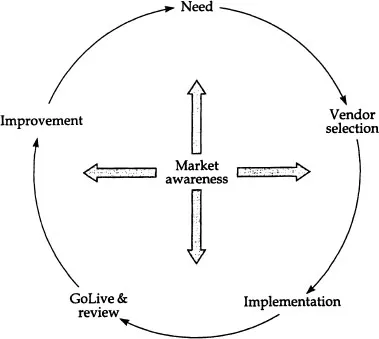
The implementation life cycle starts at the point when the need is recognized for a new information system. The existing system is inadequate and there is a need to do something. Market awareness provides an appreciation of the technology available and those providing it. This leads to the vendor selection process whereby a solution is sought to meet this need. The implementation of the solution is a complex event involving many people and culminates in the transition to a GoLive state. The adoption of a continuous improvement programme after the GoLive period enables the benefits of the system to be fully exploited. Eventually the cycle concludes with the recognition that the replacement system is inadequate and that the need arises again to do something. Within this cycle are a host of different activities. A breakdown of this cycle into its main activities is presented in Table 1.1.
The story begins with an attempt to develop an awareness of what is going on in the marketplace. Whilst relevant at all stages of the ERP life cycle, the level of awareness varies according to the necessity to participate in this marketplace. Obviously the most critical stage is when going through the process of vendor selection. However, the marketplace should not be neglected during the other stages. When alerted to the possible need for a new system the marketplace can provide a reference with which to confirm this need. During the implementation and post-GoLive review, there may be little interest as attention focuses upon the bought system. Nevertheless, it is not unknown for a vendor’s offering to be abandoned in favour of another if problems become insurmountable. Later, during the improvement stage, interest lies with improving practices and getting more out of the functionality, looking at specialist packages to boost functionality if necessary. Finally, there comes a point in time when the implementation has completed its cycle: there is a need to do something, either upgrade or move to another package and again attention focuses upon what is going on in the marketplace.
Table 1.1 A breakdown of the ERP implementation cycle
Stage | Focus | Activity | Chapters/Section(s) | |
0 Market awareness | Marketplace | Understand what is going on in the marketplace | 2, 3, 4, 5 | |
1 Define need | Requirements | Establish why | 6.1 | |
Cost-benefits | Establish costs and determine benefits | 6.2, 6.3 | ||
Requirements | Determine requirements | 7 | ||
2 | Select vendor | Vendor offerings and fit | Establish selection process Execute selection process ’Close the deal’ | 8.1 8.2 9 |
3 Implement project | Create and maintain conditions for project implementation | Establish and assign project participant roles Establish, monitor and maintain commitment Define scope Produce, monitor and update plan Establish, monitor and update budget Set up and manage problem resolution mechanisms Assess and contain risks Establish, monitor and manage performance Manage vendor relationships Install and commission hardware, software and networks Develop training strategy | 11.2.1 11.2.1 11.2.2 11.2.3 11.2.4 11.2.5 11.2.6 11.2.7 11.2.8 11.3 11.4 | |
Implement project plan | Train project team Define and develop processes Modify software Test (pilot) processes Establish and assign responsibilities for processes Design and create documentation Train users Set up data | 12.1 12.2, 12.3 12.3.2 12.4 12.5 12.6 12.7 12.8 | ||
GoLive | Resolve problems Review | 13.1 13.2 | ||
4 Post-GoLive improvements | Process performance | Improve processes | 14 |
The first three chapters are concerned primarily with the technology. The development of ERP is reviewed from its earliest beginnings (Chapter 2). By understanding how the technology has evolved, it becomes possible to develop a better appreciation of what is available (Chapter 3), where it is heading and what to watch out for (Chapter 4). This alerts us as to what is or might become redundant. This also allows us to distinguish between sales hype and what is actually available. With the technology becoming so intricate and prone to rapid change it is easy to lose perspective.
Chapter 5 focuses on developments in the marketplace. This is also an ever-changing landscape which will surprise the unaware. Established names do disappear. There is always the danger of a purchased application becoming unsupported if a company collapses or is acquired by another. A five-year investment in an ERP application is a long time during which much can happen.
The next two chapters are about issues relating to the need for an ERP application. Chapter 6 is divided into three sections. The first explores possibilities about why is there a need. The second section raises at an early stage the issue of cost. Whilst details about costs may not emerge until later in the implementation cycle, an appreciation of likely costs and their breakdown is required up-front to facilitate planning and guide negotiations. Likewise, the third section, which is about the possible benefits, provides an opportunity to assess the value of the proposed project. Chapter 7 addresses the question of what the requirements are and how these requirements are to be provided. Part of this process involves defining requirements. Whilst there are different approaches to this, the reader is referred to Section 12.2, whic...
Table of contents
- Cover Page
- Title Page
- Copyright Page
- Table of Contents
- Computer Weekly Professional Series
- Preface
- Acknowledgements
- About the author
- 1 Introduction
- 2 Historical perspective
- 3 The present generation
- 4 The next generation
- 5 Marketplace dynamics
- 6 Initial need
- 7 Requirements definition
- 8 Vendor selection
- 9 ‘Closing the deal’
- 10 Introduction to implementation
- 11 Implementation methodology
- 12 Implementation
- 13 GoLive/review
- 14 On-going
- 15 Finale
- Useful sources
- Selected reading
- Acronyms and abbreviations
- References
- Index
Trusted by 375,005 students
Access to over 1.5 million titles for a fair monthly price.
Study more efficiently using our study tools.
Frequently asked questions
Yes, you can cancel anytime from the Subscription tab in your account settings on the Perlego website. Your subscription will stay active until the end of your current billing period. Learn how to cancel your subscription
No, books cannot be downloaded as external files, such as PDFs, for use outside of Perlego. However, you can download books within the Perlego app for offline reading on mobile or tablet. Learn how to download books offline
Perlego offers two plans: Essential and Complete
- Essential is ideal for learners and professionals who enjoy exploring a wide range of subjects. Access the Essential Library with 800,000+ trusted titles and best-sellers across business, personal growth, and the humanities. Includes unlimited reading time and Standard Read Aloud voice.
- Complete: Perfect for advanced learners and researchers needing full, unrestricted access. Unlock 1.5M+ books across hundreds of subjects, including academic and specialized titles. The Complete Plan also includes advanced features like Premium Read Aloud and Research Assistant.
We are an online textbook subscription service, where you can get access to an entire online library for less than the price of a single book per month. With over 1.5 million books across 990+ topics, we’ve got you covered! Learn about our mission
Look out for the read-aloud symbol on your next book to see if you can listen to it. The read-aloud tool reads text aloud for you, highlighting the text as it is being read. You can pause it, speed it up and slow it down. Learn more about Read Aloud
Yes! You can use the Perlego app on both iOS and Android devices to read anytime, anywhere — even offline. Perfect for commutes or when you’re on the go.
Please note we cannot support devices running on iOS 13 and Android 7 or earlier. Learn more about using the app
Please note we cannot support devices running on iOS 13 and Android 7 or earlier. Learn more about using the app
Yes, you can access ERP: The Implementation Cycle by Stephen Harwood in PDF and/or ePUB format, as well as other popular books in Business & Business General. We have over 1.5 million books available in our catalogue for you to explore.