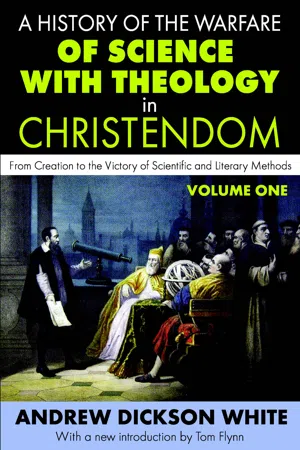
Given the powerful and forthright title of Andrew Dickson White's classic study, it is best to make clear his own sense of the whole as given in the original 1896 edition: "My conviction is that science, though it has evidently conquered dogmatic theology based on biblical texts and ancient modes of thought, will go hand in hand with religion, and that although theological control will continue to diminish, religion as seen in the recognition of a 'power in the universe, not ourselves, which makes for righteousness' and in the love of God and of our neighbor, will steadily grow stronger and stronger, not only in the American institutions of learning, but in the world at large." White began to assemble his magnum opus, a two volume work first published in 1896 as A History of the Warfare of Science with Theology in Christendom. In correspondence he wrote that he intended the work to stake out a position between such religious orthodoxy as John Henry Newman's on one side and such secular scoffing as Robert Ingersoll's on the other. Historian Paul Carter declared that this book did as much as any other published work "toward routing orthodoxy in the name of science." Insofar as science and religion came to be widely viewed as enemies, with science holding the moral high ground, White inadvertently, became one of the most effective and influential advocates for unbelief.
eBook - ePub
A History of the Warfare of Science with Theology in Christendom
Volume 1, From Creation to the Victory of Scientific and Literary Methods
- 516 pages
- English
- ePUB (mobile friendly)
- Available on iOS & Android
eBook - ePub
A History of the Warfare of Science with Theology in Christendom
Volume 1, From Creation to the Victory of Scientific and Literary Methods
The Warfare of Science With Theology
CHAPTER I.
From Creation to Evolution
I The Visible Universe
Among those masses of cathedral sculpture which preserve so much of mediæval theology, one frequently recurring group is noteworthy for its presentment of a time-honoured doctrine regarding the origin of the universe.
The Almighty, in human form, sits benignly, making the sun, moon, and stars, and hanging them from the solid firmament which supports the “heaven above” and overarches the “earth beneath.”
The furrows of thought on the Creator’s brow show that in this work he is obliged to contrive; the knotted muscles upon his arms show that he is obliged to toil; naturally, then, the sculptors and painters of the mediæval and early modern period frequently represented him as the writers whose conceptions they embodied had done—as, on the seventh day, weary after thought and toil, enjoying well-earned repose and the plaudits of the hosts of heaven.
In these thought-fossils of the cathedrals, and in other revelations of the same idea through sculpture, painting, glass-staining, mosaic work, and engraving, during the Middle Ages and the two centuries following, culminated a belief which had been developed through thousands of years, and which has determined the world’s thought until our own time.
Its beginnings lie far back in human history; we find them among the early records of nearly all the great civilizations, and they hold a most prominent place in the various sacred books of the world. In nearly all of them is revealed the conception of a Creator of whom man is an imperfect image, and who literally and directly created the visible universe with his hands and fingers.
Among these theories, of especial interest to us are those which controlled theological thought in Chaldea. The Assyrian inscriptions which have been recently recovered and given to the English-speaking peoples by Layard, George Smith, Sayce, and others, show that in the ancient religions of Chaldea and Babylonia there was elaborated a narrative of the creation which, in its most important features, must have been the source of that in our own sacred books. It has now become perfectly clear that from the same sources which inspired the accounts of the creation of the universe among the Chaldeo-Babylonian, the Assyrian, the Phoenician, and other ancient civilizations came the ideas which hold so prominent a place in the sacred books of the Hebrews. In the two accounts imperfectly fused together in Genesis, and also in the account of which we have indications in the book of Job and in the Proverbs, there is presented, often with the greatest sublimity, the same early conception of the Creator and of the creation—the conception, so natural in the childhood of civilization, of a Creator who is an enlarged human being working literally with his own hands, and of a creation which is “the work of his fingers.” To supplement this view there was developed the belief in this Creator as one who, having
…“from his ample palm
Launched forth the rolling planets into space,”
sits on high, enthroned “upon the circle of the heavens,” perpetually controlling and directing them.
From this idea of creation was evolved in time a somewhat nobler view. Ancient thinkers, and especially, as is now found, in Egypt, suggested that the main agency in creation was not the hands and fingers of the Creator, but his voice. Hence was mingled with the earlier, cruder belief regarding the origin of the earth and heavenly bodies by the Almighty the more impressive idea that “he spake and they were made”—that they were brought into existence by his word.*
Among the early fathers of the Church this general view of creation became fundamental; they impressed upon Christendom more and more strongly the belief that the universe was created in a perfectly literal sense by the hands or voice of God. Here and there sundry theologians of larger mind attempted to give a more spiritual view regarding some parts of the creative work, and of these were St. Gregory of Nyssa and St. Augustine. Ready as they were to accept the literal text of Scripture, they revolted against the conception of an actual creation of the universe by the hands and fingers of a Supreme Being, and in this they were followed by Bede and a few others; but the more material conceptions prevailed, and we find these taking shape not only in the sculptures and mosaics and stained glass of cathedrals, and in the illuminations of missals and psalters, but later, at the close of the Middle Ages, in the pictured Bibles and in general literature.
Into the Anglo-Saxon mind this ancient material conception of the creation was riveted by two poets whose works appealed especially to the deeper religious feelings. In the seventh century Cædmon paraphrased the account given in Genesis, bringing out this material conception in the most literal form ; and a thousand years later Milton developed out of the various statements in the Old Testament, mingled with a theology regarding “the creative Word” which had been drawn from the New, his description of the creation by the second person in the Trinity, than which nothing could be more literal and material:
“He took the golden compasses, prepared
In God’s eternal store, to circumscribe
This universe and all created things.
One foot he centred, and the other turned
Round through the vast profundity obscure,
And said, ‘Thus far extend, thus far thy bounds:
This be thy just circumference, O world!’”*
So much for the orthodox view of the manner of creation.
The next point developed in this theologic evolution had reference to the matter of which the universe was made, and it was decided by an overwhelming majority that no material substance existed before the creation of the material universe—that “God created everything out of nothing.” Some venturesome thinkers, basing their reasoning upon the first verses of Genesis, hinted at a different view—namely, that the mass, “without form and void,” existed before the universe ; but this doctrine was soon swept out of sight. The vast majority of the fathers were explicit on this point. Tertullian especially was very severe against those who took any other view than that generally accepted as orthodox: he declared that, if there had been any pre-existing matter out of which the world was formed, Scripture would have mentioned it; that by not mentioning it God has given us a clear proof that there was no such thing; and, after a manner not unknown in other theological controversies, he threatens Hermogenes, who takes the opposite view, with “the woe which impends on all who add to or take away from the written word.”
St. Augustine, who showed signs of a belief in a pre-existence of matter, made his peace with the prevailing belief by the simple reasoning that, “although the world has been made of some material, that very same material must have been made out of nothing.”
In the wake of these great men the universal Church steadily followed. The Fourth Lateran Council declared that God created everything out of nothing ; and at the present hour the vast majority of the faithful—whether Catholic or Protestant—are taught the same doctrine; on this point the syllabus of Pius IX and the Westminster Catechism fully agree.*
Having thus disposed of the manner and matter of creation, the next subject taken up by theologians was the time required for the great work.
Here came a difficulty. The first of the two accounts given in Genesis extended the creative operation through six days, each of an evening and a morning, with much explicit detail regarding the progress made in each. But the second account spoke of “the day” in which “the Lord God made the earth and the heavens.” The explicitness of the first account and its naturalness to the minds of the great mass of early theologians gave it at first a decided advantage ; but Jewish thinkers, like Philo, and Christian thinkers, like Origen, forming higher conceptions of the Creator and his work, were not content with this, and by them was launched upon the troubled sea of Christian theology the idea that the creation was instantaneous, this idea being strengthened not only by the second of the Genesis legends, but by the great text, “He spake, and it was done; he commanded, and it stood fast”—or, as it appears in the Vulgate and in most translations, “He spake, and they were made; he commanded, and they were created.”
As a result, it began to be held that the safe and proper course was to believe literally both statements ; that in some mysterious manner God created the universe in six days, and yet brought it all into existence in a moment. In spite of the outcries of sundry great theologians, like Ephrem Syrus, that the universe was created in exactly six days of twenty-four hours each, this compromise was promoted by St. Athanasius and St. Basil in the East, and by St. Augustine and St. Hilary in the West.
Serious difficulties were found in reconciling these two views, which to the natural mind seem absolutely contradictory ; but by ingenious manipulation of texts, by dexterous play upon phrases, and by the abundant use of metaphysics to dissolve away facts, a reconciliation was effected, and men came at least to believe that they believed in a creation of the universe instantaneous and at the same time extended through six days.*
Some of the efforts to reconcile these two accounts were so fruitful as to deserve especial record. The fathers, Eastern and Western, developed out of the double account in Genesis, and the indications in the Psalms, the Proverbs, and the book of Job, a vast mass of sacred science bearing upon this point. As regards the whole work of creation, stress was laid upon certain occult powers in numerals. Philo Judasus, while believing in an instantaneous creation, had also declared that the world was created in six days because “of all numbers six is the most productive”; he had explained the creation of the heavenly bodies on the fourth day by “the harmony of the number four”; of the animals on the fifth day by the five senses; of man on the sixth day by the same virtues in the number six which had caused it to be set as a limit to the creative work; and, greatest of all, the rest on the seventh day by the vast mass of mysterious virtues in the number seven.
St. Jerome held that the reason why God did not pronounce the work of the second day “good” is to be found in the fact that there is something essentially evil in the number two, and this was echoed centuries afterward, afar off in Britain, by Bede.
St. Augustine brought this view to bear upon the Church in the following statement: “There are three classes of numbers—the more than perfect, the perfect, and the less than perfect, according as the sum of them is greater than, equal to, or less than the original number. Six is the first perfect number: wherefore we must not say that six is a perfect number because God finished all his works in six days, but that God finished all his works in six days because six is a perfect number.”
Reasoning of this sort echoed along through the mediæval Church until a year after the discovery of America, when the Nuremberg Chronicle re-echoed it as follows: “The creation of things is explained by the number six, the parts of which, one, two, and three, assume the form of a triangle.”
This view of the creation of the universe as instantaneous and also as in six days, each made up of an evening and a morning, became virtually universal. Peter Lombard and Hugo of St. Victor, authorities of vast weight, gave it their sanction in the twelfth century, and impressed it for ages upon the mind of the Church.
Both these lines of speculation—as to the creation of everything out of nothing, and the reconciling of the instantaneous creation of the universe with its creation in six days —were still further developed by other great thinkers of the Middle Ages.
St. Hilary of Poictiers reconciled the two conceptions as follows: “For, although according to Moses there is an appearance of regular order in the fixing of the firmament, the laying bare of the dry land, the gathering together of the waters, the formation of the heavenly bodies, and the arising of living things from land and water, yet the creation of the heavens, earth, and other elements is seen to be the work of a single moment.”
St. Thomas Aquinas drew from St. Augustine a subtle distinction which for ages eased the difficulties in the case: he taught in effect that God created the substance of things in a moment, but gave to the work of separating, shaping, and adorning this creation, six days.*
The early reformers accepted and developed the same view, and Luther especially showed himself equal to the occasion. With his usual boldness he declared, first, that Moses “spoke properly and plainly, and neither allegorically nor figuratively,” and that therefore “the world with all creatures was created in six days.” And he then goes on to show how, by a great miracle, the whole creation was also instantaneous.
Melanchthon also insisted that the universe was created out of nothing and in a mysterious way, both in an instant and in six days, citing the text: “He spake, and they were made.”
Calvin opposed the idea of an instantaneous creation, and laid especial stress on the creation in six days: having called attention to the fact that the biblical chronology shows the world to be not quite six thousand years old and that it is now near its end, he says that “creation was extended through six days that it might not be tedious for us to occupy the whole of life in the consideration of it.”
Peter Martyr clinched the matter by declaring: “So important is it to comprehend the work of creation that we see the creed of the Church take this as its starting point. Were this article taken away there would be no original sin, the promise of Christ would become void, and all the vital force of our religion would be destroyed.” The Westminster divines in drawing up their Confession of Faith specially laid it down as necessary to believe that all things visible and invisible were created not only out of nothing but in exactly six days.
Nor were the Roman divines less strenuous than the Protestant reformers regarding the necessity of holding closely to the so-called Mosaic account of creation. As late as the middle of the eighteenth century, when Buffon attempted to state simple geological truths, the theological faculty of the Sorbonne forced him to make and to publish a most ignominious recantation which ended with these words: “I abandon everything in my book respecting the formation of the earth, and generally all which may be contrary to the narrative of Moses.”
Theologians, having thus settled the manner of the creation, the matter used in it, and the time required for it, now exerted themselves to fix its date.
The long series of efforts by the greatest minds in the Church, from Eusebius to Archbishop Usher, to settle this point are presented in another chapter. Suffice it here that the general conclusion arrived at by an overwhelming majority of the most competent students of the biblical accounts was that the date of creation was, in round numbers, four thousand years before our era; and in the seventeenth century, in his great work, Dr. John Lightfoot, Vice-Chancellor of the University of Cambridge, and one of the most eminent Hebrew scholars of his time, declared, as the result of his most profound and exhaustive study of the Scriptures, that “heaven and earth, centre and circumference, were created all together, in the same instant, and clouds full of water,” and that “this work took place and man was created by the Trinity on October 23, 4004 B. C., at nine o’clock in the morning.”
Here was, indeed, a triumph of Lactantius’s method, the result of hundreds of years of biblical study and theological thought since Bede in the eighth century, and Vincent of Beauvais in the thirteenth, had declared that creation must have taken place in the spring. Yet, alas! within two cen-turies after Lightfoot’s great biblical demonstration as to the exact hour of creation, it was discovered that at that hour an exceedingly cultivated people, enjoying all the fruits of a highly developed civilization, had long been swarming in the great cities of Egypt, and that other nations hardly less advanced had at that time reached a high development in Asia.*
But, strange as it may seem, even after theologians had thus settled the manner of creation, the matter employed in it, the time required for it, and the exact date of it, there remained virtually unsettled the first and greatest question of all; and this was nothing less than the question, WHO actually created the universe?
Various theories more or less nebulous, but all centred in texts of Scripture, had swept through the mind of the Church. By some theologians it was held virtually that the actual creative agent was the third person of the Trinity, who, in the opening words of our sublime creation poem, “moved upon the face of the waters.” By others it was held that the actual Creator was the second person of the Trinity, in behalf of whose agency many texts were cited from the New Testament. Others held that the actual Creator was the first person, and this view was embodied in the two great formulas known as the Apostles’ and Nicene Creeds, which explicitly assigned the work to “God the Father Almighty, Maker of heaven and earth.” Others, finding a deep meaning in the words “Let us make,” ascribed in Genesis to the Creator, held that the entire Trinity directly created all things; and still others, by curious metaphysical processes, seemed to arrive at the idea that peculiar com-binations of two persons of the Trinity achieved the creation.
In all this there would seem to be considerable courage in view of the fearful condemnations launched in the Athanasian Creed against all who should “confound the persons” or “divide the substance of the Trinity.”
These various stages in the evolution of scholastic theology were also embodied in sacred art, and especially in cathedral sculpture, in glass-staining, in mosaic working, and in missal painting.
The creative Being is thus represented sometimes as the third person of the Trinity, in the form of a dove brooding over chaos ; sometimes as the second person, and therefore a youth; sometimes as the first person, and therefore fatherly and venerable; sometimes as the first and second persons, one being venerable and the ...
Table of contents
- Cover
- Title Page
- Copyright Page
- Contents
- Introduction to the Transaction Edition
- Chapter I. From Creation to Evolution.
- Chapter II. Geography.
- Chapter III. Astronomy.
- Chapter IV. From “Signs and Wonders” to Law in the Heavens.
- Chapter V. From Genesis to Geology.
- Chapter VI. The Antiquity of Man, Egyptology, and Assyriology.
- Chapter VII. The Antiquity of Man and Prehistoric Archæology.
- Chapter VIII. The “Fall of Man” and Anthropology.
- Chapter IX. The “Fall of Man” and Ethnology.
- Chapter X. The “Fall of Man” and History.
- Chapter XI. From “The Prince of the Power of the Air” to Meteorology.
- Chapter XII. From Magic to Chemistry and Physics.
- Index
Trusted by 375,005 students
Access to over 1.5 million titles for a fair monthly price.
Study more efficiently using our study tools.
Frequently asked questions
Yes, you can cancel anytime from the Subscription tab in your account settings on the Perlego website. Your subscription will stay active until the end of your current billing period. Learn how to cancel your subscription
No, books cannot be downloaded as external files, such as PDFs, for use outside of Perlego. However, you can download books within the Perlego app for offline reading on mobile or tablet. Learn how to download books offline
Perlego offers two plans: Essential and Complete
- Essential is ideal for learners and professionals who enjoy exploring a wide range of subjects. Access the Essential Library with 800,000+ trusted titles and best-sellers across business, personal growth, and the humanities. Includes unlimited reading time and Standard Read Aloud voice.
- Complete: Perfect for advanced learners and researchers needing full, unrestricted access. Unlock 1.5M+ books across hundreds of subjects, including academic and specialized titles. The Complete Plan also includes advanced features like Premium Read Aloud and Research Assistant.
We are an online textbook subscription service, where you can get access to an entire online library for less than the price of a single book per month. With over 1.5 million books across 990+ topics, we’ve got you covered! Learn about our mission
Look out for the read-aloud symbol on your next book to see if you can listen to it. The read-aloud tool reads text aloud for you, highlighting the text as it is being read. You can pause it, speed it up and slow it down. Learn more about Read Aloud
Yes! You can use the Perlego app on both iOS and Android devices to read anytime, anywhere — even offline. Perfect for commutes or when you’re on the go.
Please note we cannot support devices running on iOS 13 and Android 7 or earlier. Learn more about using the app
Please note we cannot support devices running on iOS 13 and Android 7 or earlier. Learn more about using the app
Yes, you can access A History of the Warfare of Science with Theology in Christendom by Andrew White in PDF and/or ePUB format, as well as other popular books in History & Historiography. We have over 1.5 million books available in our catalogue for you to explore.