- 220 pages
- English
- ePUB (mobile friendly)
- Available on iOS & Android
eBook - ePub
About this book
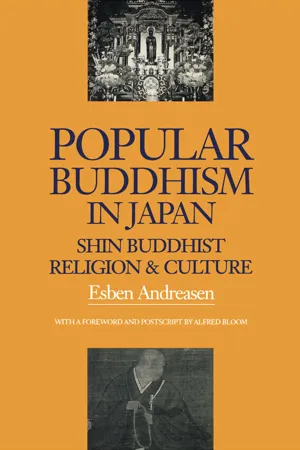
With a foreword by Prof. Alfred Bloom. This completely new study of Japanese Shin Buddhism offers a valuable combination of historical development, carefully selected readings with commentaries and illustrations. Widely welcomed both for its scope as course work reader and as a general introduction to the subject.
Information
| 1 | Shinran — the Founder |
For believers there is no doubt about the high status of the founder. He is Shinran Shonin. The title, shonin, means ‘eminent priest’ — or’saint’ if translated into a similar category in Christianity. The Emperor Meiji bestowed on him the honourable name Kenshin Daishi, ‘Great Teacher who has revealed the Truth’. This was a common practice among Japanese Emperors to give posthumous names to great teachers, signalling the social acceptance of the teaching. His importance is also seen in the size of his hall. In both Nishi and Higashi Honganji the Founder’s Hall is bigger than even Amida’s Hall. (See plan on p. 104.)
Often in introductions to Shinran’s life a four-part division is used:
● apprenticeship
● break with established Buddhism
● life in exile
● return to Kyoto as an accepted renewer of Buddhism
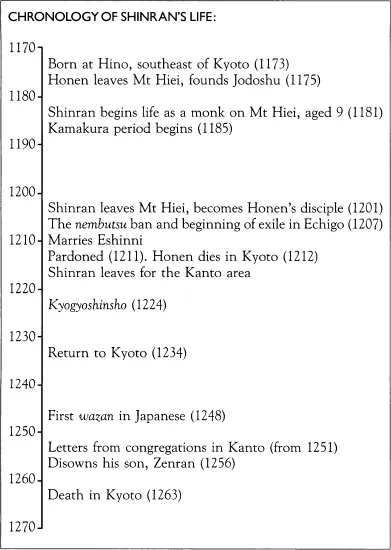
Shinran (1173–1263) belongs to the Kamakura period (1185–1333), when the military leaders, the Shoguns, had taken over from the Emperor. His family held high positions at the imperial court in Kyoto, but because of times of unrest many people at court sought a career as a Buddhist scholar monk. This was the case with Shinran who was educated as a monk on Mount Hiei outside Kyoto, thus starting his life with the prospect of following a traditional career in the Tendai sect, the most prominent at the time.
Instead, he chose his own path because of what to him were shortcomings in established Buddhism. In those days there was a general sense of decline of the spiritual meaning of Buddhism. What exactly caused the break is unclear, but it was probably due to his spiritual despair at not being able to attain enlightenment by means of the rigorous disciplines prescribed by Tendai. However, Pure Land Buddhism was one of several accepted movements within Tendai, so Shinran’s dissatisfaction must have been great. It was his own inability and anxiety for his future that made him leave Mount Hiei.
The next phase of his life found Honen (1133–1212) as the central character, the Pure Land master who had left Tendai Buddhism in 1175 and came to be the founder of Jodoshu. Shinran studied with Honen for six years, and during this time he also had an important revelation in a dream in the Rokkakudo temple in Kyoto where he undertook a one-hundred-day seclusion. During this time Shinran had a vision of Kannon Bosatsu, the bodhisattva of infinite compassion and the major attendant of Amida Buddha. (In Japan Prince Shotoku, 574–621, one of the most important persons in Japanese Buddhism, is considered a manifestation of Kannon, which is why Prince Shotoku has a prominent place in Shin Buddhism.)
The vision directed Shinran to Honen, and among other things he was perhaps also given permission to marry. This was a further incentive to break with the life of a monk. The second phase in Kyoto ends with the nembutsu-ban (1207), the prohibition against spreading the new teachings of Honen and Shinran. The Buddhist establishment of the time succeeded in persuading Japan’s military rulers to impose the prohibition, and so Honen, Shinran and others had to go into exile in various parts of the country.
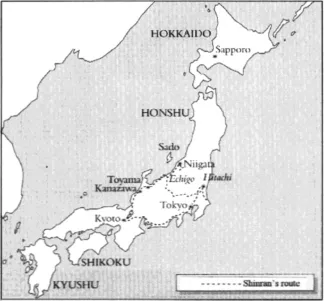
The third period was Shinran’s exile in Echigo (today’s Niigata) and Inada (today’s Kanto area north of Tokyo). It was in this period that he married Eshinni from whom we have important letters. Here his awareness of the human condition deepened and his own interpretation of Buddhism matured. When the ban was lifted after five years in Echigo he chose not to go back to the centre of culture, Kyoto, but left for Inada, another desolate area.
A number of congregations were formed and it was during this period that Shinran became known for his most important work, Kyogyoshinsho (1224), which consists of commentaries to and excerpts from a selection of sutras in the Pure Land tradition. Modern scholarship, however, suggests that he never completed Kyogyoshinsho, but constantly revised the text. It was not until he was more than 60 years of age that he left the Kanto area to end his life in Kyoto.
In the fourth period, back in Kyoto, Shinran devoted his life to his writings and the dialogue with his disciples. Shinran wrote mainly in the native Japanese, and among other writings from this period, volumes of Japanese hymns (Wazan) were very significant from the popular perspective. The wazan summarized his teaching and could be sung by his followers. The latter also turned to him for help in questions about the teachings; more than 50 letters from him to congregations in the Kanto area exist. His wife, Eshinni, lived in Echigo, but there are no signs of any estrangement. But between Shinran and his eldest son, Zenran, a conflict broke out when Zenran claimed direct authority from Shinran in his dealings with congregations in the Kanto region. In the end, Shinran had to disown him. In his last years Shinran was tended by his youngest daughter, Kakushinni, who was present at his death and arranged his burial. The chapel built at his tomb became the first Honganji, ‘The temple of the original vow’.
MAP SHOWING SHINRAN’S ROUTE
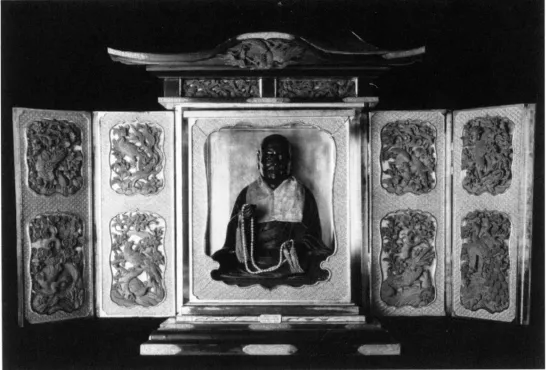
Shinran Shonin altar (Musée Guimet, Paris)
Text 1
Eshinni: Letter to Kakushinni
The letters of Shinran’s wife, Eshinni, were not discovered until 1921, but are now considered the most reliable historical references to Shinran’s life. The ten letters cover details of Eshinni’s life and family matters. They do not contradict other sources, such as his biography called Godensho, by the great-grandson of Shinran, Kakunyo. [See Text 2.]
Of importance in this excerpt of a letter is the documentation that Shinran was a doso, a temple priest of Mount Hiei, and that he had a vision at the Rokkakudo temple in Kyoto which led him to Honen. Moreover, from the fact that Eshinni assures her daughter, Kakushinni, of Shinran’s stature after his death, we may take it that Shinran’s final moments were ordinary, in contrast to other founders of Buddhist religions whose deaths reputedly were accompanied by supernatural events.
——————————
I received your letter dated the 1st day of the 12th month of last year shortly after the 20th of the same month. There is no doubt that your father was reborn in the Pure Land, and there is no need for me to reiterate this.
The circumstances which led Shinran Shonin to confine himself to the Rokkakudo, chime with the words of Prince Shotoku in a dream, and brought him to the doors of Honen Shonin are next recorded.
He left Mt Hiei, remained in retreat for a hundred days at Rokkakudo, and prayed for salvation. Then, on the dawn of the ninety-fifth day, Prince Shotoku appeared in a dream, indicating the path to enlightenment by revealing a verse. He immediately left Rokkakudo in the morning, and he called on Master Honen to be shown the way of salvation. And just as he had confined himself for a hundred days at Rokkakudo, he visited Honen daily for a hundred days, rain or shine, regardless of the obstacles. He heard the Master teach that in order to be saved in the afterlife, regardless of whether one were good or evil, only the recitation of the Nembutsu was necessary. Since he carefully kept this teaching in his heart, he would say the following when people talked about the Nembutsu: ‘Wherever Honen goes, I shall follow him, no matter what others may say — even if they say that I would go to hell, because I have wandered since the beginningless beginning and I have nothing to lose.’

This letter is to certify that your father was a doso at Mt Hiei, that he left the mountain and confined himself to the Rokkakudo for one hundred...
Table of contents
- Cover
- Half Title
- Title Page
- Copyright Page
- Table of Contents
- Preface
- Foreword
- List of Illustrations
- General Introduction
- Chapter One: Shinran — the Founder
- Chapter Two: Shin Buddhism in the Modern Age
- Chapter Three: The Dobokai Movement
- Chapter Four: Shin Buddhism and the Arts and Crafts
- Chapter Five: Rituals in Shin Buddhist Temples — notably Higashi Honganji
- Chapter Six: Death and Burial in Shin Buddhism
- Chapter Seven: Shin Buddhist Education
- Chapter Eight: Shin Buddhist Mission in Hawai‘i
- Postscript: Prof. Alfred Bloom: Appraisal of Shin Buddhism in the Modern World
- Notes on Readings
- Bibliography
- Glossary of Japanese Words
- Index
Trusted by 375,005 students
Access to over 1.5 million titles for a fair monthly price.
Study more efficiently using our study tools.
Frequently asked questions
Yes, you can cancel anytime from the Subscription tab in your account settings on the Perlego website. Your subscription will stay active until the end of your current billing period. Learn how to cancel your subscription
No, books cannot be downloaded as external files, such as PDFs, for use outside of Perlego. However, you can download books within the Perlego app for offline reading on mobile or tablet. Learn how to download books offline
We are an online textbook subscription service, where you can get access to an entire online library for less than the price of a single book per month. With over 1.5 million books across 990+ topics, we’ve got you covered! Learn about our mission
Look out for the read-aloud symbol on your next book to see if you can listen to it. The read-aloud tool reads text aloud for you, highlighting the text as it is being read. You can pause it, speed it up and slow it down. Learn more about Read Aloud
Yes! You can use the Perlego app on both iOS and Android devices to read anytime, anywhere — even offline. Perfect for commutes or when you’re on the go.
Please note we cannot support devices running on iOS 13 and Android 7 or earlier. Learn more about using the app
Please note we cannot support devices running on iOS 13 and Android 7 or earlier. Learn more about using the app
Yes, you can access Popular Buddhism in Japan by Esben Andreasen in PDF and/or ePUB format, as well as other popular books in Theology & Religion & Buddhism. We have over 1.5 million books available in our catalogue for you to explore.