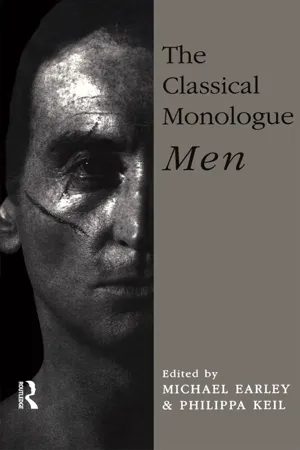
The Classical Monologue in two volumes, one for men and one for women, is a fresh selection of the best speeches from the repertoire of the classical theatre, from the Greeks to the beginning of the 20th century. These great dramatic monologues--from all periods and styles, all varied in tone and genre--make an indispensable actor's companion for auditioning, rehearsing and performing. Each monologue is accompanied by textual notes explaining any unusual vocabulary or syntax, and by commentary in which the editors offer interpretative points and practical advice in preparing the speech for performance. Both beginners and experienced actors will find TheClassical Monologue a treasury of theatrical riches waiting to be released on stage.
eBook - ePub
The Classical Monologue (M)
Men
- 146 pages
- English
- ePUB (mobile friendly)
- Available on iOS & Android
eBook - ePub
About this book
Information
The Spanish Tragedy
(c. 1586) Thomas Kyd
Act 2, scene 5. Spain. Hieronimo’s garden. Night.
Awakened by a scuffle in his garden, Hieronimo (40s–50s), a noble marshal of Spain, runs outside only to discover his son Horatio hanging dead from a tree in the arbour. Hieronimo has been an aloof and innocent bystander to all the political intrigues and machinations that have led to Horatio’s murder. In this monologue he delivers an extended lament for the loss of his son.
HIERONIMO.
What outcries pluck me from my naked bed,
And chill my throbbing heart with trembling fear,
Which never danger yet could daunt before?
Who calls Hieronimo? Speak, here I am.
I did not slumber, therefore ’twas no dream.
No, no, it was some woman cried for help,
And here within this garden did she cry,
And in this garden must I rescue her. –
But stay, what murd’rous spectacle is this?
A man hanged up and all the murderers gone!
And in my bower, to lay the guilt on me!
This place was made for pleasure, not for death.
He cuts the body down.
Those garments that he wears I oft have seen –
Alas, it is Horatio, my sweet son!
O no, but he that whilom1 was my son!
O was it thou that call’dst me from my bed?
O speak, if any spark of life remain!
I am thy father. Who hath slain my son?
What savage monster, not of human kind,
Hath here been glutted with thy harmless blood,
And left thy bloody corpse dishonoured here,
For me, amidst these dark and deathful shades,
To drown thee with an ocean of my tears?
O heavens, why made you night to cover sin?
By day this deed of darkness had not been.
O earth, why didst thou not in time devour
The vild2 profaner of this sacred bower?
O poor Horatio, what hadst thou misdone,
To lose thy life ere life was new begun?
O wicked butcher, whatsoe’er thou wert,
How could thou strangle virtue and desert?
Ay me most wretched, that have lost my joy,
In losing my Horatio, my sweet boy!
[lines 1–34]
COMMENTARY: Kyd’s The Spanish Tragedy was one of the most popular and influential Elizabethan plays. It created a vogue for a ghoulish form of melodrama and its impact can be seen in other famous revenge tragedies, most notably Shakespeare’s Hamlet. It is full of ghosts, deceit and outrageous villainy. The play also employs theatrically effective scenes and characters, calculated to excite an audience. An extremely political plot, involving the rivalry between Spain and Portugal, is thrown aside after Don Horatio, Hieronimo’s son, is murdered by Don Balthazar, a violent Portuguese prince and rival for the hand of Bel-Imperia. The death and discovery of Horatio unleash a chain of incidents that culminates in the punishment of the villains and the separate suicides of Hieronimo and his wife Isabella.
Hieronimo’s speech puts into words his emotional shock and horror at discovering his dead son. The brutal, macabre murder carried out at night in the garden creates a weird and forbidding atmosphere which the character enhances with his speech as he verbalises a process of discovery step by step. He first reacts to the sounds he has heard outside, and then to what appears before his eyes. He even touches on the sense of speech when he tries to get his dead son to speak to him. The scene is alive to all the senses, and the actor can use these by picking up their pattern in the speech and physicalising them. The actor should also notice that Hieronimo expresses his horror in deeply vocalised vowels, particularly the ‘o’ sounds: ‘O poor Hieronimo, what hadst thou misdone’. It is his way of experiencing grief and transforming it into words and laments. Sorrow becomes a deeply felt emotion echoed in the very words themselves. The blank verse lines, in many instances, are exclamations or questions and in playing you should give each line the full value it deserves. The scene is a highly dramatic tableau which presents a challenge for the actor who must perform with the corpse both as his prop, and also as a second character in the scene. It is best played when Hieronimo seems to expect the corpse to speak and answer the questions he asks it in the last third of the speech. By the final sentence he realises that he has lost his son forever.
Notes
1 whilom formerly
2 vild vile
Doctor Faustus
(c. 1589) Christopher Marlowe
Act 5, scene 2. Wittenberg. Faustus’ study.
Faustus (40s), learned doctor of the University of Wittenberg, is the epitome of the Renaissance Man: skilled in all the liberal arts and sciences, ambitious, probing and full of pride and wonder at his own abilities. All this conceit naturally makes him ripe for a tragic fall. Having made a pact with the devil to sell his soul in exchange for twenty-four years of earthly power and delight, Faustus has reached his final hour and awaits his doom. The clock has just struck eleven as his speech begins.
FAUSTUS.
Ah Faustus,
Now hast thou but one bare hour to live,
And then thou must be damn’d perpetually.
Stand still, you ever-moving spheres of heaven,
That time may cease and midnight never come.
Fair nature’s eye,1 rise, rise again, and make
Perpetual day; or let this hour be but
A year, a month, a week, a natural day,
That Faustus may repent and save his soul.
O lente, lente, currite noctis equi!2
The stars move still, time runs, the clock w...
Table of contents
- Cover Page
- Half Title Page
- Dedication
- Title Page
- Copyright Page
- Table of Contents
- Acknowledgements
- Notes to the Actor
- A Word about the Translations
- Classical Greek
- Elizabethan and Jacobean
- French and Spanish
- Restoration and Eighteenth-Century English
- English and Irish (Nineteenth and Twentieth Century)
- German, Scandinavian and Russian
- Play Sources
Trusted by 375,005 students
Access to over 1.5 million titles for a fair monthly price.
Study more efficiently using our study tools.
Frequently asked questions
Yes, you can cancel anytime from the Subscription tab in your account settings on the Perlego website. Your subscription will stay active until the end of your current billing period. Learn how to cancel your subscription
No, books cannot be downloaded as external files, such as PDFs, for use outside of Perlego. However, you can download books within the Perlego app for offline reading on mobile or tablet. Learn how to download books offline
Perlego offers two plans: Essential and Complete
- Essential is ideal for learners and professionals who enjoy exploring a wide range of subjects. Access the Essential Library with 800,000+ trusted titles and best-sellers across business, personal growth, and the humanities. Includes unlimited reading time and Standard Read Aloud voice.
- Complete: Perfect for advanced learners and researchers needing full, unrestricted access. Unlock 1.5M+ books across hundreds of subjects, including academic and specialized titles. The Complete Plan also includes advanced features like Premium Read Aloud and Research Assistant.
We are an online textbook subscription service, where you can get access to an entire online library for less than the price of a single book per month. With over 1.5 million books across 990+ topics, we’ve got you covered! Learn about our mission
Look out for the read-aloud symbol on your next book to see if you can listen to it. The read-aloud tool reads text aloud for you, highlighting the text as it is being read. You can pause it, speed it up and slow it down. Learn more about Read Aloud
Yes! You can use the Perlego app on both iOS and Android devices to read anytime, anywhere — even offline. Perfect for commutes or when you’re on the go.
Please note we cannot support devices running on iOS 13 and Android 7 or earlier. Learn more about using the app
Please note we cannot support devices running on iOS 13 and Android 7 or earlier. Learn more about using the app
Yes, you can access The Classical Monologue (M) by Michael Earley, Philippa Keil, Michael Earley,Philippa Keil in PDF and/or ePUB format, as well as other popular books in Media & Performing Arts & Acting & Auditioning. We have over 1.5 million books available in our catalogue for you to explore.