Financialization has become the go-to term for scholars grappling with the growth of finance. This Handbook offers the first comprehensive survey of the scholarship on financialization, connecting finance with changes in politics, technology, culture, society and the economy.
It takes stock of the diverse avenues of research that comprise financialization studies and the contributions they have made to understanding the changes in contemporary societies driven by the rise of finance. The chapters chart the field's evolution from research describing and critiquing the manifestations of financialization towards scholarship that pinpoints the driving forces, mechanisms and boundaries of financialization.
Written for researchers and students not only in economics but from across the social sciences and the humanities, this book offers a decidedly global and pluri-disciplinary view on financialization for those who are looking to understand the changing face of finance and its consequences.
Philip Mader, Daniel Mertens and Natascha van der Zwan
Introduction1
In countries across Asia, variations on a parable are told. A group of blind men encounter an elephant and, having never “seen” one before, one boldly reaches out, feels the elephant’s leg, and tells the others that it is very much like a tree. A second touches its side, and reports that the elephant is, in fact, quite like a wall; a third touches the trunk and finds it is a big snake; another touches the tail (a rope); another its tusk (a spear); and so on. Depending on the variant, the parable ends either with the blind men disagreeing about the nature of the beast, perhaps even coming to blows over it, or with them wisely conferring on what they have learned, understanding that each was only partially correct, and recognizing that only together could they fully comprehend the beast.
At times, in the financialization literature, one might have been reminded of this parable; certainly not in the sense of scholars being blind or ignorant of others’ perspectives, but in the sense of very different approaches having led them to divergent claims about the nature of financialization. This has involved tendencies to regard financialization as primarily, or essentially, one particular thing: as the increasing power of financial interests over politics, as the growing dominance of financial logics or “shareholder value,” as changes in the spatial organization of the global economy, as the reconfiguration of society and the class system, or as the mutation of culture and how we relate to ourselves. Yet these are not mutually exclusive, and only together give the whole picture.
Arguably, the existence of many different approaches within financialization scholarship has also been central to the term’s wide reception and uptake in recent years, particularly since the 2007–2008 Great Financial Crisis. Financialization has become the go-to term among a growing field of scholarship that studies the vastly expanded role played by finance in contemporary politics, economy and society. The concept of financialization itself has also expanded, evolving from a rather niche term used by critical scholars into one that increasingly informs research across and beyond the social sciences and humanities. We aim for this book to advance financialization studies, whose constitution as a field this volume documents, by bringing into conversation a wide range of perspectives from across disciplines and schools, in order to better understand the nature of the beast – and, to an extent, to make sure we are still talking about the same beast. As the contributions to this Handbook make clear, to work in a transdisciplinary way first requires an understanding of the specific contributions that particular (other) disciplines can make.
For this book, we have sought to reflect the breadth and depth of the financialization field, not just by including contributions from a wide range of disciplines (see especially Parts A and B) – except, alas, mainstream economics, which remains as ignorant of financialization as it remains at a loss for convincing explanations of financial crises2 – but also by distinguishing different sets of perspectives on financialization. These include more structural and spatial ones (Part C), more agency-oriented and political ones (Part D), and more technological and cultural ones (Part E). With this, the Handbook invites readers to look over and across established horizons. And, in a world in which finance is often, by the public as well as some scholars, still largely equated with Anglo-America and with the financial system narrowly defined, we endeavor for the Handbook to reflect the highly spatially and segmentally variegated financializations that different institutions, people and societies are entangled with. Participants in financialization include not just bankers, investors and wealth managers in “high finance” and on Wall Street, but also microcredit borrowers and welfare recipients in the global South, mid-sized cities’ municipal authorities, state-owned enterprises, multinational corporations and philanthropic organizations, which are all connected through a branching web of financial claims.
While aiming to broaden horizons, we also hope for this volume to help more clearly situate and delineate financialization and define its boundaries. This means to check a potentially harmful tendency toward the term being applied loosely, with “financialization” increasingly – to exaggerate only somewhat – being seen anywhere and everywhere there has lately been social, economic, political or cultural change. Simply to diagnose ever-more “financializations of” particular things and “financializations in” particular places risks devaluing the core conceptual currency of financialization studies. This is why we must take up the challenge brought by Brett Christophers (2015), to articulate more clearly “the limits to financialization.” We would argue that to maintain its value, financialization studies must more clearly than ever distinguish – connect yet contrast clearly – its objects of interest from the other “elephants in the room,” which include but are not limited to: commodification, marketization, globalization, neoliberalization, privatization, digitalization and precarization. In other words, financialization scholars must recognize and highlight financialization as but one “tendency among tendencies” in the transformation of capitalist societies,3 which has both causes and effects in other contemporaneous processes (see e.g. Davis and Walsh 2017).
Our aim for this introduction is to offer a broad map on which financialization studies can be plotted across the academic disciplines that have contributed to it, showing its emergence and growth (Section 1), and then providing an overview of the commonly proposed definitions of financialization and clarifying our own position on them (Section 2). Our chapter ends with an outline of the various contributions to this volume (Section 3), followed by a brief outlook for the field (Section 4).
Financialization: a brief history of the field
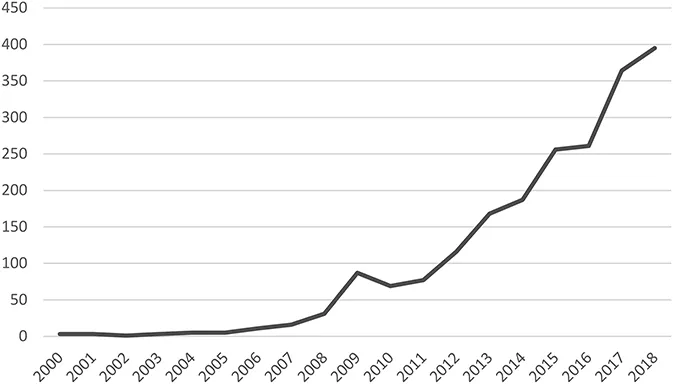
The enormous popularity of the concept of financialization has led to an outpouring of publications over the past decade. Since 2010, the number of annually published journal articles on financialization has more than quadrupled, to almost 400 (Web of Science 2019; see also Figure 1.1). Book publications, while smaller in number, have followed a similar trend: while only a handful of books existed in the early years of the 21st century, now more than a dozen books on financialization are published each year (WorldCat 2019).4 Financialization has also entered public discourse through the works of people like academic-turned-politician Yanis Varoufakis (2011) and journalists Rana Faroohar (2016) and Nicholas Shaxson (2018). They have taken the social-scientific concept and placed it center stage in their own popular narratives of “finance capitalism.” Should these trends continue, financialization – that “wonky but apt moniker picked up by academics” (Faroohar 2016: 6) – could very well enter mainstream vocabularies.
Figure 1.1 Journal articles with topic financialization by year
Source: Figure 1.1 reports the number of articles published in the years 2000–2018 that have either “financialization” or “financialisation” listed as keyword. The data presented here were collected from the Social Science Citation Index (Web of Science 2019). A search on article topics with either “financialization” or “financialisation” generated 2.112 article titles, which were subsequently grouped by year.
The speed and scale at which financialization scholarship has grown over the past decade invites us to take stock of its development. According to John Bellamy Foster, the origins of the term, which first appeared in the early 1990s, are “obscure” (Foster 2007: 1).5 Many diagnoses of financialization in this period drew parallels to an earlier period of economic and political domination by “finance capital” and rentier classes around the turn of the 20th century, written about by Lenin, Rudolf Hilferding, Michał Kalecki and John Maynard Keynes. They also sought to highlight the differences and explain why the end of the post-war “Golden Age” of capitalism had given rise to financial expansion. The earliest figurations of the research enterprise, such as in the works of Harry Magdoff and Paul Sweezy (1987), explained the increasingly central role of finance and particularly debt as a response to the stagnation that ended the post-World War II American boom, and argued that America was becoming a “casino society.” However, contrary to what many of their contemporary Keynesians thought, Magdoff and Sweezy’s Marxian perspective suggested that the growth of financial markets was not undermining or replacing the production of goods and (non-financial) services, and rather increasingly becoming a prerequisite for it.
Exemplary for the subsequent manifestations of financialization scholarship is the collection Financialization at Work by Ismail Erturk and co-editors (2008), whose selection of contributions reveals the grounding of the concept in the history of economic thought. Erturk et al. took cues from John Maynard Keynes, early 20th century economic historian and philosopher R.H. Tawney, and corporate governance theorists (and F.D. Roosevelt advisors) Adolph Berle and Gardiner Means, as well as their agency-theoretical critics Michael Jensen and Eugene Fama, whose works fueled the neoliberal counterrevolution in economics. The contributions of financialization scholars leading into the mid-2000s reflected the different perspectives on financialization that characterized the scholarship from its very beginning: the critical accounting approach of the Manchester School, represented for instance by Julie Froud and collaborators (2000); the Regulationist approach exemplified by Robert Boyer’s (2000) work; the heterodox economics of Engelbert Stockhammer (2004) and Gerald Epstein (2005); the corporate governance perspectives of William Lazonick and Mary O’Sullivan (2000); and the cultural economy approaches of Randy Martin (2002) and Paul Langley (2004), to give some examples.6 Some of the most influential conceptualizations of the term originated in this early scholarship, including the widely-employed definitions offered by Epstein (2005), Krippner (2005) and Stockhammer (2004; see also the next section of this chapter).
The scholarship on financialization entered a new phase in the years following the Great Financial Crisis, as the events of 2007–2008 served as a wake-up call, or reminder of the destructive scale and power of financial systems, prompting a much wider scholarly reckoning with finance and an increased usage of the term financialization. Moving away from public corporations and “financial markets” in the abstract, scholars scrutinized a host of financial actors – including but not limited to institutional investors and investment vehicles – and a host of different markets – bond markets, commodity markets, housing markets, welfare markets, and so on (see e.g. Aalbers 2008; Dixon and Sorsa 2009; Finlayson 2009; Montgomerie 2009; Fichtner 2013; Gospel et al. 2014). Finally, scholars also became more attuned to the variegated nature of the financialization process, focusing on places beyond Anglo-America (e.g. Engelen and Konings 2010; French et al. 2011). This led to the now-commonplace understanding that financialization cannot be reduced simpliciter to a global isomorphism towards Anglo-American finance capitalism but needs to be understood in relation to national/local contexts on the one hand and the global capitalist system on the other, even as the latter undeniably bears the historical legacy of US hegemony (Konings 2011). Illustrative in this regard are the works by Daniela Gabor (2010) on Eastern Europe, Lena Rethel (2010), Iain Hardie (2012) and Bruno Bonizzi (2013) on emerging economies, and the wide geographical reach of the FESSUD project (see FESSUD Studies in Financial Systems 2013).
This trend of broadening the scope of financialization studies has continued into the contemporary period, in which scholars have had to deal with the resilience of finance and financialization post-crisis; what one might call the “strange non-death” of financialization (cf. Crouch 2011). In recent years, we have gained a more thorough understanding of the driving forces of continued financialization, not least thanks to a growing scholarship on the role of the state and other “non-financial” actors (e.g. Nölke et al. 2013; Van der Zwan 2017). The scholarship has highlighted the inflections of finance with areas such as the food system (Clapp and Isakson 2018), the environment (Bayliss 2014; Ouma, Johnson and Bigger 2018), national treasuries (Lagna 2016; Fastenrath, Schwan and Trampusch 2017) and international development (Mader 2015; Mawdsley 2018; Storm 2018): often not merely as an intrusion, but also as a tool wielded by some players within these arenas. Noteworthy are also the ways in which scholars are exploring the boundaries of the concept by tackling theoretically and empirically complex manifestations, such as offshore finance, shadow banking and other frontlines of financial engineering (Ban and Gabor 2016; Botzem and Dobusch 2017).
The growth of the financialization scholarship coincided with its diffusion across academic disciplines. While (heterodox) economics and geography together account for the largest share of published articles on financialization, other fields – such as anthropology, accounting studies, development studies, political science and sociology – also have a clear presence in the scholarship (see Figure 1.2). The broad appeal of th...
Table of contents
Cover
Half Title
Title Page
Copyright Page
Table of Contents
List of illustrations
List of contributors
1. Financialization: An Introduction
PART A: Finance and Financialization: Taking Stock
PART B: Approaches to Studying Financialization
PART C: Structures, Spaces and Sites of Financialization
PART D: Actors, Agency and Politics of Financialization
PART E: Techniques, Technologies and Cultures of Financialization
PART F: Instabilities, Insecurities and the Discontents of Financialization
Index
Trusted by 375,005 students
Access to over 1.5 million titles for a fair monthly price.
Study more efficiently using our study tools.
Frequently asked questions
Yes, you can cancel anytime from the Subscription tab in your account settings on the Perlego website. Your subscription will stay active until the end of your current billing period. Learn how to cancel your subscription
No, books cannot be downloaded as external files, such as PDFs, for use outside of Perlego. However, you can download books within the Perlego app for offline reading on mobile or tablet. Learn how to download books offline
Perlego offers two plans: Essential and Complete
Essential is ideal for learners and professionals who enjoy exploring a wide range of subjects. Access the Essential Library with 800,000+ trusted titles and best-sellers across business, personal growth, and the humanities. Includes unlimited reading time and Standard Read Aloud voice.
Complete: Perfect for advanced learners and researchers needing full, unrestricted access. Unlock 1.5M+ books across hundreds of subjects, including academic and specialized titles. The Complete Plan also includes advanced features like Premium Read Aloud and Research Assistant.
Both plans are available with monthly, semester, or annual billing cycles.
We are an online textbook subscription service, where you can get access to an entire online library for less than the price of a single book per month. With over 1.5 million books across 990+ topics, we’ve got you covered! Learn about our mission
Look out for the read-aloud symbol on your next book to see if you can listen to it. The read-aloud tool reads text aloud for you, highlighting the text as it is being read. You can pause it, speed it up and slow it down. Learn more about Read Aloud
Yes! You can use the Perlego app on both iOS and Android devices to read anytime, anywhere — even offline. Perfect for commutes or when you’re on the go. Please note we cannot support devices running on iOS 13 and Android 7 or earlier. Learn more about using the app
Yes, you can access The Routledge International Handbook of Financialization by Philip Mader, Daniel Mertens, Natascha van der Zwan, Philip Mader,Daniel Mertens,Natascha van der Zwan in PDF and/or ePUB format, as well as other popular books in Economics & Finance. We have over 1.5 million books available in our catalogue for you to explore.