- 138 pages
- English
- ePUB (mobile friendly)
- Available on iOS & Android
eBook - ePub
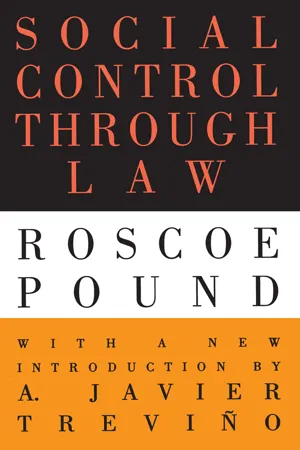
Social Control Through Law
About this book
Social Control Through Law is remarkable in manner and style. Roscoe Pound shows himself to be a jurist, philosopher, and scientist. For Pound, the subject matter of law involves examining manifestations of human nature which require social control to assert or realize individual expectations. Pound formulates a list of social-ethical principles, with a three-fold purpose. First, they are meant to identify and explain human claims, demands, or interests of a given social order. Second, they express what the majority of individuals in a given society want the law to do. Third, they are meant to guide the courts in applying the law. Pound distinguishes between individual interests, public interests, and social interests. He warns that these three types of interests are overlapping and interdependent and that most claims, demands, and desires can be placed in all three categories. Pound's theory of social interests is crucial to his thinking about law and lies at the conceptual core of sociological jurisprudence. Pound explains that rights unlike interests, are plagued with a multiplicity of meanings. He rejects the idea of rights as being natural or inalienable, and argues that to the contrary, interests are natural. The contemporary significance of the book is aptly demonstrated by the skyrocketing rate of litigation in our postmodern society. As the influence of familial and religious institutions declines, the courts exert an unprecedented degree of control over the public and private lives of most Americans. Law is now the paramount agency of social control. In the new introduction, A. Javier TreviNo outlines the principal aspects of Roscoe Pound's legal philosophy as it is conveyed in several of his books, articles, and addresses, and shows their relationship to Social Control Through Law. This book is an insightful, concise summary of Pound's ideas that, after more than half a century, remains surprisingly fresh and relevant. It will doubtlessly continue to engage jurists, legal theorists, and sociologists for many years to come.
Key takeaways
AI-Generated Insights
Insight 1
Explain how law functions as a primary mechanism of social control within civilization, considering its evolving role relative to other societal institutions.
Insight 2
Analyze the nature and task of law by distinguishing between individual, public, and social interests, and articulate how these interests are meant to guide legal application.
Insight 3
Evaluate the problem of values in legal philosophy and trace the conceptual core of sociological jurisprudence as developed by Roscoe Pound.
Index
Absolutism, rise of political, 96–97
Administration, effect of theories upon, 27
Alienation of affections, action for, 56–58, 71
America, colonial, 34
Aristotle, 119
Austin, John, 52
Bacon, Francis, 35–38, 120
Bentham, Jeremy, 55
Bramwell, Lord, 117
Cardozo, Mr. Justice, 40
Carneades, 39
Church, law of the, 22–23
Civilization, as ideal, 131–133; basis in reason, 33; defined, 132; theory of, 16–19; the two sides of, 132–133
City-state, Greek, 18
Civil law, technique of, 42
Class struggle, 12
Coke, Sir Edward, 120
Collective bargaining, 115–116
Common law, technique of, 41–42; ultra-individualism of, 60–61
Comte, Auguste, 6, 8 Conceptions, legal, 47
Conduct, need of ordering, 64–66
Constitutional limitations, skeptical view of, 39, 96
Contract, will theory of, 123–124
Coöperation, American indifference to, 127–130; as a measure of values, 126–127; as an ideal, 126–132; emphasis upon today, 131
Corporative state, 12
Dicey, Albert Venn, 110–111
Duguit, Léon, 8, 10, 12, 97–98
Durkheim, Émile, 8, 12
Duties, intangibleness of moral, 55–56
Economics, juristic emphasis on, 123
Education, as an agency of social control, 25
Ehrlich, Eugen, 10–12
Einstein, Albert, 109
Epicureanism, 36–33
Epicurus, 38
Experience, role of in law, 111–112
Facts, difficulties of ascertaining, 54–55
Force, monopoly of by state, 24–25; opposition of natural law to, 33; regime of as law, 15–16; reliance of legal order on, 32–33, 107
Function, juristic emphasis on, 123
Gény, François, 8–9
Gierke, Otto von, 11
Greek philosophy, contact of lawyers with, 104; in Hellenistic era, 35–38; theory of the just, 83–84
Grotius, Hugo, 87; theory of a right, 85
Hammurabl, code of, 45
Hauriou, Maurioe, 9–10, 11–12
Hegel, G. W. F., 16, 31
Hobbes, Thomas, 85–87
Hocking, W. E., 115
Holmes, Mr. Justice, 85–87, 94, 106–107
Husband and wife, law and the relation of, 57–58, 71–72, 74
Ideal, the nineteenth-century American, 14–16; of social order as measure of values, 118–122
Ideals, effect on application of standards, 44; effect on choice of starting points, 42–43; received from the past, 121–122
I...
Table of contents
- Cover
- Half Title
- Title
- Copyright
- Contents
- TRANSACTION INTRODUCTION
- I. CIVILIZATION AND SOCIAL CONTROL
- II. WHAT IS LAW?
- III. THE TASK OF LAW
- IV. THE PROBLEM OF VALUES
- INDEX
Trusted by 375,005 students
Access to over 1.5 million titles for a fair monthly price.
Study more efficiently using our study tools.
Frequently asked questions
Yes, you can cancel anytime from the Subscription tab in your account settings on the Perlego website. Your subscription will stay active until the end of your current billing period. Learn how to cancel your subscription
No, books cannot be downloaded as external files, such as PDFs, for use outside of Perlego. However, you can download books within the Perlego app for offline reading on mobile or tablet. Learn how to download books offline
Perlego offers two plans: Essential and Complete
- Essential is ideal for learners and professionals who enjoy exploring a wide range of subjects. Access the Essential Library with 800,000+ trusted titles and best-sellers across business, personal growth, and the humanities. Includes unlimited reading time and Standard Read Aloud voice.
- Complete: Perfect for advanced learners and researchers needing full, unrestricted access. Unlock 1.5M+ books across hundreds of subjects, including academic and specialized titles. The Complete Plan also includes advanced features like Premium Read Aloud and Research Assistant.
We are an online textbook subscription service, where you can get access to an entire online library for less than the price of a single book per month. With over 1.5 million books across 990+ topics, we’ve got you covered! Learn about our mission
Look out for the read-aloud symbol on your next book to see if you can listen to it. The read-aloud tool reads text aloud for you, highlighting the text as it is being read. You can pause it, speed it up and slow it down. Learn more about Read Aloud
Yes! You can use the Perlego app on both iOS and Android devices to read anytime, anywhere — even offline. Perfect for commutes or when you’re on the go.
Please note we cannot support devices running on iOS 13 and Android 7 or earlier. Learn more about using the app
Please note we cannot support devices running on iOS 13 and Android 7 or earlier. Learn more about using the app
Yes, you can access Social Control Through Law by Roscoe Pound in PDF and/or ePUB format, as well as other popular books in Law & Jurisprudence. We have over 1.5 million books available in our catalogue for you to explore.