eBook - ePub
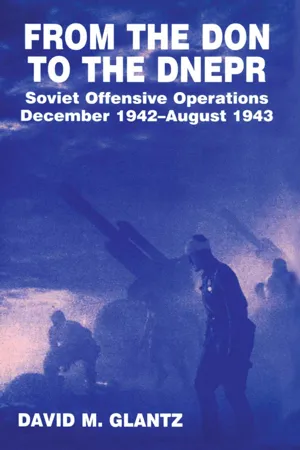
From the Don to the Dnepr
Soviet Offensive Operations, December 1942 - August 1943
- 446 pages
- English
- ePUB (mobile friendly)
- Available on iOS & Android
eBook - ePub
About this book
This book provides an in-depth study of the Soviet Army during the offensive operations that started with Battle of Stalingrad in December 1942 and went until Spring 1943. The lessons learned by the Soviet Army from these experiences helped design the military steamroller that decimated the German panzer divisions at Kursk in the Summer of 1943.
1

INTRODUCTION
The Red Army 1941–1942.
Tragedy and Rebirth of an Army
Tragedy and Rebirth of an Army
On the morning of 22 June 1941 Nazi Germany unleashed a sudden and massive offensive to destroy the Soviet state. The ambitious German undertaking, based on the premise that the bulk of the Soviet Army could be annihilated in the immediate border regions by use of blitzkrieg conducted on a large scale, caught the Soviets only partially prepared for war. Force reconstruction and reequipment programs were underway but incomplete. Although the Soviets had ample warning, for as yet inexplicable reasons, Stalin forbade the Soviet military to take prudent defensive precautions, thus granting the Germans the equivalent of strategic, operational, and tactical surprise. The German hammer blows staggered the Soviet armed forces and almost resulted in their destruction. By Soviet admission:
our pre-war views on the conduct of armed struggle in the initial period of war did not investigate the possibility of the concealed timely deployment and simultaneous action of enemy armed forces on the land, in the air and at sea. Mistakes in theory had a negative effect on resolving the practical questions of covering the state borders and deploying the armed forces which, along with other reasons, caused serious misfortunes in the war.There were many problems in working out command and control and organizing communications with operational large units. The assertion that the defense found fullest expression only in the realm of army operations was incorrect, as was the view that the struggle for air superiority must be realized on the scale of front and army operations. The complicated views at the beginning of the war concerning the organization of the army and forces of the rear did not fully meet the demands of the theory of deep offensive operations and battle. Operational and forces rear services remained cumbersome and immobile.There were also serious deficiencies in the theoretical training of commanders and in the combat training of forces ….1
These Soviet admissions, as frank as they were, understated the scale of the problem. In the initial months of the war, Soviet commanders at higher levels displayed an ineptness only partially compensated for by the fervor of junior officers and the stoicism of the hard pressed troops. Front and army commanders, unable to construct coherent defenses against the Germans' armored thrusts, displayed an alarming propensity for launching costly uncoordinated counterattacks predestined to failure. Only looming disaster drove the Soviet high command to action in a war which quickly became one of survival.
Ultimately, the Soviet Army successfully met this great challenge and triumphed, but only after years of death, frustration, and an agonizing process of military reeducation conducted during wartime. Throughout the war new generations of commanders emerged, new equipment was developed and fielded, and military theories matured after their late 1930s hiatus. In essence, the concept of deep operations, articulated in the 1936 Field Service Regulation but unrealized in the late 1930s, became the focal point of Soviet offensive theory and the means of converting tactical success into operational and even strategic success. By late 1943, the Soviets had wed their military theory and their force structure into a successful formula for achieving victory. During the ensuing two years of war the Soviets experimented with operational techniques, refined their force structure, and worked to overcome resource and logistical constraints. This second great renaissance in Soviet military thought and practice, often ignored in the West because of the Soviet disasters of 1941 and 1942 as related in the works of victorious German generals, is today viewed by the Soviets as the most important period in Soviet military affairs, a vast laboratory for military analysis and a repository of experience that can be and is tapped for inspiration and concrete advice.
For the sake of analysis, the Soviets subdivide their “Great Patriotic War” into three distinct periods, each characterized by broad unifying themes concerning Soviet fortunes in war and the state of military art. The first period of war (June 1941–November 1942) found the Soviets on the strategic defense punctuated by several Soviet attempts to undertake offensive operations on several important directions. The second period (December 1942–December 1943) was one of transition from defensive operations to a general Soviet offensive designed to wrest the strategic initiative from the Germans. The third period (1944–1945) was a period of general Soviet offensives culminating in the achievement of total victory.
The first and most difficult period commenced in June 1941 with the German invasion and the series of border battles during which the Germans swallowed up large segments of deployed Soviet forces. The large scale encirclements at Minsk, Bryansk, Vyaz'ma and Smolensk culminated in the fall of 1941, when German forces tried to cap their victorious advance with the seizure of Moscow by one last envelopment. German failure to take Moscow prompted the first major Soviet attempt to regain the strategic initiative. A desperate Soviet winter offensive in the Moscow environs, broadened into an attempt to expand the offensive across the front from Leningrad to Rostov and the Crimea, foundered because of insufficient Soviet forces and materiel, and left the Soviets vulnerable to renewed German strategic thrusts in the summer of 1942. The ill-fated and costly Soviet offensive failure at Khar'kov in May 1942 was followed by the general German offensive in south Russia which, by late fall, reached the Volga at Stalingrad and the passes of the Caucasus Mountains. Like the 1941 German offensive campaign, by late fall the Germans were overextended while the Soviets again husbanded their resources for a counterattack. Unlike 1941, by 1942 the Soviets had undertaken organizational and theoretical measures to better parry the German offensive as it ran out of steam on the banks of the Volga River. The November Soviet offensive around Stalingrad saw the strategic initiative pass into Soviet hands and marked the end of the first period of war.
The German attack in 1941 smashed the large and complex Soviet force structure and clearly demonstrated that the Soviet officer corps was incapable of efficiently commanding and controlling so elaborate a force. Likewise, Soviet industry had been unable to supply the necessary weaponry to so extensive a force. Thus, by late summer 1941 the Soviets had dismantled that portion of their force structure the Germans had not already destroyed. The Soviets severely truncated the size of all units in order to improve span of control and concentrated scarce artillery and armor assets under High Command control. The Soviets abolished rifle corps and created smaller armies comprised of rifle divisions and rifle brigades. Rifle divisions were reduced in strength; and smaller, more easily controlled rifle brigades were formed to supplement rifle divisions. The Soviets abolished their mechanized corps and the corps' component mechanized and tank divisions and consolidated armor assets in a handful of small tank brigades earmarked to support the smaller armies. Field, antitank, and antiaircraft artillery were withdrawn from rifle divisions, corps, and armies and formed into battalions, regiments, and brigades under High Command control to reinforce armies operating along specific directions. The Soviets created numerous light cavalry divisions, united into cavalry corps in order to compensate for shortages in armor and provide some mobile offensive capability for the basically footbound Soviet army.2
These measures, along with improvements in strategic and operational command and control, provided the basis for Soviet offensive successes in the winter of 1941–42. But it was clear that further improvements were necessary if the Soviets hoped to expand their limited offensive capabilities. In particular, larger and more effective mechanized formations were essential for developing tactical success into operational success. Thus in the spring of 1942, while larger artillery units were evolving, and Soviet riflemen were being reequipped with an array of automatic weapons, the Soviets created new tank corps designated to exploit success in army operations. Later, in the summer, tank armies of mixed composition (rifle, cavalry and infantry forces) were formed to conduct larger scale exploitation and in early fall, mechanized corps were formed which combined heavy armor and large numbers of mechanized infantry (often scarce in tank corps). Although the new composite tank armies proved unwieldy and difficult to coordinate, the tank and mechanized corps provided the offensive punch necessary for the Soviets to unleash the successful Stalingrad counteroffensive in November 1942. These structural changes combined with increased Soviet production of the weapons of war and revitalized Soviet military theory to produce the turnabout in Soviet battlefield fortunes in the late fall of 1942.
Soviet emphasis on implementing practical measures necessary to achieve victory eclipsed Soviet theoretical military doctrine during the first period of war, and during the war in general. Under Stalin's leadership, the General Staff made tremendous efforts to investigate strategic, operational, and tactical methods for preparing and conducting operations. The Soviets gathered, studied and analyzed battlefield experiences and converted them into directives, instructions and coherent regulations governing the conduct of war.3 This practical work paralleled similar measures undertaken to mobilize the will and resources of the nation for war. While ideology remained a strong ingredient, and party control remained preeminent, the Soviets tapped memories of past “Russian” military glories to inspire the nation. A pantheon of Russian heroes – Peter the Great, Suvorov, Kutuzov – and others reemerged, and their memories were commemorated in new military decorations for Soviet war heroes. New ranks and tides adorned the Soviet officers corps and reinforced the older Soviet class discipline even while echoes of “holy” mother Russia could be heard. If the nature of Soviet military doctrine remained constant during wartime the tone of that doctrine perceptibly changed; driven by the necessity of survival and attaining victory in war.
The foremost strategic problem for the Soviet High Command during the first period of the war was that of conducting a successful strategic defense. Specifically, the Soviets had to halt the German general offensive, deprive the Germans of their initial advantages resulting from surprise and superiority in operational and tactical skills, establish defenses along a huge front, including around Moscow and Leningrad, and prepare to conduct critical counteroffensives. All this had to be done over tremendous distances in spite of huge losses in manpower, equipment, territory and in the nation's productive base.
The Red Army conducted strategic defensive operations simultaneously along several strategic directions, using several fronts cooperating according to STAVKA plans. This practice clashed with prewar views which supposed that single fronts would conduct strategic defensive operations, and produced new concepts governing operations by groups of fronts. These operations were aimed at inflicting maximum casualties on the Germans, weakening and bleeding their main offensive groups while stopping their offensive, denying them possession of the most important economic and political regions, and creating conditions suitable for the launching of counteroffensives. Such defensive operations raged along frontages of from 200 to 800 kilometers to depths of from 100 to 600 kilometers, over periods ranging from 20 to 100 days.
Strategic reserves played a significant role in the strategic defense by establishing new defense lines, liquidating enemy penetrations, and providing forces necessary to launch counteroffensives. During this period of the war the STAVKA retained between two and ten reserve armies under its direct control, and these reserves were instrumental in launching the winter counteroffensive around Moscow in 1941–42 and the abortive Khar'kov offensive in May 1942. Strategic offensives, usually begun in the form of counteroffensive, occurred on frontages of up to 550 kilometers and penetrated to depths of up to 250 kilometers.4 All were overly ambitious, and because of force and logistical inadequacies fell far short of expectations. The Soviet High Command still had to learn the art of the possible.
Strict centralization of command and control at the highest level made successful strategic defense possible. Early attempts to create three theaters of military operations covering the three main strategic directions (northwest, west, and southwest) failed during the disastrous operations in the summer of 1941. Consequendy, to provide “uninterrupted and qualified command and control” Stalin created the STAVKA of the Supreme High Command (STAVKA VGK). Organized first on 23 June 1941, by 8 August the composition was fixed with Stalin himself as Supreme High Commander.5 The STAVKA, either directly or through its representatives, familiarized commanders of directions* and fronts with the aims of each operation, provided forces and weaponry, designated missions, and organized cooperation between fronts and other large units. It also provided a link between political and military leaders and as such provided clear political control over the conduct of the war.
In the operational arena the Soviets amassed considerable experience in conducting front and army defensive operations. Fronts covered operational directions in accordance with STAVKA plans while armies defended according to front plans. In violation of pre-war concepts shortages of men and materiel forced the deployment of the bulk of forces in a single operational echelon with only small reserves. These shallow, poorly prepared defenses were easily pierced by concentrated German armor supported by aviation. As Soviet mobilization progressed, and weapons production improved, weapons densities increased and defenses deepened. By the fall of 1942 combined arms armies created army artillery groups, air defense groups, and artillery and antitank reserves. The army's defensive depth increased to as much as 20 kilometers, the average operational density to 10 kilometers of frontage per rifle division, and the average weapons density to 15–25 guns per 1 kilometer of frontage. By late 1942 army and front defensive depths averaged 15 and 30 kilometers, respectively, with the first defensive belt best developed, consisting of battalion defensive regions. However, the fragmented nature of the defense isolated subunits and hindered maneuver of forces along the front and in its depths. The Soviets emphasized improvements in antitank defenses which had been ineffective early in the war due to the paucity of weapons and the tendency of commanders to scatter them evenly across the front. Heavy caliber artillery and aviation were ineffective against tanks for the same reason. Although antitank artillery remained in scarce supply (less than 4 guns per kilometer), by mid-1942 the Soviets began creating antitank regions (strong points) echeloned in depth along likely tank axes of advance. The detachment of antitank reserves from front and army commands to lower command echelons also increased the density and mobility of antitank defenses. After the summer of 1941, artillery customarily engaged enemy armor units to supplement antitank defenses (often in a direct fire role).6
Offensive experiences in 1941–42 provided the Soviets with the basis for improving their operational techniques in 1943. In the largest offensive, the winter campaign of 1941–42, fronts ad...
Table of contents
- Cover
- Half Title
- Title Page
- Copyright Page
- Dedication
- Table of Contents
- List of Illustrations
- List of Maps
- Abbreviations
- Preface
- 1. Introduction. The Red Army 1941–1942. Tragedy and Rebirth of an Army
- 2. Operation “Little Saturn”: The Soviet Offensive on the Middle Don — December 1942
- 3. Operation “Gallop”: The Donbas Operation – 29 January – 6 March 1943
- 4. Operation “Star”: The Khar'kov Operation — 2 February — 23 March 1943
- 5. Operation “Polkovodets Rumyantsev”: The Belgorod-Khar'kov Operation — August 1943
- 6. Conclusions
- Appendix 1. Order of Battle: Middle Don Operation December 1942
- Appendices 2 and 3. Order of Battle: Khar'kov-Donbas Operation and Manstein's Counterattack (January – March 1943)
- Appendix 4. Order of Battle: Belgorod-Khar'kov Operation (August 1943)
- Notes
- Index
Trusted by 375,005 students
Access to over 1.5 million titles for a fair monthly price.
Study more efficiently using our study tools.
Frequently asked questions
Yes, you can cancel anytime from the Subscription tab in your account settings on the Perlego website. Your subscription will stay active until the end of your current billing period. Learn how to cancel your subscription
No, books cannot be downloaded as external files, such as PDFs, for use outside of Perlego. However, you can download books within the Perlego app for offline reading on mobile or tablet. Learn how to download books offline
Perlego offers two plans: Essential and Complete
- Essential is ideal for learners and professionals who enjoy exploring a wide range of subjects. Access the Essential Library with 800,000+ trusted titles and best-sellers across business, personal growth, and the humanities. Includes unlimited reading time and Standard Read Aloud voice.
- Complete: Perfect for advanced learners and researchers needing full, unrestricted access. Unlock 1.5M+ books across hundreds of subjects, including academic and specialized titles. The Complete Plan also includes advanced features like Premium Read Aloud and Research Assistant.
We are an online textbook subscription service, where you can get access to an entire online library for less than the price of a single book per month. With over 1.5 million books across 990+ topics, we’ve got you covered! Learn about our mission
Look out for the read-aloud symbol on your next book to see if you can listen to it. The read-aloud tool reads text aloud for you, highlighting the text as it is being read. You can pause it, speed it up and slow it down. Learn more about Read Aloud
Yes! You can use the Perlego app on both iOS and Android devices to read anytime, anywhere — even offline. Perfect for commutes or when you’re on the go.
Please note we cannot support devices running on iOS 13 and Android 7 or earlier. Learn more about using the app
Please note we cannot support devices running on iOS 13 and Android 7 or earlier. Learn more about using the app
Yes, you can access From the Don to the Dnepr by David M. Glantz in PDF and/or ePUB format, as well as other popular books in History & Military & Maritime History. We have over 1.5 million books available in our catalogue for you to explore.