- 270 pages
- English
- ePUB (mobile friendly)
- Available on iOS & Android
eBook - ePub
About this book
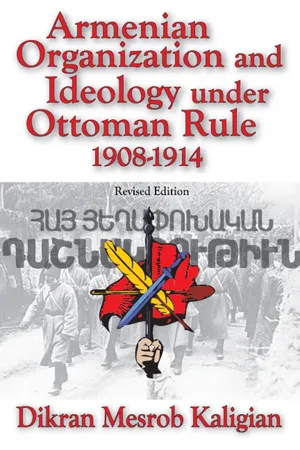
This book provides a comprehensive picture of Armeno-Turkish relations for the brief period of Ottoman Constitutional rule between 1908 and 1914. Kaligian integrates internal documents of the Armenian Revolutionary Federation, and existing research on the last years of the empire, as well as the archives of the British, American, and German diplomatic corps. By reducing the overemphasis on central government policies and by describing unofficial contacts, political relations, and provincial administration and conditions, Kaligian provides a unified account of this key period in Ottoman history. Kaligian sets out to resolve many of the conflicting conclusions in the current historiography-including the most central issue, the Armenian Revolutionary Federation relations with the Turkish Committee of Union and Progress. It is impossible to obtain a true picture of Armeno-Turkish relations without an accurate analysis of their two leading parties. This study finds that the ARF was torn between maintaining relations with a CUP that had failed to implement promised reforms and was doing little to prevent increasing attacks on the Armenian population, or break off relations thus ending any realistic chance for the constitutional system to succeed. The party continued to stake its reputation and resources on the success of constitutional government even after the trauma of the 1909 Adana massacres. The decisive issue was the failure of land reform. This book sets the record straight in terms of understanding Armeno-Turkish relations during this short but pivotal period. Kaligian's study, the first of its kind, shows that the party's internal deliberations support the conclusion that it did remain loyal and contradicts the view that the party's only aim was to incite a rebellion against Ottoman rule. The author has done an excellent job of leading the reader through this rich history, using primary source information to bridge the gaps from theory, to analysis, to evidence.
I
Triumph to Tragedy: From Constitutional Restoration to the Adana Massacres, July 1908-April 1909
The July 23, 1908 revolution, by restoring the 1876 Constitution, promised many opportunities for the Armenians of the Ottoman Empire and for the ARF. Both greeted the revolution with joy because of the promise of equal rights for all Ottoman citizens and because it meant the end of the absolute rule of the man known as the Red Sultan, for all the Armenian blood he had spilt.
At the same time, others would take advantage of the change in government. Within days, Austria-Hungary would announce the annexation of the Ottoman provinces of Bosnia and Herzegovina. Soon Bulgaria would declare itself an independent kingdom and Crete would unite with Greece. The CUP expected that restoration of the Constitution would win it support from the liberal states of Europe; instead the Constitutional regime was struck a blow before it had even begun to rule.1
The ARF would throw itself into Ottoman political life, pursuing cooperation with the CUP and taking a most active role in the first parliamentary elections. It would no longer have to work underground and so, began publishing newspapers and sending fieldworkers into the provinces to organize ARF bodies and mobilize the Armenian population in support of the Constitution. But ARF and Armenian support for the Constitution would be gravely shaken by the Adana massacres the following April.
The Constitutional Revolution
The fear of losing large parts of Macedonia spurred both the CUP and its supporters in the military to more urgent action against the Sultan’s regime. There were popular uprisings in support of the Constitution in Monastir, Gribava, Elasma, Kosovo, and other cities in the region and assassinations of officers and government officials who were supportive of the Sultan. Unrest among the Third Army in Macedonia soon turned into open rebellion and when troops were sent from Constantinople to suppress the rebellion, they refused to fire on their comrades. On July 22, the CUP in Monastir proclaimed the restoration of the Constitution followed by similar proclamations in Üsküp, Köprili, Presova, Serres, and then Salonika. Abdul Hamid had been forced into a corner and on July 23 he announced the restoration of the 1876 Constitution.2 According to Mikael Varantian:
The Red Sultan, with a sweet smile, went before the Young Turk leaders and swore his allegiance to the constitution. The doors of the prisons were opened and thousands of Armenian, Turk, and other prisoners … were released from their cells. Huge processions took place where Moslem and Christian embraced and in some locations celebrations were organized. The Turkish leaders loudly proclaimed their fervent sympathy for the oft-tortured Armenians and their ideological brotherhood. They publicly confessed that the Armenian revolutionaries were their instructors and educators on the road to freedom…3
Varantian was the main theoretician of the ARF and an active political commentator. He was born in Karabagh and educated there and in Germany and Switzerland. He was a member of the editorial board of the party organ Troshag and was a member of the ARF Western Bureau from 1904–1915. He was the party’s representative to the Second International and wrote a number of books, most notably The History of the ARF. Agnouni (Khachadour Maloumian) was born in Karabagh and educated at the Nersesian College in Tiflis. He was part of the editorial staff of the Mshag newspaper and later took part in the negotiations leading to the founding of the ARF. He became part of the staff of Troshag in 1899 and was a member of the Western Bureau from 1901 until 1914, when he was elected to the Armenia Bureau. He was one of the organizers of both the 1902 and the 1907 Congress of Ottoman Opposition Forces in Paris. He moved to Constantinople when the Constitution was restored where he was a prolific political commentator, publishing many works and giving public addresses.4 In a letter to his comrades in Geneva, which he closed with the words “from a free Constantinople,” Agnouni described the celebrations:
You can’t imagine how happy I am to write to you from this city without fear of being spied on. A city where mouths that had been silenced for 32 years together cry “freedom.” The masses are intoxicated with emotion. After 30 years of silence, it is possible to yell and get drunk for 30 days.5
The ARF greeted the Ottoman Constitution with joy. It ended all its demands for European intervention and the enforcement of Article 61 of the Treaty of Berlin. It stopped publishing Pro Armenia and other propaganda efforts in Europe because: “We were yoking ourselves with our Muslim neighbors so our combined forces could aid the progress and welfare of a healthy empire.”6
In the provinces as well, the constitutional events made a very good impression on the Armenian population. While the Armenians were holding public events to celebrate, the Muslim and Kizilbash (Alevi) population were indifferent to the restoration. The local ARF body in Pingian (near Agn) believed that they were so backward and uneducated that they couldn’t understand the effects that the revolution had brought and would bring. It would mean eliminating bribery, the firing of corrupt governmental and municipal officials, less military taxes, and the lightening of the 10 percent Aghnam tax.7
With the success of the revolution, members of the CUP Central Committee went from Salonika to Constantinople to take charge. The military element in Salonika had played a decisive role in the revolution, but there was a large civilian element as well. It was these elements that would become most prominent initially, rather than the party ideologues or founders.8 But although the CUP seemed to be politically invulnerable, Hasan Kayali has observed that it:
lacked self-confidence and organization. Having operated as a secret body in the capital and the provinces it did not draw on a popular sociopolitical base or avail of a structured and disciplined empire-wide political network. Therefore, it was not prepared to make a bid for exclusive political power, and very soon the general population’s rising expectations began to haunt it.9
The CUP did not feel able to remove the Sultan, even though they distrusted him. It used its influence on the government but inserted few ministers as its leadership were junior officers and bureaucrats and age and seniority had long been the precondition for authority in the empire.10 Its confidence could hardly have been helped either, when Austria-Hungary took advantage of the political situation to annex the Ottoman province of Bosnia.
Although it was still a committee and not a political party, it operated on policy issues like a party with its political and social program. However, by failing to create a participatory political organization, it entrenched its existing leadership who were predominantly Turkish-speaking and from the same geographic area. Thus:
It admitted few newcomers to its inner circles despite its ambition to rally all segments of the population behind it. At the end of August the merger of Prince Sabahaddin’s Paris-based League for Private Initiative and Administrative Decentralization with the CUP was announced. Since the Committee subscribed to a program of centralization, the merger might have been viewed as a reconciliation of the two principal currents of Young Turk ideology. In fact, it was an unsuccessful maneuver to neutralize the decentralist faction, which reasserted itself within days by forming a rival party. The CUP failed to accommodate even the centralist old guard in exile. Ahmed Riza was one of the few to be recognized…. Like other prominent Young Turks of the pre-1908 period, however, he was gradually distanced from the inner councils of the Committee. The CUP’s exclusionism derived from the social insecurities and administrative inexperience of its members and plagued it in its relations with different political and social groups … in the years to come…. The CUP’s admitted lack of political acumen and social standing necessitated that it rely on statesmen outside the Committee to occupy the top government positions. Its insistence on manipulating the government from outside to conform to its political aims compounded the typical problems associated with legitimacy in revolutionary transfers of power. Not until the spring of 1909 did the Committee create the beginnings of a formal political organ and prepare to take on the responsibility of governing the empire.11
The election law for the 1908 parliamentary elections had first been drafted by the 1877–8 parliament. It called for a two-stage election process. In the primary election, all male Ottoman citizens over twenty-five years old who paid taxes were eligible to vote for secondary electors. These electors then voted for the actual deputies for each sancak. The two-stage process favored the election of local notables. The political and economic influence of landowners in the provinces usually resulted in their success in the primary election.12
The CUP made deals with Greek and Armenian parties before the elections but also allotted seats to the Jewish community because they knew that their representatives could make a real contribution to the Parliament. In fact, they were depending on the expertise of the better educated non-Muslim groups “to further their own program of reform and progress…. The non-Muslim deputies in the assembly were expected to play a vital role in the introduction and passage of legislation designed to bring about the modernization and economic revival of the empire.” They “tended to be better educated and more open to the ideas of change and modernization than Muslim deputies. Many of them were professionally qualified (engineers, agronomists, etc.) and were expected to provide expert opinion when matters related to their professions were discussed in the Chamber.”13 To quite an extent, this became the case, as in the example of the Armenian deputy Krikor Zohrab. He was a renowned lawyer and law professor and also a leading figure of Armenian literature having published many short stories. He was born in Constantinople and educated at the Shahn-azarian School and Galatasaray Lycée. He became one of the leading voices of the Parliament, looked to by both Muslim and non-Muslim deputies, and the key figure on legal matters as he had personally trained most of the other lawyers in the chamber.
In all, ten Armenians were elected to the Parliament. Armen Garo and Vartkes representing Erzerum, Kegham Der Garabedian from Mus. and Vahan Papazian from Van were ARF members. Hagop Babikian from Rodosto and Bedros Halajian from Constantinople were CUP members and Krikor Zohrab was a liberal voting with the Ahrar (Liberal Union) Party until later moving closer to the positions of the ARF. Murad Boyajian representing Kozan in Cilicia was a Hnchak and Nazareth Daghavartian from Sivas and Stephan Ispartalyan from Izmir were independent.14 The ARF recognized the critical role it had to play in the Parliament, considering its deputies’ abilities and its position as perhaps the most fervent supporter of the Constitutional system. It therefore moved quickly to prepare a platform of reforms for Armenian deputies to introduce in the inaugural sessions of the Ottoman Parliament and released it to the public on September 1, 1908:
Convinced that for every government, and especially a multi-lingual country like the Ottoman Empire, the best form of government is a decentralized federation; when each of the regions with their distinct geographic-economic-ethnographic character will enjoy internal administrative autonomy, which in addition will harmoniously strengthen and confirm the whole governmental structure;
Similarly, knowing that it is possible to reach those goals gradually, through fundamental, liberal reforms and joint cooperation with neighboring peoples and the other political parties, moreover hoping to secure the new regime from undesirable shocks;
The ARF presently, and for the first sessions of the Ottoman Parliament, proposes the following demands, which are necessary and suggested by current realities:
1) The independence and territorial integrity of the Ottoman Empire will be recognized because it has a liberal, constitutional regime.
2) Turkish Armenia composes an inseparable part of the Empire and it runs its internal affairs, based on the system of decentralization, from which all peoples living in the country will derive e...
Table of contents
- Cover
- Half Title
- Title Page
- Copyright Page
- Dedication
- Table of Contents
- Acknowledgments
- Figures
- Introduction
- Chapter I—Triumph to Tragedy: From Constitutional Restoration to the Adana Massacres, July 1908-April 1909
- Chapter II—Aftermath of the Hamidian Counterrevolution and Adana Massacres, May 1909-December 1910
- Chapter III—Ottoman International Crises and the Deterioration of ARF-CUP Relations, 1911
- Chapter IV—The End of ARF-CUP Relations and Start of the First Balkan War, 1912
- Chapter V—Armenian Reform Negotiations and the CUP Return to Power, 1913
- Chapter VI—The Arrival of European Inspectors-General and the Coming of War, January-August, 1914
- Conclusion
- Map
- Biographies
- Bibliography
- Index
Trusted by 375,005 students
Access to over 1.5 million titles for a fair monthly price.
Study more efficiently using our study tools.
Frequently asked questions
Yes, you can cancel anytime from the Subscription tab in your account settings on the Perlego website. Your subscription will stay active until the end of your current billing period. Learn how to cancel your subscription
No, books cannot be downloaded as external files, such as PDFs, for use outside of Perlego. However, you can download books within the Perlego app for offline reading on mobile or tablet. Learn how to download books offline
Perlego offers two plans: Essential and Complete
- Essential is ideal for learners and professionals who enjoy exploring a wide range of subjects. Access the Essential Library with 800,000+ trusted titles and best-sellers across business, personal growth, and the humanities. Includes unlimited reading time and Standard Read Aloud voice.
- Complete: Perfect for advanced learners and researchers needing full, unrestricted access. Unlock 1.5M+ books across hundreds of subjects, including academic and specialized titles. The Complete Plan also includes advanced features like Premium Read Aloud and Research Assistant.
We are an online textbook subscription service, where you can get access to an entire online library for less than the price of a single book per month. With over 1.5 million books across 990+ topics, we’ve got you covered! Learn about our mission
Look out for the read-aloud symbol on your next book to see if you can listen to it. The read-aloud tool reads text aloud for you, highlighting the text as it is being read. You can pause it, speed it up and slow it down. Learn more about Read Aloud
Yes! You can use the Perlego app on both iOS and Android devices to read anytime, anywhere — even offline. Perfect for commutes or when you’re on the go.
Please note we cannot support devices running on iOS 13 and Android 7 or earlier. Learn more about using the app
Please note we cannot support devices running on iOS 13 and Android 7 or earlier. Learn more about using the app
Yes, you can access Armenian Organization and Ideology Under Ottoman Rule by Dikran Kaligian in PDF and/or ePUB format, as well as other popular books in History & 20th Century History. We have over 1.5 million books available in our catalogue for you to explore.