- 868 pages
- English
- ePUB (mobile friendly)
- Available on iOS & Android
eBook - ePub
About this book
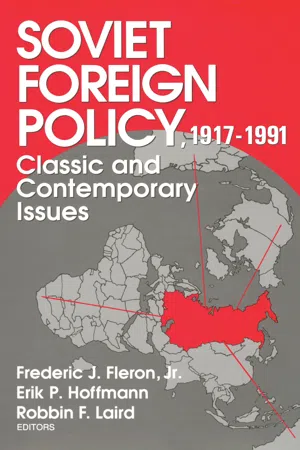
The purpose of this anthology is to deepen Western understanding of the sources and substance of the foreign policy of the Soviet Union. Authoritative analysts here explore significant issues in Soviet foreign relations from the era of the Bolshevik Revolution and the Civil War to the period of reform that preceded the final collapse of the Soviet system. The volume is designed for courses in Soviet political history, diplomatic history, comparative foreign policy, and the mainstream of international relations.
Information
VI
Policy and Performance
22
The Soviet Military in Transition*
Surprising changes are occurring in Soviet military policy, developments that raise fundamental questions about the nature of the Soviet political system as well as about the Soviet military threat. Interpreting this upheaval in Soviet military affairs is therefore not simply an academic matter. How well the appraisal is done has important implications for Western security calculations.
The military policy of any country is a complex and intricate matter for analysis, and the danger of getting lost among its many aspects is great. So as to see the forest despite the many trees, it is helpful to have a taxonomy of military policy categories. The six categories presented here have the virtue of being comprehensive and providing a proper context for analyzing Soviet military policy. Any aspect of Soviet military policy falls into at least one of these categories, and some may fall into several.
The first category is foreign policy, which military policy reflects and supports. What is the present character of Soviet foreign policy? Does it reflect a status-quo outlook, or is it expansionist, seeking to alter the balance of power in the world? The answer to this fundamental question creates the foundation for most aspects of military policy.
Second, there is military strategy, which relates to the ways in which military power is used to attain specific objectives. While military strategy concerns the use of military forces in wartime, it is also about the use and political utility of military power in peacetime. In the Soviet view, strategy encompasses arms races and how the USSR competes in them, as well as how it conducts arms control negotiations. Foreign policy and military strategy are sometimes merged into a single category by some analysts and called "grand strategy."
Closely related to military strategy is military doctrine. Doctrine, in the Soviet view, is the official state policy on both the socio-political and the military aspects of military affairs in a particular state. It links military structure to the political goals of the state. Although doctrine is based on the findings of military science, which hold for all countries, it is also particularized for the geographical, social, political, and economic character of a given state. It dictates the general guidelines for organization, tactics, operations, and strategy.
* Reprinted by permission of the author from Problems of Communism, XXXIX, 3 (May-June 1990).
A fourth category is military manpower policy. It concerns who will serve, who will lead, who will follow, and what the education, training, and ethnic mix of the armed forces will be. It affects a large portion of the population and has deep political ramifications for the relationship between the military and society.
Military industry is the fifth category. It includes research and development, weapons and equipment procurement, how these activities are financed, what proportion of the national income is devoted to military industry, how weapons and equipment are modernized, and the relationship of military industry to the rest of the economy.
The last category comprises all aspects of military organization, from the highest command levels and their relation to the political authorities, down to small-unit tables of organization and equipment. It includes the command-and-control structure and how it works, as well as the "rear," i.e., the full depth of the homeland and how it will be mobilized and protected.
This article looks at current developments in each of these six areas. Where appropriate, it provides some historical perspective to highlight the significance of the current changes. It is far from the complete story of the tumultuous unfolding events, but it does reveal their major contours and many of the forces influencing Soviet military policy. A seventh section turns to the nexus of party-military relations, both for what it tells us about the prospects for further change in the various areas of military policy and for what it suggests about the evolving nature of the entire Soviet polity. The conclusion ventures a tentative prognosis of the future course of military policy and of the ways in which recent domestic developments may impede changes not only in this sector but throughout the Soviet system.
FOREIGN POLICY
The changes that have occurred in Soviet foreign policy since Mikhail Gorbachev came to power in 1985 need not detain us long. Suffice it to highlight here several key points that shape the basic orientation of contemporary Soviet military policy.
Gorbachev's first and perhaps most critical step in foreign policy was to revise the official ideology and thereby create a basis for a new definition of "peaceful coexistence."1 Peaceful coexistence as a policy has its roots in Lenin's abrupt reversal of direction in 1921, both at home and abroad.2 Since communist revolutions were not occurring in the advanced industrial states of Europe as the Bolsheviks had anticipated, they had to decide how to hold on to power and preserve revolutionary gains in an isolated Russia. The policy formula with respect to foreign relations was found in the separation of "state-to-state" relations from "party-to-party" relations, and the pursuit of different policies along these two dimensions. Unable to provoke successful revolutions in the capitalist states of the West, Lenin sought to normalize relations with them, to give them the impression that Bolshevik Russia was not a threat, and to develop as much economic interaction with them as possible in order to advance Soviet industrialization. At the same time, he by no means intended to surrender the pursuit of international revolution in the name of the working class. Through the Comintern, an organization formed in 1919 to direct policies of communist parties allied with Moscow, the Bolsheviks would continue to promote working-class revolutionary consciousness throughout the world.3
This formula, in one variation or another, has been the Soviet official line ever since, except in the period when Stalin allied first with Germany, then with the Western democracies, and finally with Sovietized Eastern Europe after World War II. Nikita Khrushchev returned to the old Leninist formula, naming it "peaceful coexistence"—Lenin never actually used the term, but occasionally spoke of "cohabitation" (sozhiteVstvo)—and gave it a new twist to accommodate the dangerous new realities introduced by nuclear weapons.
As a policy, peaceful coexistence did not mean renunciation of competition with capitalism. Rather, it was defined as "a specific form of the international class struggle," one that temporarily avoided war. Unlike Lenin, who believed that a final showdown in war with the West was inevitable. Khrushchev conceived of peaceful coexistence as a strategy for defeating the West through internal revolutions without having to resort to global war or the use of nuclear weapons.
However, peaceful coexistence did not mean that the Soviet Union had renounced war. It seems fairly clear from recent Soviet statements that the Soviet political and military leadership expected that the competition between systems might lead to a nuclear war. Guided by a fundamentally offensive military doctrine, the Soviet leadership built its forces not simply for "deterrence" in the Western understanding of the concept but rather for making the best of the situation were a war to occur.4
The fundamental ideological assumptions underlying peaceful coexistence, then, dictated both an expansionist foreign policy and a military policy striving for military pre-eminence. In this light, the large Soviet military buildup over the past three decades is not an aberration; it is quite logical. The seriousness of the policy was evident in the great economic sacrifices forced on the population in order to pay for the military buildup.
When Gorbachev came to power, the Soviet Union was facing a major crisis in policy, both domestic and foreign. A new revolution in military affairs was demanding forces and weapons that the Soviet scientific-technological and industrial bases could not provide. The United States was winning the qualitative arms race. Soviet foreign policy, with its inherently expansionist character, was provoking a Western reaction that the Soviet economy and political system could not counter successfully.
As Gorbachev's supporters have argued, the large military component in the Soviet Union's past foreign policy has caused the West to arm more vigorously. In effect, massive military power has not translated into the political influence that Soviet leaders had expected. The implications of this view for military doctrine and force structure have been dramatic.
Gorbachev's approach to dealing with the crisis was not to tinker with the symptoms but rather to launch a fundamental attack on the disease itself. This meant radical changes in domestic policy that, in turn, required a different foreign policy orientation toward the world. Such shifts in course had been seen earlier in the repeated Soviet peace offensives, but those had been largely tactical in nature. The present shift is strategic, that is, it is meant to endure for a long time. It involves not merely a pause for obtaining Western technology to improve defense industries, but appears to include a basic restructuring of the entire economic and political system.5
It is against this background that Gorbachev's ideological revisions must be seen. He went right to the assumptions of Marxism-Leninism that had grounded all previous Soviet military doctrine: class interest and class struggle. In his book Perestroika: New Thinking for Our Country and the World, he declared that in the present age new interests have emerged—"humankind interests"—that transcend class interests. Nuclear weapons make the avoidance of war a "humankind interest." Saving the global environment is another such interest. These humankind interests, in Gorbachev's exegesis, take precedence over class struggle and require cooperative efforts with imperialist states. Moreover, they render irrelevant the view that war is but the continuation of political relations by other means. Thus, Gorbachev insists, Carl von Clausewitz must be put back on the shelf and forgotten. Given Lenin's admiration for Clausewitz's views on war, this is quite a reversal.6
Gorbachev did not stop here. He removed from the definition of peaceful coexistence the notion that it was a "specific form of the class struggle." The 27th Congress of the Communist Party of the Soviet Union (CPSU) gave peaceful coexistence a new and much longer definition, one that made no mention of class struggle and put the emphasis on proper and peaceful interstate relations with all foreign countries, regardless of their politico-economic system. While Gorbachev still holds that class analyses and class struggle are relevant in states where class antagonisms persist, he views the issue as of low priority in the larger context of East-West relations, where cooperative interstate dealings are to be the order of the day.
The foreign policy component of this policy change has the task of presenting the Soviet Union as a status-quo power, one committed to nonintervention even in Eastern Europe, where Moscow has abided by the policy even in the face of unprecedented challenges to the socialist systems there.
Given these extraordinary ideological revisions, Gorbachev's new prescription for military doctrine was quite logical: it must be "defensive." No other justification for military capabilities would do. Of course, the old formula for Soviet military doctrine had included its "defensive character," but this had been socio-political and had not extended to its military-technical component. Gorbachev now insists that the military-technical side of doctrine must also emphasize the defense, not offense. The strategic aim in the new policy is the "prevention," not the "waging" of war.
We cannot know with confidence the long-term "intent" of Soviet foreign policy. The goal might be expansionist. We can, however, infer with confidence that Gorbachev has made the Soviet Union a status-quo power for the present. Moreover, centrifugal political forces in the union republics even raise questions whether the present Soviet territorial composition and political structure can be maintained intact. The extraordinary direction that Soviet foreign policy has taken under Gorbachev clearly requires major adjustments in all aspects of Soviet military policy.
MILITARY STRATEGY
What do the foreign policy changes mean for contemporary Soviet military strategy? As understood by the Soviet Union, military strategy is a subcategory of "strategy" writ large—which includes ideology, foreign policy, military strategy and policy, and economic policy. The military leadership has a special responsibility for the internal logic of military strategy, but the political leadership has always held authority over where military strategy fits into the overall Soviet strategy in the international class struggle and foreign and economic policy. Thus, while military strategy as a subcategory has an internal logic of its own, this logic is not pursued independently. Arms control, conducted as diplomacy, naturally has a fundamental impact on military strategy as it relates to weapons development and force-building. Accordingly, the military leadership has been called upon to coordinate the various military factors that bear on arms control negotiations.
Gorbachev's "new thinking" has triggered an unusually sharp debate over Soviet military strategy. The debate encompasses a wider group of participants than any such discussion since the early 1920's. The Foreign Ministry has asserted itself in an uncharacteristic fashion, not only in the formal policy process but also by allowing its publications, particularly its Vestnik, to be used by civilian critics to enter the debate. And of course, the institutes of the USSR Academy of Sciences concerned with foreign, economic, and security policy have been vocal participants.
As noted above in the discussion of Soviet foreign policy, Gorbachev and his reformers have already recast the basic framework in which military strategy must operate. They have done this primarily through ideological revisions that relegated "class struggle" to a secondary place and, as a consequence, heightened Soviet engagement with the West and China.
Consequently, the role of military strategy in the larger external strategy— what is often called "grand strategy"—has been markedly reduced. Civilian critics have argued with great force that the mix of military, ideological, political, and economic means in Soviet strategy has not been too heavily weighted toward the military. They insist that enormous military power has not translated into increased political effectiveness vis-à-vis the West. Rather, it has provided cohesion to NATO and served to justify the large military buildup in the United States over the past decade. Moreover, these critics point to the period 1955-58, when Khrushchev effected a 37-percent reduction of forces without reducing Soviet security, since the reductions were accompanied by a major peace offensive against the West.7
As evidenced by his decisions to reduce forces unilaterally and to reduce defense spending, Gorbachev has clearly been persuaded by these arguments. In fact, almost all of the developments in Soviet military policy over the past three years make sense only in the context of a new strategy in which the role of military power is greatly reduced.
Gorbachev can point to considerable successes for his new strategy. The Soviet Union is being seen in the West as much less threatening, and the Western military establishments are beginning their own responses in the form of reductions of spending and forces. Even in Afghanistan, the withdrawal of Soviet forces has not yet meant the collapse of the client government.
In Germany and Eastern Europe, however, the record looks mixed in the eyes of some of Gorbachev's critics, not least, the military. Obviously Gorbachev intended a withdrawal of some Soviet forces from the Warsaw Pact states, but it is doubtful that he anticipated the rapid collapse of communist regimes there, particularly in East Germany. Soviet spokesmen had been telling Westerners for some time that Soviet forces would be out of Eastern Europe by the year 2000, but as political developments have spun out of the Kremlin's control, the date will have to be considerably advanced. The reformers supporting Gorbachev may not see this as a misfortune but rather as an opportunity for reducing further the role of the military in the mix of instruments for Soviet strategy.
Arms control negotiations have been de-emphasized somewhat as a component of Soviet strategy if only because events in Eastern Europe and Western military reductions have tended to move ahead of what diplomats can achieve at the negotiating table. This is particularly true for conventional arms cont...
Table of contents
- Cover Page
- Half title
- Title Page
- Copyright Page
- Contents
- Preface
- Classic Issues in Soviet Foreign Policy
- I. HISTORY
- II. METHODOLOGY
- III. IDEOLOGY AND BEHAVIOR
- IV. PROSPECT AND RETROSPECT
- Contemporary Issues in Soviet Foreign Policy
- V. PERSPECTIVES AND POLICYMAKING
- VI. POLICY AND PERFORMANCE
- VII. RETROSPECT AND PROSPECT
- Index
Trusted by 375,005 students
Access to over 1.5 million titles for a fair monthly price.
Study more efficiently using our study tools.
Frequently asked questions
Yes, you can cancel anytime from the Subscription tab in your account settings on the Perlego website. Your subscription will stay active until the end of your current billing period. Learn how to cancel your subscription
No, books cannot be downloaded as external files, such as PDFs, for use outside of Perlego. However, you can download books within the Perlego app for offline reading on mobile or tablet. Learn how to download books offline
Perlego offers two plans: Essential and Complete
- Essential is ideal for learners and professionals who enjoy exploring a wide range of subjects. Access the Essential Library with 800,000+ trusted titles and best-sellers across business, personal growth, and the humanities. Includes unlimited reading time and Standard Read Aloud voice.
- Complete: Perfect for advanced learners and researchers needing full, unrestricted access. Unlock 1.5M+ books across hundreds of subjects, including academic and specialized titles. The Complete Plan also includes advanced features like Premium Read Aloud and Research Assistant.
We are an online textbook subscription service, where you can get access to an entire online library for less than the price of a single book per month. With over 1.5 million books across 990+ topics, we’ve got you covered! Learn about our mission
Look out for the read-aloud symbol on your next book to see if you can listen to it. The read-aloud tool reads text aloud for you, highlighting the text as it is being read. You can pause it, speed it up and slow it down. Learn more about Read Aloud
Yes! You can use the Perlego app on both iOS and Android devices to read anytime, anywhere — even offline. Perfect for commutes or when you’re on the go.
Please note we cannot support devices running on iOS 13 and Android 7 or earlier. Learn more about using the app
Please note we cannot support devices running on iOS 13 and Android 7 or earlier. Learn more about using the app
Yes, you can access Soviet Foreign Policy 1917-1991 by Jr. Fleron in PDF and/or ePUB format, as well as other popular books in Politics & International Relations & International Relations. We have over 1.5 million books available in our catalogue for you to explore.