- 298 pages
- English
- ePUB (mobile friendly)
- Available on iOS & Android
eBook - ePub
About this book
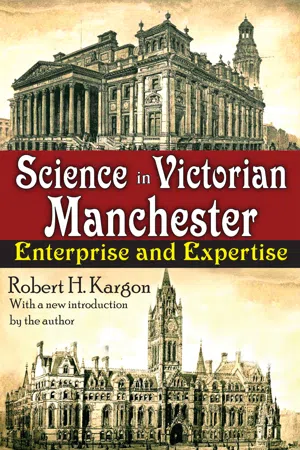
The evolution of an urban scientific community under the pressures of conceptual and social change is the main focus of this book. Manchester was Victorian Britain's leading industrial city. In order to describe and analyze the transformation of science in the eighteenth century, Robert Kargon closely examines Manchester through successive stages. In so doing, he traces the evolution of science from an activity pursued by gentlemen-amateurs to a highly specialized profession.At the end of this process, the author shows, a major trans formation in our understanding of the nature of science can be discerned: scientific knowledge, it was realized, could be produced. Science was no longer regarded primarily as the di vine design rendered into laws of nature, but rather as a method, or instrument, to be applied to novel areas of human endeavor. Science had become on the one hand enterprise, and on the other expertise. In each chapter, Kargon relates the changing conception of science and its social role to the birth, growth, and character of the city's scientific institutions.The contours of the scientific community-its interests, concerns, and approaches to what it came to see as critical problem---were shaped by its civic environment. Its character, in turn, responded to the development of the disciplines represented within it. As the sciences increased in specialization and complexity during the course of the nineteenth century, they placed new stress upon the community, affecting the composition of its membership and the nature of its leading institutions. The scientific frontier reacted upon Manchester just as Manchester acted upon it. Now available in paperback, this classic work in history includes a new introduction by the author.
1
The Structure of Science in Manchester in 1840
To some the city of Manchester in the early twentieth century seemed an unlikely place for the pursuit of science. Upon his arrival, Henry Moseley—one of physics’ brightest lights—was resigned to “being in the desert.” His Oxford tutor called it “a ghastly place and I feel sorry for anyone who is condemned to profess and teach in its murky atmosphere.”1 Smoky, dirty, aggressively bürgerlich and obviously lacking the genteel virtues of Oxford or Cambridge, Manchester was nonetheless a splendid, shining world-center for scientific research and teaching. Its university and its urban scientific institutions, enjoying unmatched community support, provided a magnet for the best and brightest young investigators. In Ernest Rutherford’s physics laboratory Manchester possessed the nursery of modern physical science, and it could boast of many of the glittering names of contemporary physics—Bohr, Chadwick, Moseley, Geiger, Darwin, and numerous others. It can be argued with considerable justice that the city had, in the first two decades of the twentieth century, one of the most exciting and productive communities in the history of recent science. Yet merely seventy years earlier the city’s scientific community was considered a provincial backwater with little claim to the world’s attention. The evolution of Manchester from its modest state at the beginning of the Victorian period into one of scientific eminence, and the conditions of this passage, is the subject of the undertaking which follows.
The Revolutionary City and the Scientific Community
Lying at the foot of hills which stretch northward from it, the city of Manchester rises on the left bank of the river Irwell, between that river and two smallish ones, the Irk and Medlock. On the right bank of the Irwell lies its sister city Salford. In the mid-eighteenth century, the countryside to the east of Manchester was thinly populated, marshy land. By 1840, the beginning of our story, this land was the most densely populated in England. The Manchester region had been, during this period, the scene of an industrial revolution which transformed the face of the county and the character of its people.
The simple population statistics are dramatic enough. In 1773 the population was estimated at about 24,000. By 1801, the first official census determined its numbers at well over 70,000. By 1841, Manchester and Salford had grown to the stupendous size of over 300,000. Economic opportunity accounted in the main for this demographic marvel. It has been estimated that in the first decade of the nineteenth century immigrants to the city accounted for a third of its increases and by the third decade of the century for over three-fifths.2 What in the 1780s had been a market town, already attracting attention to its bustle and activity, was by 1840 an extraordinary agglomeration which excited and terrified contemporary observers, who viewed Manchester as both monstrous and awe-inspiring. “Amid the fogs which exhale from this marshy district,” a French critic-admirer wrote, “and the clouds of smoke vomited forth from the numberless chimneys, Labour presents a mysterious activity, somewhat akin to the subterraneous action of a volcano.”3
The immediate cause of this growth was the industrial revolution, and the industrial revolution in turn was shaped by cotton. David Landes has succinctly summed up this complex upheaval in three simple principles: the substitution of machines for human effort and skill; the substitution of inanimate (especially steam) for animate sources of power; and use of new and plentiful raw materials. Of this last, cotton was by far the most important. In 1760 Britain imported 2.5 million pounds for its domestic industry; by 1787 consumption had increased to 22 million pounds, and by the 1830s to 366 million pounds.4 The locus of these changes was Lancashire, and Manchester was its most significant center.
Whereas in the last half of the eighteenth century Manchester merchants were still largely independent producers peddling rough fustians on horseback, and the town’s Tuesday Market still bore traces of its medieval roots, by the mid-nineteenth century, Manchester was Britain’s second city, a place where great fortunes were made and, simultaneously, dismal industrial conditions wrecked numerous lives. In the 1780s the elite of Manchester society was still composed of gentlemen, physicians, lawyers, clergymen, and small “putting-out” manufacturers. The elite groups possessed all the aspirations of their peers in other regions. The institutions of the town—the clubs, churches, libraries, theaters, and so forth—supplied them with the cultural satisfactions appropriate to their stations. By the 1840s, however, the social situation had altered, and the market town’s institutions were either outgrown or outmoded. The city was by then rife with class division, dominated by a powerful bourgeoisie, and marked by a powerless proletariat.5 Manchester was both pioneer and victim.
The wealth and prestige of the eighteenth-century town lay with its clergy, professional men, and merchant-manufacturers. From the 1770s on, however, the economic scene changed rapidly. Inventions, especially in spinning, stimulated a cotton boom. While some of the wholesale merchants of the town invested in the new equipment, many of the new factory industrialists emerged not from the putting-out industries nor from merchandizing, but rather from the manufacture of textile machinery, as, for example, did John Kennedy, Robert Owen, and James McConnel. With the advent of the power loom, weaving sheds were added to the spinning mills. By 1827 half the country’s power looms were in Manchester and nearby Stockport.6 The mechanization of the cotton industry stimulated a proliferation of engineering and machinery-making firms. Manchester and Salford directories of the latter part of the eighteenth century trace the phenomenal growth of engineering activities, coordinated with the steep rise in cotton manufacture.7 In 1844 a foreign writer observed what to him was a remarkable scene:
The manufactories and machine shops form as it were,a girdle around the town. . . . Factories seven stories in height, rear their lofty fronts along the banks of the Irwell and along the borders of the canals. . . . The waters of the Irk, black and fetid as they are, supply numerous tanneries and dye-works; those of the Medlock supply calico-printing establishments, machine shops and foundries.8
Within the relatively short span of the Biblical three score and ten, Manchester was entirely transformed. The suddenness of the change was universally noted: “At Manchester,” Leéon Faucher wrote in 1844, “industry has found no previous occupant, and knows nothing but itself. Every-thing is alike and everything is new; there is nothing but masters and operatives.”9
Linked with this transformation in the minds of many was Manchester’s interest in science and technology. Faucher continued: “Science, which is so often developed by the progress of industry has fixed itself in Lancashire.” Faucher’s Mancunian translator added: “With respect to science, the whole phenomenon of Manchester society is but a continual series of investigations into, and practical application of, scientific knowledge.”10
Owing to technical success, Manchester was in fact widely regarded not only as the center of Britain’s most vital industry but the center of invention and therein of progress. The People’s Journal summarizes a view which many Mancunians would have heartily endorsed: “Invention, physical progress, discovery are the war-cries of today. Of this great movement Manchester is the centre. In that lies its especial importance. That work which it seems the destiny of the nineteenth century to accomplish is there being done.” Manchester was a mark of the tendencies of its time and, as the People’s Journal continued, “a clue, more or less perfect, to the social condition of the future.”11
An unbiased observer would have to conclude, however, that in 1840 the scientific community of the city of Manchester was relatively undeveloped—that the city was, compared with the great metropolitan centers and even with many university towns, a scientific backwater. To be sure, the city boasted the presence of the internationally renowned Dr. John Dalton and ceremoniously trotted him (or his reputation) out when the occasion seemed to warrant it. But apart from this slender claim Manchester seemed to possess little to merit the admiration or incur the envy of London or even of Glasgow.
Still, backwater though it might have appeared, Manchester, even in 1840, actually possessed a complex structure of scientific institutions and organizations. Despite its provinciality, Manchester provided the setting for a scientific community which served all segments of society and which performed several functions relating to fruitful diversity among conceptions of “science.” The premier scientific organization, both in age and reputation, was the famous Literary and Philosophical Society of Manchester, established in 1781 by prominent members of the city elite to encourage discovery and to facilitate the dissemination of literary and scientific culture among those gentlemen best prepared to make use of it.
The “Lit. & Phil.” was joined in 1821 by the Natural History Society, whose major goal, it appears, was the preservation of interesting collections and the convening of like-minded amateurs of the fields and streams of south Lancashire which were beginning to be heavily scarred with the effluences of industrialism. Soon the Royal Manchester Institution, providing both an art gallery and public lectures in the sciences, joined them in their effort to enrich the private lives of the haute-bourgeoisie and the public life of the city. The Manchester Mechanics’ Institution (established 1825), the New Mechanics’ Institution (established 1829), and the Salford Mechanics’ Institution (established 1839) brought the wave of interest in science and technology to the working class or, at least, to that advanced segment of it able to profit from science courses, public lectures, and reading rooms.
These institutions, performing a variety of functions and aiming at several levels of society, were joined in the 1830s by two new types of scientific organizations, heralds of things to come both socially and intellectually in the city of Manchester. The first was the Statistical Society (1834), dedicated to collecting and analyzing data concerning the major problems beginning to affect the burgeoning industrial complex of Manchester and its environs. Its aim was decidedly reformist, attempting to give some solid base to its members’ wide-ranging criticisms of conditions and to provide some impetus for reform.
Ultimately activist in its aims also was the Manchester Geological Society (1838), which brought together for the presentation of papers and public lectures those concerned with the economic development of the region and those natural history “buffs” in love with the vanishing beauties of the surrounding countryside. The appearance on the scene in the 1830s of these two new “concerned” groups signaled the coming end of an era: an end to the eighteenth-century conception of science as the recreation of leisured gentleman and of the busy “professionalist.” The theme of the need for scientific knowledge for the health of the city and the success of its industries was the slender thread which bound together all segments of the Manchester scientific community both in the new institutions of the 1830s and in the older ones as they were continuously transformed in the decades to follow. It was a theme which was not recognized at once and not by all sections of the Manchester elite, but its binding powers grew in the years ahead and helped to produce, in fact as well as in name, a Manchester scientific community.
The assessment of Manchester science in 1840 will have to include a detailed examination of the aims, practices, and composition of the institutions which provided a setting for the practice and dissemination of science; it will have to go beyond the individual societies and attempt to grapple with the more complex relationships that obtained among them. Any serious examination will require some picture of the interlocking directorates, the special functions within the community that each played, the special conceptions of “science” that each formulated, and the share of the available talent that was apportioned among them. In short, nothing less than a portrait of the “ecology” of scientific institutions in the city will suffice. This chapter will be devoted to supplying the elements of this portrait and to the attempt to develop some picture of the dynamic relationships among the various organizations and men who populated them. Succeeding chapters will attempt to assess the internal and external forces tending to disrupt the system and to describing the new situations resulting from such changes.
The Manchester Literary and Philosophical Society and the Manchester Scientific-Cultural Network
The most prestigious scientific institution in the city in 1840 was by all odds the Literary and Philosophical Society, founded in 1781. Most accounts credit Dr. Thomas Percival (1740-1804) with being the vis motrix of the society. Educated at the Warrington Academy and Edinburgh and Leyden Universities, Percival settled in Manchester in 1767. He had already become a fellow of the Royal Society of London two years previously and, upon setting up his medical practice in Manchester, continued his philosophical interests. Around him grew an informal weekly intellectual club; as the membership increased, the original format became cumbersome and the original plan was extended.
The preface to volume 1 of the society’s Memoirs (1785) gives an official account and may perhaps supply some sense of motivation. The literary and philosophical societies formed in the different parts of Europe are not only a means of diffusing knowledge but also provide a means to encourage “a greater number of important discoveries.” The societies offer the “respectable sanction of societies of men of the first eminence and learning” and also an “easy mode of publishing” the products of their intellectual interaction. “Science, like fire,” the preface continues, “is put in motion by collision.”12
The origins of the society were impeccably genteel:
Many years since, a few Gentlemen, inhabitants of the town who were inspired with a taste for Literature and Philosophy, formed themselves into a kind of weekly club for the purpose of conversing on subjects of that nature. These meetings were continued, with some interruption for several years; and many respectable persons being desirous of becoming members the numbers were increased so far as to induce the founders of the Society to think of extending their original design. Presidents and other officers were elected, a code of laws and a regular Society constituted and denominated THE LITERARY AND PHILOSOPHICAL SOCIETY OF MANCHESTER.13
The bylaws limited the membership, at first, to fifty ordinary members, supplemented by an undetermined honorary membership, eligibility for the latter based on the member’s “residing at a distance from Manchester” and by his having “distinguished himself by his literary or philosophical publications; or favoured the Society with some paper.”14
The bylaws indicated that the subjects for discussion and for the presentation of papers included natural philosophy, theoretical and experimental chemistry, literature, civil law, commerce, and the arts. Excluded, pointedly, were “Religion, the Practical Branches of Physic, and British Politics.”15 The exclusion of religion and politics as subjects for debate and discussion had ample precedent and equally sufficient and obvious practical advantages. That the practical parts of medicine were not to be discussed prevented the society, on the one hand, from becoming a narrowly focused professional society (more than half the founding members were physicians, surgeons, or apothecaries) and, on the other, from opening a Pandora’s box of potential disputation.
An historian of the society, Francis Nicholson, has preserved a list from the original minutes of the founding members. Providing an index to the cultural elite of the town, the list includes the Reverend Thomas Barnes (1747-1810), minister of Cross Street Chapel; George Bell, M.D. (1755-1804), honorary physician to the Manchester Infirmary; Thomas Henry (1734-1816), apothecary to the infirmary and, until the arrival of Dalton, the town’s leading chemist; Peter Mainwaring, M.D. (1696P-1785), first presi...
Table of contents
- Cover Page
- Title Page
- Copyright Page
- Contents
- Introduction to the Transaction Edition
- Preface
- 1 The Structure of Science in Manchester in 1840
- 2 The Emergence of the Devotee : The Changing Face of Amateur Science
- 3 The Coming of the Civic Scientists
- 4 The Science of Civic Virtue: Chemistry, Health, and Industry
- 5 Academic Science: Owens College Born and Reborn
- 6 University Science: Arthur Schuster and the Organization of Physics in Manchester
- Notes
- Bibliographical Note
- Index
Trusted by 375,005 students
Access to over 1.5 million titles for a fair monthly price.
Study more efficiently using our study tools.
Frequently asked questions
Yes, you can cancel anytime from the Subscription tab in your account settings on the Perlego website. Your subscription will stay active until the end of your current billing period. Learn how to cancel your subscription
No, books cannot be downloaded as external files, such as PDFs, for use outside of Perlego. However, you can download books within the Perlego app for offline reading on mobile or tablet. Learn how to download books offline
Perlego offers two plans: Essential and Complete
- Essential is ideal for learners and professionals who enjoy exploring a wide range of subjects. Access the Essential Library with 800,000+ trusted titles and best-sellers across business, personal growth, and the humanities. Includes unlimited reading time and Standard Read Aloud voice.
- Complete: Perfect for advanced learners and researchers needing full, unrestricted access. Unlock 1.5M+ books across hundreds of subjects, including academic and specialized titles. The Complete Plan also includes advanced features like Premium Read Aloud and Research Assistant.
We are an online textbook subscription service, where you can get access to an entire online library for less than the price of a single book per month. With over 1.5 million books across 990+ topics, we’ve got you covered! Learn about our mission
Look out for the read-aloud symbol on your next book to see if you can listen to it. The read-aloud tool reads text aloud for you, highlighting the text as it is being read. You can pause it, speed it up and slow it down. Learn more about Read Aloud
Yes! You can use the Perlego app on both iOS and Android devices to read anytime, anywhere — even offline. Perfect for commutes or when you’re on the go.
Please note we cannot support devices running on iOS 13 and Android 7 or earlier. Learn more about using the app
Please note we cannot support devices running on iOS 13 and Android 7 or earlier. Learn more about using the app
Yes, you can access Science in Victorian Manchester by William T. Golden in PDF and/or ePUB format, as well as other popular books in History & Modern British History. We have over 1.5 million books available in our catalogue for you to explore.