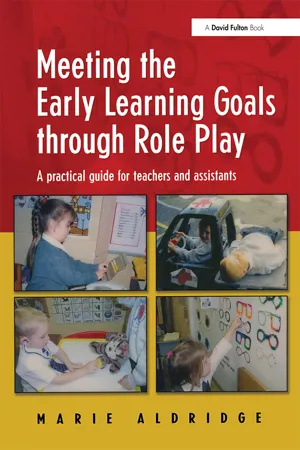
eBook - ePub
Meeting the Early Learning Goals Through Role Play
A Practical Guide for Teachers and Assistants
- 196 pages
- English
- ePUB (mobile friendly)
- Available on iOS & Android
eBook - ePub
Meeting the Early Learning Goals Through Role Play
A Practical Guide for Teachers and Assistants
About this book
This book offers step-by-step guidance to help busy practitioners create meaningful role play that will delight young children, enhance learning and link to the Early Learning Goals. The role play scenarios have been carefully created so that children can identify with them and will be excited and eager to join in. They give children the opportunity to play freely, to discover and develop at their own pace and to link directly to the Early Learning Goals and beyond. This Book shows practitioners exactly how to plan, organize and implement role play activities. The activities have been tried, tested and enjoyed in the busy nursery where the author works. The book also divides the play scenarios into the DfES stated area of learning (personal, social, emotional, communication, language and literacy, mathematical, knowledge of the world, creative and physical) allowing practitioners to choose activities to suit their needs. The book includes: step-by-step guidance; photographs and plans; a list of easily obtained and inexpensive play equipment; and a planning template for practitioners to develop their own ideas. It should prove useful to teachers and assistants from nursery classes up to key stage 1.
Information
Transport and Journeys
Road, rail and air
Play situation
Create a vehicle (train, bus, aeroplane, car, lorry, bicycle, rocket or spaceship) in which children can go to various imaginary destinations of their choice. It will comprise the vehicle, numbered or coded seats, doorway, driving seat, steering wheel, controls, engine, windows, mechanics and support services: a ticket controller either in an office or travel agent's, or a conductor on a bus. The children will be able to buy tickets for a chosen destination, get on the vehicle, store their baggage and pretend to travel. There are numerous roles for the children to play within this scenario: drivers, passengers, mechanics or office staff, and they will begin to understand the factors that affect people even if they only go on a short journey. (See Tables 24-28.)
Introductory prompts
Why do we need to travel?
Where can I go to find out about travel?
Have any of them ever been on a journey? Where did they go? How did they travel there?
How do they travel to school?
How do they know where the vehicle is going?
Is the journey going to be long or short?
Where can you get food from when you travel?
What happens if the vehicle breaks down?
Possible roles
CAR OR LORRY OR BICYCLE: driver, rider, passengers, garage staff, mechanics, office staff, police and road safety personnel
TRAIN: train driver, guard, ticket collector, station ticket office person, cleaners, passengers and mechanics
BUS OR COACH: bus driver, passengers, bus conductor or officer selling tickets, mechanics, passengers and cleaners
AEROPLANE: pilot, flight crew, air steward and cabin crew, passengers, baggage controllers, checking and weighing-in staff, food controllers, arrivals officers, departure officers and mechanics
ROCKET OR SPACESHIP: space crew, astronauts, flight control, mechanics and scientists
Resources
Supply uniforms, hats, chairs, trolleys, luggage, tickets, brochures, timetables, office desk, writing tools, calendars, telephones, mobile phones, computer keyboard, VDU screen, stamper, money, tills, engine (construction kits), steering wheel, gear stick and pedals (construction kits), tools for mechanics, Brio and real tools, rolling white board for drawing props, control panel (batteries and bulbs), card, boxes, paint.
See Recommended reading for books about road, rail and air transport.
Potential learning opportunities
Personal, social and emotional development
The road, rail and air transport role-play scenarios will help the children to:
Disposition and attitude
- explore a new learning environment involved with transport projects with imagination, creativity, confidence, humour and persistence;
- initiate play, building on their own experiences of travel; begin to take a lead in the play and organise others;
- discuss their own play journeys with peers and adults confidently;
Self-confidence and self-esteem
- improve their confidence and begin to develop and be proud of their own personality;
Making relationships/behaviour/self-control
- express feelings and be sensitive to the needs of others;
- work cooperatively within a small group, showing respect, interest and care for others;
- share the role-play resources and space, take turns fairly, form queues and be polite;
- explore the need for their own simple rules within the area for safety reasons;
- play independently within the role-play area: buying tickets, finding seats, dealing with baggage and enjoying the journey;
Self-care
- select appropriate equipment for a task and use it sensibly and feel confident to ask for advice and help from peers and supporting adults if problems arise or equipment is not available;
- improve their dressing skills by tackling various types of clothes and fastenings when wearing costumes;
Sense of community
- be aware of the different transport systems that operate in their own local area and further afield;
- understand how transport systems have changed with time.
Communication, language and literacy
The road, rail and air transport role-play scenarios will help the children to:
Speaking, listening and communicating
- speak clearly and use appropriate body language to get attention, defend their own interests and to be understood by friends and family;
- develop questioning techniques (how, when, where and why) about where vehicles are travelling, how much the journey costs and the times involved; begin to use language as a means of communicating: giving simple
- instructions, explaining routes and directions, asking for help, expressing opinions and responding to aural stimuli from telephones, passengers' requests, computers and other equipment;
- share with the group what they have achieved through play;
Reading and linking sounds to letters
- develop a need to read and awareness of environmental print: posters, leaflets, tickets, maps, brochures, magazines and timetables;
- listen with interest to and read a selection of stories and non-fiction books, magazines and other class-made reading material about relevant transport and travel topics;
- retell some of the stories using drama as a tool remembering the main characters, sequence of events and key rhymes and chants;
- create real life stories which can be recorded in a format that the children choose: video, photograph, tape, picture or writing;
Writing
- develop their confidence and enjoyment of being able to write by experimenting with mark-making tools in the role-play area and writing their own and their friends' names on play documents;
- write using emergent, symbolic and conventional letter forms, postcards from various destinations, posters, leaflets and other advertising material using travel brochures and magazines to develop them;
- make zig-zag books to capture different stages of the children's imaginary journey.
Mathematical development
The road, rail and air transport role-play scenarios will help the children to:
Representation
- record information about the number of travellers on a given journey in pictorial and numerical forms (Which were the most popular seats and why? Which was the most popular destination?);
Sorting/matching/ordering
- sort and match tools used by mechanics according to shape, size and colour and place them in appropriately labelled boxes and on shelves;
- match one seat on a vehicle to one child with a correctly numbered, coloured or shaped ticket;
Number
- reco...
Table of contents
- Cover
- Title
- Copyright
- Contents
- Acknowledgements
- Introduction
- House
- Health care
- Shops and services
- Transport and journeys
- Appendix: Tina Bruce's 12 features of play
- Recommended reading
- Bibliography
Trusted by 375,005 students
Access to over 1.5 million titles for a fair monthly price.
Study more efficiently using our study tools.
Frequently asked questions
Yes, you can cancel anytime from the Subscription tab in your account settings on the Perlego website. Your subscription will stay active until the end of your current billing period. Learn how to cancel your subscription
No, books cannot be downloaded as external files, such as PDFs, for use outside of Perlego. However, you can download books within the Perlego app for offline reading on mobile or tablet. Learn how to download books offline
We are an online textbook subscription service, where you can get access to an entire online library for less than the price of a single book per month. With over 1.5 million books across 990+ topics, we’ve got you covered! Learn about our mission
Look out for the read-aloud symbol on your next book to see if you can listen to it. The read-aloud tool reads text aloud for you, highlighting the text as it is being read. You can pause it, speed it up and slow it down. Learn more about Read Aloud
Yes! You can use the Perlego app on both iOS and Android devices to read anytime, anywhere — even offline. Perfect for commutes or when you’re on the go.
Please note we cannot support devices running on iOS 13 and Android 7 or earlier. Learn more about using the app
Please note we cannot support devices running on iOS 13 and Android 7 or earlier. Learn more about using the app
Yes, you can access Meeting the Early Learning Goals Through Role Play by Marie Aldridge in PDF and/or ePUB format, as well as other popular books in Education & Early Childhood Education. We have over 1.5 million books available in our catalogue for you to explore.