- 284 pages
- English
- ePUB (mobile friendly)
- Available on iOS & Android
eBook - ePub
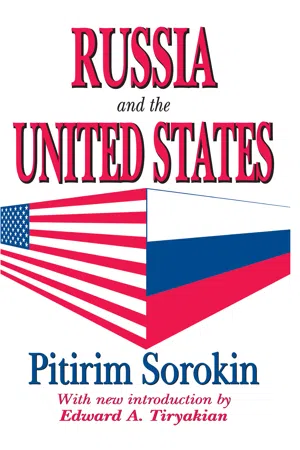
Russia and the United States
About this book
Throughout the Cold War, both the United States and the Soviet Union viewed themselves as saviors of the world, and each saw itself as working on behalf of humanity against the other. The unexpected implosion of the Soviet empire in 1989 brought an end to this bipolar world and left both nations uncertain about their relations to the world and to each other. Antagonism between the United States and Russia is rooted in a lack of knowledge of each other's culture and history. This pioneering volume, first published in 1944 at the height of the U.S.-Soviet alliance, steers us through the labyrinth of mutual ignorance that continues in the post-Cold War era. Pitirim Alexandrovitch Sorokin is one of the major figures of modern sociology. Born in rural Russia in 1889, he took an active part in the country's political life. Following his emigration to the United States, he strove to develop an insider's knowledge of his new home. Russia and the United States was written in the hope of fostering cooperation between the two countries in the postwar world. By noting a shared belief in each nation's historical role or "exceptionalism," Sorokin argues that there is a fundamental compatibility in the basic values of the two countries, facilitated by shared mental, cultural, and social attitudes that preceded the communist period.Without minimizing the tyrannical nature of the Soviet regime, Sorokin locates and traces the development of democratic tendencies in Russia. He also points out that American democracy has not been fully achieved and that both nations have yet to fulfill their ideals. Both countries have been melting pots of diverse racial, ethnic, national, and cultural groups and peoples, and from their multiethnic composition, Russia and the United States have each developed a rich and creative culture. Sorokin rejects the notion of diametrically opposed American and Russian "souls," in favor of an appreciation of shared values.
Information
Chapter One
The Significant Lesson of Russian-American Relationships
1. Enthusiasm and Apprehensions
Our attitude toward Russia presents a peculiar contradiction. We are highly enthusiastic about the Russian Army: we praise its ability, its heroism and courage, its sacrifices; we feel very grateful to it for saving us and all the United Nations from utter catastrophe. At the same time many of us entertain serious suspicions and vague apprehensions respecting Russian Communism, atheism, “imperialism,” and “barbarism.” Some go so far as to find fault with Russia for whatever she does. If her armies retreat under the pressure of the German hordes, such detractors condemn her for her inability to defeat singlehanded the common enemy. They triumphantly shout: “Did we not tell you that the Red Army was good for nothing and would be cut to pieces in three weeks? Did we not warn against any entanglement with those impotent barbarians?” On the other hand, when the Red Army forces the German legions to retreat, such critics warn us gravely about the danger of a Muscovite invasion of Europe — the dire menace to civilization which would result from the victory of these twentieth-century “Scythians”! Their fundamental purpose is to see Russia’s population and culture utterly exterminated and the earth freed from “such scum.” Herein they are in complete accord with Hitler, Goebbels, and Company!
Others, while not going so far as these “saviors of civilization,” nevertheless show the same trend. Take, for instance, the majority of the proponents of various types of “union now” and postwar alliances. Most such plans ignore both the desirability and the possibility of an intimate alliance with the Soviet Union, though they envisage a multitude of schemes for closer co-operation with Great Britain, France, Spain, Latin America, and even Germany, If an alliance with Russia is even mentioned in this connection, it is hedged about with all manner of safeguards designed to reduce her role in world affairs to the barest minimum.
2. Momentous Questions and Answers
Although the more extreme form of anti-Russian sentiment is not widespread, being confined largely to certain influential factions in this country and others of the United Nations of the West, the milder (contradictory) attitude of mingled enthusiasm and apprehension is entertained by a substantial percentage of the people of the United States and other countries. The prevalence of this attitude naturally raises the questions: To what extent is it justified? Does it have any valid basis? Is it to be seriously reckoned with in constructive planning for the postwar order? Should this country in particular strive for a close alliance with Russia, or should it avoid such intimate co-operation in its own interest as well as for the sake of the well-being of mankind?
These questions are highly important and must be clearly answered. Throughout the entire history of the United States, Russia has been its best friend. If the respective governments do not commit the stupidest blunders, Russia will constitute in the future our best and most important ally. In the interest of both nations and of humanity at large, the most wholehearted co-operation is not only possible and desirable but essential. The chances for such co-operation between Russia and the United States are better, and those of an armed conflict are slighter, than the respective chances in the relations of either of these countries and any other great power. Without the co-operation of these two nations no lasting peace is possible. If a new and nobler social order is to emerge from this tragic war, the United States and Russia must play a leading role in the work of reconstruction; and Russia will discharge its mission faithfully and wholeheartedly. If such an effort fails through insidious double-crossing on the part of egoistic nations, neither America nor Russia will be responsible for its miscarriage.
Such is my answer to the problem. It is clear. It differs markedly from many a current conjecture offered by so-called “experts” in international relations and socio-political planning. The subsequent pages of this book will demonstrate briefly the reasons for such an answer, and will indicate why my answer is more valid than most contemporary plans for postwar unions and alliances.
3. The Miracle of Lasting, Unbroken Peace Between the United States and Russia
The most decisive reason is the unique and undeniable fact of an uninterrupted peace between these countries, extending throughout the entire history of the United States. The utopia of a lasting peace between great powers has actually been realized in these relationships. Russia is practically the only major power with which the United States has never waged war, or even engaged in a single serious diplomatic conflict. A few minor diplomatic squabbles have, to be sure, occurred; but such petty clashes frequently mar the relations of even the various regions, provinces, or states of the same country. Moreover, the relations between Russia and the United States have been, for the most part, exceedingly warm, friendly, and co-operative. Throughout the greater part of the nineteenth century Russia was hailed in this country as “the best friend of the United States,” and the United States was exceedingly popular in Russia. Let us note a few landmarks of this significant phenomenon.
France and Russia were the first foreign powers to help the United States as a sovereign nation. Already in 1779–1780 Russia was aiding this country in its struggle for independence through the armed neutrality of the League of Baltic Kingdoms organized by Russia and directed against England. As early as 1781 the United States was represented by Francis Dana at the Russian seat of government. Thereafter mutually beneficial diplomatic and social relations rapidly multiplied. In 1798 Russia offered the United States a coalition against France. In 1801 a close friendship, marked by frequent personal correspondence, was established between Czar Alexander I and Jefferson, each being a sincere admirer of the other. In 1807 the cordial relationship grew still warmer and more intimate. In 1812 Czar Alexander I offered to mediate between the United States and Great Britain. A number of agreements were concluded in 1812 and subsequent years concerning the neutrality and freedom of the seas and other important matters in which the interests of the two countries were identical. During this and subsequent periods Russia vitally assisted the United States to secure complete freedom of the seas for neutrals — a factor so important for the economic and political interests of this country. Russia and its “Prince of Peace,” Czar Alexander I, were exceptionally popular among Americans at that time.
Later on, several other treaties were concluded to the mutual benefit of both nations. When one of the two countries happened to be in a difficult position, the other country usually came to its assistance. Thus, when Russia was attacked by a coalition of European powers in the Crimean War, the United States not only refrained from joining them but manifested its sympathy for Russia. Again, to cite a recent example, during the grave famine of 1921–1922 the American Relief Administration came to the rescue and saved, through its generous help, the lives of several millions of Russians. Similarly, when certain European powers threatened to intervene in American affairs during the Civil War, Russia sent her fleet with sealed orders to prevent such intervention. In this and other ways Russia vitally helped the United States during this difficult period. When, on top of this, Russia in 1867 sold Alaska to the United States for a mere $7,000,000, her popularity in the United States knew no bounds.
Only rarely — as at the end of the nineteenth century and again during the disastrous period of the Russian revolution of 1917 and the following years — has this unique friendship been clouded and the two countries shown a tendency to drift apart. But this temporary alienation never led either to war or to any serious diplomatic conflict. Even the sending of the American expeditionary forces in 1918 does not belie this statement: it was dispatched not against Russia but rather to help Russia. It was sent in response to explicit invitation on the part of various anti-Communist governments and sections of the population of Russia at a time when Germany still menaced Russia, and when the Communist government was as yet far from being firmly established. In addition, it was an insignificant force, and its military operations hardly amounted to anything that could properly be called war. Hence its activities in no way constituted an act of aggression against Russia.
Incidentally, it may be added that when both countries have happened to be involved in the same war, they have invariably been ranged on the same side, fighting a common enemy, whether in the case of the Boxer uprising, the war of 1914–1918, or the present war.
4. The Significance of the Miracle
The story of this remarkable relationship is highly significant and merits our attention for a number of reasons. In the first place, there are few cases in human history where two great powers, in contact and interacting with each other, have enjoyed unbroken peace for a period of 165 to 335 years (if we begin with the establishment of the English colonies on this continent). I know, to be sure, of several instances of prolonged peace between nations isolated from one another, without uninterrupted diplomatic and social relations. But I hardly know, in the entire range of Western history, another case of such protracted peace between great powers in continuous interaction.
It means that the age-old prayer of humanity “Glory to God in the highest, and on earth peace, good will to men,” was actually answered in the case of the mutual relations of the United States and Russia. The phenomenon shines as a glorious solitary beacon in the dark and bloody history of the international conflicts of powers, proving that permanent peace between nations is possible. In this sense a token of hope, a source of unquenchable inspiration for a humanity aspiring for peace. Such is its first significance.
Its second lesson concerns all those who, at the present time, are preoccupied with plans for future social reconstruction. If they do not wish to build their temple of peace upon precarious foundations of wishful thinking, they must study carefully the real causes of the Russo-American miracle. If they can discover what these causes are, they can better understand the forces that work for peace and those that produce war. Without such knowledge only Utopias doomed to failure can result. We shall presently see that most such projects are indeed destined to become complete fiascoes because they do not eliminate the causes of war or create the conditions necessary for a durable peace.
The third lesson applies to the “practical politicians,” pseudo-patriots, and cynical “crusaders” who on every possible occasion either shout or whisper their contempt, suspicions, apprehensions, and forebodings concerning Russia — Russian “double-crossing,” Russian Communism, Russian “militarism,” and so on. For various reasons they find an alliance with the Soviet Union “dangerous,” “undesirable,” “impractical,” or “unimportant” The unique record of unbroken peace with Russia is either forgotten or ignored. If their obsession were a mere personal hobby, it could be disregarded, for everyone is entitled to his own particular mania, provided it is socially harmless. In this case, however, the obsession may prove harmful for both countries, as well as for the rest of the world. To be sure, it can hardly wreck the long-standing harmonious cooperation of the two countries, which is based upon too powerful impersonal forces to be destroyed. However, under specific conditions the obsession in question might gravely prejudice the creative alliance.
We are now prepared to analyze the matter more deeply and to discover the underlying causes. A clarification of this issue not only may serve to prolong the peaceful relations existing between two great nations, but may be instrumental in extending the blessings of lasting peace to the international relations of other countries.
5. The Main Cause
How and why has unbroken peace been possible for such a long time between the United States and Russia? It has been due mainly to the lack of any serious clash between the vital interests or basic values of the two countries, and it has been facilitated by the mutual mental, cultural, and social congeniality of the two nations. In a subsequent chapter it will be shown that the principal and necessary cause of war has always been an irreconcilable conflict between the vital interests or the fundamental values of the societies involved. When and where such a clash occurs war ensues. In its absence, war either does not occur or else occurs infrequently and on a small scale. In the same chapter it is demonstrated that a similarity in mentality, social institutions, and culture is one of the most important supplementary forces working in favor of peace. (See also Chapters two and ten.)
No long or pedantic analysis is needed in order to see that the vital interests of Russia and the United States have never seriously conflicted, whether in the economic, political, territorial, or socio-cultural sphere. Both countries comprising vast continents, separated from each other by an ocean, neither of them was interested in territorial encroachment at the expense of the other. Each possessed sufficient territory, and each, in the process of expansion, naturally turned its attention to more accessible and more profitable areas than those of its distant neighbor across the Pacific.
The general situation is strikingly exemplified by such facts as the voluntary ceding of Alaska by Russia at the purely nominal price of some $7,000,000. We have no basis for claiming that Russia was forced to cede it under the military pressure of the United States, which was at that time (partly owing to the Civil War) militarily rather weak and a small power in comparison with Russia. No overt or hidden military pressure was exerted by the United States in this connection. Nor are we warranted in assuming that the Russian Government was simply stupid — unaware as to the great economic and strategic importance of Alaska. Anyone who has studied the history of the expeditions organized by the Russian Government throughout the seventeenth and eighteenth centuries and at the beginning of the nineteenth century for the exploration and annexation of Far Eastern Siberia, Kamchatka, the Kurile and Aleutian Islands, Sakhalin, the Bering Peninsula, and Alaska has ample evidence of its farsighted understanding of the enormous value and importance of these regions. Already in 1819 the net annual income of the nineteen Russian colonies on the American coast reached six million rubles. If, nevertheless, Russia sold Alaska, the reasons were sound and perfectly comprehensible: geo-politically, economically, and militarily Alaska gravitated not to Russia but to the United States (after this country had reached the Pacific). A less friendly, territorially small power (hungry for Lebensräum) would have pursued a different policy: such a power would have tried to hold Alaska by all means, up to armed conflict, since its retention would have constituted for such a society a vital interest. For Russia — with its vast territory, and having at its disposal many regions more accessible, more easily developed, not separated by the enormous distances of Siberia from the main centers of the Russian Empire, not divided by an ocean from the Russian mainland, and not containing the germs of future military and other complications — the cession of Alaska was in no way prejudicial to any vital interest or basic value. Therefore Russia voluntarily sold it at practically a gift price.
Similarly, the purely economic interests of the two countries have been free from any serious clashes. If anything, their economic interests have been complementary, especially after the development of industry in the United States during a period when Russia was still only slightly industrialized. There was no need for cutthroat competition for foreign markets. Each country supplied its own chief market; each possessed a vast territory of its own to develop; each could be self-sufficient if the need for autarchy should arise. Moreover, their geographic situation clearly defined the areas of their primary economic influence: in such areas the other country could not compete successfully even if it wished to do so.
On the other hand, as their international and diplomatic history clearly shows, both countries had many common economic interests in respect to which they harmoniously cooperated. Whether it was the principle of the “freedom of the seas,” or other economic interests defined in their diplomatic agreements and treaties, both nations almost invariably found their interests mutually advantageous. Hence their diplomatic undertakings, as well as their reciprocal economic policies, have been, as a rule, those of true allies. Being earlier industrialized than Russia, the United States directly and indirectly found in Russia a market for the products of its industry — scarcely ever a competitor. Conversely, Russia profited greatly by the economic, industrial, and technological experience of the United States.
The technological and industrial impact of America upon Russia was already notable by the second half of the nineteenth century and has exerted an increasing influence up to the most recent years: everyone knows the role played by our technology and industry in the re-industrialization of Russia during the period from 1921 to 1943. If Russia needed industrial products and economic guidance, it was only natural to seek such assistance from the most highly industrialized and technologically most advanced nation in the world — namely, the United States.
In brief, the economic relations of the two countries have proved in the main harmonious, complementary, and mutually beneficial. A certain amount of friction respecting secondary and relatively unimportant economic interests has, of course, been inevitable, such as the disagreement concerning concessions for railroad building in China (by J. P. Morgan; Kuhn, Loeb, and Company; and E. H. Harriman). But such disagreements did not lead to war or even to any serious diplomatic conflict. This essential harmony of interest promises further co-operation, although selfish, ignorant, and shortsighted groups may attempt to create a mountain of economic conflict out of a molehill of petty antagonisms.
A similar absence of friction has prevailed in the military field. Neither country has demanded, for the sake of strategic security, any part of the territory of the other or any portion of the territory of countries contiguous to the other. The only possible area of conflict — Alaska — was, as we have seen, voluntarily ceded by Russia to the United States. From the military standpoint Russia has never manifested any interest in American continental territory or in the islands on the eastern and western sides of the American mainl...
Table of contents
- Cover Page
- Title
- Copy Right
- Content Page
- Introduction to the Transaction Edition
- Preface: Pro Domo Sua
- Chapter One The Significant Lesson of Russian-American Relationships
- Chapter Two Facilitating Factors: Sociocultural Similarities
- Chapter Three American and Russian Souls
- Chapter Four Russian and American Social Institutions
- Chapter Five Russian Religious and Ecclesiastical Institutions
- Chapter Six The Moral Standards of the Two Nations
- Chapter Seven Creative Blossoming of the Two Nations
- Chapter Eight Mutual Influence of the Two Nations Upon Each Other’s Sociocultural Life
- Chapter Nine The Russia of the Post-Destructive Phase of the Revolution
- Chapter Ten The Cause and Factors of War and Peace
- Chapter Eleven The Conditions and Possibilities of a Lasting Peace in the Postwar Period
Trusted by 375,005 students
Access to over 1.5 million titles for a fair monthly price.
Study more efficiently using our study tools.
Frequently asked questions
Yes, you can cancel anytime from the Subscription tab in your account settings on the Perlego website. Your subscription will stay active until the end of your current billing period. Learn how to cancel your subscription
No, books cannot be downloaded as external files, such as PDFs, for use outside of Perlego. However, you can download books within the Perlego app for offline reading on mobile or tablet. Learn how to download books offline
Perlego offers two plans: Essential and Complete
- Essential is ideal for learners and professionals who enjoy exploring a wide range of subjects. Access the Essential Library with 800,000+ trusted titles and best-sellers across business, personal growth, and the humanities. Includes unlimited reading time and Standard Read Aloud voice.
- Complete: Perfect for advanced learners and researchers needing full, unrestricted access. Unlock 1.5M+ books across hundreds of subjects, including academic and specialized titles. The Complete Plan also includes advanced features like Premium Read Aloud and Research Assistant.
We are an online textbook subscription service, where you can get access to an entire online library for less than the price of a single book per month. With over 1.5 million books across 990+ topics, we’ve got you covered! Learn about our mission
Look out for the read-aloud symbol on your next book to see if you can listen to it. The read-aloud tool reads text aloud for you, highlighting the text as it is being read. You can pause it, speed it up and slow it down. Learn more about Read Aloud
Yes! You can use the Perlego app on both iOS and Android devices to read anytime, anywhere — even offline. Perfect for commutes or when you’re on the go.
Please note we cannot support devices running on iOS 13 and Android 7 or earlier. Learn more about using the app
Please note we cannot support devices running on iOS 13 and Android 7 or earlier. Learn more about using the app
Yes, you can access Russia and the United States by Pitirim Sorokin in PDF and/or ePUB format, as well as other popular books in Social Sciences & International Relations. We have over 1.5 million books available in our catalogue for you to explore.