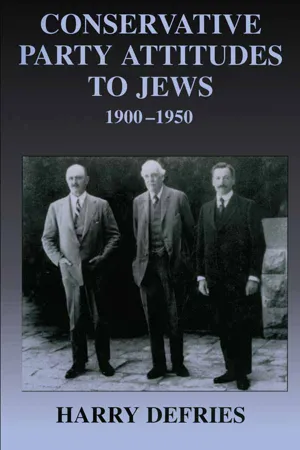
- 280 pages
- English
- ePUB (mobile friendly)
- Available on iOS & Android
eBook - ePub
Conservative Party Attitudes to Jews 1900-1950
About this book
This work examines the attitudes of the Conservative Party towards Jews in Britain, Palestine and elsewhere from 1900-1948. It aims to show how the Conservative Party in the first half of the 20th century regarded both itself and British society on the one hand, and Britain's role on the other.
––1––
Introduction
The purpose of this study is to examine the attitudes towards Jews which were held by the Conservative Party, and the consequences which resulted from these attitudes, in the period 1900–48. By this means it is proposed to shed light on the way in which the Conservative Party viewed itself and British society in the first half of the twentieth century. The changes in the Party will be examined in the light of its outlook and actions throughout the period towards the Jewish community in Britain, Europe and Palestine. It is an examination of the perception, rather than the reality, of the Jewish community.
The study examines the important policy issues, primarily immigration into Britain and the Palestine Mandate, where the Conservatives interfaced with Jewry; it is not an attempt to explore those issues which may have been considered important to the Jewish community in general or the Anglo-Jewish community in particular, nor is it an examination of the relationship of the Conservative Party to the Anglo-Jewish elite. An examination of those issues would fall to those undertaking a study of Anglo-Jewry rather than the Conservative Party. Nor is this work an exploration of the Jews and the Conservative Party; that subject has been considered by Geoffrey Alderman, primarily in The Jewish Community in British Politics1 and London Jewry and London Politics 1889–1986.2 Similarly, this is not a study of the relationships of individual Jews with the Conservative Party, although it does consider the development of a number of episodes involving Jewish Conservative politicians, such as the opposition to Samuel Samuel in Putney and the role of Leslie Hore-Belisha as a member of Chamberlain's cabinet.3 Thus a precise definition of ‘who is a Jew’ is not relevant for the purposes of this study.4 It is considered that a definition of Jews as being persons of Hebrew descent or whose religion is Judaism was sufficient to identify them as a group to those involved in the period under review.
This is also not a study of party institutions,5 but an examination of politicians, primarily Conservative parliamentarians. This study has deliberately focused on the parliamentary party. It will be suggested that the policies of the Party were largely decided by the parliamentary leadership. The backbench MPs would seek to influence those policymakers as would the Party officials and the voluntary Party; the effect of this influence diminishes the further one was removed from the seats of power. However, there are instances where contributions by local parties have made more than a local impact, such as the anti-Semitic references which appeared in the journal of the Ilford Conservative Association during 1926, which attracted the attention of the Board of Deputies of British Jews,6 and the motion at the conference of the Junior Imperial League in 1931 to adhere to the Balfour Declaration.7 The role of the Conservative national press, however, owing to its perceived influence and also to the interventions in political life during the period by their proprietors, will be reviewed, but this is not primarily an examination of the way in which the Conservative press established its policies or the role of its proprietors.
There is no distinction made between the Liberal Unionists and the Conservatives in that part of the study prior to their formal amalgamation in 1912 as it is suggested that there were no significant differences between those groups which affect this book.8 This study also utilizes the popularly held name of the Party from time to time.
This work suggests that generally the factions which arose in the Party during the period under review did not have any direct or indirect influence on the attitudes towards the Jews. The exception is the Tariff Reform campaign9 which had a significant impact and was perhaps a movement which had a fundamental impact upon the Party itself.10 In addition, the divisions over India and the opposition to appeasement are both discussed in the context of Conservative policies towards Palestine.11 The divergence in the Party between philo-Semites and anti-Semites did not result in the type of cleavage that was witnessed in other divisions in the Party, such as those outlined above. As will be examined throughout this study, there is evidence of anti-Semitism amongst those Conservatives who, objectively, may be regarded as pro-Jewish.
An anti-Semite is defined in the Concise Oxford Dictionary as a person ‘hostile to or prejudiced against Jews’. The term ‘anti-Semitism’ was coined in 1879, from the Greek, by the German agitator Wilhelm Marr to designate the then current anti-Jewish campaigns in Europe.12 It soon came into general use as a term denoting all forms of hostility manifested towards Jews throughout history. In any examination of the relationship between Jews and non-Jews, the reader, as well as the author, must be sensitive to the many different manifestations of what may be generally termed ‘anti-Semitism’. The ‘blackballing’ of a Jewish aspiring club member because of his ethnic character cannot be placed equally alongside the actions of the Nazi state in deliberately attempting to kill all Jews within its control; yet both are examples of anti-Semitism. Thus an examination of Conservative attitudes to Jews and ‘Jewish’ policy issues requires a recognition of the relative positions on the spectrum of pro- and anti-Semitic views and actions which took place during the period under review. Whilst this work is not one which seeks to compare directly Conservative attitudes to Jews with those of other British political parties or those in continental Europe, it is hoped that this study does allow the reader to place the varying Conservative attitudes in context.
The modern term ‘Zionism’ also first appeared at the end of the nineteenth century, denoting the movement whose goal was the political return of the Jewish people to the Land of Israel.13 Anti-Zionism, the opposition to the concept of the Jewish homeland and statehood, became almost synonymous with anti-Semitism in the 1970s in the writings of many left-wing intellectuals and politicians.14 However, during the period of this study, anti-Semitism does not necessarily imply anti-Zionism, as is suggested in Chapter 3, although by the 1930s it will be demonstrated that anti-Zionists were employing anti-Semitic stereotyping.15
There are throughout this study repeated references to parliamentary and other public statements by Conservatives which set out their attitudes to the Jews. These are expressions of the rhetoric used by Conservative politicians. It is suggested that there was generally little difference between this public rhetoric and the private expressions of opinion. An example is the examination undertaken of the accusations by some Conservative politicians and some of the Conservative press that the Jews were engaged in an international conspiracy to dominate the world.16 A further example is Lord Devonshire's private cabinet memorandum of February 1923, which reveals that he considered that anti-Zionism and anti-Semitism were linked by the anti-Jewish prejudice which had been intensified by the ‘vague belief’ in a world-wide Judaeo-Bolshevik conspiracy,17 a view apparently also held by Neville Chamberlain in 1939, as noted below. The use of language in the first half of the twentieth century was different from that at the end of the century. It is suggested here that there was less ‘coded’ use of English then than is undertaken by contemporary politicians, who appear concerned increasingly with so-called ‘political correctness’. Thus, the examination of the rhetoric in the earlier period is likely, at least in the case of this area of study, to be much closer to the true meaning which the speaker or writer wished to convey. Hence, it is legitimate for a historian to examine this public expression of opinion and give it due weight.
The period under examination begins at the commencement of a new century when the Conservative Party had won a general election and ends with the termination of Britain's mandate over Palestine. During this period of nearly half a century the Conservatives held office, alone or in coalition, for some two-thirds of the time; over 32 of those 48 years.
The Jewish community in Britain numbered probably about 160,000 in 190018 and 385,000 in 1945.19 The total population during this period was about 41,460,000 in 1900 and 49,180,000 in 1945.20 Anglo-Jewry thus formed about 0.39 per cent of the population at the beginning of the century. In 1945, although the Jewish community had disproportional growth compared to the general population, it formed only about 0.78 per cent of the inhabitants of the United Kingdom. Yet the perception of the size of the Jewish community in Britain was often very different from the reality. Northcliffe, the press lord, appeared to have an unrealistic appreciation of the number of Jews in the world. He is reported to have considered that in 1919 there were 1,500,000 Jews in London alone,21 while in 1940 a group of Conservative MPs wrote to the prime minister requesting that the refugees present in Britain should not be naturalised as this would ‘result in a permanent increase of our already over-large Jewish population’.22
It was not only the perceived size of the Jewish community which concerned Conservatives, but their perceived power. Leo Maxse, who had served as a vice-president of the National Union of Conservative and Unionist Associations and was the editor of the National Review, had run a vigorous campaign during 1912 on the Marconi affair and in the December dealt with the Indian Silver affair.23 He wrote:
Lest we be thought to write with prejudice on such matters – and we frankly confess to profoundly distrusting government by Isaacs, by Samuel, and by Montagu, not because they are Jews – for many Jews we have the greatest respect – but because they are bringing discredit to this country, which is falling more and more into the hands, not of the best Jews, who make admirable citizens, but of that type of Jew who regards the whole duty of man as consisting in scoring some material advantage.24
The National Review was passionately concerned with the defence of the Empire and was anti-German. Maxse equated pro-Germanism with the Jewish community in Britain and essentially saw the Jews as acting as a fifth column for the German state. In March 1913 he devoted space to his own article on ‘Disloyal Jews’, maintaining that ‘a certain number of disloyal Jews who infest both parties are equally active in playing Germany's game by intriguing against the Triple Entente’. Whilst protesting that he had no anti-Semitic prejudice, Maxse suggested that Britain would be ‘infinitely richer in everything that is worth having if those other Jews, who are little better than German spies, are returned with their money bags to the various countries they came from’.25
The expression of negative views towards Jews were not confined to the extreme right of the Conservative Party. Even those who did not maintain that Jews were necessarily disloyal believed that they could not be true Englishmen. Arthur Balfour considered that Jews, ‘however patriotic, able, and industrious, however much they threw themselves into the national life, still by their own action, remained a people apart and not merely held a religion differing from the vast majority of their fellow country-men, but only inter-married among themselves’.26 Fifteen years later, another leader of the Conservative Party, Austen Chamberlain, wrote to his sister after the debate in the Commons in July 1920 following the Amritsar massacre in India and General Dyer's suspension from command:
Our party has always disliked & distrusted [Montagu]. O n this occasion all their English & racial feeling was stirred to passionate display – I think I have never seen the House so fiercely angry – & he threw fuel on the flames. A Jew, a foreigner, rounding on an Englishman & throwing him to the wolves – that was the feeling, & the event illustrates once again what I said of Dizzy. A Jew may be a loyal Englishman & passionately patriotic, but he is intellectually apart from us & will never be purely & simply English.27
It was apparently irrelevant to Chamberlain that Montagu's family had immigrated to England in the late eighteenth century, that he was third-generation British, and that his father had sat in both Houses of Parliament. Montagu represented the Anglo-Jewish elite, which has been dubbed ‘the Cousinhood’, owing to the interconnected marriages which were consummated by this group.28 This coterie represented the leadership of the Jewish community. They had mainly originated from western Europe, unlike those Jews from eastern Europe who came to Britain in the mass immigration which began in 1881. Whereas much of the pre-1881 community had become middle class, the later immigrants, at least for a generation or more, were working class.29 Some of these working-class Jews were socialists or communists and, with similarly minded co-religionists elsewhere, were to provide further ammunition, if it were needed, for Conservative attacks on Jewry.30 One such incident occurred in April 1938 when the Jewish Labour MP, Emanuel Shinwell, was told to ‘[g]o back to Po...
Table of contents
- Cover
- Half Title
- Cass Series: British Politics and Society
- Title Page
- Copyright Page
- Table of Contents
- Series Editor's Preface
- Preface
- Acknowledgements
- 1 Introduction
- 2 The Conservatives and Alien Jewish Immigration, 1900–18
- 3 The Unionists and Zionism, 1900–18
- 4 Conservative Attitudes towards Jews in the Great War and the Russian Civil War
- 5 The Conservatives and Jewish Immigration, 1918–29
- 6 The Conservatives and the Palestine Mandate, 1920–29
- 7 The Conservatives, Anti-Semitism and Jewish Refugees, 1933–39
- 8 The Conservatives and Palestine, 1930–39
- 9 The Conservatives and the Jews during the Second World War
- 10 The Conservatives and Palestine, 1945–48
- 11 Conclusion
- Notes
- Bibliography
- Index
Trusted by 375,005 students
Access to over 1.5 million titles for a fair monthly price.
Study more efficiently using our study tools.
Frequently asked questions
Yes, you can cancel anytime from the Subscription tab in your account settings on the Perlego website. Your subscription will stay active until the end of your current billing period. Learn how to cancel your subscription
No, books cannot be downloaded as external files, such as PDFs, for use outside of Perlego. However, you can download books within the Perlego app for offline reading on mobile or tablet. Learn how to download books offline
Perlego offers two plans: Essential and Complete
- Essential is ideal for learners and professionals who enjoy exploring a wide range of subjects. Access the Essential Library with 800,000+ trusted titles and best-sellers across business, personal growth, and the humanities. Includes unlimited reading time and Standard Read Aloud voice.
- Complete: Perfect for advanced learners and researchers needing full, unrestricted access. Unlock 1.5M+ books across hundreds of subjects, including academic and specialized titles. The Complete Plan also includes advanced features like Premium Read Aloud and Research Assistant.
We are an online textbook subscription service, where you can get access to an entire online library for less than the price of a single book per month. With over 1.5 million books across 990+ topics, we’ve got you covered! Learn about our mission
Look out for the read-aloud symbol on your next book to see if you can listen to it. The read-aloud tool reads text aloud for you, highlighting the text as it is being read. You can pause it, speed it up and slow it down. Learn more about Read Aloud
Yes! You can use the Perlego app on both iOS and Android devices to read anytime, anywhere — even offline. Perfect for commutes or when you’re on the go.
Please note we cannot support devices running on iOS 13 and Android 7 or earlier. Learn more about using the app
Please note we cannot support devices running on iOS 13 and Android 7 or earlier. Learn more about using the app
Yes, you can access Conservative Party Attitudes to Jews 1900-1950 by Harry Defries in PDF and/or ePUB format, as well as other popular books in History & Middle Eastern History. We have over 1.5 million books available in our catalogue for you to explore.