eBook - ePub
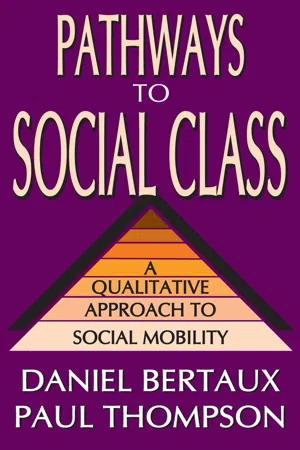
Pathways to Social Class
A Qualitative Approach to Social Mobility
- 344 pages
- English
- ePUB (mobile friendly)
- Available on iOS & Android
eBook - ePub
About this book
Calling for a broader, new approach to social mobility research, Pathways to Social Class: A Qualitative Approach to Social Mobility moves beyond pure statistics to use qualitative techniques-such as life stories and family case studies-to examine more closely the dynamics of mobility and address more fundamental sociological questions.
Information
1
Introduction
Daniel Bertaux And Paul Thompson
Behind this book lies a dream, which we have shared for many years: a dream of a renewed study of social mobility rising to grapple with the astonishing diversity and complexity of its fundamental theme. We are convinced that such a renewal must depend upon a broadening of methodological and theoretical perspectives. The closely linked case studies which we present here are demonstrations of the richness of insights which new approaches to social mobility can bring.
Social mobility processes are integral to the very metabolism and core regulation of societies, both to their continuity and change over time. It is through such processes that basic social structures of class, status, and situs (branches of industry) are reproduced or transformed, emerge or disappear; that societies themselves move forward, consolidate or splinter, that institutions and enterprises recruit, that families launch their children, that individuals imagine and seek personal fulfilment in their lives. These processes are complex because they operate within unstable frameworks, and because they are intrinsically reflexive. All these levels interact between each other and none of them are constant. The incessant thrust of technological and economic change continually creates new types of work and opportunity in some places, while wiping out entire industries and ways of life in others. Just as marriages break and firms go bankrupt, so whole political societies may be recast or split through revolutions, wars, or the dissolution of empires. Individuals swim in waters now benign, now turbulent. Some may flourish in an inherited family niche, while others will starve in the same way. Against those who succeed or fail through transmission, we need to set those who choose to migrate in search of a better life, those who move to escape an economic trap, or those driven to adapt by the turmoil of revolution, fleeing from persecution or war, and death.
Change originates not only from above, but equally from below, through the initiatives of masses of people. Through having fewer children or more, or through moving, voting with their feet, they can transform the structures of social space or demography.1 At any given moment the range of possibilities for a given social group, or family, or individual, are limited: shaped negatively by restrictions such as lack of economic or cultural resources but also by group prejudice and privilege, positively by the opportunities provided by the local and national economy, access to education, means of travel and social imagination. Most people take the structure they see as given and circulate within it, filling a space; but a sufficient minority contribute to the momentum of change by either creating new spaces within the old structures, or moving. The changing roles of women and men, the world-wide currents of emigration and immigration, are all witnesses to the widely dispersed human drive towards a better life. And in the development of this drive, the engine of social change and individual fulfilment— or disappointment—the primary location of generation and transmission lies within families, which provide the social and emotional launch pads for individual take-off.2
At all social levels—from politics and economics to local and family relationships—social competition and rivalry intertwine with mutuality and obligation. And because all these levels interlock and interact and yet are propelled by their own semi-independent logic, the outcomes must always be uncertain. Equally important, the strategies which succeed in a particular historical time and social context cannot be assured to work in another. Individuals, families, and organizations struggle after ways of sur-viving or succeeding in social worlds which are always evolving: to create limited spheres of order in the perpetual shadow of turbulence or even chaos. This fundamental instability of the human social universe means that laws of social mobility would themselves be timebound illusions. The understandings which we can reach of the social meanings and experiences of mobility, and the complexity of processes which underlie it, cannot pretend to universality: their validity depends upon how clearly they reflect their historical moment.
The Classics of Sociology
If we look back to the classic texts of the founding fathers of sociology, it is immediately evident that within the broad canvasses which they drew, most of them saw the characterization of social mobility processes, whether of individuals or whole groups in competition, as crucial to understanding the evolution of societies.
Thus when de Tocqueville depicted early 19th-century American society, he highlighted its lack of an aristocratic tradition on the European model, and how its heavy emphasis on equality of opportunity and equity in reward made for a special dynamism, by allowing its most energetic citizens to win prosperity unchecked by entrenched privileges. For him individualism and the aspiration to upward mobility were at the centre of the American cultural model, which he rightly perceived as different from the European ones. In the same spirit, when de Tocqueville compared the fates of England and France at the end of the 18th century, he pointed to the openness of the English aristocracy, so that successful commoners could readily be co-opted to its ranks through ennoblement, thus greatly reducing the chances of social revolution, in contrast to the rigidity of the French aristocracy which prepared the ground for the French revolution.3 For Pareto too the relative openness of the upper classes was a central issue. He devoted his main book to the battling for social power between élites and counter-élites, and concluded that a core process in European societies was the ‘circulation of elites’.4
The same theme fascinated Sorokin, whose magnificently ambitious Social Mobility is the last and most explicitly titled of these classic texts. It centres on the recurrent competition between social groups, but again especially between élites and counter-élites. Sorokin draws up his interpretations through examining a remarkably wide range of historical cases, from the skill of India’s Brahmins in holding on to their power through centuries to the less lucky fates of some of the European aristocracies, including that of Russia, whose catastrophic demise and fall he himself witnessed in 1917.5
Durkheim, whose social theory was dominated by a conservative sense of the need for social order and integration, tended to view social mobility as a disruptive rather than an adaptive process.6 Subsequently Parsons similarly focused on the social mechanisms of systemic integration, continuity and stability rather than change, and he also showed too little sense of the historical dimension. On the other hand, in terms of understanding the connections between different social levels, and especially the importance of the institution of the family, his contribution was important and far-sighted.7
The opposite view was of course taken by Marx, who saw social conflict as the principal dynamic of change. Yet when re-examined more closely, his perspective has more in common with the other founding sociologists than might be first assumed. For if there is a vital thread connecting these earlier classic pieces of sociological thinking, it is certainly not simply social mobility in the narrower sense of individual movement which the term is widely taken to imply today. The issue can be better characterized as the continual process of ‘generalised social competition’ through which individuals, families, and social groups all fight for their share of resources and their spot in the sun. For instance the proletarian revolution for which Marx called would have resulted in a clear and dramatic process of collective social mobility, upwards for the proletariat, downwards for the bourgeoisie: and it is the anticipation of such fates that fuelled the dynamic of class struggle—especially the con-stant struggle of the capitalist class against the formation of the proletariat into a class for itself.8
Seen in this way, Marx’s thinking confronts many of the same issues. For instance he was well aware of the openness of American society, and indeed foresaw the possibility that through a combination of continuing immigration, followed by upward mobility often through small independent enterprise, the American working class, even if swelling in numbers, might fail to consolidate into a class on European lines, because too few families stayed in it for long enough. A working class with such a fluidity was inimical to solidarity.9
Driven by close observation to a reluctant admiration of the English bourgeoisie’s entrepreneurial spirit and the French bour-geoisie’s political courage, Marx found much less to admire in the German middle ranks which he found wanting in both economic initiative and political audacity. Weber, however, was much less pessimistic about them. His The Protestant Ethic and the Spirit of Capitalism is a brilliant case study of how cultural values contributed crucially to the historic upward mobility of Calvinists and other Protestant groups as economically successful entrepreneurs. Weber also shared with Simmel—in his Philosophy of Money—an understanding of the emergence of a modern urban society reshaped by markets, creating a free-for-all space in which individuals, bringing initially drastically unequal sets of resources and thus of life chances, nevertheless competed for goods and money, for social recognition and political power. Both Weber and Simmel sought to identify the games and rules of this generalized competition, whose outcome was and still is the sharply differentiated life trajectories which mark out mobility.10
Social mobility processes in the broader sense were thus a concern in one way or another of all the founding fathers of sociology. Most of them also showed a clear understanding of the importance of specific historical contexts. It is true that too many of them tried to push their interpretations into social equivalents of natural laws. But above all, for us their strength is the breadth and diversity of perspective within which they situated their discussions of social competition and mobility: and in this they exemplify the broader spirit in which social mobility can still be studied.
The Survey Paradigm
Whereas the early classics of sociology set the social-historical processes of social mobility and social dynamics at the heart of their thinking, today social mobility research has become a highly specialized and technical field. Over the last forty years it has been entirely reshaped by the adoption and development of the survey as its almost exclusive method. Increasingly, as its methodological sophistication has intensified, social mobility research has narrowed its interests to hypotheses which a survey can test, at the price of cutting itself off from the observation of other dimensions of mobility processes and from the development of sociological and historical thinking as a whole.
The attraction of the survey for the study of social mobility is obvious. It is indeed an excellent tool for describing statistically the relative sizes of human flows between social classes or strata. The patterns of these intergenerational flows show the enormous impact of economic development (structural mobility) and the relatively low level of downward mobility flows. These patterns can also be tested against an ideal society of equal opportunity, to provide a mathematical measure of social justice.11 They can also be compared across nations, as Goldthorpe and Erikson have done with great mastery in The Constant Flux.12 It is also possible to test, across large numbers of individual cases, whether for example a mother’s or father’s occupation or education or a son’s own education or first job are likely, on average, to weigh more or less in the son’s main occupation.13 Quantitative description and testing clearly has a crucial role in social mobility research.
The problems start when the survey, instead of being conceived as one way of looking at the flows of men and women in social space, comes to be regarded as the only scientific approach to the study of social mobility processes. For the technical requirements of the survey tend to dictate substantive choices and narrow down the range of observed phenomena—as for example in the repeated focus on men rather than women. There is far more to social mobility processes than is ever likely to catch the unaided survey eye, as we believe this book demonstrates. Indeed at their narrowest, statistical studies of social mobility resemble the observation of a carnival through a keyhole.
To some extent the limitations of the survey perspective are ascribable to a narrowness of theoretical perspective, for stratification has been the only major theoretical field with which mobility research normally interacts. But our belief is that the difficulty lies with the intrinsic logic of the method itself as much as with its theoretical orientation. Certainly, as Mike Savage argues in Chapter 10, the survey method can and should be modified in important respects; and there are very few aspects of human life which are absolutely out of range of the survey. But the survey method is best used to do what it can do most efficiently, rather than in aiming at reducing other methods, with different strengths, to its own ways of seeing. It is condemned to remain blind to core aspects of the very processes which it aims to investigate; which is why the approach of case study—which, conversely, also has its own built-in limits—is vital for the full development of the field.
The strength of the survey method derives from its ability to describe social phenomena in terms of numbers, and to generalize its empirical findings to the whole population which it investigates through the technique of the representative sample of individuals. From this sample each interviewee must answer to the same basic list of closed questions. The built-in limitations which ensue are characteristic weaknesses of the survey method: the obverse side of these same strengths.14
One basic corollary of analysing through numbers is that argument and description become dominated by the language of variables, and give little space to matters which cannot be adequately conveyed through that language. Thus life stories show the central-ity of subjective perceptions and evaluations in shaping the life choices. They are redolent with descriptions of feeling and experience of relationships with significant others, with interpretations of turning-points, with influences which were rejected rather than followed, with dreams of lives that might have been. They also reveal the crucial importance of local contexts, local structures of opportunities, and local games of competition. The essential point is not whether or not some of these matters are quantifiable, but that they are much more clearly expressed in words. The language of words is infinitely vaster, richer, and more capable of subtler, particular variation; while the attraction of mathematics is precisely in its simplifying abstraction. The strength of one cannot be reduced to the strength of the other: they flourish best in their own ways, distinct but complementary.
Another weakness of the survey approach to social mobility research derives from the unit of observation: the randomly-chosen individual, whom the analysis tends to treat as an isolate. Yet individuals are embedded within family, occupational, and local contexts, and mobility is as much a matter of family praxis as individual agency, for it is families which produce and rear individuals with specific characteristics and social skills, endowing them with their original moral and psychic energy and with economic, cultural, and relational resources. Equally, as Schumpeter once remarked, social—as opposed to occupational—status is primarily carried by families rather than by individuals.15
It would of course be possible for surveys to base their samples on households or—as in our own An...
Table of contents
- Cover Page
- Title Page
- copy
- Contents
- List of Figures
- Notes on the Contributors
- 1 Introduction
- 2 Women, Men, and Transgenerational Family Influences in Social Mobility
- 3 Heritage and its Lineage: A Case History of Transmission and Social Mobility over Five Generations
- 4 Shadow and Reality in Occupational History: Britain in the First Half of the Twentieth Century
- 5 The Familial Meaning of Housing in Social Rootedness and Mobility: Britain and France
- 6 The Local World View: Social Change and Memory in Three Tuscan Communes
- 7 Migration, Mobility, and Social Process: Scottish Migrants in Canada
- 8 Transmission in Extreme Situations: Russian Families Expropriated by the October Revolution
- 9 Social Mobility in Hungary since the Second World War: Interpretations through Surveys and through Family Histories
- 10 Social Mobility and the Survey Method: A Critical Analysis
- Index
Trusted by 375,005 students
Access to over 1.5 million titles for a fair monthly price.
Study more efficiently using our study tools.
Frequently asked questions
Yes, you can cancel anytime from the Subscription tab in your account settings on the Perlego website. Your subscription will stay active until the end of your current billing period. Learn how to cancel your subscription
No, books cannot be downloaded as external files, such as PDFs, for use outside of Perlego. However, you can download books within the Perlego app for offline reading on mobile or tablet. Learn how to download books offline
We are an online textbook subscription service, where you can get access to an entire online library for less than the price of a single book per month. With over 1.5 million books across 990+ topics, we’ve got you covered! Learn about our mission
Look out for the read-aloud symbol on your next book to see if you can listen to it. The read-aloud tool reads text aloud for you, highlighting the text as it is being read. You can pause it, speed it up and slow it down. Learn more about Read Aloud
Yes! You can use the Perlego app on both iOS and Android devices to read anytime, anywhere — even offline. Perfect for commutes or when you’re on the go.
Please note we cannot support devices running on iOS 13 and Android 7 or earlier. Learn more about using the app
Please note we cannot support devices running on iOS 13 and Android 7 or earlier. Learn more about using the app
Yes, you can access Pathways to Social Class by Daniel Bertaux,Paul Thompson in PDF and/or ePUB format, as well as other popular books in Social Sciences & Social Classes & Economic Disparity. We have over 1.5 million books available in our catalogue for you to explore.