- 188 pages
- English
- ePUB (mobile friendly)
- Available on iOS & Android
eBook - ePub
About this book
The world-wide growth in demand for Japanese throughout the world has led to rapid developments in Japanese language teaching. This volume examines these developments and their implications for the future in a series of case studies.
Information
Chapter 1
Developing a Japanese language learning aptitude test
UNIVERSITY OF TSUKUBA3
1. Introduction
This author has been personally involved in the joint development of a ‘Japanese Language Learning Aptitude Test’ (to be referred to as the ‘Test’ hereafter in this paper) at Nagoya University since 1981, and subsequently at Tsukuba University from 1985. In October 1979, a Japanese language learning course was established at Nagoya University for state-sponsored foreign research students, with scholarship funds provided by the Japanese Ministry of Education (Monbushō). The aim of the programme was to cultivate Japanese language skills required for practical use in study and research at the postgraduate level. Only about 600 contact hours were, however, allotted for this learning, making it a challenging task for both students and instructors.
Courses were held twice a year, starting in October and again in April; from the inauguration of the programme in October 1979, four courses were held between October 1979 and September 1981. The initial method adopted for dividing the classes into smaller groups was by alphabetic order of names, followed up by monitoring of individual student progress during the study of hiragana. Adjustments were then made on the basis of the results of the monitoring; the outcomes of subsequent tests that were administered to the groups were also used to reorganise the class structure. Under this procedure, a period of almost one month was required to achieve a stable class structure. Thus a major expenditure of time was needed to get each programme off the ground, with approximately one sixth of the total programme time period being devoted to establish a grouping of classes that fitted the progress speed of the students, and the selection of teaching methods appropriate for each group. The Test presented and discussed in this paper was developed as a solution to this problem.
2. Summary of the first-generation Test
The Test comprises three subtests designed for measuring three skill areas:
1. The ability to process visual information (prepared by Ōtsuka Yōko)
2. The ability to process hearing information (prepared by Ōsaki Yoshiko)
3. The ability to analyse sentence structure (prepared by Fujiwara Masanori)
2.1 Measuring the ability to process visual information
2.1.1 Pattern Recognition Question
In this question, a stimulus pattern slide was displayed for five seconds; students were then asked to select that same stimulus pattern from a group of four test patterns within five seconds (see Fig. 1 below). Six sub-questions were conducted for each of three tests:
1. Displaying the stimulus pattern and the test patterns simultaneously (Question I)
2. Displaying the questions successively (Question IV)
3. Displaying a mask between the stimulus pattern and test patterns to erase the afterimage (Question VII)
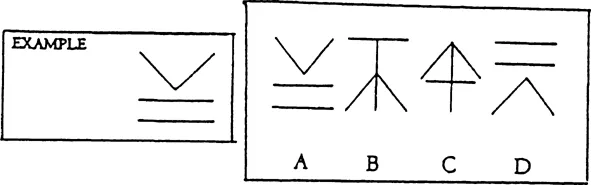
(Fig. 1)
2.1.2 Kanji element abstraction and character shape pattern question
In Question III, students looked at five kanji and were asked to determine which of the four kanji on the right has an element identical to the kanji on the far left (see Fig. 2 below). After having been given three examples illustrating what is required in this question, students were then asked to solve five of these questions in three minutes.
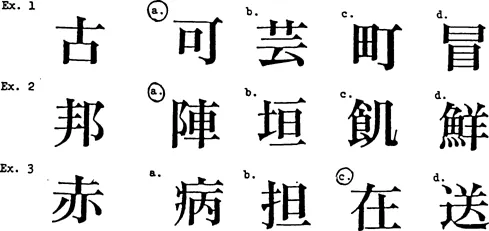
(Fig. 2)
In Question IV, students view a chart displaying character component shapes such as the left (hen), crown (kanmuri), trailing (tare) or enclosure (nyō) patterns, and are then asked to select the appropriate elements for five kanji from five question patterns, as shown in Fig. 3 below. This question had to be completed in three minutes.
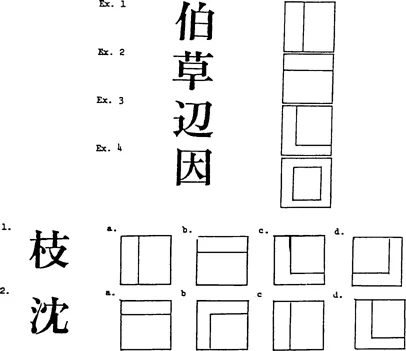
(Fig. 3)
2.2 Measuring the ability to process hearing information
2.2.1 Memorising continuous sounds (Question VIII)
In this question, students listened to a continuous sound such as satapakama and then had to select from the four word samples written in romanisation the sound closest to the one they memorised. Four such questions were conducted.
2.2.2 Memorising several different sounds (Question IX)
Students listened to mora sounds (e.g. pa, ma, ta) and then had to select from several sound combinations given on the question sheet the combination that contained all of the sounds heard initially. Four such questions were conducted.
2.2.3 Identifying differences between sustained sounds (Question X)
Students had to capture the differences between pairs of similar-sounding items, such as papa and pāpā. Six such questions were conducted.
2.2.4 Identifying phonemes; memorising continuous sounds (Question V)
Students listened to one continuous sound including phoneme contrast, an area which is known as being difficult for students of the Japanese language, and then had to select from four continuous sounds the one heard first. A total of 22 sub-questions were posed. This question required the identification and memorisation of contrasting phonemes, which is again a difficult area for many foreign learners of Japanese.
2.3 Measuring the ability to analyse sentence structure
For this area, an artificial language was created in accordance with the rules of Japanese grammar. For each question, students were provided with a small dictionary translating entries of the artificial language into English, and from English into the artificial language. The dictionary entries covered the three major word classes of Japanese (nouns, verbs and adjectives), but particles, adverbs and conjunctions were not included.
The question required students to work out a grammatical rule from the three to four examples given, then match the item given in the question by choosing the appropriate form from the alternatives provided. A total of 30 sub-questions was posed, with 30 minutes available (see Fig. 4 overleaf). (Question VI).
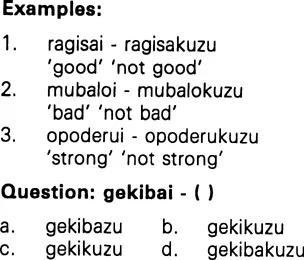
(Fig. 4)
The above was a general description of the content of the first-generation Test, which was designed to be taken in 90 minutes. Section 3. below deals with the analysis of the Test and its results.
3. Test analysis
The above-described first-generation Test was used from October 1981 to April 1985. Using the data compiled on the 84 students who were administered this test from 1981 to October 1984, a team led by Murakami Kyōko made an analysis of the Test in 1986, which succeeded in clarifying the two areas (3.1 and 3.2) given below:
3.1 Aptitude test: final test correlation chart
As shown in Table 1, the reliability of the respective subtests was 0.79 for the visual questions, 0.53 for the hearing questions, 0.84 for the grammatical questions, and 0.86 overall. In so far as the overall score is concerned, this is a generally satisfactory level. When one looks at the individual subtests, however, with the exception of the grammatical questions, the reliability of the visual and hearing questions is not so satisfactory. In particular, the hearing questions were unsatisfactory.
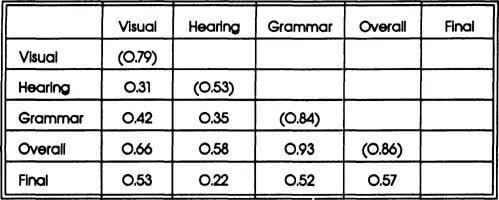
NOTE: Figures in parentheses indicate the alpha coefficient
(Table 1)
3.2 Aptitude test: final test averages ...
Table of contents
- Cover
- Half Title
- Title Page
- Copyright Page
- Table of Contents
- Preface
- About the Editor
- Introduction Recent approaches in course design and materials development for the teaching of Japanese: an overview
- Chapter 1 Developing a Japanese language learning aptitude test
- Chapter 2 Designing materials for Business Japanese: the SOAS/DTI Diploma Course
- Chapter 3 An integrated approach to placement in Japan
- Chapter 4 Teaching Japanese using Apple Macintosh and HyperCard
- Chapter 5 The potential of CASTEL/J: a database-oriented approach to CALL
- Chapter 6 The new GCSE Japanese: syllabus and materials
- Chapter 7 Teaching Japanese in Derbyshire: an area-based approach
- Chapter 8 The importance of design to an English-Japanese learner’s dictionary for English-speaking users
- Chapter 9 Course design for autonomous learning
- Bibliography
- Notes
Trusted by 375,005 students
Access to over 1.5 million titles for a fair monthly price.
Study more efficiently using our study tools.
Frequently asked questions
Yes, you can cancel anytime from the Subscription tab in your account settings on the Perlego website. Your subscription will stay active until the end of your current billing period. Learn how to cancel your subscription
No, books cannot be downloaded as external files, such as PDFs, for use outside of Perlego. However, you can download books within the Perlego app for offline reading on mobile or tablet. Learn how to download books offline
Perlego offers two plans: Essential and Complete
- Essential is ideal for learners and professionals who enjoy exploring a wide range of subjects. Access the Essential Library with 800,000+ trusted titles and best-sellers across business, personal growth, and the humanities. Includes unlimited reading time and Standard Read Aloud voice.
- Complete: Perfect for advanced learners and researchers needing full, unrestricted access. Unlock 1.5M+ books across hundreds of subjects, including academic and specialized titles. The Complete Plan also includes advanced features like Premium Read Aloud and Research Assistant.
We are an online textbook subscription service, where you can get access to an entire online library for less than the price of a single book per month. With over 1.5 million books across 990+ topics, we’ve got you covered! Learn about our mission
Look out for the read-aloud symbol on your next book to see if you can listen to it. The read-aloud tool reads text aloud for you, highlighting the text as it is being read. You can pause it, speed it up and slow it down. Learn more about Read Aloud
Yes! You can use the Perlego app on both iOS and Android devices to read anytime, anywhere — even offline. Perfect for commutes or when you’re on the go.
Please note we cannot support devices running on iOS 13 and Android 7 or earlier. Learn more about using the app
Please note we cannot support devices running on iOS 13 and Android 7 or earlier. Learn more about using the app
Yes, you can access Japanese Language Teaching in the Nineties by Stefan Kaiser in PDF and/or ePUB format, as well as other popular books in Social Sciences & Education Curricula. We have over 1.5 million books available in our catalogue for you to explore.