eBook - ePub
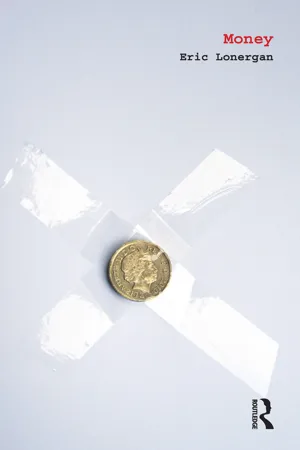
Money
About this book
Eric Lonergan explores our complex relationship with money. In a provocative and insightful analysis, he argues that few things seem to matter more to us, but few things are as poorly understood. Economists have long worked with the theory that our relationship to money is rational, but not all our reactions to it make sense. Lonergan shows that many of our views about money, credit and saving are little better than prejudices. The same social and emotional forces that affect quant traders in the worlds financial markets can be seen in the mania of Pok n card trading in the school playground.This fascinating book reveals the tension between money's capacity to assist us in our lives and its propensity to cause instability and to distort our values. We are limited in our ability to control money's power, says Lonergan, but only by understanding money better, and thinking about it less, may we get on with enjoying what we have.
1
Print it
It values everything, but costs nothing.
Child's play
Where money comes from is unknown to most people, including most who work in the world’s financial centres. If you asked most finance ministers where money comes from they would be loath to admit to the truth: that they are not really sure. People rarely think about it. Like many things in life, using money doesn’t usually require any understanding of how it works or even where it comes from. My young daughter is no different. She would prefer it if I was a policeman. “Hedge fund manager” doesn’t mean much to her. But our system of money and banking has one property that intrigues even young and impatient minds: it functions mysteriously, almost magically; its origins are clandestine. The banking system is usually stable and disregarded, even though it ties all our activity together. It is intrinsically fragile because it depends on confidence, although no one is really conscious of this. Most mysteriously of all, when destabilized by panic – our sudden awareness of this fragility – it is usually costless to stabilize, requiring little more than pressing a button on a keyboard and speaking a few words. That is why it is easier to explain money’s origins to children: it is too simple for adults to accept.
My daughter likes magic and mystery, so I try explaining banking to her. I leave hedge funds for another occasion, when I can think of a way to cast them in a positive light. Banks are useful. We deposit money with them, and they use this money to lend to other people, allowing them to buy houses or cars, and sometimes to pay bills. People need to borrow because houses and cars cost a lot and they cannot pay for them in one go. People also need to save. Banking is a kind of inter-temporal sharing arrangement: sharing across time. Some people have surplus money today, but they will need it in the future when they retire, others would like to borrow now and repay through time. It follows that savers are usually older than borrowers. Savers receive interest because they are lending money. A younger person gets a house, and an older one receives interest on their savings. Some countries seem to have higher interest rates than others. One reason is the age of the population. Countries with young populations are likely to have higher interest rates than those with older populations.
It doesn’t take long to get into philosophy. My daughter’s ability to reason is at the point where she can ask, “If God made us, who made God?” In a similar vein she asks me, “Where does the money come from, in the first place?” As with God, the origins of money are disconcerting when exposed to very straightforward scrutiny.
“What? They just print it?”
“Well … actually, yes. In fact, they don’t even have to bother printing it any more; they just press the 1 on their computer keyboard, and then the 0 a few times. They probably ask someone else to physically press the keys, and there is almost certainly someone who checks that they don’t make any mistakes … Some central banks store some gold, just in case, and not very much. They hold gold mainly out of nostalgia for the era of metal standards when, say, one pound note could be exchanged for a pound of silver.”
It is worth being clear about this process, because children are not alone in finding it disconcerting. I find it disconcerting, although I don’t know why. This strange fear, engendered by our ability to create money out of nothing, explains in large part why governments and policy-makers have been so reluctant to prevent the needless economic suffering that is generated by financial panic. The fear is not completely irrational, as we shall see, but in the main it is. If the eurozone ever does break up, this irrationality will be the root cause.
Every year a country’s central bank decides how much money to create, say, $1bn (or the local currency equivalent). They do not just gift this to the public, although they probably should. They usually get the money into the system by buying something from banks: usually government bonds. Over time, the amount of money in the economy grows depending on how much the central bank decides to create. They usually decide this on the basis of how fast they believe the economy can grow, and they grow the stock of money proportionately. This is entirely sensible. It happens all the time, and we pay no attention to it.
This real-world alchemy does not end with the central bank creating money out of thin air. Effortlessly, the banking system amplifies and multiplies the effects of this $1bn through lending. Banks lend the $1bn of cash they receive from the central bank to companies and individuals. Companies and individuals spend the money, paying other companies and individuals, who in turn deposit the money back in the bank, which lends it again, and so on. At the end of this multiplying process of lending, spending and re-depositing, deposits and loans grow to a multiple of the amount of money that the central bank created in the first place. Some people have savings, and other have houses: not just houses, of course, but factories, roads, universities and businesses.
It all happens without our really being aware that it happens. Progress depends on it. But we don’t learn about it at school. It doesn’t even get explained on business courses or in economics lessons. Many people believe that their money is stored in a safe at the bank, if they think about it at all. Ignorantly, we think of a deposit with a bank as money; indeed, in most of economics deposits are referred to as “money”, and are categorized as such in official statistics, which is misleading. Deposits are not money: they are loans we make to banks.
This fact is essential to a banking panic. Precisely because the total value of deposits exceeds the amount of money in banks by a factor of twenty to thirty, if everyone tries to redeem their deposits at the same time the bank runs out of cash. But the solution to a banking panic is effortless, and disconcerting: a central bank merely needs to say that it will create as much money as is needed, and provide this to the banks, and everyone should calm down. If everyone wants to withdraw their deposits simultaneously, they can. If they can, they don’t need to, so they won’t. The central bank can provide this commitment as long as its computers are switched on. The banking system is stabilized instantaneously when there is trust, and the ability to create money at will creates this trust.
On 10 October 2008 we came very close to having a bank run across the entire global banking and financial system. We were lucky it was a Friday. Over the following weekend, the major countries of the world announced that they were willing to create as much money as was necessary should everyone wish to take out their deposits – they didn’t use those precise words, but that was the implication – and so it was not necessary. It was too late to avoid the ensuing recession, caused in the main by the effects of this severe panic, but total collapse was averted. It cost nothing but words.
Too easy
You may not believe all of this, particularly if you are a normal, sensible person. It can’t be that easy to prevent human suffering. Indeed, Franklin D. Roosevelt, US president during the later years of the Great Depression, is believed to have initially dismissed this solution, or a variant of it, precisely for being “too easy”. For some reason, human beings are very resistant to the belief that something as important as money can be created so easily, and at no cost, and furthermore that during a panic, and a severe recession induced by the panic, money should be printed and handed out to the public to spend. There is nothing dangerous or irresponsible about this, no more than it is dangerous or irresponsible to use water to put out a fire.
I expect that you distrust this author’s recommendation that a costless gift of cash to the public can ever solve serious economic problems. You may be inclined to check my credentials. Is the author a crank? It is human to seek reassurance from authoritative figures. We are all conventional. So I refer you to an article published by former chairman of the US Federal Reserve Board Ben Bernanke. It is inelegantly entitled “Japanese Monetary Policy: A Case of Self-Induced Paralysis?” (Bernanke 2000). This paper was written by Bernanke when he was a professor at Princeton University in December 1999. He was unimportant then and could talk more openly and freely than he does now that his every word is scrutinized. In the paper, his final policy recommendation for Japan, which was perceived to be struggling with an apparently interminable recession, is precisely that the central bank print money and give it to the population. He was right, but they never did it. Why? Partly because they did not believe a solution could be that easy. And partly because they were scared.
What is the cause of this fear? Perhaps we are all hesitant and fearful in proximity to real power. There is a fine line between power and danger, and the authority to print money is an extraordinary power. The solution of simply printing money may seem trivial relative to the gravity of a recession, which incurs serious human suffering. It is nonsensical, irrational, but at least honest, to admit that you regard a solution as “too easy”, as though to be credible in a crisis the measures must be difficult to take. Many of these attitudes are failures of analysis and understanding. This is not to say that extreme caution and vigilance are not warranted in granting power over the printing press, because in human history this power has been abused to very costly effect, generating rising inflation or in extremis hyperinflation.
How is it that money has these dual powers: to facilitate complex exchange and stave off panic in an instant, but also, in the wrong hands, to wreak its own destruction? The economist Paul Krugman makes frequent reference to an article in the Journal of Money, Credit and Banking by academics Joan Sweeney and Richard Sweeney (1977). The article analyses a babysitting group. I first came across this parable in Krugman’s book Peddling Prosperity (1994), and despite the relatively trivial activity under study, it provides a uniquely clear way of answering this question.
A simplified version of the Sweeneys’ story goes as follows. A large group of parents, mostly lawyers, decide to organize their babysitting requirements. It was probably one particularly high-powered couple who came up with the idea, and decided to impose it on the group (this is not a premise of the original paper, I should add). The parents decide to issue two “babysitting coupons” to each family, and things get off to a reasonable start. But after a month or so, parents try to save coupons and the system grinds to a halt. In an attempt to save and hold more than two coupons in reserve, everyone volunteers to babysit, and no one is willing to spend. There is a babysitting recession: a combination of unemployed babysitters, and no parents able to escape.
Being lawyers, their instinct is to legislate and force people to go out on predetermined days. But social events can’t be legislated in advance. The strength of a free market is that it adapts to the specifics of time and place. Finally, after a lengthy consideration of Keynesian, Austrian and monetarist theories, they printed more coupons, and the babysitting economy recovered. That is exactly how money works in the economy. If everyone suddenly decides to save as much as they can – owing to panic, fear or extreme pessimism – activity will grind to a halt. The solution is to give them more money and assuage their fear.
Now imagine that the coupon-printing mother in the babysitting co-op starts to get greedy, and reasons that if she prints herself a few more coupons no one will notice. She tries a few times, and it works. So she does a few more. Soon, she goes a little mad and prints as many as she can. A problem then arises: more people want to go out than are willing to babysit. It does not take long for someone to start offering two coupons for one evening’s babysitting. That’s inflation. (If it continues, there will be a revolution, of course, and her trusted authority as the printer of coupons will be revoked.)
A country’s level of inflation tells us a lot about that country. Normal levels of inflation, between 1 per cent and 5 per cent, imply that the institutions of government can function with a reasonable degree of trust, because the power to print money is not being abused. But if inflation goes from 5 per cent to 10 per cent, and then 30 per cent or higher, as is the case in Argentina or Zimbabwe, it tells you something more sinister is at work. For most of human history, sufficient trust did not exist for a system of paper money to persist. It is probably the case that sufficient trust could not exist, because there was no way to monitor rulers. That is why we relied on metal standards or used precious coins with intrinsic value. Our ability to monitor government, which requires information and independent institutions such as statistical agencies, legal institutions and a free press, has made paper and electronic money possible. Rapidly rising inflation is a sign of desperation, or dictatorship.
Retribution
We tend intuitively to think of many economic issues as zero-sum: one person’s gain is another’s loss. We find it difficult to accept that market economics works because, like most forms of human cooperation, the sum is worth more than the parts. But panic and fear impose costs on all of us because the process of cooperation breaks down. Printing money to stabilize a panic or reverse a recession benefits everyone at no necessary cost to anyone. Even many technical economists miss this point by perceiving the process purely in terms of inflation. This view is premised on the assumption that money is “neutral”, meaning that it does not affect the level of economic activity, but only the price. But the parable of the babysitters illustrates otherwise. The availability of money in a panic directly affects the level of activity and not just the price, because contractions in the economy have enduring consequences. Money can defy the law of supply and demand. In very particular circumstances, if you produce more of it, its value (or purchasing power) can rise.
Severe recessions do not necessarily cause the price level to fall, but they are likely to permanently impair our ability to produce goods and services. In purely economic terms, recessions can result in a more sustained loss of skills and an irrecoverable loss of capital resources. This is enduring damage to what economists call the supply side of the economy: our ability to provide goods and services. At a more important human level recessions are likely to cause significant psychological scarring and, at their worst, increases in violence, crime and child poverty. The cold terminology of economics describes all of this as a decline in human or social “capital” . All that really means is that it has enduring effects: it affects the future and not just the present.
For much of our economic history, and in many countries even now, such as Japan, the resistance to printing money during recessions is evident. We have identified the irrational fears. But there is another dimension to this opposition: retribution. A phase of growth, often a boom, usually precedes a panic or recession. And there are always high profile protagonists in any boom. The instinct for natural justice leads to the view that the recession brings just deserts to those protagonists; be they homeowners who “borrowed too much”, high-tech firms that were over-optimistic, greedy bankers or irresponsible policy-makers. Many of these phrases are banal tautologies, particularly “greedy bankers”, but more important than their accuracy is that they are of no relevance to how to respond to a panic or recession. The retributive point of view might be expressed as: let’s needlessly incur a recession in which a great many people suffer because it may teach a reckless minority a lesson. But the ills of severe recession do not fall in any way fairly, nor does anyone learn any lessons. There is plenty of risk in life without us wilfully creating more. Wrongdoing should be punished in good times and bad; this is a separate matter. The belief that recessions are “cleansing” is a primitive and ignorant myth, more likely residing in a reflex desire for retribution than an understanding of economics or social change.
Printing money is costless. This can be the saviour of society, or its ruin. The fact that money is physically valueless remains disconcerting to many people, despite the huge facilitation of social organization and exchange that electronic money permits. Such is his unhappiness with this state of affairs that Texas Congressman Ron Paul recommends returning to the gold standard. He is convinced that the printing press is the root of all ills. A philosophical tension lies at the heart of this unease. The value of money is not physical, it is social. But we do not think of money’s worth as residing in its social acceptance and trust in our institutions. Nor do we like the idea that people don’t always get what they “deserve ”. We associate money with individualism, with selfishness, with materialism and miserliness, but the dependence of its value on institutional trust and its inherent social character is closer to something at the other extreme of human experience: morality.
2
Money's morality
To trade, the first condition was to be able to lay aside the spear. (Marcel Mauss, The Gift, [1954] 2008)
The great student of capitalism Karl Marx quotes approvingly from Shakespeare’s Timon of Athens:
Gold? Yellow, glittering, precious gold? …
… much of this will make black, white; foul, fair;
Wrong, right; base, noble; old, young; coward, valiant. …
This yellow slave
Will knit and break religions; bless th’accurst;
Make the hoar leprosy ador’d; place thieves,
And give them title, knee, and approbation,
With senators on the bench.
… much of this will make black, white; foul, fair;
Wrong, right; base, noble; old, young; coward, valiant. …
This yellow slave
Will knit and break religions; bless th’accurst;
Make the hoar leprosy ador’d; place thieves,
And give them title, knee, and approbation,
With senators on the bench.
(The Life of Timon of Athens IV.3, quoted in Marx [1956] 1986: 181)
Shakespeare describes how wealth and money – “gold” – alter our attitude towards others. He believes in money’s reflexive power: it is not under our control; it affects us. But Shakespeare is not moralizing, as Marx wants to imply. The conventional attitudes of his time towards lepers and thieves were hardly noble. He reveals our hypocrisy, and he observes that money reveals it too. Marx is an insightful and stirring writer himself, although his argument often cedes to rhetoric. Like any great thi...
Table of contents
- Cover
- Half Title
- Title
- Copyright
- Contents
- Acknowledgements
- Introduction to the second edition
- Introduction
- 1. Print it
- 2. Money's morality
- 3. Global money
- 4. Future selves, worry and Schuld
- 5. Controlling the future
- 6. Other people's money
- 7. Money measures
- 8. The sacred and the profane
- 9. How much do you deserve?
- 10. The other side of the coin
- 11. Money
- Postscript: Money in Europe
- Further reading
- References
- Index
Trusted by 375,005 students
Access to over 1.5 million titles for a fair monthly price.
Study more efficiently using our study tools.
Frequently asked questions
Yes, you can cancel anytime from the Subscription tab in your account settings on the Perlego website. Your subscription will stay active until the end of your current billing period. Learn how to cancel your subscription
No, books cannot be downloaded as external files, such as PDFs, for use outside of Perlego. However, you can download books within the Perlego app for offline reading on mobile or tablet. Learn how to download books offline
We are an online textbook subscription service, where you can get access to an entire online library for less than the price of a single book per month. With over 1.5 million books across 990+ topics, we’ve got you covered! Learn about our mission
Look out for the read-aloud symbol on your next book to see if you can listen to it. The read-aloud tool reads text aloud for you, highlighting the text as it is being read. You can pause it, speed it up and slow it down. Learn more about Read Aloud
Yes! You can use the Perlego app on both iOS and Android devices to read anytime, anywhere — even offline. Perfect for commutes or when you’re on the go.
Please note we cannot support devices running on iOS 13 and Android 7 or earlier. Learn more about using the app
Please note we cannot support devices running on iOS 13 and Android 7 or earlier. Learn more about using the app
Yes, you can access Money by Eric Lonergan in PDF and/or ePUB format, as well as other popular books in Economics & Monetary Policy. We have over 1.5 million books available in our catalogue for you to explore.