- 368 pages
- English
- ePUB (mobile friendly)
- Available on iOS & Android
eBook - ePub
About this book
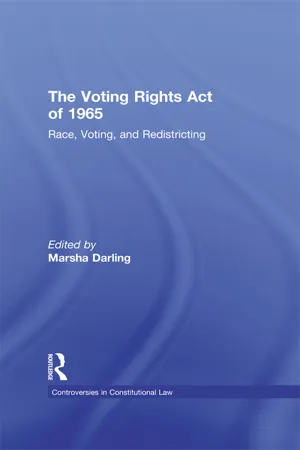
Political redistricting is one of the most controversial issues in contemporary American society. The practice of shaping voting districts to enhance the political representation of minorities at all levels of government emerged as a legal remedy for redressing the systematic historical exclusion of minority political representation. It continues to have vocal and active defenders and detractors to this day with court rulings upholding or challenging the practice every year. The controversies of redistricting have challenged America's commitment to participatory democracy and America's ability to account for its historical record of voting and racial discrimination. The legal and historical arguments addressing the policy of redistricting and the constitutional issues surrounding it revolve around interpretations of the Fifteenth Amendment and America's ability to accept or reject race-based solutions to political representstion. This three-volume set brings together all the major legal cases and the most influential articles on the legal and historical arguments surrounding this issue.
THE DEBATE
Senate-89th Congress, 1st Session
April 22-May 26, 1965
April 22-May 26, 1965
EVERETT DIRKSEN [R., ILL.]. Mr. President, I can see the Continental Congress in session 189 years ago. It was June. It was considering a resolution by Richard Henry Lee, of Virginia. The purport of the resolution was that the Colonies are and of right should be free and independent States. That resolution was referred to a committee consisting of Jefferson, Adams, Franklin, Roger Sherman, and Robert Livingston. Jefferson undertook the task of formulating a declaration to carry out the sense of that resolution. What he wrote and what was approved was the Declaration of Independence.
How significant it is as a world document and how highly it is esteemed in the American tradition can be noted from the care that has been lavished upon its preservation. First, it was kept in the archives of the State Department. When the British invaded our Capital in 1812, it was removed to Virginia. When it was returned to Washington, it was kept in the Patent Office. Later it was placed in the Library of Congress. Today, it reposes in the National Archives in a glass case, bound in bronze and sealed in helium that light, dampness, or insects will not mar it.
One especial sentiment in that document is appropriate to this occasion. After asserting that man is endowed with certain inalienable, God-given rights, Jefferson then wrote:
Governments are instituted among men deriving their just powers from the consent of the governed.
What a strange, amazing concept in a world of kings, czars, and emperors who had fastened upon mankind the belief that they rule by divine mandate. Was this a whimsy from the pen of the great Virginian? Was it a mockery or did it have purpose. How well we know that it did have purpose for it became the very foundation of the system of government which the Constitution makers promulgated in Philadelphia 11 years later. In his own way, Abraham Lincoln reaffirmed it at Gettysburg fourscore and 7 years later when he expressed the prayerful hope that government of the people, for the people, and by the people would not perish from the earth.
How then shall there be government by the people if some of the people cannot speak? How obtain the consent of the governed when a segment of those governed cannot express themselves?
How strange that nearly two centuries after Thomas Jefferson wrote those words into the Declaration of Independence, assuring to the governed a reasonable chance to consent or dissent, the problem still vexes the National Government.
Can there be any doubt that this is the problem before us?
Men are taxed but not permitted to pass upon those who impose such taxes. Can this be the consent of the governed?
Men are compelled to render military service but not permitted to pass upon those who decree such service. Is that the consent of the governed?
Men are fined and imprisoned under laws dealing with crime and social infractions but not permitted to pass upon the authors of such laws. Is this the consent of the governed?
Men are compelled to send their children to schools which are supported with their taxes but not permitted to pass upon those who make the laws and issue the regulations under which their children are educated. Is this the consent of the governed?
Men pay for a variety of services such as gas, electricity, telephone service, railroad fares, airplane fares, the rates for which are predicated upon laws enacted by men whom they are not permitted to select. Is this the consent of the governed?
Bloody strife and a century of history have brought no solution to the problem. The final fulfillment of the basic concept set forth in the Declaration of Independence has not been achieved. And now, 100 years to the month after civil strife came to an end, we seek a solution which overrides emotion and sentimentality, prejudice, and politics and which will provide a fair and equitable solution.…
SAM ERVIN [DEM., N.C.]. Mr. President, will the Senator from Illinois yield for questions?
MR. DIRKSEN. I yield for questions.
MR. ERVIN. The bill contains a provision which condemns without judicial trial the States of Alabama, Mississippi, Louisiana, Georgia, South Carolina, and Virginia, and 34 counties in North Carolina; does it not?
MR. DIRKSEN. Yes; if the Senator will modify his language.
1. I do not believe it condemns the States. It takes account of a condition that has existed in those States.
2. I do not for a moment admit that the bill is punitive. Surely I do not admit that it is a bill of attainder, a point that was made before the full committee.
MR. ERVIN. I presume that the Senator from Illinois will admit that the States that I have designated and the 34 counties of North Carolina are brought within the provisions of the bill without being given any judicial trial to determine whether they are violating the provisions of the 15th amendment.
MR. DIRKSEN. We are seeking by the bill to remedy a condition that exists in those States, or that we believe exists with respect to citizens of the United States. It is not a question of providing a judicial trial for various States where that condition exists. We go to the heart of the problem and seek to supply a remedy that we think is constitutional and nonpunitive.…
MR. ERVIN. I ask the Senator from Illinois if he does not know that under section 4 of the bill those States and counties cannot go into a court in the District of Columbia and rebut the presumption arising against them by showing that they are not engaged in violation of the 15th amendment.
MR. DIRKSEN. The bill provides the method for the States to cleanse themselves of any taint, if they believe that the finger of taint has been placed upon them.
MR. ERVIN. I ask the Senator from Illinois if the bill does not shut every courthouse door in America against the States I have enumerated and the 34 counties of North Carolina, except the U.S. District Court for the District of Columbia?
MR. DIRKSEN. My distinguished friend has used the expression “shut every courthouse door” in the land except the U.S. District Court for the District of Columbia. The device of the court of the District of Columbia has been used in a great many other statutes. It is neither a restraint nor an infamous device that we resort to in connection with the bill to give a State an opportunity to make a test case in court.…
MR. ERVIN. Does not the bill provide, in effect, that a State or political subdivision of a State covered by the formula set out in section 4(b) cannot escape the coverage of the bill unless it does one of these three things: First, it has to show to the District Court of the District of Columbia that it has not used a literacy test during the 5 years preceding the filing of the action in the U.S. District Court for the District of Columbia, for the purpose of abridging or denying the right to vote on account of race or color; second, it must show the District Court of the District of Columbia that the percent of persons in such State or subdivision voting in the most recent presidential election exceeded the national average percent of persons voting in such election, and that there is no denial or abridgement of the right to vote on account of race or color in such State or subdivision; or third, it must show the District Court of the District of Columbia that the percent of persons registered to vote in the State or political subdivision by State or local election officials exceeded 60 percent of the persons of voting age meeting residence requirements in such State or subdivision, and that there is no denial or abridgement of the right to vote on account of race or color in such State or subdivision.
MR. DIRKSEN. Yes; and why not put emphasis on the very last point that the Senator from North Carolina read; that is, that if there is no discrimination with respect to the voting rights based upon race or color—and that is the whole key to the bill, and is the key to the provision the Senator just read
MR. ERVIN. No; even in that case, the State or counties could not escape the consequences of the bill.
MR. DIRKSEN. That is an unconditional clause at the very end.
MR. ERVIN. The word “and.”
MR. DIRKSEN. That is correct.
MR. ERVIN. “And” is added to the first clause.
MR. DIRKSEN. That is the reason “and” was put there instead of “or.”
MR. ERVIN. It was placed there so as to “hook” the States twice. They would be required to escape two dilemmas.
MR. DIRKSEN. The whole bill is predicated upon a showing of discrimination, wherever it is shown. Then, of course, there is no choice except to put into effect the machinery set up by the bill.
MR. ERVIN. But the bill provides, in addition, that it must be shown that there is no abridgement or denial of the vote in violation of the 15th amendment. In one alternative the States must show that the number of persons voting in the State or the political subdivision falling within the compass of the formula exceeded the national average of persons voting in the United States, must they not?
MR. DIRKSEN. If their voting record was up to the national average and they had registration up to 60 percent, and they still discriminated, there would be no effect to the bill. We are aiming at discrimination, and that is the reason for the final clause.
MR. ERVIN. Why does the Senator believe the bill should require each of the 34 counties in North Carolina to prove not only that it is not engaged in a violation of the 15th amendment, but also that it voted more people than the national average?
MR. DIRKSEN. That is a device, if one wishes to call it a device, to encourage States where there has been discrimination to bring their registration lists up, to get their voting lists up, if they can, and if they are so disposed; but always with the understanding that no matter where they go with registration, no matter what their percentage of votes is in a given election, if discrimination still continues, it still becomes a problem for the instrumentality that is set up under the act.
MR. ERVIN. But why must we require a North Carolina county to vote to a greater extent than the national average in order to escape the consequences of this bill? Why not have the North Carolina counties on an equal basis with all of the other States and counties which are not covered by the bill?
MR. DIRKSEN. If the Senator wants to change the percentage of registration, I would not oppose it. I have indicated time and time again that I may be charged with reaching into the air and pulling down the figure of 60 percent. My friend may have some other suggestion. I have kept myself quite flexible.…
JACOB JAVITS [R., N.Y.]. In answer to that question, there is one fundamental concept about this bill which we must understand. That is the analogy with a person who was speeding and then comes into court and says, “I am not speeding any more.”
This bill was designed not only to correct an active history of discrimination, the denying to Negroes of the right to register and vote, but also to deal with the accumulation of discrimination. Our means may be reasonable or unreasonable. They may stand up or not stand up. But to assume that this bill has only one dimension and to say, “I am not discriminating now” is neither the background nor purpose of the bill. The bill would attempt to do something about accumulated wrongs and the continuance of the wrongs.…
MIKE MANSFIELD [DEM., MONT.]. Mr. President, slightly more than a month ago the President, in a moving and eloquent address before a joint session of Congress, outlined his proposals for carrying out his state of the Union promise—to remove the last remaining barriers to the right to vote. On March 18, the distinguished minority leader and myself were joined by 64 other Members of this body in introducing S. 1564, a bill to enforce the 15th amendment to the Constitution.…
This bill is brought to us after patient and thoughtful counsel from both sides of the aisle; it has been thoroughly documented by extensive hearings and thoughtful examination in the Senate Judiciary Committee which labored most effectively within the time limit set by the Senate. It is a legislative proposal that needs but little polishing to remove all vestiges of the unfulfilled promises of the 15th amendment and also any question of its constitutionality. It is now our responsibility—I know we shall fulfill our pledge to insure that all our citizens can freely exercise their right to vote.…
Today, in spite of the efforts to enforce previous legislation, discriminatory tests and devices are still with us. The hearings on this bill are replete with example after example of abuse and misuse of the literacy tests and similar subjective performance examinations. Indeed, new forms of discrimination are being devised and applied as quickly as old ones are invalidated by the courts. The voting and registration statistics in many areas point unerringly to deliberate and systematic discrimination. Plainly, something more than the approach tried thus far is required. The provisions of S. 1564 will meet the problem head on. They will do so fairly yet effectively.
While S. 1564 runs to 18 pages, its basic provisions are simple. What complexities there are, are due essentially to provisions guaranteeing procedural fairness as well as administrative direction and workability.
Let me describe the bill, very briefly.
1. S. 1564 flatly forbids every State or any political subdivision therein to use any qualifications or procedures so as to deny or abridge the right to vote on account of race or color. In other words it enforces the 15th amendment.
2. Within the framework of any lawsuit brought by the Attorney General under existing legislation, the bill provides for three new remedies: the suspension of literacy tests and similar devices, a ban on new voting qualifications or procedures and the appointment of examiners to determine voting eligibility. These new remedies will apply in any suit, brought in any State, where the Federal court finds discrimination.
3. The bill provides for an automatic suspension of literacy tests and similar devices in States or political subdivisions where the objective facts themselves point clearly to discriminatory use. In these areas, Congress is making the legislative judgment that the tests or devices have been used in a discriminatory manner. Thus, under the bill, tests and devices will be suspended whenever two conditions are present—when less than 50 percent of the persons of voting age were registered or voted in 1964 and when more than 20 percent of the population was nonwhite. The committee adopted, as a separate and additional triggering mechanism, suspension when less than 25 percent of persons of voting age of any race or color are registered to vote. The suspension is to last until a court judgment is issued declaring either that there has been no denial of voting rights by means of tests or devices during the preceding 5 years or that the percentage of persons registered or voting exceeds either 60 percent or the national average and there is no denial of the right to vote. This latter provision was sponsored in the Judiciary Committee by the distinguished minority leader whose credentials as an advocate of this legislation are unimpeachable. There has been some misunderstanding and misinterpretation as to its design and effect. I know that the distinguished minority leader in his wisdom will clarify the effects of this provision prior to final passage. In like manner, I am confident the Senator as a whole shall thoughtfully consider the entire bill and especially the difficult problem of dealing with the poll tax. The bill we ultimately pass shall then be free of any possible ambiguity or constitutional doubt.
Some concern has been expressed that a logical relationship is lac...
Table of contents
- Cover
- Title Page
- Copyright Page
- Acknowledgments
- Table of Contents
- Series Introduction
- Volume Introduction
- U.S. Constitution, Amendments XIV and XV
- The Enforcement Act (The Civil Rights Act of 1870)
- The Force Act of 1871
- The Unhappy History of Civil Rights Legislation E. Gressman
- Civil Rights Act of 1957, President's State of the Union Message, Part IV
- Civil Rights Act of 1960, Title III
- United States Supreme Court Opinion in Gomillion v. Lightfoot
- Civil Rights Act of 1964, Title VIII
- Voting Rights Act of 1965
- Address on Voting Rights to Joint Session of Congress by President Johnson, March 15, 1965
- Text of President Johnson's Voting Rights Message to Congress, Week Ending March 19, 1965
- Text of President Johnson's March 13th News Conference, Week Ending March 19, 1965
- Report of the House Judiciary Committee, The Origins, House Report No. 439
- Debate on Proposed Administration Bill, S. 1564, Senate-- 89th Congress, 1st Session (April 22-May 26, 1965)
- Tables for States That Used Tests or Devices as Defined in the VRA, Presented by Attorney General Katzenbach, March 18, 1965
- Congressional Quarterly Fact Sheet on Voting Rights: “Sweeping Voting Bill Introduced in Congress,” Week Ending March 19, 1965
- Resolution, House of Representatives-- 89th Congress, 1st Session, July 6-9, 1965
- Conference Report to Accompany S. 1564, August 2, 1965
- Statement, Senate, August 4, 1965
- Floor Action: Senate Votes for VRA, Week of May 28, 1965
- United States Supreme Court Opinion and Justice Black's Opinion in South Carolina v. Katzenbach
- Copyright Acknowledgments
Trusted by 375,005 students
Access to over 1.5 million titles for a fair monthly price.
Study more efficiently using our study tools.
Frequently asked questions
Yes, you can cancel anytime from the Subscription tab in your account settings on the Perlego website. Your subscription will stay active until the end of your current billing period. Learn how to cancel your subscription
No, books cannot be downloaded as external files, such as PDFs, for use outside of Perlego. However, you can download books within the Perlego app for offline reading on mobile or tablet. Learn how to download books offline
Perlego offers two plans: Essential and Complete
- Essential is ideal for learners and professionals who enjoy exploring a wide range of subjects. Access the Essential Library with 800,000+ trusted titles and best-sellers across business, personal growth, and the humanities. Includes unlimited reading time and Standard Read Aloud voice.
- Complete: Perfect for advanced learners and researchers needing full, unrestricted access. Unlock 1.5M+ books across hundreds of subjects, including academic and specialized titles. The Complete Plan also includes advanced features like Premium Read Aloud and Research Assistant.
We are an online textbook subscription service, where you can get access to an entire online library for less than the price of a single book per month. With over 1.5 million books across 990+ topics, we’ve got you covered! Learn about our mission
Look out for the read-aloud symbol on your next book to see if you can listen to it. The read-aloud tool reads text aloud for you, highlighting the text as it is being read. You can pause it, speed it up and slow it down. Learn more about Read Aloud
Yes! You can use the Perlego app on both iOS and Android devices to read anytime, anywhere — even offline. Perfect for commutes or when you’re on the go.
Please note we cannot support devices running on iOS 13 and Android 7 or earlier. Learn more about using the app
Please note we cannot support devices running on iOS 13 and Android 7 or earlier. Learn more about using the app
Yes, you can access The Voting Rights Act of 1965 by Marsha Darling in PDF and/or ePUB format, as well as other popular books in Law & Civil Rights in Law. We have over 1.5 million books available in our catalogue for you to explore.