- 191 pages
- English
- ePUB (mobile friendly)
- Available on iOS & Android
eBook - ePub
About this book
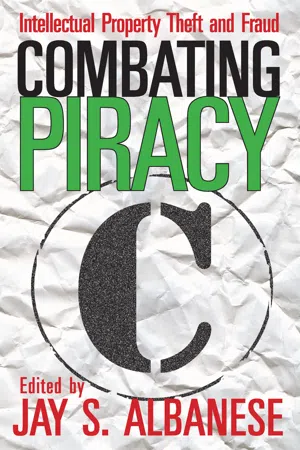
Fraud and piracy of products and ideas have become common in the early twenty-first century, as opportunities to commit them expand, and technology makes fraud and piracy easy to carry out. In Combating Piracy: Intellectual Property Theft and Fraud, Jay S. Albanese and his contributors provide new analyses of intellectual property theft and how perpetrators innovate and adapt in response to shifting opportunities.The cases described here illustrate the wide-ranging nature of the activity and the spectrum of persons involved in piracy of intellectual property. Intellectual property theft includes stolen copyrights, trademarks, trade secrets, and patents, which represent the creative work of individuals for which others cannot claim credit. The distributors of books, movies, music, and other forms of intellectual property pay for this right, and those who distribute this work without compensation to its creator effectively hijack or "pirate" that property without the owner's or distributor's permission. The problem has grown to the point where most software in many parts of the world is pirated. The World Health Organization estimates that 10 percent of all pharmaceuticals available worldwide are counterfeit.Such widespread fraud illustrates the global reach of the problem and the need for international remedies that include changed attitudes, public education, increasing the likelihood of apprehension, and reducing available opportunities. The contributors show that piracy is a form of fraud, a form of organized crime, a white-collar crime, a criminal activity with causes we can isolate and prevent, and a global problem. This book examines each of these perspectives to determine how they contribute to our understanding of the issues involved.
1
Fraud: The Characteristic Crime of the Twenty-first Century
Jay S. Albanese
Virginia Commonwealth University
Virginia Commonwealth University
In the same way that larceny characterized much of twentieth century, fraud will likely characterize the twenty-first century. Larceny, defined as taking property of another with intent to deprive the owner, remained at high levels throughout the 1900s, and is the most common of all crimes. In the United States, for example, larcenies reported to police rose from 4.3 million during the 1970s to 7.1 million by 2002 (Federal Bureau of Investigation, 2004). Victimization surveys (including both crimes reported to police as well as those unreported) revealed stable, but much higher levels of larcenies at approximately 14 million incidents per year, far surpassing the volume and rate per 1,000 population of any other serious crime (Bastian, Perkins, Rennison, and Ringel, 2004).
Fraud is defined as purposely obtaining the property of another through deception, and its popularity as a crime of choice is growing. The connection between fraud and many of the serious crimes of the twenty-first century can be seen from the facts of recent cases.
A two-year investigation into the illegal practices of Indonesian immigration brokers resulted in an indictment alleging that the owners, employees, and associates of these brokerages knowingly defrauded the government for several years. Thousands of Indonesian immigrants living throughout the United States were aided in fraudulently applying for a wide variety of government benefits through alien labor certification, Virginia driver’s licenses and identification cards, United States passports, and Social Security cards. The investigation revealed that fraudulent asylum applications for Indonesian clients were prepared in return for a fee of $2,000 or more. These applications typically contained false claims that the applicant had been raped, sexually assaulted, beaten, or robbed by Muslims in Indonesia on account of the applicant’s Chinese ethnicity or adherence to Christianity. The defendants often supported these claims with counterfeit Indonesian documents, such as birth certificates, baptismal certificates, and police reports. The investigation also revealed that these same defendants coached their clients to exploit the perceived sympathies of the asylum officers and immigration judges assigned to consider the applications. In addition, Indonesian clients were routinely aided to obtain Virginia Department of Motor Vehicles (DMV) driver’s licenses, learner’s permits and identification cards by fraud (U.S. Fed News, 2004).
The U.S. government brought fraud accusations against two Moroccan defendants originally charged in the first major terrorism trial since the September 11, 2001 attacks. The superseding indictment alleged that they devised a scheme to defraud Titan Insurance Company by filing false claims. The pair claimed they were injured in a July 5, 2001 auto accident and submitted fraudulent claims for lost wages, physical therapy, and household services. An alleged Detroit terror cell—which the government said included the four men—came to light six days after the World Trade Center attack when federal agents raided an apartment and found false IDs and other materials that the government claimed were blueprints for terror attacks (Associated Press, 2004).
These cases connect the simple motivation of theft that motivates many frauds with larger attempts at illegal immigration, false identity documents, terrorism, and other crimes, illustrating that fraud is often used to fund other criminal objectives. Why is fraud becoming a crime of choice among both thieves and those with larger criminal objectives?
Ownership and Storage
There has been a fundamental shift in the method by which property is owned. This shift has occurred for reasons of changes in technology, communications, and globalization. For much of the twentieth century, personal and business cash and property was kept physically on the premises, in safety deposit boxes, or in local banks. In every case, the owner had quick, direct physical access to the property at all times. This situation has changed. In contemporary society credit and debit transactions are overtaking cash transactions in volume, and personal property is increasingly leased or borrowed rather than owned. Therefore, fewer people are holding cash or valuables on their person or in their homes, making larceny less attractive as a crime.
Efforts to conceal ownership sometimes occur to either perpetrate a fraud or to conceal other kinds of criminal activity. A former employee of a used automobile dealership pleaded guilty to taking part in a complex money-laundering scheme intended to exchange drug sale proceeds for luxury vehicles. Invoices, financing and other documents were forged or altered to disguise customer identities and the true nature of financial transactions. The dealership was suspected of selling vehicles to known narcotics dealers and filing false forms in order to disguise the true purchaser of the vehicles (Jardini, 2004). This case illustrates how fraud can be used to disguise not only the source of funds needed to purchase property, but also conceal the actual owner of the property. Similar kinds of frauds have been used to conceal the identities of victims of trafficking in human beings, the smuggling of natural resources, and other kinds of theft, concealment, and illegal transport (United Nations Interregional Crime and Justice Research Institute, 2004; Warchol 2004; Krebs, 2004).
Movement
The movement of property has been made easier by the rise and growth of the Internet, facilitating wireless transactions and making the conversion of cash to property and property to cash easier. A director of The Gillette Company testified before the U.S. Congress that 34 million counterfeit Duracell batteries were seized in 2004, along with 31 million fake Gillette shaving products and tens of thousands of fake Oral-B toothbrushes. He estimated a $200 billion loss to the U.S. economy and a loss of 750,000 American jobs, asking Congress to pursue international avenues to promote enactment of mandatory confiscation and destruction laws, strengthened criminal penalties, and enhanced global cooperation on the issue. Fox further testified that “The majority of goods are stolen not for personal use but by organized criminals intent on the resale of the goods or to use them as collateral for other consumables such as drugs.” This is carried out through organized retail theft rings, which “recruit gangs of shoplifters, giving them lists of low-volume, high value items to be stolen from retail outlets items such as razor blades, batteries, over-the-counter drugs, infant formula, and designer clothing.” Those caught are treated as individual shoplifters and are handled leniently, overlooking the organized crime connection behind the crimes (Fox, 2005). This suggests a larger profit motive behind these frauds than personal gain; instead, fraud becomes a self-supporting business with profit potential far beyond that of mere larceny. The scope of harm produced by larceny is usually limited to the value of the physical property taken, whereas fraud often involves re-selling of nonphysical property that has limitless value. For example one Internet posting on a known hacker website read, “I work in the fraud dept. for a well known U.S. company, and have access to hundreds of CCs (credit card numbers) on a daily basis. All I’m looking for is an easy way to make some money and stay anonymous...” He received the first of six inquiries within an hour, describing how to sell and use stolen private information quickly and easily sold over the Internet (Kirby, 2005).
Table 1.1 illustrates that arrests for fraud have increased substantially over the last thirty years. Whether changes in fraud are measured by arrests (up 171 percent) or by the rate of arrests per 100,000 population (+102 percent), which accounts for population growth, table 1.1 shows a substantial increase over time. But has fraud always been popular?
Protecting Property from Larceny
Perhaps the oldest form of criminal behavior is theft, and it remains the most common crime in all societies of all types. The most common form of theft, historically, has been larceny b...
Table of contents
- Cover Page
- Title Page
- Copyright Page
- Contents
- Introduction
- 1 Fraud: The Characteristic Crime of the Twenty-first Century
- 2 Intellectual Property Theft and Organized Crime: The Case of Film Piracy
- 3 Causes and Prevention of Intellectual Property Crime
- 4 Intellectual Property and White-collar Crime: Report of Issues, Trends, and Problems for Future Research
- 5 Addressing the Global Scope of Intellectual Property Crimes and Policy Initiatives
- 6 Report of the Task Force on Intellectual Property
- About the Contributors
- Index
Trusted by 375,005 students
Access to over 1.5 million titles for a fair monthly price.
Study more efficiently using our study tools.
Frequently asked questions
Yes, you can cancel anytime from the Subscription tab in your account settings on the Perlego website. Your subscription will stay active until the end of your current billing period. Learn how to cancel your subscription
No, books cannot be downloaded as external files, such as PDFs, for use outside of Perlego. However, you can download books within the Perlego app for offline reading on mobile or tablet. Learn how to download books offline
Perlego offers two plans: Essential and Complete
- Essential is ideal for learners and professionals who enjoy exploring a wide range of subjects. Access the Essential Library with 800,000+ trusted titles and best-sellers across business, personal growth, and the humanities. Includes unlimited reading time and Standard Read Aloud voice.
- Complete: Perfect for advanced learners and researchers needing full, unrestricted access. Unlock 1.5M+ books across hundreds of subjects, including academic and specialized titles. The Complete Plan also includes advanced features like Premium Read Aloud and Research Assistant.
We are an online textbook subscription service, where you can get access to an entire online library for less than the price of a single book per month. With over 1.5 million books across 990+ topics, we’ve got you covered! Learn about our mission
Look out for the read-aloud symbol on your next book to see if you can listen to it. The read-aloud tool reads text aloud for you, highlighting the text as it is being read. You can pause it, speed it up and slow it down. Learn more about Read Aloud
Yes! You can use the Perlego app on both iOS and Android devices to read anytime, anywhere — even offline. Perfect for commutes or when you’re on the go.
Please note we cannot support devices running on iOS 13 and Android 7 or earlier. Learn more about using the app
Please note we cannot support devices running on iOS 13 and Android 7 or earlier. Learn more about using the app
Yes, you can access Combating Piracy by Graham Dawson,Jay S. Albanese in PDF and/or ePUB format, as well as other popular books in Law & Intellectual Property Law. We have over 1.5 million books available in our catalogue for you to explore.