- 320 pages
- English
- ePUB (mobile friendly)
- Available on iOS & Android
eBook - ePub
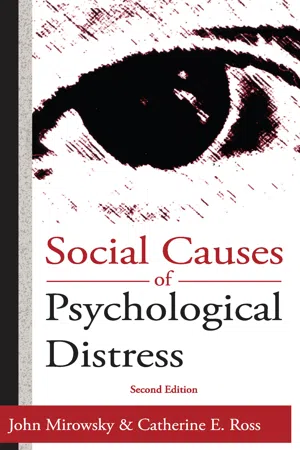
Social Causes of Psychological Distress
About this book
A core interest of social science is the study of stratification--inequalities in income, power, and prestige. Few persons would care about such inequalities if the poor, powerless, and despised were as happy and fulfilled as the wealthy, powerful, and admired. Social research often springs from humanistic empathy and concern as much as from scholarly and scientific curiosity. An economist might observe that black Americans are disproportionately poor, and investigate racial differences in education, employment, and occupation that account for disproportionate poverty. A table comparing additional income blacks and whites can expect for each additional year of education is thus as interesting in its own right as any dinosaur bone or photo of Saturn. However, something more than curiosity underscores our interest in the table. Racial differences in status and income are a problem in the human sense. Inequality in misery makes social and economic inequality personally meaningful. There are two ways social scientists avoid advocacy in addressing issues of social stratification. The first way is to resist projecting personal beliefs, values, and responses as much as possible, while recognizing that the attempt is never fully successful. The second way is by giving the values of the subjects an expression in the research design. Typically, this takes the form of opinion or attitude surveys. Researchers ask respondents to rate the seriousness of crimes, the appropriateness of a punishment for a crime, the prestige of occupations, the fair pay for a job, or the largest amount of money a family can earn and not be poor, and so on. The aggregate judgments, and variations in judgments, represent the values of the subjects and not those of the researcher. They are objective facts with causes and consequences of interest in their own right. This work is an effort to move methodology closer to human concerns without sacrificing the scientific grounds of research as such. The
Information
I
Introduction
1
Introduction
Understanding the Connections Between Social and Personal Problems
Why are some people more distressed than others?
Imagine a man who left his inner-city high school at the first opportunity, without a degree and without basic skills; who spent years unemployed or underemployed; who finally got a factory job that he managed to hold onto long enough to make a down payment on a house and to start a family; who was among the first laid off when the product his factory produced could not compete with those made where labor costs are lower; and whose unemployment compensation has run out.
Imagine a woman who married young because she was pregnant; who had two more children by unplanned pregnancies in quick succession; who took a boring and unpleasant job at minimum wage because her husband couldn't support the family; whose husband says she trapped him into marriage, is embarrassed that she has a job, and gives her little help with the children and housework; who can't always find someone to look after the children, can't afford day care, and can't afford to miss work; whose boss gave her a bad report for being absent or late too often; and who has just learned that she is pregnant again.
The despair these people feel is deeply personal. Their problems are deeply social (Mills 1959). More than that, it is the despair that identifies the social facts as social problems.
One of the core interests of sociology is the study of social stratification—the inequalities in income, power, and prestige. Few persons would care about such inequalities if the poor, powerless, and despised were as happy and fulfilled as the wealthy, powerful, and admired. Sociology springs from humanistic empathy and concern as much as from scholarly and scientific curiosity. A sociologist might observe that black Americans are disproportionately poor, and investigate the racial differences in education, employment, and occupation that account for the disproportionate poverty. A table comparing the additional income blacks and whites can expect for each additional year of education is as interesting in its own right as any dinosaur bone or photo of Saturn. But something more than curiosity underscores our interest in the table. Racial differences in status and income are a problem in the human sense as well as in the academic. This is what brings attention to them. The inequality in misery makes the social and economic inequality meaningful.
The traditional division of academic turfs can mask the connection between personal and social problems (Pearlin and Lieberman 1979). Researchers who study personal problems often rely on speculation in drawing connections to the social milieu. Those who study the structure of society and its institutions often guess about consequences for the subjective quality of life. Speculation and guessing have their hazards. The researcher who thinks a particular social condition is distressing may simply project personal values, preferences, and emotional responses not shared by people in the situation. An error of that sort is unacceptable in social science.
The cautious researcher often concentrates on the social condition and leaves its emotional consequences unmentioned. This creates a reassuring appearance of objectivity. Speak of status mobility, but don't mention the bitterness of failure or the pride of success. Speak of marital status, but don't mention the comforts of marriage or the loneliness and hardship of divorce. Speak of employment status, but don't mention the reassurance of a regular paycheck or the worries and doubts of unemployment. This avoids the appearance of attributing one's own feelings to others.
Critics of value-free social science say that researchers project their own values, beliefs, and feelings whether or not they admit it and whether or not they know it. The demographer who studies divorce rates knows that becoming divorced is usually a disturbing transition and being divorced is often a lonely and impoverished state. Even if the researcher computes rates that represent the currents of marital dissolution without prejudice or bias, the very choice of divorce as an object of study is value laden. Critics argue that researchers should drop all pretense of value-free social science and be unabashed advocates of openly declared causes.
The trouble with advocacy is that it begins with the choice of a conclusion. The advocate then selects or creates arguments and facts that support the chosen conclusion. Advocates believe that debate and struggle result in a natural selection of the truest and most correct arguments and facts. The arguments and facts that evolve from the debate and struggle of advocates may simply appeal to the prejudices and self-interests of the greatest number. Or they may simply represent the prejudices and self-interests of the wealthy or powerful—those who can afford or control advocates. Whatever the role of advocacy in politics, its value in scholarship is limited: a temporary stance for the development of hypotheses. Advocacy provides possibilities, but not answers.
There are two ways that social scientists avoid advocacy The first way is to resist projecting personal beliefs, values, and responses as much as possible, while recognizing that the attempt is never fully successful. Social science can be relatively value-free, if not absolutely. The value-free social scientist looks at society in ways that do not demand moral agreement. Two demographers can calculate the same divorce rate, even if one sees it as a measure of human tragedy and the other as a measure of human liberation.
The second way social scientists avoid advocacy is by making the values of the subjects the values expressed in the research. Typically, this takes the form of opinion or attitude surveys. Researchers ask respondents to rate the seriousness of crimes, the appropriateness of a punishment for a crime, the prestige of occupations, the fair pay for a job, or the largest amount of money a family can earn and not be poor, and so on. The aggregate judgments, and variations in judgments, represent the values of the subjects and not those of the researcher. They are objective facts with causes and consequences of interest in their own right. In addition, they provide "objective" definitions of value-laden terms such as "serious," "fair," and "poor." They are objective in the sense that they are not mere reflections of the researcher's own feelings.
The two approaches are useful, but they have their limits. The demographers can calculate divorce rates without deciding whether the rates indicate suffering or release from suffering. Ultimately, though, if the divorce rate is increasing, people want to know which it is. The survey researcher can ask the public's opinion, but does the public really know? Respondents might simply project cultural stereotypes. And what if judgments differ among the happily married, unhappily married, never married, currently divorced, and divorced but remarried? To whose opinion do we give the greatest weight?
There is a way to evaluate the subjective quality of social conditions without imposing the judgments of the researcher or public: Explicitly and objectively measure feelings such as fear, anxiety, frustration, anger, guilt, despair, depression, demoralization, joy, fulfillment, and hope. Then map the frequency and intensity of such feelings across social conditions and positions. Suppose that women with jobs outside the home are happier than housewives. It is not the researcher's opinion. It is not the public's opinion. It is a social fact. This is the alternative we have chosen. It is the focus of our book.
The inequality of misery is the essential inequality. The founders of the United States recognized this in the second sentence of the Declaration of Independence, which says that the pursuit of happiness is an unalienable and self-evident right. When sociologists and economists study the unequal acquisition and accumulation of valuables, they study the pursuit of happiness. The subjective quality of life is the ultimate valuable. Goods, service, wealth, and prestige are the means or markers of acquired value, but not the value itself. As means, they may or may not be effective. As markers, they may or may not coincide with happiness. The correspondence is a matter for study. Our study of unequal distress has three primary aspects:
Distress as a Sign
The misery, demoralization, or distress a person feels is not the problem. It is a consequence of the problem. Misery is not only real, it is realistic. Suffering contains a message about the causes of suffering. The message can be read, understood, and acted upon. We are not looking for a drug to suppress the misery. We realize that such drugs have humane uses, but they are palliative. A drug that suppresses anguish does not remove the cause of the anguish. We are not looking for a way to talk people into believing things are better than they seem. An illusion cannot dispel a distressing reality. It just makes the reality more perplexing. We are looking for information on how people feel under various circumstances. Individuals can use that information to make decisions about personal and communal lives. If someone would rather not be distressed, and would rather that others not be distressed, then the information may be useful.
Gradations in Distress
Distress has many forms, suffered more or less. Situations are not either good or bad, they are better or worse. We do not see our task as dividing people into two categories: happy and fulfilled, or miserable and distressed. We certainly do not see our task as dividing people into the categories "sane" and "insane," or "well" and "ill." We think that mental illness and psychiatric diagnoses are largely categorical names for the extremes of graded traits, like the words "tall," "fat," or "smart." We see no great divide, no natural boundary, between common and uncommon misery. We look at all the shades and tones of distress.
Ordinary People in the Community
The inequality of misery is a fact of everyday life produced by unequal resources, opportunities, limitations, and demands. There are many kinds of ordinary people. Social scientists often speak of them as a composite— the mythical "average person" who is 55 percent female, 70 percent married, has 1.7 children, completed 12.5 years of education, etc. The averages flatten a great range and variety of experiences and situations. By comparing the various types of ordinary people, the dimensions and textures of social reality become visible. The lives of ordinary people in the community constitute a huge natural experiment beyond anything we could or would produce in a laboratory. The contingencies and exigencies of life differentially frustrate, strain, challenge, and empower. We compare the rich, middle-class, and poor; those with good jobs, bad jobs, and no jobs; men and women; young, middle-aged, and old; the single, married, divorced, and widowed; blacks, whites, and Hispanics; parents and non-parents; the dropouts, graduates, and postgraduates. Practically and ethically, no laboratory can affect the personality, mind, and emotions with the force and power of everyday life. To the extent that human action creates society, it experiments in the causes of misery and happiness. We observe and report the outcomes of that experiment—the lives and fortunes of ordinary people out in the world.
Preview
Part I: Introduction
Social Causes of Psychological Distress is, first and foremost, a statement of our view and our understanding. Much of what we see and understand comes from the work of other scholars, including sociologists, demographers, psychologists, epidemiologists, psychiatrists, and social workers. Throughout the book we strive to give credit where it is due and to describe accurately the ideas and findings attributed to the work of others. However, Social Causes of Psychological Distress is not a textbook summary of the field. We look to the findings of others to answer questions, and we look to the ideas of others to stimulate and discipline our own. Our colleagues gave us a lot of good material to work with. We cut and assembled that material into our own construction—our representation of the social causes of distress. This second edition of Social Causes of Psychological Distress summarizes, synthesizes, and elaborates our observations and thoughts from two decades of research. It also presents many new results discovered by us and others since the publication of the first edition in 1989. This volume has five major parts. Part I is this introduction, in which we sketch our view and outline subsequent chapters.
Part II: Researching the Causes of Distress
In Part II (Chapters 2 and 3) we describe how sociologists study psychological distress. The sociologist's approach to studying the causes of psychological distress differs from that of the psychiatrist or psychologist. Part II highlights two distinctive elements of the sociological approach: looking for gradations in distress rather than diagnosing mental illness, and interviewing people in the community rather than experimenting in laboratories.
Chapter 2: Measuring Psychological Distress.
We begin by describing psychological distress and the ways of measuring its gradations. By psychological distress we mean the unpleasant subjective states of depression and anxiety, which have both emotional and physiological manifestations. We call the emotional component mood, and the physiological component malaise. We contrast the diagnostic approach of psychiatry with our own approach. The diagnostic approach assumes that psychological problems result from discrete disease entities that invade and disturb the human organism. We think the presumed entities are mythical—a linguistic throwback to eighteenth- and nineteenth-century science of infectious diseases.
In the last part of Chapter 2 we evaluate three distinct hypotheses about the relationships among forms of psychological symptoms. The galaxy hypothesis says that symptoms of the same type (e.g., depression) generally appear together and symptoms of different forms (e.g., depression versus schizophrenia) generally do not. The nebula hypothesis says that all forms of psychological symptoms tend to appear together, in an amorphous mix. The spectrum hypothesis says that symptoms of similar type go together more than symptoms of different types, but gradually shade from one to another (e.g., anxiety to depression to paranoia to schizophrenia). A map of the correlations among ninety-one symptoms in a community sample shows a spectrum of symptoms with an overall pattern analogous to a color wheel.
Chapter 3: Real-World Causes of Real-World Misery.
Next we contrast our population-based survey method with the experimental method of psychology. Chapter 3 begins with a summary of the way that human sciences infer causal relationships. There are three formal criteria for establishing cause: (1) association—two things go together more than expected by chance; (2) nonspuriousness—the association is not just accidental because the two happen to result from the same prior condition; and (3) causal order—one of the two things cannot cause the other, so it must be the consequence.
Survey researchers talk to large numbers of people in the community who are representative of the larger population. We discuss the way survey research meets the three criteria of cause, using as an example the idea that low income causes depression. We discuss causal order in particular detail, because it is the most difficult criterion to establish. Practically, population researchers like sociologists look to six kinds of information to judge causal order: the things that do not change, common sequences, "relative stickiness," common knowledge, longitudinal data, and patterns and their explanations. Because explaining patterns is the heart of modern causal analysis, we discuss it in the most detail, contrasting the "social selection" versus "social causation" views on the association between low income and depression.
Next we talk about experimental studies of distress. The essence of an experiment is that a researcher manipulates a hypothesized cause and randomly assigns subjects to different levels of exposure. We discuss the practical, inherent, and philosophical limitations of experiments. Practical limitations include stable traits that cannot be manipulated, weak manipulation, trivial manipulation, analog manipulation, and unrepresentative subjects. Although the practical limitations of experiments can be reduced, the inherent limitations cannot. The core inherent limitation is that the laboratory is not the world. As a consequence, experiments cannot show patterns of distress in the real world; they cannot show causal direction in the real world; and they cannot explain why observed patterns of distress exist. The philosophical limitation of experiments is that they treat subjects as objects.
Despite practical, inherent, and philosophical limitations, the prestige of randomized, controlled experiments is so great in the scientific community that many social psychologists are loath to give it up. We describe strategies that preserve the appearance of a randomized, controlled experiment while skirting the substance. A genuine experiment on the causes of distress would manipulate personalities, worldviews, or social characteristics in a way calculated to make some subjects more distressed than others. But a researcher cannot produce a personality, worldview, or social characteristic in a one- or two-hour laboratory session that is more salient than those the subject came in with. On close examination, most experiments seemingly on the causes of distress simply evoke the different responses of individuals with different personalities, worldviews, or levels of distress.
Part III: Social Patterns of Distress
Even the most elementary information about the social patterns of distress is remarkably recent. The earliest community surveys were done at the very end of the 1950s and beginning of the 1960s, and published...
Table of contents
- Cover Page
- Title
- Copyright
- Acknowledgments
- Part I INTRODUCTION
- Part II RESEARCHING THE CAUSES OF DISTRESS
- Part III SOCIAL PATTERNS OF DISTRESS
- Part IV EXPLAINING THE PATTERNS
- Part V CONCLUSION
- References
- Index
Trusted by 375,005 students
Access to over 1.5 million titles for a fair monthly price.
Study more efficiently using our study tools.
Frequently asked questions
Yes, you can cancel anytime from the Subscription tab in your account settings on the Perlego website. Your subscription will stay active until the end of your current billing period. Learn how to cancel your subscription
No, books cannot be downloaded as external files, such as PDFs, for use outside of Perlego. However, you can download books within the Perlego app for offline reading on mobile or tablet. Learn how to download books offline
Perlego offers two plans: Essential and Complete
- Essential is ideal for learners and professionals who enjoy exploring a wide range of subjects. Access the Essential Library with 800,000+ trusted titles and best-sellers across business, personal growth, and the humanities. Includes unlimited reading time and Standard Read Aloud voice.
- Complete: Perfect for advanced learners and researchers needing full, unrestricted access. Unlock 1.5M+ books across hundreds of subjects, including academic and specialized titles. The Complete Plan also includes advanced features like Premium Read Aloud and Research Assistant.
We are an online textbook subscription service, where you can get access to an entire online library for less than the price of a single book per month. With over 1.5 million books across 990+ topics, we’ve got you covered! Learn about our mission
Look out for the read-aloud symbol on your next book to see if you can listen to it. The read-aloud tool reads text aloud for you, highlighting the text as it is being read. You can pause it, speed it up and slow it down. Learn more about Read Aloud
Yes! You can use the Perlego app on both iOS and Android devices to read anytime, anywhere — even offline. Perfect for commutes or when you’re on the go.
Please note we cannot support devices running on iOS 13 and Android 7 or earlier. Learn more about using the app
Please note we cannot support devices running on iOS 13 and Android 7 or earlier. Learn more about using the app
Yes, you can access Social Causes of Psychological Distress by Catherine E. Ross in PDF and/or ePUB format, as well as other popular books in Social Sciences & Mental Health in Psychology. We have over 1.5 million books available in our catalogue for you to explore.