- 224 pages
- English
- ePUB (mobile friendly)
- Available on iOS & Android
eBook - ePub
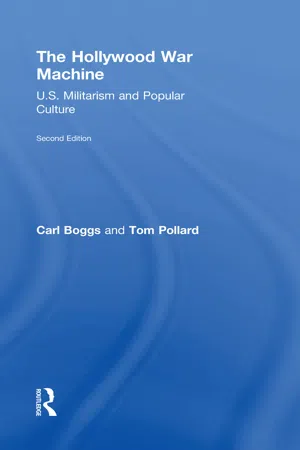
About this book
The newly expanded and revised edition of The Hollywood War Machine includes wide-ranging exploration of numerous popular military-themed films that have appeared in the close to a decade since the first edition was published. Within the Hollywood movie community, there has not been even the slightest decline in well-financed pictures focusing on warfare and closely-related motifs. The second edition includes a new chapter on recent popular films and another that analyzes the relationship between these movies and the bourgeoning gun culture in the United States, marked in recent years by a dramatic increase in episodes of mass killings.
Information
Chapter 1
Media Culture in the Imperial System
One of the remarkable features of American public life today is the extent to which Hollywood studios continue to turn warfare into stunning media spectacles—a phenomenon shared with TV and video games, like movies, beneficiaries of the same high-tech assets. Violence and bloodshed, endemic to military combat, are now the artistic and technological essence of modern cinematic overkill, whether at the hands of Tony Scott or Oliver Stone, Edward Zwick or Quentin Tarantino, Michael Bay or Steven Spielberg (celebrated directors all). It is Bay’s work that today probably best exemplifies the Hollywood war frenzy that we explore throughout this book, for he is master not only of the battlefield genre (Pearl Harbor, 2001) but of similar violent fare (Transformers, 2007). If graphic scenarios of death and destruction wind up as the predictable offshoot of empire, they are also the stock-in-trade of blockbusters, both mirroring and contributing to the culture of militarism that permeates early twenty-first century America.
Beyond accelerating the twin processes of economic crisis and social decay, the George W. Bush years (2001-08) spurred the militarization of both political and popular cultures, reflected in escalating incidents of rampage killings, expansion of the Pentagon war machine, a more belligerent foreign policy, and a corporate media increasingly saturated with images and narratives of violence. The indicators are rather difficult to miss: two bloody wars in Iraq and Afghanistan; stepped-up war on terrorism accompanied by interventions (often by drone aircraft) in Pakistan, Libya, Yemen, and Somalia; constant military threats against Iran; continued nuclear buildup; and growth of a security state fueled by the stepped-up work of the National Security Agency (NSA), Drug Enforcement Administration (DEA), and kindred federal agencies. Domestically, a sprawling prison-industrial complex, with some 2.3 million detainees, seems to be taking on a life of its own. By 2013, the United States was spending nearly $700 billion yearly on its military colossus—more than 40 percent of the world total and dwarfing such purported competitors as China ($166 billion) and Russia ($90 billion), not to mention North Korea (at $10 billion).1 The Barack Obama presidency has, despite many promises, done relatively little to alter or reverse these worsening tendencies, either domestically or globally.
To sustain U.S. global supremacy, a legacy of World War II, the Pentagon now has ten command zones covering most of the planet as well as more than eight hundred armed-forces bases in dozens of nations. Since no country or empire in world history has even approached this scale of military power, it would be astonishing if conduits of imperial ideology did not function continuously to invest that power with maximum domestic support—without which the burdensome risks and costs of war would likely be resisted by much of the general population. Given the lack of an ambitious state propaganda apparatus in the United States, these hegemonic functions become the domain of established media and popular culture, their mission being to furnish legitimation for empire. As might be expected, military virtues transmitted not only through movies but TV and video games have today become more deeply entrenched in American society.
Legitimating Empire
Postwar imperial expansion that ultimately brought the United States to lone superpower status gained new momentum after the events of 9/11, fueled by George W. Bush’s war on terror. The attacks gave rise to a mood of fear and anxiety, seized by the media, rightwing politicians, think tanks, and sectors of the warfare state, giving the White House a green light to pursue new military ventures. While carrying out two costly (and woefully underfinanced) wars in Afghanistan and Iraq, the Bush administration brought crisis to the domestic banking system and larger economy while stoking trends toward plutocracy.2 With trillions of dollars earmarked for bases, wars, arms supplies, intelligence operations, surveillance, and law enforcement, combined with tax cuts for the wealthy and further deregulation of Wall Street, the United States faced its worst economic debacle since the Great Depression. An oligarchic social structure coincided with an authoritarian political system, global empire, economic instability, and mounting poverty. By 2011, according to the Economic Policy Institute, the richest 1 percent of Americans laid claim to more wealth than the entire lower 90 percent.3 The Obama presidency did little to overturn any of these trends.
During the Obama reign, Washington has intervened militarily in several countries: not only Afghanistan and Iraq, but Pakistan, Yemen, Somalia, Libya, and Syria, with Iran remaining on the U.S./Israeli target list. U.S. drone strikes have been regularly launched across the Middle East, with mounting civilian casualties. The counterproductive war on drugs, militarized in some zones, continues full-force in Mexico, Central America, Colombia, and parts of the Middle East as well as the United States itself. American power is being extended and consolidated throughout the Pacific region, ostensibly to counter the China “threat.” Meanwhile, every international move undertaken by Bush and Obama has been endorsed or celebrated by the mainstream media: CNN, Fox, other TV networks, Time magazine, The Washington Post, The New York Times, and The Wall Street Journal.
As of this writing (late 2014), the U.S. military had left in its wake conditions of Hobbesian anarchy in most nations where it intervened—in Iraq, Afghanistan, the Balkans, and Libya. Years of uncritical Washington support for Israel had contributed to the much same conditions—violence, chaos, breakdown—in Gaza. The result, of course, was not only anarchy and instability but blowback, as demonstrated by the spread of insurgent groups usually dismissed in the West as “terrorists.” Oliver Stone and Peter Kuznick write, in their book The Untold History of the United States (2012): “The consequences of years of misguided and short-sighted U.S. policies were coming home to roost around the world.”4 Nowhere has this been more apparent than in the Middle East, where the social fabric of several countries (Iraq and Syria) has been eviscerated in the wake of military operations. Chalmers Johnson had anticipated exactly such outcomes in his seminal 2000 book Blowback.5
President Obama, following President Bush, has proclaimed that U.S. warfare against enemies serves to make the nation stronger, protecting its seemingly fragile “security.” The problem is that this official rationale—along with pretenses of promoting democracy and human rights—clashes starkly with the historical reality. Such claims are met with derision around the world yet, sadly, are taken seriously by most Americans, including the educated elite. One reason for this yawning gulf is the pervasive influence of media culture, which does so much to legitimate the warfare state and its repeated foreign ventures.
The steady growth of a militarized society in the United States coincides with the expansion of the media in its diverse forms: movies, TV, radio, Internet, video games, print journalism, and mobile technology. A great font of information, opinion, communication, and entertainment, the corporate media is a linchpin of ideological hegemony, a vital repository of values, attitudes, beliefs, and myths that shape public opinion on a daily basis. Transnational media conglomerates like Disney, Time Warner, Microsoft, Apple, Viacom, and News Corporation—all sites of unfathomable wealth and power—ritually celebrate the wonders of a “free-market” economy, the virtues of personal consumption, the blessings of a political system built on freedom and democracy, a benevolent U.S. foreign policy, the need for globalized military superiority, and of course old-fashioned patriotism. We should thus hardly be surprised to find a constant flow of militaristic images and discourses across the media landscape, perhaps nowhere more so than in Hollywood cinema.
From its earliest formative period, the United States had moved inexorably along the path of colonialism, racism, and militarism, first conquering Indian lands and vast areas of Mexico and then, following settlement of North America, pushing outward into Latin America, Pacific islands, and Asia at the close of the Spanish-American War. For a good part of the twentieth century, the United States was in a state of war (or preparing for war), spanning two World Wars, interventions in Korea, Indochina, Central America, the Balkans, Afghanistan, Iraq, Libya, and Syria, with further warfare in the Middle East (to advance economic and geopolitical priorities) a virtual certainty. In this context, the ruling elites naturally want the mass public to believe this global power is being wielded for entirely noble ends around universal principles of freedom and democracy consistent with the long-held myth of Manifest Destiny.
Here the always-crucial mechanisms of legitimation take on special meaning. All power structures require systemic ideological and cultural supports—popular consensus—but the imperatives of empire add more complexities to these ordinary requirements. Imperial ambitions, a bloated war economy, a surveillance network, constant armed interventions— these must be made to appear somehow “natural,” ordinary, worthy of sacred duty. Motifs of national exceptionalism, superpatriotism, high-tech warfare, and civilizing mission help satisfy this legitimation function, as does the national chauvinism associated with economic, technological, and military supremacy. To translate this ideological matrix into popular language and understanding, to integrate it into the political culture, is the task less of a classical propaganda apparatus than of an education system, communications network, and media culture appropriate to modern capitalism. In the United States today, the sprawling media complex is an extension of megacorporate operations that comprise the largest and most influential media-entertainment system ever known. And Hollywood filmmaking, as we indicate throughout this book, is increasingly central to that system—an indispensable bulwark of empire.
U.S. pursuit of global domination, a goal shared equally by Republicans and Democrats, feeds concentrated government, corporate, and military power, not to mention a massive law-enforcement and surveillance order that cannot by itself provide legitimation. That is precisely the role of media culture. As we argue in later chapters, Hollywood filmmaking contributes generously to this function, despite the release of motion pictures here and there that might run counter to the dominant patterns. Legitimation, it should be emphasized, gains force not primarily through state censorship or controls but through ordinary work carried out at all levels of media, where crude propaganda or “conspiratorial” efforts are scarcely needed to enforce hegemonic codes. The repetitive formulas, images, myths, and illusions contained in popular Hollywood movies and TV programs can be expected to influence mass audiences in rather predictable ways, much like advertising, public relations, and think-tank operations. One likely response to the yearly flood of violent combat, action/adventure, sci-fi, and horror movies is quicker readiness to support U.S. military ventures that, in an ideologically-charged milieu, generally require little intellectual rationale. Noble objectives, when taken for granted, usually speak for themselves.
To be sure, complex industrialized societies possess diverse agencies of hegemony and politicization, but none today rival the power of a globalized corporate media culture. As Douglas Kellner points out: “Media culture spectacles demonstrate who has power and who is powerless, who is allowed to exercise force and violence and who is not. They dramatize and legitimate the power of the forces that be and demonstrate to the powerless that if they fail to conform they risk incarceration or death.”6 It is a culture geared both to established power and to young people—not only film but TV, video games, social media, and music—whose political views are just forming and therefore much easier to shape. That such views might be partial, uneven, or lacking coherence hardly detracts from their salience or intensity, especially when it comes to issues of foreign and military policy. Despite its liberal reputation, moreover, Hollywood makes expensive, high-tech movie entertainment that, directly or indirectly, dramatizes ideological themes that fit the consensual requirements of empire.
Here Henry Giroux argues that American militarism must in part be understood partly as an ideological construct that permeates every corner of society. He writes that “Militarism and war have not only changed the nature of the political order but the nature and character of American life.”7 For Americans in the early twenty-first century, reports of military assaults, bombings, drone attacks, special operations, black sites, and covert actions—and threats of more warfare—are a routine feature of everyday life. Media spectacles of violence and killing on a large scale can be linked to what Giroux calls the “neoliberal dystopian dream machine” rooted in fear, anxiety, and despair.8 One result, no doubt intended by the political and media chieftains, is a collective moral numbing in the face of terrible human and material costs accumulated by the warfare state. With moral numbing comes something akin to “zombie politics”—a national psychosis of alienation and retreat that undercuts political debate.
Cinematic Imperialism
The Hollywood War Machine has moved full-speed ahead over the past several years, capitalizing on the post-9/11 American sense of a wounded, vengeful, but still internationally powerful nation ready to set the world straight, by military force where necessary. Several recent films deserve special attention for their embrace of strong, pro-military themes and capacity to reach large audiences with messages celebrating U.S. armed might.
No better example of this cinematic direction is likely to be found than the popular Rambo series, spanning 1982 to 2008—the latest edition directed by Sylvester Stallone, main protagonist of each graphically-bloody movie. We have written extensively about the earlier Rambo phenomenon elsewhere in this book, especially in the context of Vietnam. It is enough to note here that Rambo as warrior hero seems to have achieved permanent status within American media culture, surpassing even the legendary John Wayne. Rambo-inspired films are explicitly designed to evoke audience pride in and identification with the U.S. military as a vehicle of imperial power—tales of a warrior charged with fighting evildoers in Communist-infested Asian countries.9 The latest Rambo movie features one of the goriest Hollywood celebrations of violence ever, where human beings are bombed, blasted, stabbed, shot, blown up, incinerated, bludgeoned, beaten, beheaded, and tossed out of planes—all to advance U.S. military agendas. Rambo alone kills eighty-three villains, perhaps short of a record but surely enough to uphold his reputation as “the beast.” (Were Rambo given such representation in another culture, the American media would surely ascribe to him Hitlerian dimensions of evil.)
In the film Vantage Point (2008), a box-office hit, Peter Travis depicts the assassination of a U.S. president attending a global war on terrorism summit in Spain. With anti-American fanatics assaulting the very citadel of Washington power (center of the “free world”) the crowd goes into shock and panic as the drama unfolds repeatedly from different camera angles. This familiar good-versus-evil narrative was heavily promoted as a cinematic trope alerting Americans to new threats against national security. In the movie Live Free or Die Hard (2009), Len Wiseman brings to the screen a reprise of Die Hard pictures starring Bruce Willis as New York City police detective John McClane, here seen taking on (and routing) a group of sinister high-tech terrorists ready to hack into (and bring down) U.S.-based computer systems—a formula that would be repeated in movie after movie. In the cultish film Transformers (2007), Michael Bay revisits his fixation on technowar by means of a narrative framing combat between opposing robotic forces: between noble and heroic Autobats and evil Decepticons, the latter repelled when they assault a U.S. military base in Qatar. Bay’s more epic 2014 sequel, subtitled “Age of Extinction,” pushes the same images and narratives of hyper-violence toward more dystopic and mysterious outcomes.
Predictably enough, many post-9/11 Hollywood movies and TV programs are set in the Middle East, their story-lines typically riddled with anti-Muslim and anti-Arab stereotypes. Islamophobia has long permeated the American entertainment industry, as Jack Shaheen shows at great length in his book Reel Bad Arabs (2001).10 The Middle East is not only overwhelmingly Muslim but is the site of roughly two-thirds of the world’s recoverable oil reserves, making the region a certain battle ground of future resource wars. U.S. political and military strategy there heavily depends on the success of media propaganda of the sort we discuss here and elsewhere.
The Showtime production of Homeland, in 2014 entering its fourth successful season, fits this requisite perfectly. Widely acclaimed and winner of several awards, the program revolves around the escapades of CIA officer Carrie Mathison (played by Claire Danes), forced to handle the case of brainwashed Marine Nicholas Brody, who returns from Iraq to enter an Islamist conspiracy to kill American political leaders. Based on the Israeli series Hatufim (Prisoner’s War), the program won the 2012 Golden Globe Award for best TV series, after TV Gu...
Table of contents
- Cover Page
- Title Page
- Copyright Page
- Contents
- Preface
- 1 Media Culture in the Imperial System
- 2 Militarism in American Popular Culture
- 3 War and Cinema: The Historical Legacy
- 4 The Vietnam Syndrome: Politics and Cinema
- 5 Recycling the Good War
- 6 Cinematic Warfare in the New World Order
- 7 Hollywood after 9/11
- Postscript Blowback and American Sniper
- Notes
- Index
- About the Authors
Trusted by 375,005 students
Access to over 1.5 million titles for a fair monthly price.
Study more efficiently using our study tools.
Frequently asked questions
Yes, you can cancel anytime from the Subscription tab in your account settings on the Perlego website. Your subscription will stay active until the end of your current billing period. Learn how to cancel your subscription
No, books cannot be downloaded as external files, such as PDFs, for use outside of Perlego. However, you can download books within the Perlego app for offline reading on mobile or tablet. Learn how to download books offline
Perlego offers two plans: Essential and Complete
- Essential is ideal for learners and professionals who enjoy exploring a wide range of subjects. Access the Essential Library with 800,000+ trusted titles and best-sellers across business, personal growth, and the humanities. Includes unlimited reading time and Standard Read Aloud voice.
- Complete: Perfect for advanced learners and researchers needing full, unrestricted access. Unlock 1.5M+ books across hundreds of subjects, including academic and specialized titles. The Complete Plan also includes advanced features like Premium Read Aloud and Research Assistant.
We are an online textbook subscription service, where you can get access to an entire online library for less than the price of a single book per month. With over 1.5 million books across 990+ topics, we’ve got you covered! Learn about our mission
Look out for the read-aloud symbol on your next book to see if you can listen to it. The read-aloud tool reads text aloud for you, highlighting the text as it is being read. You can pause it, speed it up and slow it down. Learn more about Read Aloud
Yes! You can use the Perlego app on both iOS and Android devices to read anytime, anywhere — even offline. Perfect for commutes or when you’re on the go.
Please note we cannot support devices running on iOS 13 and Android 7 or earlier. Learn more about using the app
Please note we cannot support devices running on iOS 13 and Android 7 or earlier. Learn more about using the app
Yes, you can access The Hollywood War Machine by Carl Boggs,Pollard Tom in PDF and/or ePUB format, as well as other popular books in Social Sciences & National Security. We have over 1.5 million books available in our catalogue for you to explore.