- 348 pages
- English
- ePUB (mobile friendly)
- Available on iOS & Android
eBook - ePub
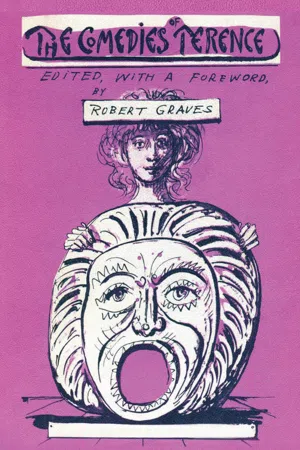
The Comedies of Terence
About this book
Terence achieved in his brief twenty-six years a standard of stylistic perfection and artistic restraint that ranked him, along with Plautus, as the greatest of the Roman comic playwrights. He was, at the very least, a gifted translator and adaptor, having used Greek New Comedies as the basis for all six of his extant plays. How far his own contribution exceeded that of simple translation is difficult to say, but we know that the Latin, undeniably his, was so faultlessly styled that his work served as a textbook for scholars and grammarians for hundreds of years.Terence had a considerable impact on the Revival of Letters; his comedies were studied and were frequently adapted into new works by such men as Steele, Chapman, and, most famously, Moliire. Indeed, had there been no Terence, it is doubtful that the Comedy of Manners could have arisen when it did, and all comic writing for the stage, from Moilire through the Restoration drama to the present day, would be diminished for lack of him. Appropriately, the language of this translation is from the Restoration. Graves has based his version on the one made in 1689 by Laurence Echard; he has corrected inaccuracies, eliminated defects and obscurities, but retained the period tone.Including in this book are the major comedies: The Fair Andrian, The Mother-In-Law, The Self-Tormentor, The Eunuch, The Tricks of Phormio and The Brothers. A close reading of Terence is a fine corrective to any idea that may still be current, about the glory that was Greece and grandeur that was Rome during the Hellenistic period. It is an assurance that in some respects at least, this age is not depraved at all.
Information
The Tricks of Phormio
A Comedy acted at the Roman Sports, when L. Posthumius Albinus and L. Cornelius Merula were Curule Ediles, by the Company of L. Ambivius Turpio and L. Attilius Prenestae.
Flaccus, a freedman of Claudius, composed the music, which was performed on unequal flutes.
It was taken from the Greek of Apollodorus, called Epi-diacazomenos, and acted four times, under the Consulship of C. Fannius and M. Valerius.
Before Christ 161
A.U.C.592
Dramatis Personae
DEMIPHO, a rich old citizen of Athens, covetous, mistrustful, ¿md petulant
CHREMES, Demipho’s brother, another citizen of Athens, an old, uxorious, hen-pecked gentleman, in fós í’oíí¿’í Zot;ed! a girl in a corner
ANTIPHO, Demipho’s son, a good-natured, modest, well-bred young gentleman, very fond of his wife Phanie
PHAEDRIA, Chremes’s son, an amorous genteel spark of the town, passionately in love with Pamphila, a music-girl
PHORMIO, the parasite, a bold, cheating, intriguing, subtle fellow, and one of singular impudence
GETA, servant to Antipho, an ingenious, designing, plotting fellow, true to the interest of Antipho and his cousin, Phaedria
DAVUS, a servant, an intimate of Geta’s
DORIO, a covetous, ill-natured, peevish bawd-master, owner of Phaedria’s music-girl

NAUSISTRATA, Chremes’s wife, a haughty imperious woman, who keeps Chremes in awe of her
SOPHRONA, nurse to Phanie, a harmless old woman
Non-Speaking Parts:
DORCIO, a servant of Demipho’s
PHANIE, married secretly to Antipho
SERVANTS
ATTENDANTS
Act One
SCENE: The street before DEMIPHO’S door
TIME: Morning
TIME: Morning
DAVUS alone, with a bag of money in his hand
DAVUS. My very good friend and compatriot Get a came to me yesterday, asking about a small sum of money he had left in my hands formerly; he begged me to get it together, so I have, and am just carrying it to him. His young master, I hear, has now picked up a wife; and this looks as if ’twere a present for Mrs Bride. What a confounded custom ’tis for those who have but very little, to be always pampering such as have abundance! All that this poor fellow now has, with much ado, scraped together bit by bit out of his pitiful allowance must go at one swoop, nobody ever considering how he has starved himself for it. And soon poor Geta must be squeezed once again, to give her ladyship joy of her first-born; and after that again upon the brat’s anniversary day, when ’tis initiated forsooth. The child is the pretended recipient of all these gifts, but ’tis the mother runs away with ’em. But isn’t that Geta, there?
Enter GETA.
GETA, to them within. If a red-haired fellow should enquire for me. . . .
DAVUS. He’s here, spare your breath.
GETA, turning about. Ho, Davus! I was just coming to meet ye.
DAVUS. Here, hold out your hand.
Gives him the bag.
Tis all good coin, and just what I owed ye.
GETA. Thou art an honest fellow, and ’twas kindly done not to forget me.
DAVUS. Kind indeed, as the world goes now, I’ll assure ye; for ’tis come to such a pass, that a man must first pray, and then be thankful, to get again what is his own. But why so concerned?
GETA. You may well ask that! If you did but know the dread and danger I’m in.
DAVUS. And how, pray?
GETA. You shall know, upon promise of secrecy.
DAVUS. Away, simpleton! What! trust me with thy money, and afraid to trust me with a secret! I shouldn’t win a pin for my sleeve by dealing falsely with thee now.
GETA. Prithee, hear me then.
DAVUS. Yes, with both ears.
GETA. You know Mr Chremes, our old master’s elder brother, don’t ye?
DAVUS. Very well.
GETA. And his son Phaedria too?
DAVUS. As well as I know thee.
GETA. It so fell out that the two reverend gentlemen took a journey together, Chremes to Lemnos, and our master to Cilicia—for an old crony of his had wheedled him over there: had sent him letter upon letter, promising him whole mountains of gold, with the Devil and all.
DAVUS. What, to him that already had enough and to spare?
GETA. Never wonder at him, man, ’tis his nature to exceed his wants.
DAVUS. Pox of ill luck! What a pity it is I wasn’t born King!
GETA. When the two old gentlemen set out they made me tutor to their sons. davus. Ah, Geta, that was a hard task for thee.
GETA. Troth, so I found it by woeful experience. My unlucky genius used me very ill that day. At first I tried to be strict with them. But why waste words? My faithfulness to my old masters cost me many a sore drubbing.
DAVUS. As the proverb has it: ’tis hard to kick against the goad!
GETA. Upon that I dropped the reins, and gave the mettlesome pair their heads.
DAVUS. You understood the rules of the market.
GETA. As for our youngster, he was very regular for awhile. But Mr Phaedria immediately picked up his music-girl, and fell head over ears in love. She was kept it seems by a damnable, griping bawd-master. The old gentleman had taken care to keep the young men’s pockets empty: so that our amorous spark could do nothing but look fawningly into his mistress’s eyes, follow her around town, and perhaps lead her to the Music School and back again. I and my young master, having little else to do, must needs bear him company. Right before the school was a barber’s shop, where we commonly awaited her coming out. One day, while we were thus dancing attendance on the girl, in comes a young fellow blubbering so loud that it made us all wonder. We asked what ailed him? ‘Why,’ said he, ‘never till now did I know poverty to be such a sad intolerable burden! Hard by I’ve just seen a poor girl, crying and taking on most grievously for the death of her mother, by whose dead body she was sitting. She had neither friends, acquaintances, nor relations, to stand by her, or look after the funeral, except for one poor old woman. It grieved me to the very soul, for she was of marvellous beauty’ In short, we were all agog at the story. Mr Antipho presently cried: ‘Shall we go and see her?’ ‘Ay, ay,’ says another, ‘let’s go! Prithee, honest man, bring us to the place!’ Away we go, come to her, see her. A pretty rogue i’ faith, she was; and what’s more, she had nothing of ornament to set off her beauty. Her hair hung about her ear...
Table of contents
- Cover Page
- Title page
- Copyright Page
- Contents
- Foreword
- The Fair Andrian
- The Mother-in-Law
- The Self Tormentor
- The Eunuch
- The Tricks of Phormio
- The Brothers
Trusted by 375,005 students
Access to over 1.5 million titles for a fair monthly price.
Study more efficiently using our study tools.
Frequently asked questions
Yes, you can cancel anytime from the Subscription tab in your account settings on the Perlego website. Your subscription will stay active until the end of your current billing period. Learn how to cancel your subscription
No, books cannot be downloaded as external files, such as PDFs, for use outside of Perlego. However, you can download books within the Perlego app for offline reading on mobile or tablet. Learn how to download books offline
Perlego offers two plans: Essential and Complete
- Essential is ideal for learners and professionals who enjoy exploring a wide range of subjects. Access the Essential Library with 800,000+ trusted titles and best-sellers across business, personal growth, and the humanities. Includes unlimited reading time and Standard Read Aloud voice.
- Complete: Perfect for advanced learners and researchers needing full, unrestricted access. Unlock 1.5M+ books across hundreds of subjects, including academic and specialized titles. The Complete Plan also includes advanced features like Premium Read Aloud and Research Assistant.
We are an online textbook subscription service, where you can get access to an entire online library for less than the price of a single book per month. With over 1.5 million books across 990+ topics, we’ve got you covered! Learn about our mission
Look out for the read-aloud symbol on your next book to see if you can listen to it. The read-aloud tool reads text aloud for you, highlighting the text as it is being read. You can pause it, speed it up and slow it down. Learn more about Read Aloud
Yes! You can use the Perlego app on both iOS and Android devices to read anytime, anywhere — even offline. Perfect for commutes or when you’re on the go.
Please note we cannot support devices running on iOS 13 and Android 7 or earlier. Learn more about using the app
Please note we cannot support devices running on iOS 13 and Android 7 or earlier. Learn more about using the app
Yes, you can access The Comedies of Terence by Robert Graves in PDF and/or ePUB format, as well as other popular books in Literature & Ancient & Classical Drama. We have over 1.5 million books available in our catalogue for you to explore.