eBook - ePub
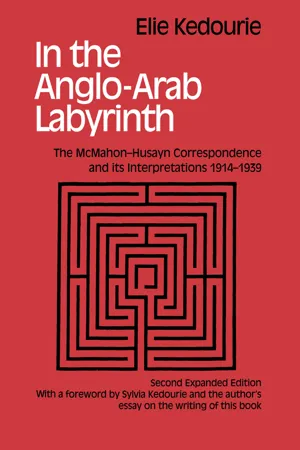
In the Anglo-Arab Labyrinth
The McMahon-Husayn Correspondence and its Interpretations 1914-1939
- 368 pages
- English
- ePUB (mobile friendly)
- Available on iOS & Android
eBook - ePub
In the Anglo-Arab Labyrinth
The McMahon-Husayn Correspondence and its Interpretations 1914-1939
About this book
The McMahon-Husayn correspondence has been at the heart of Anglo-Arab relations since World War I. It aroused great controversy, particularly over Palestine. Here, it is examined in historical context to determine why it was so obscure and what lay in the minds of those who drafted it.
Part I
The Quicksand
This Arab question is a regular quicksand.
SIR EDWARD GREY
1.
Cairo, London and the Sharif of Mecca
Between July 1915 and March 1916, the British high commissioner in Egypt and the Sharif of Mecca exchanged a number of letters now generally known as the McMahon-Husayn correspondence. Almost from the start, the correspondence became the subject of conflicting interpretations, and the passage of time did not diminish – indeed sharpened – the controversy. It is perhaps not too much to say that for half a century the correspondence haunted Anglo-Arab relations. Less than a year after the end of the war, details of the correspondence were disclosed in a long article in The Daily Telegraph signed by the journalist Perceval Landon, but in reality written by Colonel T. E. Lawrence. By 1923 English readers had at their disposal in chapter 1 of J. de V. Loder’s book The Truth about Mesopotamia, Palestine and Syria, an accurate and reasonably full account of these exchanges, and by 1934 readers of Arabic had available to them, in a well-known work by Amin Sa’id, a more or less complete text of the letters. Finally, in 1938 most of the letters were printed in an English version by George Antonius as an appendix to his book The Arab Awakening. But it was not until 1939 that the British government at last officially published the correspondence in a white paper.1
Official publication of the letters was at the request of the Arab delegations to the Palestine conferences of 1938-9. The delegations believed that the correspondence showed that Sir Henry McMahon had promised Palestine to the Sharif in 1915, and that its publication therefore would strengthen the Arab case against Zionism. Such belief was indeed widely prevalent in the Arab world, and it had been greatly strengthened over the years by the refusal of successive British governments to disclose officially the text of these letters. The correspondence thus became part of the Palestine dispute, and it was in the light of this dispute that it has been generally read, scrutinized, and argued over as lawyers, say, would argue over the wording of a contract or the proper construction of a statute. But when McMahon and Husayn were secretly writing to one another in 1915-16, the Balfour declaration had not been written, there was no British mandate in Palestine and no dispute between Zionists, Arabs and British over the control of Palestine. When they were written, the letters had formed part of quite a different history, that of British and of Sharifian war-time diplomacy.
In order fully to understand the meaning of these documents, which are at once deliberately vague and unwittingly obscure, and to account for the remarkably divergent interpretations to which they have given rise, we must see them then as belonging to two different histories: that of Anglo-Sharifian negotiations during 1914-16, and that of the Palestine dispute which began with the British conquest of Palestine and the Balfour declaration. We must also form some idea of the character and aims of those who wrote them, and of the misunderstandings, the divergent preoccupations, the conflicting ambitions which in later years led to such confusion and contention.
I
The first letter in the correspondence came from Mecca, but it was not written by Husayn or addressed to McMahon. Dated 14 July 1915 and received in Egypt on 18 August, it was addressed to Ronald Storrs, oriental secretary at the British residency in Cairo, and it came from Abdullah, second son of the Sharif. The letter asked for British acknowledgement of Arab independence in an extensive territory comprising the Levant, Mesopotamia and Arabia, for a treaty making Great Britain responsible for the defence of this independent state, and for British approval of the proclamation of ‘an Arab Khalifate of Islam’. The letter did not come out of the blue, for writer and recipient had met and corresponded intermittently on political questions since February 1914. The original contact was sought by Abdullah who, while on a visit to Cairo, saw Kitchener and represented to him that affairs in the Hijaz were not going well ‘owing to the recent appointment of a new Turkish Vali who combined civil and military functions…and does not act harmoniously with his father’. In case matters got worse, and an attempt was made to depose his father, would the British government, Abdullah asked, use its ‘good offices’ with the Sublime Porte to prevent this? If Istanbul embarked on such a design ‘the tribes of the Hejaz would fight for the Sharif and a state of war against the Turkish troops would ensue’. The British government could surely not remain indifferent to disturbances in the holy places which so many of its subjects visited yearly? If disturbances did ensue Abdullah hoped that ‘the British Government would not allow reinforcements to be sent by sea for the purpose of preventing the Arabs from exercising the rights which they have enjoyed from time immemorial in their own country round the holy places.’1
Abdullah’s move was audacious. It was nothing less than an attempt to recruit the British government as an auxiliary in his father’s quarrel with the Porte. The quarrel was between a centralizing government intent on extending the Hijaz railway from Medina to Mecca, and an over-mighty subject who had no desire to give up his quasi-independent status, his armed following, or his autocratic powers over the population of the Hijaz. The clash between Husayn and the Porte – a clash between a traditional despotism and a modernizing absolutism – is well described by acting consul Abdurrahman, whose despatch, sent from Jeddah a month or so after Abdullah’s visit to Cairo, supplies the context in which the latter’s overtures to Kitchener have to be seen. The consul described the insecurity which had been lately reigning in the Hijaz: armed robberies and plundering of shops by beduins in Jeddah, telegraph and telephone wires between Mecca and Jeddah cut almost daily, the mails and the caravans robbed and escort soldiers murdered, kidnapping of women, and an Afghan, ‘a very respectable resident of Mecca in the bad books of the Grand Shereef for his outspokenness’, murdered on the latter’s orders together with seven soldiers of his escort while travelling to Ta’if.’ It is an open secret’, affirmed the consul, ‘that the cause of all this disturbance is the Grand Shereef himself. He was, up to the arrival of the New Vali, the sole monarch of the Hedjaz and his word was law in this country. The Grand Shereef is naturally opposed to any reform and wants that everything should run in ancient rut. All departments in Mecca and Jeddah were under the authoritative guidance of the Shereef and the Turkish Government was only in name. Every Vali who came here during the last five years had to be either slave of the Grand Shereef or be summarily dismissed’.2 Devey, the British consul in Damascus (who had served in Jeddah) supplemented the information in Abdurrahman’s despatch: ‘The Vali of Mecca Wahab Bey’, he wrote in a memorandum of 30 March, ‘is on bad terms with the Shereef: on his arrival in Mecca the Shereef turned out all his Bisha force of Police to meet him with honour, but soon afterwards the Vali ordered these native “Bisha” police to be deprived of their government rifles which were at once handed over to the Turkish Government uniformed police. He also told the Shereef not to inflict punishment on Arabs. Consequently the Shereef is inciting the Arabs round about Mecca to insurrection on the pretext of protesting that they will allow no railway to be made to Mecca because it will lessen their camel transport profits. The Union and Progress are striving to bring the Arabs to consent to this project, and the chief representative of their party in Mecca, a Circassian Bey or colonel, who was visiting round the Arabs for this purpose, was lately killed and hacked to pieces.’1
The Vali’s determination to assert his authority crumbled very quickly. He had no forces to oppose to the Sharif and was obliged to sue for peace. In a despatch of 19 March, the acting British consul reported that the Sharif’s conditions for calling off the disturbance were that the government should abandon the idea of extending the railway to Mecca, that the Hijaz should remain free from conscription as hitherto, and most significantly, that the court of justice in Jeddah should deal only with foreigners’ cases, presumably abandoning the Ottoman inhabitants of the Hijaz and their interests to his unfettered discretion.2 This was a mere reversion to what used to obtain under the Hamidian regime, when the Sharif of Mecca, in return for abstaining from meddling in imperial politics, from intriguing with foreign powers, and threatening the Sultan’s title to the caliphate, was allowed to oppress the Hijazis and fleece the pilgrims with impunity. But the privileges which Abd al-Hamid bestowed amicably, and not under duress, the zealous and clumsy Young Turks had now to concede under threat, at a heavy cost to the prestige and authority of the Porte.
The Sharif, then, won his skirmish with the Porte without the British aid which Abdullah had been sent to solicit. From Cairo the latter had gone to Constantinople in order to negotiate on the spot with the Ottoman ministers. On his way back to the Hijaz, he stopped in Cairo once more where, as on the previous occasion, he stayed in Abdin Palace as the Khedive’s guest. Storrs went to see him there on 18 April. Abdullah declared himself dissatisfied with the result of his negotiations at Constantinople, and he disclosed that ‘his tather had instructed him, Storrs recorded in a note dated the following day, to approach Kitchener ‘with a view to obtaining with [sic] the British Goyernment an agreement similar to that existing between the Amir of Afghanistan and the Government of India, in order to maintain the status quo in the Arabian peninsula and to do away with the danger of wanton Turkish aggression. He assured me’, Storrs went on, ‘that the Arabs were concentrating and solidifying, that Ibn Saud, the Idrissi, and even the Imam Yehia would before long be in complete unity with each other and with the Sherifate.’ On the morrow Storrs returned and, under instruction, informed Abdullah ‘that he should not expect any encouragement from the British Government; that it was more than possible that the Porte did not really intend to carry out their threat [to extend the railway to Mecca]; that in any case we should wait to hear how the latest developments were received at Mecca before communicating the Sherif’s desire to the Foreign Office; that we had in principle not the smallest wish to interfere in the government or the administration of the Holy Cities, which only concerned us in so far as they affected the safety and comfort of British pilgrims.’1 Kitchener, writing to Sir William Tyrell, Sir Edward Grey’s private secretary, a few days later may have been correct in saying that Abdullah was told that ‘the Arabs of the Hejaz could expect no encouragement from us and that our only interest in Arabia was the safety and comfort of Indian pilgrims’,2 but the language recorded in Storrs’s note (which was not sent to the foreign office until the following December) is clearly less categorical than Kitchener made out. For by saying that British interest in the Hijaz was only ‘in principle’ solely directed to the welfare of the pilgrims, and by suggesting that reactions in Mecca to Ottoman policies should be awaited before anything further was done, Storrs hinted that the rejection of Abdullah’s approach was not as final or irrevocable as it, at first sight, seemed to be.
Again, one wonders whether the note which Storrs composed for the record in fact contains all that passed between him and Abdullah. In his memoirs he mentions one other episode which does not figure in the note. Here, he describes the charm of Abdullah’s conversation and he goes on: ‘Travelling by a series of delicately inclined planes, from a warrior past I found myself in the defenceless Arab present, being asked categorically whether Great Britain would present the Grand Sharif with a dozen, or even a half-dozen machine guns. When I enquired what could possibly be their purpose, he replied (like all re-armers) “for defence and, pressed further, added that the defence would be against attack from the Turks. I needed no special instructions to inform him that we could never entertain the idea of supplying arms to be used against a Friendly Power. Abdullah can have expected no other reply, and we parted on the best of terms’.1
We may better appreciate this delicate ironizing about Friendly Powers and the like by referring once more to Storrs’s note which confirms that the two interlocutors found each other congenial. Abdullah confided in Storrs the ‘poor opinion’ he had formed of the Sultan and the other Princes, who, he said, ‘had their hands tied behind their backs, and recorded like phonographs the thoughts of the Jews.’ Abdullah was here repeating the widespread accusations made against the Committee of Union and Progress by their Ottoman rivals and by British embassy circles at Constantinople.2 Abdullah may indeed have sensed that retailing gossip of this kind would please his interlocutor, who seems, in fact, to have shared this belief in the occult and nefarious influence of the Jews over the Young Turks. Thus, in 1916 he was still speaking of ‘Jews now reigning in the Bosphorus’. Earlier, in a letter of December 1914 to Colonel O. A. G. Fitzgerald, Kitchener’s personal military se...
Table of contents
- Cover
- Title
- Copyright
- Contents
- Foreword to New Edition
- Preface
- PART I: THE QUICKSAND
- PART II: THE FLY IN THE FLY-BOTTLE
- Epilogue: Knowledge, Power and Guilt
- Works Cited
- Appendix: In the Anglo-Arab Labyrinth: Genesis of a History
- Index
Trusted by 375,005 students
Access to over 1.5 million titles for a fair monthly price.
Study more efficiently using our study tools.
Frequently asked questions
Yes, you can cancel anytime from the Subscription tab in your account settings on the Perlego website. Your subscription will stay active until the end of your current billing period. Learn how to cancel your subscription
No, books cannot be downloaded as external files, such as PDFs, for use outside of Perlego. However, you can download books within the Perlego app for offline reading on mobile or tablet. Learn how to download books offline
We are an online textbook subscription service, where you can get access to an entire online library for less than the price of a single book per month. With over 1.5 million books across 990+ topics, we’ve got you covered! Learn about our mission
Look out for the read-aloud symbol on your next book to see if you can listen to it. The read-aloud tool reads text aloud for you, highlighting the text as it is being read. You can pause it, speed it up and slow it down. Learn more about Read Aloud
Yes! You can use the Perlego app on both iOS and Android devices to read anytime, anywhere — even offline. Perfect for commutes or when you’re on the go.
Please note we cannot support devices running on iOS 13 and Android 7 or earlier. Learn more about using the app
Please note we cannot support devices running on iOS 13 and Android 7 or earlier. Learn more about using the app
Yes, you can access In the Anglo-Arab Labyrinth by Elie Kedouri in PDF and/or ePUB format, as well as other popular books in History & Historiography. We have over 1.5 million books available in our catalogue for you to explore.