eBook - ePub
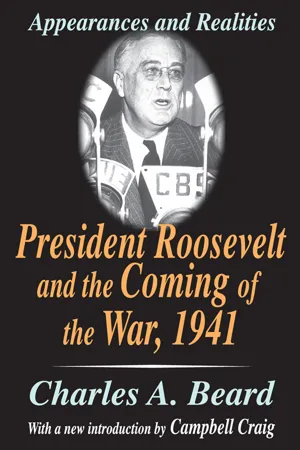
President Roosevelt and the Coming of the War, 1941
Appearances and Realities
- 614 pages
- English
- ePUB (mobile friendly)
- Available on iOS & Android
eBook - ePub
About this book
Conceived by Charles Beard as a sequel to his provocative study of American Foreign Policy in the Making, 1932-1940, President Roosevelt and the Coming of the War outraged a nation, permanently damaging Beard's status as America's most influential historian.Beard's main argument is that both Democratic and Republican leaders, but Roosevelt above all, worked quietly in 1940 and 1941 to insinuate the United States into the Second World War. Basing his work on available congressional records and administrative reports, Beard concludes that FDR's image as a neutral, peace-loving leader was a smokescreen, behind which he planned for war against Germany and Japan even well before the attack on Pearl Harbor.Beard contends that the distinction between aiding allies in Europe like Great Britain and maintaining strict neutrality with respect to nations like Germany and Japan was untenable. Beard does not argue that all nations were alike, or that some did and others did not merit American support, but rather that Roosevelt chose to aid Great Britain secretly and unconstitutionally rather than making the case to the American public. President Roosevelt shifted from a policy of neutrality to one of armed intervention, but he did so without surrendering the appearance, the fiction of neutrality. This core argument makes the work no less explosive in 2003 than it was when first issued in 1948.
Information
PART I
APPEARANCES
CHAPTER I
Moral Commitments for the Conduct of Foreign Affairs in 1941
P RESIDENT ROOSEVELT entered the year 1941 carrying moral responsibility for his covenants with the American people to keep this nation out of war—so to conduct foreign affairs as to avoid war. Those covenants, made in the election campaign of 1940, were of two kinds. The first were the pledges of the Democratic party to which he publicly subscribed while he was bidding for the suffrages of the people. The second were his personal promises to the people, supplementing the obligations of his party's platform.1
The antiwar covenants of the Democratic party, to which President Roosevelt had committed himself unreservedly during the campaign, were clear-cut: “We will not participate in foreign wars, and we will not send our Army, naval, or air forces to fight in foreign lands outside of the Americas, except in case of attack…. The direction and aim of our foreign policy has been, and will continue to be, the security and defense of our own land and the maintenance of its peace.”
In supplementing the pledges of the Democratic platform, President Roosevelt had also been unequivocal in his personal declarations. At Philadelphia, October 23, 1940, he had branded as false a Republican charge that “this Administration wishes to lead this country into war,” and proclaimed that he was “following the road to peace.” At Boston on October 30, he was even more emphatic, for there he declared: “I have said this before, but I shall say it again and again and again: Your boys are not going to be sent into any foreign wars…. The purpose of our defense is defense.” At Buffalo, November 2, his vow was short and unqualified: “Your President says this country is not going to war.”
It is true that the Democratic platform of 1940 pledged to liberty-loving peoples wantonly attacked “all the material aid at our command, consistent with law and not inconsistent with the interests of our own national self-defense.” It is true also that during the campaign President Roosevelt reiterated, reinforced, and enlarged upon this promise. But neither Democratic party leaders nor President Roosevelt at the time construed the pledge to extend, conditionally, material aid to liberty-loving peoples as canceling the conditions and their antiwar covenants. And indeed it would require more than casuistry to show that an indefinite and conditional pledge in fact obliterated ex vi termini definite and unequivocal pledges to the contrary made simultaneously and subsequently.2
On their part, the Republicans and their candidate, Wendell Willkie, likewise committed themselves to definite promises that they would keep the United States out of war. The antiwar plank of the Republican platform read: “The Republican party is firmly opposed to involving this nation in foreign war.” While expressing a real fear that the Administration was heading for war, Mr. Willkie reiterated again and again and again during the campaign a solemn promise that if elected President no American boys would be sent to fight in any European or Asiatic war.3
Whatever secret reservations President Roosevelt and Mr. Willkie may have cherished when they made their antiwar commitments to the American people, there can be no doubt about the unequivocal nature of their covenants to keep the country out of war if victorious at the polls.4 Nor could there be any doubt that the overwhelming majority of the American people were then convinced that the United States should stay out of war in Europe and Asia. That conviction had long been maturing, in a large measure as the result of experiences during and after World War I.
As leader of “the great crusade” in 1917-18, President Wilson had held up before the American people a noble dream of a new and better world. In moving speeches and summary statements, he had told them that they were fighting a war for democracy, a war to end wars, a war to crush German military despotism, a war to close the old era of secret diplomacy and imperialism, a war to establish permanent peace among the war-weary peoples of the earth. But the war had scarcely come to a close when stark events began to dissolve the dream. Even in the so-called settlement at Versailles only two or three of President Wilson's Fourteen Points for an ideal peace were realized. For the American people the years that followed were years of deepening disillusionment.5
With regard to foreign policy, no trend in American public opinion between 1919 and 1941 was more marked than a diminishing confidence in the peace promises of the League of Nations and a growing resolve to keep the United States out of the next war in Europe. If the trend was especially marked at first among Republicans, it became powerfully evident among Democrats at their national conventions in 1924 and 1928.6 It reached a high point in 1932. In February of that year Franklin D. Roosevelt, then seeking the Democratic nomination for President, publicly declared that he was opposed to American membership in the League of Nations and was in favor of nonentanglement in the political quarrels of Europe; and in November of that year, after making a nationwide campaign mainly on domestic issues, Governor Roosevelt was elected President of the United States.7 The trend of Democratic opinion against involvement in the next European war came to a climax in 1935 when Congress, completely dominated by Democrats, passed the first Neutrality Act—a law deliberately designed to keep the United States out of the next European war, already on the horizon, by forbidding a number of specific practices identical with or akin to the practices that had prevailed in 1914-17 and had resulted in “shooting” incidents on the high seas prior to the declaration of war on Germany in April, 1917. Although President Roosevelt dissented from some features of the Neutrality measure he signed it, endorsed the design of Congress to keep the United States out of the next war, and praised the purpose of Congress in his campaign for reëlection in 1936.
Only once during the years from 193 3 to 1940 did President Roosevelt apparently make an open break with the policy of neutrality for the United States in European wars. That was in his “quarantine speech” at Chicago in October, 1937; but almost immediately he declared in effect that his speech really meant no breach with the Neutrality Act, no intention on his part to intervene by arms in a European war when it came.8 Furthermore, if, despite his subsequent denials, the quarantine speech was to be taken at the moment as indicating that President Roosevelt had actually shifted from neutrality to the doctrine of armed intervention, that indication was explicitly canceled in 1939 and 1940 by his various public promises to maintain the neutrality of the United States.
Had President Roosevelt been privately convinced in 1940 that the United States should enter the war, he knew, as well as Mr. Willkie did, that the sentiment of the Democratic party, and of the country, was almost solidly against that view. Only a small proportion of the delegates at the Republican convention at Philadelphia in June dared to reveal opinions veering in the direction of war for the United States and all such opinions were quickly overridden by the resolute majority of noninterventionists.9 At the Democratic convention in Chicago a few days later the antiwar sentiment among the delegates was even stronger, if possible, than it had been among the Republicans at Philadelphia; President Roosevelt and his agents bowed to that sentiment.10
Indeed, in respect of foreign policy, the striking feature of the political campaign of 1940 was the predominance of the antiwar sentiment among Democrats and Republicans—the overwhelming majority of the American people. At no time during that contest did President Roosevelt or Mr. Willkie or any other responsible party leader venture to propose openly that the United States should become involved in foreign wars or should adopt measures calculated to result in war. On the contrary, as far as the two great parties were concerned, the only choice before the voters was between two candidates, President Roosevelt and Mr. Willkie, both engaged in outbidding each other in the solemnity and the precision of their pledges to maintain the neutrality and peace of the United States.
Nor must the circumstances in which their pledges were made be forgotten. Before the campaign of 1940 got into full swing France had fallen a victim to Hitler's conquering hordes, British armed forces had suffered disaster at Dunkirk, Germany seemed triumphant in western Europe, and Great Britain was beleaguered, daily expecting a German invasion. In other words, the peril of Britain seemed greater in the summer and autumn of 1940 than it did after June, 1941, when Hitler plunged into a war with Russia. Yet it was in those months of Britain's desperation in 1940 that President Roosevelt and Democratic candidates for Congress, pleading for the suffrages of the American people, promised that, if victorious, they would maintain the security and peace of the United States.
If the processes of popular election and responsible government had any meaning or validity, the antiwar covenants with the American people, freely entered into by the Democratic party and President Roosevelt during the campaign of 1940, were specific commitments to be fulfilled after their victory at the polls in November. Those covenants were explicit mandates for the President in the conduct of foreign affairs in 1941. They were equally explicit mandates for the Democratic Senators and Representatives, who had indubitable control of Congress, in the enactment of legislation relative to all issues of peace and war.
Those covenants were no mere incidents or practical jokes of the campaign: They were, in fact, major promises of the campaign, extensively and definitely expounded in documents and speeches, and were binding in honor and good conscience after the election. In short, unless deceiving the people in matters of life and death is to be regarded as a proper feature of the democratic politics and popular decisions at the polls are to be treated as chimeras, President Roosevelt's peace pledges of 1940 were imperatives for him in 1941; and only by spurning the peace pledges of their party could Democratic Senators and Representatives dominant in Congress enact into law measures calculated to take the United States into war.
To this principle of representative government, admittedly, exceptions are allowable, for example, where a drastic and unexpected alteration in the posture of affairs calls for a change of policy after an election. If, however, President Roosevelt came to the conclusion in 1941 that his antiwar commitments of 1940 had been rendered obsolete by changed circumstances in 1941 and that the United States should engage in war, he was under constitutional and moral obligations to explain to the country the grounds and nature of a reversal in policy. It may be said, to be sure, and has been said by defenders of his course, that in many of his addresses in 1941 he declared that there was danger or war coming, danger of attacks upon the United States, and a growing need for more and more preparation for defense. Indeed he did assert publicly that Hitler had designs for conquering the world, suppressing all religions, destroying liberty, and subduing the American people. He did say, more than once, that Hitler intended to attack the United States and, after the “shooting war” had begun, that Hitler had attacked America.11 In some addresses also he claimed that, in the election returns of 194012 and ...
Table of contents
- Cover
- Half Title
- Title Page
- Copyright Page
- Table of Contents
- Transaction Introduction
- Prefatory Note
- Part I. Appearances
- Part II. Unveiling Realities
- Part III. Realities As Described By The Pearl Harbor Documents
- Part IV. Epilogue
- Index
Trusted by 375,005 students
Access to over 1.5 million titles for a fair monthly price.
Study more efficiently using our study tools.
Frequently asked questions
Yes, you can cancel anytime from the Subscription tab in your account settings on the Perlego website. Your subscription will stay active until the end of your current billing period. Learn how to cancel your subscription
No, books cannot be downloaded as external files, such as PDFs, for use outside of Perlego. However, you can download books within the Perlego app for offline reading on mobile or tablet. Learn how to download books offline
Perlego offers two plans: Essential and Complete
- Essential is ideal for learners and professionals who enjoy exploring a wide range of subjects. Access the Essential Library with 800,000+ trusted titles and best-sellers across business, personal growth, and the humanities. Includes unlimited reading time and Standard Read Aloud voice.
- Complete: Perfect for advanced learners and researchers needing full, unrestricted access. Unlock 1.5M+ books across hundreds of subjects, including academic and specialized titles. The Complete Plan also includes advanced features like Premium Read Aloud and Research Assistant.
We are an online textbook subscription service, where you can get access to an entire online library for less than the price of a single book per month. With over 1.5 million books across 990+ topics, we’ve got you covered! Learn about our mission
Look out for the read-aloud symbol on your next book to see if you can listen to it. The read-aloud tool reads text aloud for you, highlighting the text as it is being read. You can pause it, speed it up and slow it down. Learn more about Read Aloud
Yes! You can use the Perlego app on both iOS and Android devices to read anytime, anywhere — even offline. Perfect for commutes or when you’re on the go.
Please note we cannot support devices running on iOS 13 and Android 7 or earlier. Learn more about using the app
Please note we cannot support devices running on iOS 13 and Android 7 or earlier. Learn more about using the app
Yes, you can access President Roosevelt and the Coming of the War, 1941 by Charles Beard in PDF and/or ePUB format, as well as other popular books in Geschichte & Nordamerikanische Geschichte. We have over 1.5 million books available in our catalogue for you to explore.