
- 187 pages
- English
- ePUB (mobile friendly)
- Available on iOS & Android
eBook - ePub
Japanese Religions Past and Present
About this book
Each of the eight chapters deals with a specific topic, such as Shinto, Buddhism, the new religions, and Christianity; there is an introduction that outlines the subject to be considered followed by a series of readings.
Information
1
Meeting Japanese Culture
Over the past century and a half, and especially in the decades since 1945, Japanese society has undergone some of the most rapid changes that any society has ever seen. From 1853, when Japan was opened up to the outside world by the Americans, until the end of the nineteenth century, the Japanese saw their country transformed from a feudal society into an industrialised one, heavily influenced by the West. Japanese political and education systems were based on Western models, while modern Western techniques in industry, engineering, manufacturing and many other fields were swiftly learned and assimilated. In the early twentieth century Japan began to come into conflict with other countries, first with Russia, which she defeated in war in 1904-5, and later with China and, of course, the Allies in the Second World War.
The twentieth century has been, in many respects, one of turbulence for Japan: wars, industrial upheavals, the strife of industrial recessions and depressions in the 1920s and 1930s, the emergence of an increasingly nationalistic and fascist regime and the years of military expansion from the early 1930s on, leading to total war. Japan became the only nation to experience the horrors of atomic bombs at first hand, at Hiroshima and Nagasaki in 1945, and shortly after, beaten, desolate and in chaos, for the first time in her history had to submit to defeat at the hands of foreign powers.
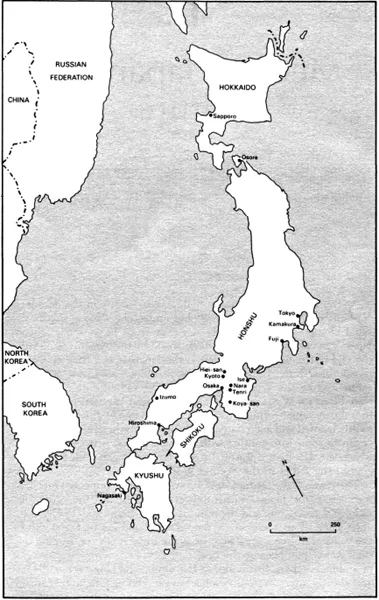
After seven years of foreign rule by an occupying army, Japan returned to independence in 1952, and since then her progress has been staggering. The desolate wastelands of 1945 have become hi-tech bustling cities, and the Japanese economy has risen, phoenix-like, to make Japan one of the world’s richest nations. Japan today is a world leader, an industrial and technological giant to whom the West now looks for inspiration and for new goods and ideas.
All this has had a considerable effect on the lives of the Japanese, who have become, in a few decades, a race of city-dwelling industrialists where they were once village-dwelling farmers. Yet one of the most remarkable features of Japanese life is that, while so much has changed, there remains a sense of underlying stability, both in the social system and within Japanese culture. The religious ethos itself has been a major influence here: as the first chapter shows, there is a sense of continuity that has helped give people a source of strength and stability which acts as a balance to the increasing speed of change in other aspects of life. These underlying continuities will become more apparent in subsequent chapters.
The readings in this chapter will also bring out some of those underlying stabilities whilst providing the outsider with an introduction to Japanese culture in general. Reading No. 1 is an impressionistic view of Japan by a Western observer which brings out many of the differences between Japan and the West that strike visitors to Japan. It also draws attention to many of the cultural elements of stability in Japan (the important adherence to concepts of purity, ceremony, style and ritual, for example). Some of these themes appear, in a different way, in the next reading (No. 2) on Japanese language. In order to understand a culture it is useful to at least have some knowledge of the ways its language functions. Aasulv Lande’s introduction to the complexities and intricacies of the Japanese language helps us in this, for it shows the flexible nature of Japanese, able to assimilate elements from abroad, as well as the ways it underpins and provides a sense of cultural stability.
In particular it brings out the importance in Japan of relationships between people, an issue that is developed by the next two readings. Harumi Befu (No. 3) discusses key elements in Japanese cultural behaviour, ethics and social relationships. Ruth Benedict (No. 4) looks at some of these issues from a different angle, and her analysis of Japan as a ‘shame’ rather than as a ‘guilt’ culture (an idea presented in her famous work The Chrysanthemum and the Sword, published in 1946) has been a central question in the continuing debate on the nature of the Japanese national character. In the final reading, Takeo Doi (No. 5) discusses and expands on this issue further, relating it to some of the key cultural issues of obligation discussed by Befu, and providing a generally sympathetic Japanese response to and discussion of Benedict’s ideas. The themes found in these readings, concerning Japanese social attitudes, ethics and social relationships, provide some of the basic foundations of Japanese culture. At the same time they express many of the themes that are important within Japanese religious culture as well, and as such will be addressed in various contexts throughout the rest of this book.

Reading No. 1
Japan – the pure land: the impressions of a visitor
By FINN STEFÁNSSON

Everything is so pure, so neat, so decorative – like a doll’s house. The chairs are too small, the seats in the coach are not so big either, again and again you have to bend to enter a door. The rice paddies are small like the squares on a chessboard, the rooms are like cells in a honeycomb, the rush hours in Tokyo are claustrophobic.
The Westerner towers like a giant, especially among elderly Japanese. The youth have begun to grow taller because of the more varied diet after the Second World War. It will not be long before the average height of the Japanese reaches that of the people from Northern Europe.
In many fields the Japanese are ahead of us, especially in technology. Everywhere you see the effects of highly advanced computer-controlled technology. Buses and trains depart, not to the minute, but to the second. Japan’s superb public transport, spear-headed by the ultra-fast ‘hikari’ (bullet) service on Japan’s new inter-city network (Shinkansen) is perhaps the best in the world. Buses and commercial vehicles in reverse gear automatically give out warning sounds. At pedestrian crossings, the green light is accompanied by music to let the blind know when to cross.
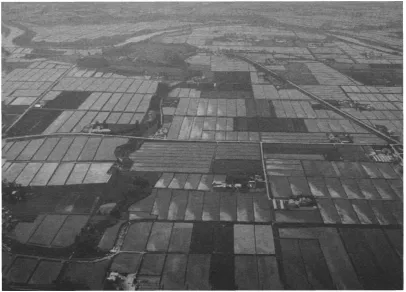
Rice growing in Hokkaido
In the car factories industrial robots attack the steel plates like prehistoric lizards, greedy and fire-breathing, and each may carry out five or six complicated processes along the assembly line. Live ‘industrial robots’ then carry out a similar series of processes.
The reverse side of Japanese efficiency is a certain automation and uniformity. What are these live robots who dedicate their lives to the factories like in real life? Why do schoolchildren wear old-fashioned, black uniforms? Why must boys of 10 to 14 have crew-cut hair styles like soldiers? Why do the vast majority of males living in the cities wear dark suits and ties? Why do people on underground trains and on buses sleep as if remote-controlled?
At once foreign yet familiar to us, Japan is a welfare state with shops abounding in goods. Prices are higher than in Western countries but the range of goods often surpasses anything we see in cities in the West.
Foreign to us are, for instance, the code of politeness, people’s shyness and the central concepts of purity.
The mixture of shyness and politeness is ingrained from childhood. Again and again you meet groups of schoolchildren coming towards you, curious but also shy. They titter and draw back a little when you say hello, but then their curiosity prevails. You shake hands and again this is almost too much. They withdraw from you until finally, when they have reached a certain distance, they wave and shout, ‘Goodbye’ – more and more hilariously the further they retreat. This tittering shyness applies to almost all women – they bow submissively and shrink back in the same movement.
The themes of purity and purification are constantly on view in Japan. At all Shinto shrines there are places of purification, and this ritual purification gives purity to body and soul which leads to honesty. A key concept in Japanese ethics is shōjiki (‘there are no lies’). Through purification the connection to the divine is restored, and all existence is revived by being taken back to its original plane and source. The life of a Japanese is to be compared to the cycle of the sun: sunset means purification in water, sunrise means revival. The daily visit to the shrine is thus deeply ingrained into the course of nature. It also means that important European concepts such as the conflict between the divine and man (sin) and between soul and body (dualism) do not exist in the Japanese world.
The symbolism of renewal and resurrection can be found in a peculiar tradition at the great Shinto shrines at Ise. The extremely beautiful main shrine, built of wood, is replaced every twentieth year by a new, exact copy of the old, erected on a purified site next to the old. The extensive re-building symbolises the purification and revival of all of Japan. Standing at the site under the cedars, 50 metres high, a thousand years old, and planted when the first gracefully simple shrine was erected, one can sense this feeling of continued renewal.
Purity also means being able to distinguish between different spatial relations, such as inside and outside. When you enter a house you take off your shoes at the front door and put on a pair of slippers (usually too small!) You must not wear any kind of shoes on the tatami mats in the inner apartment; in the toilet there is a pair of toilet slippers; and if you go to the small pavilion in the garden, you wear outdoor slippers, and having arrived at the pavilion, you change these into pavilion slippers. It may sound like a comic ritual but it definitely gives you a heightened awareness of where you are. It is a mixture of prim stylisation and sublime aesthetics.
The traditional Japanese way of life is ceremonial and stylised, and reveres beauty in the minutest details. The aesthetics, built on a harmonious fusion of disparate forms, is expressed in the tea ceremony, in all sorts of cooking, sports, dress, gardening, the wrapping paper used for gifts, ink calligraphy and the various artistic forms such as ikebana (flower arrangement).
The concepts of purity entail some serious drawbacks: discrimination against people with impure jobs and of people belonging to ethnic minorities has long been a problem in Japan. Blood, dead animals and human excrement have long been seen as impure and therefore taboo subjects. As a result, butchers, tanners, street sweepers and refuse collectors have for centuries been seen as marginal members of society. At the bottom of the social pyramid there is a group known as the burakumin, estimated at two to three million people, whose social status is comparable to the untouchables of India. In the Tokugawa period, when the hierarchic structure prevailed, this group was called ‘people who are not people’ and even today they are considered a race apart by many Japanese who feel that to mention them is taboo.
Similarly these ideas about the purity of the race discriminate against the Ainu, the aborigines of the northern Island of Hokkaido, and the many Koreans (whose culture paradoxically has influenced the Japanese very much) who have been resident in Japan f...
Table of contents
- Cover
- Half Title
- Title Page
- Copyright
- Table of Contents
- Preface
- 1. Meeting Japanese Culture
- 2. Japanese Religions - an Introduction
- 3. Folk Religion
- 4. Shinto
- 5. Buddhism
- 6. The New Religions of Japan
- 7. Christianity in Japan
- 8. Religion and Politics in Japan
- Notes on the Readings
- Bibliography
- Index
Trusted by 375,005 students
Access to over 1.5 million titles for a fair monthly price.
Study more efficiently using our study tools.
Frequently asked questions
Yes, you can cancel anytime from the Subscription tab in your account settings on the Perlego website. Your subscription will stay active until the end of your current billing period. Learn how to cancel your subscription
No, books cannot be downloaded as external files, such as PDFs, for use outside of Perlego. However, you can download books within the Perlego app for offline reading on mobile or tablet. Learn how to download books offline
Perlego offers two plans: Essential and Complete
- Essential is ideal for learners and professionals who enjoy exploring a wide range of subjects. Access the Essential Library with 800,000+ trusted titles and best-sellers across business, personal growth, and the humanities. Includes unlimited reading time and Standard Read Aloud voice.
- Complete: Perfect for advanced learners and researchers needing full, unrestricted access. Unlock 1.5M+ books across hundreds of subjects, including academic and specialized titles. The Complete Plan also includes advanced features like Premium Read Aloud and Research Assistant.
We are an online textbook subscription service, where you can get access to an entire online library for less than the price of a single book per month. With over 1.5 million books across 990+ topics, we’ve got you covered! Learn about our mission
Look out for the read-aloud symbol on your next book to see if you can listen to it. The read-aloud tool reads text aloud for you, highlighting the text as it is being read. You can pause it, speed it up and slow it down. Learn more about Read Aloud
Yes! You can use the Perlego app on both iOS and Android devices to read anytime, anywhere — even offline. Perfect for commutes or when you’re on the go.
Please note we cannot support devices running on iOS 13 and Android 7 or earlier. Learn more about using the app
Please note we cannot support devices running on iOS 13 and Android 7 or earlier. Learn more about using the app
Yes, you can access Japanese Religions Past and Present by Esben Andreasen,Ian Reader,Finn Stefansson in PDF and/or ePUB format, as well as other popular books in Theology & Religion & Asian Religions. We have over 1.5 million books available in our catalogue for you to explore.