- 599 pages
- English
- ePUB (mobile friendly)
- Available on iOS & Android
eBook - ePub
About this book
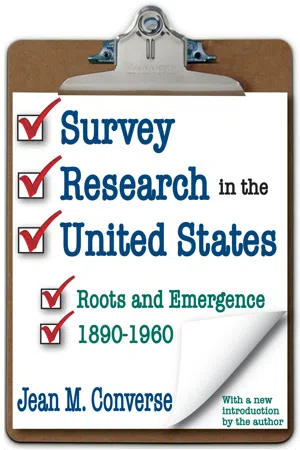
Hardly an American today escapes being polled or surveyed or sampled. In this illuminating history, Jean Converse shows how survey research came to be perhaps the single most important development in twentieth-century social science. Everyone interested in survey methods and public opinion, including social scientists in many fi elds, will find this volume a major resource.Converse traces the beginnings of survey research in the practical worlds of politics and business, where elite groups sought information so as to infl uence mass democratic publics and markets. During the Depression and World War II, the federal government played a major role in developing surveys on a national scale. In the 1940s certain key individuals with academic connections and experience in polling, business, or government research brought surveys into academic life. By the 1960s, what was initially viewed with suspicion had achieved a measure of scientific acceptance of survey research.The author draws upon a wealth of material in archives, interviews, and published work to trace the origins of the early organizations (the Bureau of Applied Social Research, the National Opinion Research Center, and the Survey Research Center of Michigan), and to capture the perspectives of front-line fi gures such as Paul Lazarsfeld, George Gallup, Elmo Roper, and Rensis Likert. She writes with sensitivity and style, revealing how academic survey research, along with its commercial and political cousins, came of age in the United States.
Information
Part 1 The Ancestors: 1890–1940
1 The Reformist Ancestor of Policy: The Social Survey
The study of history allows one to make a conscious choice of ancestors.
Marvin S. Becker
The English Social Survey
The Choice of Ancestors
Any man who wrote seventeen books in as many years in his spare time surely deserves to be a founding father of something. At the turn of the century, the indefatigable Charles Booth (1840–1916) produced a landmark study of social conditions, Life and Labour of the People in London (1889–1903),1 the first English “social survey” of huge proportions. The intellectual lineage of American survey research has sometimes been taken back to Booth, but in these short accounts the line of descent is not very clear.2 How was the line transmitted to these American survey researchers, who began to function in the 1930s and used the name in the 1940s? Is the link to Booth through surveys a loose linguistic one, available because so many connotations have been given the multipurpose word surveys over its long life? Or is there a more substantial line of intellectual influence and succession?
Indeed, there is, first, a linguistic connection. The naming of social surveys as such was made in direct analogy to the surveying of land, and they were qualified as social to indicate that these were surveys of people rather than agricultural or geological surveys and also to distinguish broad-based data collection about human beings from the “bare enumeration” of official census collection.3 And, as we shall see, the linguistic connection is still a live one.4
The second reason that Booth is an ancestor of choice is that of drama and clarity. There he is at the turn of the century, astride a monument, a huge survey of the largest city in the world, which he conducted with the help of a small staff (which included Beatrice Potter Webb) but in enormous part by himself. At the time, Booth was engaged in the owning and managing of a thriving international steamship company that sometimes took him abroad, and so much of his survey work had to be conducted at night and on weekends. He spent his own money on the project—33,000 English pounds. He took to the political lecture circuit on behalf of old-age pensions because of his empirical findings. At the same time he lived a family and personal life, with a wife and children, friends, political and business colleagues at hand, correspondence with those afar.5 He wrote on and on for publication—not only the seventeen volumes mentioned but other books as well. Booth was a man “obsessed,” as Abrams has put it, gathering “an avalanche of facts.”6 Booth thus has a certain mythic proportion that is pleasing in venerable forebears.
In his lifetime, this made for renown and influence. The Booth survey, along with other late Victorian work, was an example of thoroughness and scientific authority to American activists who wanted to establish objective “scientific facts” to help power social change. An American social survey movement of widespread, fervent fact-gathering about social problems was conducted at the state and local level by laymen and professionals, but it showed some influence from Booth. In the 1930s, under the impetus of the Great Depression and the New Deal, surveys of national scope were undertaken by social scientists in government, not without some of the same hope and fervor of effecting social change through applied science that characterized surveys in the Victorian and Progressive eras. The national work added important technical capacities to the survey.
Booth’s ancestry thus has some reality for survey research, but it should nevertheless be viewed in the context of two qualifications. First, for the scientific roots of survey research—even in its specifically factual inquiry—Booth’s social survey is not the only ancestor of choice. The census survey of population and official government statistics is another. Tracing that lineage would take us back at least to the first national census surveys of population (in the United States, 1790, and in England, 1801) and back to predecessors in the 1600s in work on epidemics, vital records, life tables for insurance companies, and other quantitative studies done in England and Europe. We shall not proceed either that far back or that wide, and we shall largely neglect the history and development of the United States Bureau of the Census, except where it impinges on the history of probability sampling.7
Second, we should note that Booth did not invent surveys of social conditions. The poor had been a worry as well as a fascination in England for centuries, and counting them was of importance in assessing the problem and in assigning responsibilities. In 1601 the Elizabethan Poor Law established the principle of workhouses and charged parishes with the responsibility for raising taxes for poor relief. There was some empirical research into the incidence of poverty and other social conditions from the seventeenth to the nineteenth century,8 but the industrialization and urbanization of the nineteenth century—the new visibility of poverty in congested cities and the menace of epidemics—spurred fact-gathering and reform efforts in both England and the United States. A systematic effort to ground the argument in descriptive statistics was made in both countries midcentury as the new statistical societies of the 1840s undertook sanitary surveys of health and housing conditions by house-to-house canvass.9 In the United States, surveys of social conditions were conducted by letter and questionnaire to businesses and by house-to-house canvass carried out by police, settlement-house workers, insurance agents, students, agricultural agents, and religious workers. But none of these had the scope of Booth’s project at the turn of the century.10
The Booth Enterprise
The Social Context
The English social survey and its American counterpart were the “factualizing” branch of a broad social movement that spanned the Atlantic roughly from the 1880s to World War I. In late Victorian England, a congeries of wealthy philanthropists, charity workers, Marxists, single-taxers, trade unionists, Fabian socialists, liberals, workers of the new settlement houses, physicians and health workers, evangelists of the new Salvation Army all reflected their various concerns about the plight of the poor and fear of their revolutionary threat. Solutions were cast in fervent programs for Christian evangelism and in fervent debate about the rival prescriptions of capitalism and socialism.
Booth undertook his inquiry in this context, with policy and influence in mind, intent on being “scientific”—that is, unbiased and objective— and graphic in his presentation. Along with a businessman’s deep respect for numbers, Booth also had a novelist’s eye for individual character and detail, and he animated his quantitative treatment with sprightly street scenes and memorable characters, which made his work accessible to a large audience. “Mr. Booth’s inquiry,” as it came to be called, was well known long before the complete edition of 1902–03, for he had presented preliminary findings to the Royal Statistical Society in two papers (1887–1889). When he published the first volume in 1889, it sold out quickly and was widely reviewed in a “chorus of praise,” with only some negative criticism. Booth was soon elected president of the Royal Statistical Society (1892–1894) and later served on royal commissions investigating social conditions. The universities of Cambridge, Oxford, and Liverpool all conferred honorary degrees on him, and the government made him a Privy Councillor.11
It has long been thought that Booth was directly inspired to his inquiry by a skeptical reaction to the claims of the Social Democratic Federation, a Marxist group, that one Londoner in four was living in misery. But if this was not the specific stimulus, the issue of who and how many the poor were was given new salience in the 1880s, and Booth responded to this.12 Within the first two years of his work, he concluded that one Londoner in three was living in poverty. The London poor were not a ragtag group of beggars and drunkards who refused to work but instead comprised well over a million people—a whopping 30.7 percent of the population—in the richest city in the world. These people were living below a “Line of Poverty” that Booth quantified as a “regular though bare” income of eighteen to twenty-one shillings a week for a “moderate” family. Those he defined as the poor struggled to obtain the necessities of life; the very poor, who had even less income and less certainty, lived in a state of “chronic want” or outright “distress.”13 They were poor less because of drink and depravity, indulgence and improvidence—popular hypotheses that the problem was one of individual morality rather than of social or economic conditions—and more because they lacked enough work or because they were overwhelmed with sickness, debt, injury, or too many mouths to feed. The efforts of private charities and public authorities to help the poor get back on their feet were largely unavailing, Booth concluded. As to the churches, their ministry was largely irrelevant to both the material needs and spiritual condition of the poor.14
The Booth Method: An Effort at Enumeration
Any appraisal of Booth’s survey of London inevitably pays tribute to the sheer size of his inquiry—“monumental” is the relentless adjective—but his significance for survey research stems more from two of the four volumes of the poverty series than from the seventeen-volume work as a whole, which encompasses studies of industries and religious influences. For the seven volumes dealing with religion, Booth found no means of classifying and quantifying the voluminous detail he obtained from interviewing almost 1,800 informants and from the questionnaires of hundreds of other church workers.15 The volumes abound in colorful vignettes and observations that have their own fascination, but they do not have the definition and classification of the poverty work. For his five volumes on industry, Booth lacked data on individual income, and he was not able to link the aggregate data on the wage structures of industry with the data on household income of his poverty series. As the Simeys have put it, the poverty and industry series were “allowed to run in different directions, the first toward a deeper understanding of the nature of poverty as a social phenomenon, the second nowhere in particular.”16
It is important to note that Booth’s work did not incorporate the new correlation analysis of Karl Pearson and G. Udny Yule, innovations of 1895–99, nor did his data collection incorporate systematic sampling, which Arthur L. Bowley applied to the social survey in 1912–13.17 By Booth’s invention of a poverty line and his conversion of it into a poverty map of London, color-coded for eight economic levels, he nevertheless captured in summary form enormous amounts of information. The poverty work alone is indeed deservedly called monumental.
For this work, Booth and his assistants used a variety of methods, consulting existing statistics, conducting interviews with informants, and making countless observations of real conditions. Booth himself became a “participant observer” when he rented a room in the houses of relatively poor Londoners. The most important procedure was what Beatrice Webb called “the method of wholesale interviewing,”18 in which Booth and his assistants spent enormous numbers of hours in essence interviewing the interviewers, the so-called school board visitors.
The visitors were attendance officers who had visited families personally, many over long periods of time, asking questions and making observations. Booth used the visitors in effect as a field staff. He had not set them to their initial task, so he could not standardize their observations, and he remained dissatisfied that he lacked a fully objective indicator of poverty and had to rely instead on the visitors’ opinions. But he had confidence that their opinions were not biased, coming as they did from visitors of every kind of experience and persuasion, and he made persistent efforts to check their impressions against other findings. Collectively, they had great physical coverage as well, encompassing 80 percent of London.19
For some 3,400 streets in the East End of London, Booth condensed the visitors’ information into notebooks of standardized format that captured the particulars for each house: the residents’ occupations, the number of occupants per room, the number of children, and the class category (i.e., income and general situation). Booth defined, classified, and tabulated the information by individual household. When he expanded his inquiry to London as a whole, he deemed the family-by-family inquiry too lavish in time and made notebook entries of a more summary fashion, as shown in the following example:
Colour for map: purple [meaning a mixture of classes]
Houses: number scheduled 109; unscheduled 0
Character: two to eight rooms, let in tenements
Number of children aged three to thirteen: 231
Description of street: Struggling poor, mostly casual. Few in regular work.
Porte...
Table of contents
- Cover Page
- Title Page
- Copyright
- Dedication
- Contents
- Acknowledgments
- Abbreviations
- Introduction to the Transaction Edition
- Introduction
- Acknowledgments
- Part 1 The Ancestors: 1890–1940
- 1 The Reformist Ancestor of Policy: The Social Survey
- 2 The More Elegant Ancestor of Science: Attitude Measurement in Psychology and Sociology
- 3 The Most Direct Line, Business: Market Research and Opinion Polling
- Part 2 The Prewar and Wartime Generation: 1935–1945
- 4 The Prewar Years: Academic Entrepreneurs and Survey/Poll Data
- 5 The Wartime Experience in Policy Research
- 6 The Wartime Experience in Science (I)
- 7 The Wartime Experience in Science (II)
- Part 3 Migrations to the Universities: 1940–1960
- 8 General Perspectives and Anticipations
- 9 The Bureau of Applied Social Research: The First Wave
- 10 The National Opinion Research Center: From the Margins of Commercial Polling
- 11 The Survey Research Center at Michigan: From the Margins of Government
- 12 The Academic Establishment of Survey Research: A Summary and Evaluation
- Notes
- Index
Trusted by 375,005 students
Access to over 1.5 million titles for a fair monthly price.
Study more efficiently using our study tools.
Frequently asked questions
Yes, you can cancel anytime from the Subscription tab in your account settings on the Perlego website. Your subscription will stay active until the end of your current billing period. Learn how to cancel your subscription
No, books cannot be downloaded as external files, such as PDFs, for use outside of Perlego. However, you can download books within the Perlego app for offline reading on mobile or tablet. Learn how to download books offline
Perlego offers two plans: Essential and Complete
- Essential is ideal for learners and professionals who enjoy exploring a wide range of subjects. Access the Essential Library with 800,000+ trusted titles and best-sellers across business, personal growth, and the humanities. Includes unlimited reading time and Standard Read Aloud voice.
- Complete: Perfect for advanced learners and researchers needing full, unrestricted access. Unlock 1.5M+ books across hundreds of subjects, including academic and specialized titles. The Complete Plan also includes advanced features like Premium Read Aloud and Research Assistant.
We are an online textbook subscription service, where you can get access to an entire online library for less than the price of a single book per month. With over 1.5 million books across 990+ topics, we’ve got you covered! Learn about our mission
Look out for the read-aloud symbol on your next book to see if you can listen to it. The read-aloud tool reads text aloud for you, highlighting the text as it is being read. You can pause it, speed it up and slow it down. Learn more about Read Aloud
Yes! You can use the Perlego app on both iOS and Android devices to read anytime, anywhere — even offline. Perfect for commutes or when you’re on the go.
Please note we cannot support devices running on iOS 13 and Android 7 or earlier. Learn more about using the app
Please note we cannot support devices running on iOS 13 and Android 7 or earlier. Learn more about using the app
Yes, you can access Survey Research in the United States by Jean M. Converse in PDF and/or ePUB format, as well as other popular books in Social Sciences & North American History. We have over 1.5 million books available in our catalogue for you to explore.