eBook - ePub
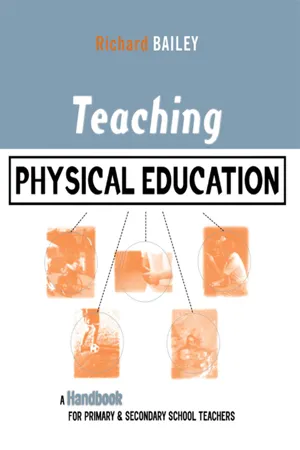
Teaching Physical Education
A Handbook for Primary and Secondary School Teachers
- 222 pages
- English
- ePUB (mobile friendly)
- Available on iOS & Android
eBook - ePub
About this book
Designed for all trainee and newly qualified teachers, teacher trainers and mentors, this volume provides a contemporary handbook for the teaching of physical education, covering Key Stages 2, 3 and 4 in line with current DfEE and TTA guidelines.
Information
| 1 | The physical education curriculum |
Introduction
This chapter examines the scope and content of physical education in schools. It is important for trainee and newly qualified teachers to be aware of different interpretations of their subject, and to consider their own views. As professionals, physical educators need to develop their own philosophy of teaching, one that guides their practice and the character of their daily encounters with pupils. They also need to be critically aware of policy documentation and guidance from central agencies.
Objectives
By the end of this chapter you should:
- understand the importance of physical education, physical activity and movement for all pupils;
- be familiar with various interpretations of the aims and purposes of physical education;
- know the statutory requirements related to the content of physical education.
Children and movement
‘Physical education makes me feel as if I could fly away!’ (11-year-old from Leeds, England, quoted in Talbot, 1999).
There is little doubting the central importance of movement and physical activity in the lives of children and young people. Consider the following recent research findings (see Bailey, 1999a and 1999b):
- Physical activity play is the first appearing and most frequently occurring expression of play in infants.
- Children in all cultures around the world engage in both spontaneous and rule-governed forms of physical activity.
- Most children would rather take part in physical activities than in any other endeavour.
- They would prefer to succeed in these activities than in classroom-based work.
- Physical competence is a major factor influencing social acceptance in children of all ages and both sexes.
- Regular physical activity can make significant positive contributions to physical, mental and emotional well-being in children.
Bailey (1999b) coined the phrase infans ludens (child the player) to draw attention to the essentially active, playful nature of children's lives. Similarly, Bruner (1983: 121) suggests that activity, play and movement constitute the ‘culture of childhood’, and this idea has been extended by Bjorkvold (1989), who argues that any education that disregards such experiences creates a harmful and dispiriting tension. He expresses this view as a clash between ‘child culture’ and ‘school culture’:
| Child Culture | School Culture |
| play | study |
| being in | reading about |
| physical proximity | physical distance |
| testing one's own limits | respecting boundaries set by others |
| the unexpected | the expected |
| sensory | intellectual |
| physical movement | physical inactivity |
| I move and I learn! | Sit still! |
It may not be surprising that both teachers and pupils regularly rate physical education lessons among the most important curriculum areas (Birtwistle and Brodie, 1991). Pupils also regularly vote it among the most popular subjects. This reaction to the subject offers physical education teachers a great advantage, as most pupils come to them highly motivated and eager to learn. It also places a responsibility on those teachers not to turn the pupils off physical education and even physical activity, as can sometimes happen.
Task 1.1
Spend a few moments listing your personal experiences of physical activity and physical education. Not all of these experiences need be positive, and it is important to include negative feelings and memories, as well. Talk to friends and colleagues about their experiences. Are there any emerging themes and patterns? Which are the most frequently reported experiences? Are there significant differences between the reports of physical education professionals and those outside the subject? Are there any differences between males' and females' responses? What sorts of experiences of physical education and physical activity have people found off-putting?
Some of the most useful people to whom trainee or newly qualified teachers can talk are those who hated their subject at school. Predictably, most physical education teachers loved the subject as pupils, and sometimes find it difficult to appreciate contrary experiences. However, coming to understand such experiences can make them more sensitive when dealing with their pupils, and may help them avoid some of the behaviours that have put some people off physical education and physical activity in the past.
Aims and purposes of physical education
‘Cheshire Puss,’ she began, rather timidly… ‘Would you tell me, please, which way I ought to go from here?’ ‘That depends a good deal on where you want to get to,’ said the Cat. ‘I don't much care where,’ said Alice. ‘Then it doesn't matter which way you go,’ said the Cat. ‘So long as I get somewhere,’ Alice added as an explanation. ‘Oh, you're sure to do that,’ said the Cat, ‘if you only walk long enough.’
(Lewis Carroll, Alice's Adventures in Wonderland)
As the above quotation from Alice in Wonderland makes clear, it is very difficult to know which way to proceed without an understanding of where you want to end up. Aims give a sense of direction and purpose. The physical education teacher, today, has to address and prioritize a host of aims, including aims deriving from statutory regulations (like the National Curriculum) and from school policy. The teacher, as a professional, also needs to reflect on his or her own views of the subject, and the aims they express.
Task 1.2
What are the aims of physical education? What do you think are the purposes of the subject?
For 10 minutes, brainstorm your initial ideas. Then highlight the ones that you feel are especially central to the subject, and rank them in order of importance.
Repeat this task from time to time throughout the year. Does your list change? Do you add or remove items? Does your ordering of the central aims change?
Numerous authors have offered their own views on the aims of physical education. Talbot (1999), for example, claims that the subject ‘aims to develop physical literacy and integrated development of the whole person’, whilst Almond (2000: 12) proposes (among other things) ‘moving beyond play into disciplined forms of physical activity such as sport and dance’, and Parry (1998: 64) talks of ‘the development of certain human excellences of a valued kind’. The National Curriculum for England and Wales also has its list of aims and purposes, which are outlined below:
PE offers opportunities for children to:
- become skilful and intelligent performers;
- acquire and develop skills, performing with increasing physical competence and confidence, in a range of physical activities and contexts;
- learn how to select and apply skills, tactics and compositional ideas to suit activities that need different approaches and ways of thinking;
- develop their ideas in a creative way;
- set targets for themselves and compete against others, individually and as team members;
- understand what it takes to persevere, succeed and acknowledge others' success;
- respond to a variety of challenges in a range of physical contexts and environments;
- take the initiative, lead activity and focus on improving aspects of their own performance;
- discover their own aptitudes and preferences for different activities;
- make informed decisions about the importance of exercise in their lives;
- develop positive attitudes to participation in physical activity.
(http://www.standards.dfee.gov.uk/schemes/phe/peksiyaims/)
One message that should come across from these different presentations of the aims and purposes of physical education is that the subject has a distinctive and significant contribution to make to the overall education of every pupil. Moreover, ‘if the potential and range of the physical education experience is not fully realized, then that child cannot be said to be properly educated’ (Bailey, 1999a: 34). The following section considers the scope and possibilities of physical education.
Dimensions of physical education
There are many different ways of thinking about the content and character of physical education (see, for example, the different contributions to Armstrong, 1990, 1992, 1996, and Almond, 1997). A useful framework for understanding the subject is provided by Arnold (1979; adapted by Bailey, 1999b):
- education about movement;
- education through movement;
- education in movement.
Education about movement
This aspect stresses the value of introducing pupils to a range of physical activities, as well as the concepts, rules and procedures associated with them. Of course, there are many activities that pupils might experience, and each can make a contribution to their development and education.
The National Curriculum (DfEE, 2000) sets out the activity areas that pupils should experience, and the expected standards of pupils' performance (the attainment target). The activity areas are:
- dance activities;
- games activities;
- gymnastics activities;
- swimming activities and water safety; ...
Table of contents
- Cover
- Half Title
- Title Page
- Copyright Page
- Table of Contents
- Series Editor's foreword
- Foreword
- Preface
- Acknowledgements
- 1 The physical education curriculum
- 2 Planning and evaluation
- 3 Promoting a positive climate for learning
- 4 Lesson organization and management
- 5 Teaching skills
- 6 Managing behaviour
- 7 Special educational needs and differentiation
- 8 Monitoring, assessment, recording, reporting and accountability
- 9 Information and communication technology
- 10 Citizenship and values education
- 11 Meeting the new class
- Appendix
- References
- Index
Trusted by 375,005 students
Access to over 1.5 million titles for a fair monthly price.
Study more efficiently using our study tools.
Frequently asked questions
Yes, you can cancel anytime from the Subscription tab in your account settings on the Perlego website. Your subscription will stay active until the end of your current billing period. Learn how to cancel your subscription
No, books cannot be downloaded as external files, such as PDFs, for use outside of Perlego. However, you can download books within the Perlego app for offline reading on mobile or tablet. Learn how to download books offline
Perlego offers two plans: Essential and Complete
- Essential is ideal for learners and professionals who enjoy exploring a wide range of subjects. Access the Essential Library with 800,000+ trusted titles and best-sellers across business, personal growth, and the humanities. Includes unlimited reading time and Standard Read Aloud voice.
- Complete: Perfect for advanced learners and researchers needing full, unrestricted access. Unlock 1.5M+ books across hundreds of subjects, including academic and specialized titles. The Complete Plan also includes advanced features like Premium Read Aloud and Research Assistant.
We are an online textbook subscription service, where you can get access to an entire online library for less than the price of a single book per month. With over 1.5 million books across 990+ topics, we’ve got you covered! Learn about our mission
Look out for the read-aloud symbol on your next book to see if you can listen to it. The read-aloud tool reads text aloud for you, highlighting the text as it is being read. You can pause it, speed it up and slow it down. Learn more about Read Aloud
Yes! You can use the Perlego app on both iOS and Android devices to read anytime, anywhere — even offline. Perfect for commutes or when you’re on the go.
Please note we cannot support devices running on iOS 13 and Android 7 or earlier. Learn more about using the app
Please note we cannot support devices running on iOS 13 and Android 7 or earlier. Learn more about using the app
Yes, you can access Teaching Physical Education by Richard Bailey in PDF and/or ePUB format, as well as other popular books in Education & Education General. We have over 1.5 million books available in our catalogue for you to explore.