![]()
Chapter 1
The art and angst of viewing Holocaust films
Bruce Sklarew
Holocaust films furnish vital portrayals of unimaginable and unspeakable horrors. They bear witness to tragic degrees of sadism and human suffering. As commemorative works of art, they confront us and bring us closer to absorbing the nightmarish reality of the Holocaust, but they remain only a facsimile of the horror.
To understand why these Holocaust films evoke such profound, threatening, and other affective reactions, we focus on the power of their indelible images and the milieu of their viewing. A devastating dream or nightmare stuns or overwhelms us abruptly, but relatively briefly, but Holocaust films like Night and Fog (Dauman, Halfon, Lifchitz, & Resnais, 1955) and Son of Saul (Rajna, Sipos, & Nimes, 2015) continue to disturb and haunt us for a long time. Our associations with a dream’s visual and auditory content can unveil unconscious latent content. With film, one can search for the equivalent of these associations through juxtapositions, flashbacks, thematic relations, and in the director’s oeuvre and life. Their weaving of fragmented perceptions through the dream work’s visual representations and secondary revision is similar to film images arranged into a narrative structure through editing.
The impact of both dreams and film—as with literature, theater, and the other arts—relates to the viewer’s particular history and ego functions including memory, reality testing, synthetic functions, fantasy, regulation of affects, and regression in the service of the ego.
Viewing a film, one is “plunged into a darkened, anonymous and indifferent tube which allows this festival of affects we call a film … an erotization of the space” (Barthes, 1981). Self-awareness, censorship, and the defenses are lulled, and suspension of disbelief allows access to primary process thinking. In this regressed and permeable state of weakened conscious control, one spawns associations in the form of memories, fantasies, affects, forbidden impulses, and primal scene imagery from conscious and preconscious reservoirs. In the ambiance of the dark theater, the film viewer’s perception is imposed by the filmmaker. For both viewer and dreamer, stilled in a regressive, passive-receptive position, the lights go out and images appear. Since the dream intrudes into the passive state of sleep, the dreamer does not consciously seek the dream or the nightmare. In contrast, the film viewer can be hungry for the film experience. In this primitive state the viewer is fed, drinking like the infant at the breast. Lewin (1946/1973) suggests that the breast flattens onto a dream screen with which we merge as we drift into sleep and the dream emerges. “The dream picture is as if painted on or projected like a motion picture onto a screen.” In Persona (Bergman, 1966) Bergman shows a literal screen with a boy watching two women. Bibi Andersson, a nurse and caretaker, merges with Liv Ullman, a rejecting mother, as her son searches and caresses the screen. Early childhood dreaming prepares us for the affective response and the style of the film experience. The infant’s experience at the breast, the dream screen, and the actual screen at the theater coalesce.
In this state of confinement, the moviegoer is more attuned to the primary preverbal infantile experience of visual and auditory stimuli—facial expressions, gestures, or body movements—than to language. In The Pawnbroker (Langer, Lewis, & Lumet, 1965), the survivor (Rod Steiger) kneels silently at the body of his murdered assistant, a surrogate son. A viewer complimented Steiger for his blood-curdling scream—a tribute to silent image-making. Silence, Steiner (1967) suggests, is the best response to the unspeakable. The exquisite Night and Fog (Dauman, Halfon, Lifchitz, & Resnais, 1955) needs little narrative to move us as it exposes the “welcoming” in the shower room; we see torn concrete in a ceiling gouged from desperate fingernails,
the camera tiptoeing in and out of the rooms of horrible human remains and possessions, almost having the quality of props, and that we can look but we cannot stay—it’s too unbearable and ultimately, we are not truly invited because we weren’t there.
(Kaufman, 2017)
Steiner (1961) said explicit signification is unnecessary—“the kind of thing under which language breaks” (p. 352). Looking at photographs can lead from the still image to vibrant and relentless motion. The notorious photograph of the lone small boy raising his hands in horror before threatening Nazis can initiate in the viewer a continuing progression of images through space and time to his destiny in the gas chambers, like spawning a film. While prowling in the streets of Marseille, Henri Cartier-Bersson said, “I craved to seize the whole essence, in the confines of one single photograph, of some situation that was in the process of unrolling itself before my eyes” (Cartier-Bresson, 1952). Parallel to motion in time the photographic image presents a surface that invites the viewer’s curiosity to plunge cognitively and affectively into the beyond, “what the reality must be like if it looks this way” (Sontag, 1977, p. 17).
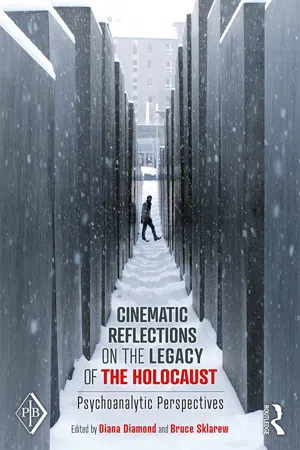
Symbolic objects other than images and texts absorb the impact of the Holocaust, such as the piles of shoes and the cattle car in the United States Holocaust Museum and the coffin-like structures in the Berlin Holocaust Memorial that evoke a flow of visual and olfactory reactions. Another vehicle is the touch of proprioception, referring to the “archives of the feet,” as experienced in walking on the killing fields in Lithuania (Sklarew, M., personal communication). The witness walks on the floor of loose, rattling ceramic faces of victims in the Berlin Jewish Museum. In the film Ida (Abraham, Dzieciol, & Pawlikowski, 2013), the novice who was left on the steps of the convent—with no knowledge that she was Jewish—visits the previously unknown death site of her parents and brother. Siblings visit their father’s place of death in Six Million and One (Fisher, 2011). The protagonist in Son of Soul (Rajna, Sipos, & Nemes, 2015) desperately struggles to find a rabbi among the arriving inmates to preside over the burial of a preadolescent boy with the traditional prayers. Saul believes the boy is his son and thus wants to preserve his Jewish heritage. Elie Wiesel (1968) said that to remember is “a ‘matzeva,’ an invisible tombstone, erected in the memory of the dead unburied.”
With the exception of Holocaust deniers, people cognitively acknowledge its reality. Dealing with the horrific aspects of the Holocaust, however, necessitates a suspension of disbelief reinforced by what is actually seen and heard. Ilan Avisar (1988) wrote of Primo Levi’s doubting literary expression in portraying the authentic horrors:
Compared with words, the photographic image is a better means of objective representation and has a stronger immediate and sensuous impact on the viewer. Words have weight; photos have shock value. The extraordinary power of revealing and arresting photos rests on a complex mental process whereby the visual perception is associated with the knowledge that what is seen is the result of objective recording, and hence the content of the picture is immediately recognized as a piece of authentic actuality (p. 4).
Roland Barthes (1981) said the photograph evidences that what he saw has indeed existed.
Always the photograph astonished me, with an astonishment which endures and reviews itself, inexhaustibly. Perhaps this astonishment, this persistence reaches down into the religious substance out of which I am molded; nothing for it: photography has something to do with resurrection … what I see is not a memory, an imagination, but a reconstitution, a piece of Maya, such as art lavishes upon us, but reality in a past state: at once the past and the real (p. 82).
The reality of the Holocaust is so unimaginable and extraordinary that it defies our basic notions of empirical reality, the raw material of every realistic art (Langer, 1975). It was an “experience under circumstances in which death is more ‘real,’ a more accurate measure of existence—gruesome as that may sound—than life.” Langer concludes that “the moment one speaks of the ‘reality of the Holocaust,’ one is compelled to include its ‘unreality,’ since the two fundamentally coexist.”
The immobilized, chained prisoners in Plato’s cave see only shadows of reality projected onto a wall, as the film viewer and dreamer see only illusions, mere reflections of reality, but reflections of a visual and auditory narrative, which may be perceived as real. When awakening from a vibrant and disturbing dream, we ask ourselves, is it real? Sometimes we emerge from a Holocaust film uncertain that the events portrayed really happened, wondering if this horrendous event can have occurred.
Many struggle with the overwhelming emotional impact summoning resistance, using defense mechanisms such as isolation of affect, avoidance, and denial. Even sophisticated filmgoers will not see or rewatch a film like the gritty Son of Saul (Rajna, Sipos, & Nemes, 2015) because they fear the emotional toll of confronting the gas chambers and incinerators used in the mass murders of Jews, especially when carried out by Jewish inmates propelled by the Nazis. The Sonderkommandos, who were ordered to complete the exterminations, ironically become victims.
Many also avoid Liliana Cavani’s The Night Porter (Edwards, De Simone, & Cavani, 1974) because of the complicity of the victim in sadomasochism; however, it is not gratuitous but a “tribute” to the continuing vulnerability to re-enact sadomasochistic behavior decades later, even if culminating in death. In the final scene Dirk Bogard, a former Nazi camp photographer, and Charlotte Rampling, who at age 15 was “rescued” by him, walk across a desolate bridge late at night to be assassinated by Nazis.
Annette Insdorf in her remarkably comprehensive book Indelible Shadows: Film and the Holocaust (2003) refers to Siegfried Kracauer (1960) recounting the myth of the Gorgon Medusa “whose face, with its huge teeth and protruding tongue, was so horrible that the sheer sight of it turned man and beast into stone” (Insdorf, Introduction, xvii). Athena warned Perseus never to look at the face itself but only at its mirrored reflection in the polished shield she had given him.
Perseus cut off Medusa’s head … the reflection of happenings which would petrify us were we to encounter them in real life. The film screen is Athena’s polished shield. … In experiencing … the litter of tortured human bodies in the films made of the Nazi concentration camps, we redeem horror from its invisibility behind the veils of panic and imagination.
(Kracauer quoted in Insdorf, 2003, Introduction, p. xvii–xviii)
Some watch Holocaust films out of curiosity or duty, or perhaps even to unexpectedly find sadistic gratification in identifying with the Nazis. Reading, being read to, listening to speakers, proprioceptive reactions, still photos, visiting museums or memorials or other avenues can offer us knowledge or an array of meaningful images, but none provide the perturbing experience of watching a finely textured film that can stir unsettling feelings and help us mourn and commemorate through its haunting artistry.
References
Abraham, E., & Dzieciol, P. (Producers), & Pawlikowski, P. (Director). (2013). Ida [Motion Picture]. Poland: Solopan.
Avisar, I. (1988). Screening the Holocaust: Cinema’s Images of the Unimaginable. Bloomington and Indianapolis: Indiana University Press.
Barthes, R. (1981). Camera Lucida (Trans. Richard Howard). New York: Hill & Wang.
Bergman, I. (Producer & Director). (1866). Persona [Motion Picture]. Sweden: Svensk Filmindustri.
Cartier-Bresson, H. (1952). The Decisive Moment. New York: Simon & Schuster.
Dauman, A., Halfon, S., & Lifchitz, P. (Producers), & Resnais, A. (Director). (1955). Night and Fog [Motion Picture]. Paris: Cocinor Films.
Fisher, D. (Producer & Director). (2011). Six Million and One [Motion Picture]. Israel: Fisher Features Ltd.
Insdorf, A. (2003). Indelible Shadows: Film and the Holocaust. Cambridge: Cambridge University Press.
Kaufman, B. (2017). Personal communication.
Kracauer, S. (1960). Theory of Film: The Redemption of Physical Reality. New York: Oxford University Press.
Langer, P., & Lewis, R. (Producers), & Lumet, S. (Director). (1965). The Pawnbroker [Motion Picture]. United States: Allied Artists Pictures.
Lewin, B. (1973). Sleep, the mouth, and the dream screen. In J. Arlow (Ed.), Selected writings of bertram d. lewin. Hoboken, NJ: Psychoanlytic Quarterly. (Original work published 1946).
Rajna, G., & Sipos, G. (Producers), & Nemes, L. (Director). (2015). Son of Saul [Motion Picture]. Hungary: Sony Classics.
Sklarew, M. Personal communication.
Sontag, S. (1977). On Photography. New York: Farrar, Straus and Giroux.
Steiner, G. (1967). Language and Silence. New York: Atheneum.
Steiner, G. (1961). The Death of Tragedy. New York: Alfred K. Knopf, p. 352.
Wiesel, E. (1968). Legends of Our Time (Trans. S. Donadio). New York: Holt, Rinehart and Winston, p. 8.
![]()
Chapter 2
Six Million and One
A documentary
Anna Ornstein
Introduction
An increasing number of Holocaust-related documentaries have been released during the last few years but few offer the insight into the extreme conditions that existed in concentration camps, and few reach the emotional depth, that Six Million and One (Fisher, 2011) does. This is the third documentary in the family trilogy b...