- 320 pages
- English
- ePUB (mobile friendly)
- Available on iOS & Android
eBook - ePub
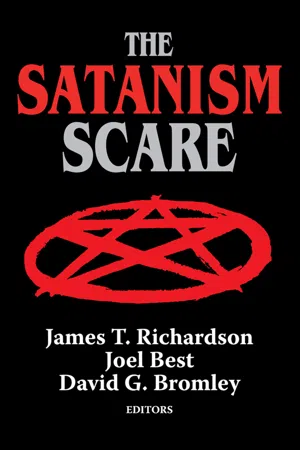
The Satanism Scare
About this book
Although there is growing concern over Satanism as a threat to American life, the topic has received surprisingly little serious attention. Recognizing this, the editors of this volume have selected papers from a wide variety of disciplines, broadly covering contemporary aspects of Satanism from the vantage points of studies in folklore, cults, religion, deviance, rock music, rumor, and the mass media.All contributors are skeptical of claims that a large, powerful satanic conspiracy can be substantiated. Their research focuses instead on claims about Satanism and on the question of whose interests are served by such claims. Several papers consider the impact of anti-Satanism campaigns on public opinion, law enforcement and civil litigation, child protection services, and other sectors of American society.The constructionist perspective adopted by the editors does not deny the existence of some activities by 'real' Satanists, and two papers describe the workins of satanic groups. Whatever the basis of the claims examined and analyzed, there is growing evidence that belief in the satanic menace will have real social consequences in the years ahead.
Information
I
INTRODUCTION
1
Satanism as a Social Problem
James T. Richardson, Joel Best and David Bromley
Why a collection of scholarly articles about contemporary satanism? Many academics would consider the topic unworthy of serious consideration; they equate antisatanism with flying saucer cults, parapsychology enthusiasts, and other causes at or beyond the lunatic fringe. We disagree.
Contemporary antisatanism warrants serious examination, if only because this movement’s influence now extends into important segments of American society. Long a staple topic for religious broadcasters and “trash TV” talk shows, satanism has crept into network news programs and prime-time programming, with news stories, documentaries, and made-for-TV movies about satanic cults. Growing numbers of police officers, child protection workers, and other public officials attend workshops supported by tax dollars to receive formal training in combating the satanist menace. Authority figures ranging from New York’s Cardinal O’Connor to federal “drug czar” William J. Bennett warn against the threat of satanism. The general public has responded to these messages: when a Texas poll recently asked “How serious a problem do you think satanism is to our society, if at all?” 63 percent of Texans responded “very serious,” and another 23 percent said “somewhat serious.”
Satanism—a subject of denunciations by media and public figures, and an issue of some concern to a large segment of the general public—has attracted surprisingly little serious attention from social scientists. We believe it is time to address this neglect.
CONSTRUCTING THE SATANIST PROBLEM
This volume’s contributors have backgrounds in several of the social sciences, in particular sociology, anthropology, folklore, and history. Each chapter uses its own set of concepts and offers its own stance on satanism as a contemporary social problem. There is, however, a general approach that provides a foundation for the book as a whole. Our perspective toward satanism is constructionist.
Constructionism contrasts with more traditional orientations toward the study of social problems. Traditionally, researchers took for granted the objective reality of their subject matter—say, crime. That is, they made an assumption that the real world contained crimes and criminals, objective phenomena that could be studied. These researchers measured crime rates, searched for the causes of crimes, examined the characteristics of criminals, and so on, never questioning why something was designated a crime or someone was called a criminal. This approach is sometimes called objectivist, because it takes for granted the objective reality of the phenomena under study.
Constructionists criticize objectivism on the ground that our world is socially constructed. There is no natural phenomenon “crime”; all crimes are identified through social processes. Legislative bodies write criminal codes that define some acts as crimes, and those laws are enforced (that is, interpreted) by police officers, prosecutors, and other agents of the criminal justice system who must ask themselves whether the events they encounter fit the legal definition of crime, and if so, what to do about it. All “crimes” and “criminals” are identified through these social processes, and all other social problems are constructed in similar fashion. These processes of social construction are the focus of constructionists’ attention, as they try to understand the social construction of reality, including social problems.
Most warnings about satanism make objectivist assertions—that satanic cults conduct human sacrifices; that listeners are influenced by satanic messages backmasked onto heavy metal records, that much child sexual abuse is motivated by satanism, and so on. Social scientists guided by objectivist assumptions might try to study coven members and the effects of listening to backmasked lyrics, or accept at face value sometimes bizarre statements made by allegedly abused children.
In contrast, essays in this volume view the social problem of satanism as a social construction. In this view, warnings about covens, backmasking and ritual abuse should be seen as claims, and, for constructionists, the process of making claims is the essence of social problems.1 Once the researcher’s focus shifts to the process of claimsmaking, an entirely new set of research questions emerges, focused on production and validation of claims.
Perhaps the most basic questions for constructionists are: Who is making claims? Why are they making them? What do they say? and How do others respond? Claims about satanism may come from various sources such as preachers and parents, journalists and ex-cult members, therapists and political leaders. Each of these claimsmakers has a distinctive approach to the topic; presumably preachers see satanism in essentially religious terms, while journalists apply the canons of their profession when reporting on alleged satanists and their activities. Claimsmaking therapists may be justifying a new therapeutic practice or diagnosis, and politicians may be seeking political advantage. Obviously, claimsmakers have different audiences (e.g., the preacher’s congregation, the journalist’s readers or viewers, the therapist’s potential clients) and different objectives (e.g., preachers want to win souls, journalists seek to inform, therapists want clients).
Constructionist analysts look carefully for the claimsmakers’ interests— what do they stand to gain by making claims and having those claims taken seriously? This is one of the most important questions to ask when examining the process of constructing a social problem. Finding out what advantages accrue to claimsmakers when claims are made and accepted often reveals motivations hidden from casual observers.
Claimsmaking is a form of persuasion; claimsmakers call attention to a social phenomenon and, in the process, attempt to shape perceptions of that phenomenon. Thus, we need to be concerned, not only with people making claims, but with the rhetoric of those claims. If satanism is a social problem, exactly what sort of social problem is it? It makes a big difference whether satanists are characterized as alienated loners, members of small, basically harmless cults, or as participants in a vast, powerful, criminal conspiracy.
Whether the audience takes claims seriously depends, in part, on the claims’ content. Are they plausible? Do they mesh well with cultural beliefs and values? Whether people accept and act on claims is the ultimate test of claimsmakers’ impact.
Claimsmakers must compete in a social-problems marketplace (Hilgartner and Bosk 1988; Best 1990). At any given moment, many causes demand our attention and concern. Some claimsmakers fail to influence others; their claims do not shape policy or even public opinion. Other claims are more successful: people believe them and social policies change.
Currently, claims about the menace of satanism enjoy some success— even if most academics do not yet take the topic seriously. Many ordinary people, as well as opinion leaders in society, appear to take these claims seriously, which suggests that scholars should do so as well. We need to know why the antisatanists’ campaign is working, and what the future holds for this movement.
THE ROOTS OF CONTEMPORARY ANTISATANISM
Antisatanism’s appeal has several sources, each of which has contributed to the construction of satanism as a contemporary social problem. During the 1980s, elements of apparently unrelated social movements converged in the cause of antisatanism. Each movement brought its own set of concepts and concerns. Five precursor movements—fundamentalist Christianity, the anticult movement, the development of “satanic churches,” the new wave of child saving, and the survivor/recovery movement—made particularly important contributions to social construction of the satanist menace.
Fundamentalist Christianity
During the 1970s, fundamentalism became a powerful political and economic force in American society (Bromley and Shupe 1984; Jorstad 1990). There has been a strong fundamentalist undercurrent since the early part of this century, but it was relatively invisible to many Americans, and was ignored or ridiculed for decades by intellectuals. This view of fundamentalism changed dramatically in the 1970s, as fundamentalists were invited into the political arena by conservative political leaders with common interests (Jorstad 1990:58).
The “new” fundamentalism was led symbolically and (to a degree) literally by the Reverend Jerry Falwell, who established the Moral Majority in 1979. Fundamentalism had been quietly gaining strength in numbers and economic power, and fundamentalist leaders and conservative political organizers decided to make its new-found strength felt. Fundamentalists became involved in politics, registering tens of thousands of new voters, and endorsing candidates. They burst on the national scene, and became involved in political races at all levels, even presidential politics. The New Right also became involved in other social issues, such as sex education and prayer in the schools, abortion, and the Equal Rights Amendment.
Fundamentalists of Protestant, Catholic and Mormon persuasion have found that they share common interests, and can work together to achieve joint political goals (Chandler 1984; Richardson 1984). The alliance of various threads of the new fundamentalist movement help create an infrastructure (Hadden 1984; Jorstad 1990; Latus 1984). Thus, it became easier for the religious right to take a united stand on new concerns—rock music, or censoring books in schools, or satanism—simply because they had worked together on other matters. Fundamentalists could receive new “marching orders” quickly through this network.
This fundamentalist infrastructure, with its organizations, publications, and television and radio broadcasts, has responded vigorously to the perceived threat of satanism. Fundamentalists take an objectivist view, treating the growth of satanism very matter of factly; after all, holy scripture predicts the spread of satanism and the growth of Satan’s power. The issue is not whether Satan exists and is gaining power, but what this means and what people should be doing about it. The message is clear and simple: all real Christians should be warning others about the satanic threat.
Belief in Satan is an essential element of Christian fundamentalist cultural heritage, part of the cultural baggage fundamentalists carry. This belief has spread as fundamentalism has grown. National survey data show a significant increase in belief in the Devil from 1964 to 1973 (Nunn 1975). Nunn adds (1975:87):
The evidence also showed Devil-believers to be not the unchurched but Godfearing Christians who actively participate in their Protestant and Catholic Churches, especially in the Bible-belts of America. . . . Consistently, ... the more active the participation in religious services, the greater the likelihood people were certain the Devil was around.
The fundamentalist infrastructure regularly promotes warnings about the satanic menace. Shelves in religious bookstores are filled with titles on satanism, and major televangelists warn of Satan’s growing threat. People, including many only peripherally involved in fundamentalism, apparently accept the antisatanist message. Acceptance is more likely when the message comes from sources that conceal its fundamentalist origins. For instance, when the press, law enforcement, and psychiatrists appear to take satanism seriously, others are encouraged to do so. If the secular press and the usually antireligious therapeutic community seem to accept the objective reality of satanism, then the satanism scare gains considerable momentum.
The Anticult Movement
The Anticult Movement (ACM) emerged in the late 1960s and early 1970s (Shupe and Bromley 1980), focused on getting young people out of new religious groups (popularly called cults) that had proliferated in the late 1960s. Once America found out that the new religions were serious, “high demand” groups, which sought to change youths’ lives in ways strange and unacceptable to their parents, society counterattacked.
The ACM emerged as a coalition of distraught parents, religious leaders, former members, and others, including a few professional therapists and academics. ACM groups exchanged information, lobbied politicians, and presented their views to the press, which was always on the look-out for a good “human interest” story. Cult stories qualified because they could be “framed” as child-stealing stories that characterized gurus as “Pied Pipers” who could turn political recruits into mental captives.
Accusations of brainwashing by cults became a “social weapon” (Rob-bins, Anthony and McCarthy 1978), justifying attacks—even extralegal ones—against new religions, while excusing parents and recruits from responsibility. After all, how could children stand up against the cult’s psychotechnology, even if properly raised and educated? To counteract the cult’s powerful tactics, the ACM turned to forcible “deprogramming” (Bromley and Richardson 1983). Thousands of members were kidnapped by agents of their parents, incarcerated, and put through rigorous resocialization until they either recanted their beliefs or escaped. The label “deprogramming” served to make the point that the recruit had first been “programmed” by the cult.
The ACM’s account of cult brainwashing was readily accepted by the media, which in turn passed the tale on to the general public. Many, if not most, people believe that cults brainwash their members, and that cults are evil groups which should be controlled. Cults are the most despised groups in America, according to a recent Gallup Poll (Richardson 1990). The ACM message has been received, and accepted.
The ACM used the Jonestown tragedy to promote its view of exotic religions, even though the People’s Temple was vastly different from the groups on which the ACM had focused attention (Richardson 1980). In 1988, a major ACM drive promoted the tenth anniversary of the Jonestown tragedy with widely dispersed press packets stressing that cults brainwash members, and keep them through mind control practices. The ACM’s claims were accepted without question, and the nation was reminded again of the social problem of cults.
In recent years the ACM has exploited the growing attention paid to satanism. ACM literature regularly reports on “satanic cult” activities, presenting them as another example of evil cults at work. ACM conferences have sessions dealing with satanism, and ACM press releases comment on events such as the killings at Matamoros. Satanic cults are accused of brainwashi...
Table of contents
- Cover
- Half Title
- Title Page
- Copyright Page
- Table of Contents
- Part I. Introduction
- Part II. Anthropologial and Historical Perspectives on Satanism
- Part III. The Satanic Threat to Children
- Part IV. Psychiatry and Occult Survivors
- Part V. Satanism and the Law
- Part VI. Rumors and News About Satanism
- Part VII. The Satanists
- Biographical Sketches of the Contributors
- Index
Trusted by 375,005 students
Access to over 1.5 million titles for a fair monthly price.
Study more efficiently using our study tools.
Frequently asked questions
Yes, you can cancel anytime from the Subscription tab in your account settings on the Perlego website. Your subscription will stay active until the end of your current billing period. Learn how to cancel your subscription
No, books cannot be downloaded as external files, such as PDFs, for use outside of Perlego. However, you can download books within the Perlego app for offline reading on mobile or tablet. Learn how to download books offline
Perlego offers two plans: Essential and Complete
- Essential is ideal for learners and professionals who enjoy exploring a wide range of subjects. Access the Essential Library with 800,000+ trusted titles and best-sellers across business, personal growth, and the humanities. Includes unlimited reading time and Standard Read Aloud voice.
- Complete: Perfect for advanced learners and researchers needing full, unrestricted access. Unlock 1.5M+ books across hundreds of subjects, including academic and specialized titles. The Complete Plan also includes advanced features like Premium Read Aloud and Research Assistant.
We are an online textbook subscription service, where you can get access to an entire online library for less than the price of a single book per month. With over 1.5 million books across 990+ topics, we’ve got you covered! Learn about our mission
Look out for the read-aloud symbol on your next book to see if you can listen to it. The read-aloud tool reads text aloud for you, highlighting the text as it is being read. You can pause it, speed it up and slow it down. Learn more about Read Aloud
Yes! You can use the Perlego app on both iOS and Android devices to read anytime, anywhere — even offline. Perfect for commutes or when you’re on the go.
Please note we cannot support devices running on iOS 13 and Android 7 or earlier. Learn more about using the app
Please note we cannot support devices running on iOS 13 and Android 7 or earlier. Learn more about using the app
Yes, you can access The Satanism Scare by Joel Best in PDF and/or ePUB format, as well as other popular books in Social Sciences & Religious Fundamentalism & Cults. We have over 1.5 million books available in our catalogue for you to explore.