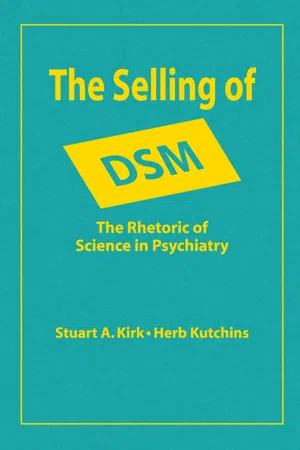
When it was first published in 1980, the Diagnostic and Statistical Manual of Mental Disorders, Third Edition—univer-sally known as DSM-III—embodied a radical new method for identifying psychiatric illness. Kirk and Kutchins challenge the general understanding about the research data and the pro-cess that led to the peer acceptance of DSM-III. Their original and controversial reconstruction of that moment concen-trates on how a small group of researchers interpreted their findings about a specific problem—psychiatric reliability—to promote their beliefs about mental illness and to challenge the then-dominant Freudian paradigm.
- 270 pages
- English
- ePUB (mobile friendly)
- Available on iOS & Android
eBook - ePub
About this book
Information
Topic
Medicine1
PSYCHIATRIC DIAGNOSIS
AND THE NEW BIBLE
AND THE NEW BIBLE
A photograph in The New York Times on Monday, January 29, 1990, showed an attractive, groomed, well-dressed young couple sitting at a kitchen table graced by flowers and candles, dining on gnocchi alla Gorgonzola that the 33-year-old husband had just prepared. Both he and his 25-year-old wife had serious and determined expressions that matched their attire. Dining without his suit coat, he sported a fashionable striped shirt with tie and suspenders. He and his wife looked like any upper-middle-class young couple on their way up in the corporate and social world.
In fact, the husband had grown up surrounded by wealth and privilege as an heir to the duPont family. Both he and his wife have been active in political affairs; he had contributed handsomely to political causes. He himself had run for a New Hampshire seat in the United States House of Representatives in 1988, but had been defeated in the primary.
This news story did not appear in the home or food or society section of the Times; it appeared in the national news section because the couple was not headed to a charity event, but was returning to court to ask a judge to reverse a 1986 court decision that the husband was mentally ill and legally incompetent. That early decision, the couple explained to the news reporter (Hinds, 1990), has meant that the husband is not allowed to manage his own money, was unable to vote when he lived in Virginia, needed the court to validate his marriage three years before and has affected their plans to have children. The wife explained that the court action, prompted by her husband's parents, was a stigma on their marriage and terribly humiliating. They were afraid to have children for fear that his family would try to take them away. It was reported that the parents had already sought to have a guardian appointed for their unborn children.
The precipitating events in this family struggle are the son's political activities and financial contributions to the conservative political organizations of Lyndon H. LaRouche. The parents apparently feared that their son would give away his family inheritance to a disfavored organization.
From the news account, the critical issue for the court in the case is the husband's legal competence as evaluated by psychiatric experts. Although legal competence is not determined solely by psychiatric diagnosis, psychiatric experts usually build their testimony around their diagnostic conclusions. In this case, as often happens, both sides in the dispute hired psychiatrists to give testimony. As often happens, the psychiatrists disagreed. Manhattan psychiatrist Dr. David A. Halperin, hired by the parents in 1985, testified that the son was mentally ill and suffered from a “schizoaffective disorder.” Further, the doctor claimed, the son had joined the LaRouche organization “as an expression of his mental illness.” A psychiatrist hired by the son testified that the son was mentally competent, but did have a “mixed personality disorder. ” Both psychiatrists drew their diagnoses from the American Psychiatric Association's (APA) Diagnostic and Statistical Manual of Mental Disorders, Third Edition (1980)—DSM-III—the official “bible” for categorizing mental disorders.
Anyone who cared to go beyond the Times account by looking up the description of these diagnoses of mental disorders in DSM-III would discover a novel world of categories and criteria. Schizoaffective Disorder is found in a residual section titled “Psychotic Disorders Not Elsewhere Classified.” The opening sentence about Schizoaffective Disorder is candidly enlightening:
The term Schizoaffective Disorder has been used in many different ways since it was first introduced, and at the present time there is no consensus on how this category should be defined. (p. 202)
The few sentences that follow this opening more than confirm the general confusion.
What does DSM-III reveal about the diagnostic judgment of the defense psychiatrist? The description of that diagnosis in its entirety is:
Mixed Personality Disorder should be used when the individual has a Personality Disorder that involves features from several of the specific Personality Disorders, but does not meet the criteria for any one Personality Disorder. (p. 330, emphasis in original)
The diagnostician is confronted with the perplexing task of first determining that the individual has a personality disorder even though the individual does not meet the criteria for any of the defined personality disorders. The clinician may pick and choose features for a tailor-made “mixed personality disorder.’
This family struggle is newsworthy in part because it pits some cherished American values against each other: political freedom versus state intervention; personal liberty versus protection from self-inflicted harm; parental responsibility versus filial independence. These conflicts find their way into the judicial system from many sources and directions. In the duPont case, however, the outcome appears to rest on the accuracy of a psychiatric diagnosis and what that diagnosis implies about an individual's capacities to manage his life. The diagnosis in this case is clearly consequential—it affects the personal and civil liberties of an individual. But just as clearly, the accurate diagnosis is in dispute among reputable psychiatrists.
This is not a rare occurrence. A few months later, The New York Times reported (Shulruff, 1990) that a Wisconsin man was facing charges of sexually assaulting an acquaintance who had been diagnosed as having a “multiple personality disorder.” The prosecutor suggested that the woman had 21 personalities, not all of which consented to sexual relations. Lawyers and psychiatrists debated whether different personalities would be sworn to testify, whether each had different sexual histories and whether the diagnosis was valid. A National Public Radio report on November 9, 1990, indicated that the man had been convicted and that three of the victim's personalities had testified against him. By December, a circuit court judge had ordered a new trial because of several irregularities (New York Times, 1990), including the fact that the defense attorney had not been allowed to conduct a psychiatric examination of the victim before the trial. Some medical experts by then had claimed that the victim had 46 personalities. Will newly identified personalities testify at the second trial?
Since diagnosis guides decisions about treatment, diagnostic confusion can have profound consequences for both patient and practitioner. A decade ago, diagnostic and treatment controversies concerning Raphael J. Osheroff's psychiatric condition led to a famous malpractice suit against Chestnut Lodge, a well-respected private psychiatric hospital near Washington, D.C. Although the case was eventually settled out of court, the issues it raised struck close to the heart of the status of psychiatry as a scientifically grounded profession, as it highlighted the ideological divisions between psychoanalytic and psychopharmacological psychiatrists (Shuchman & Wilkes, 1990; Klerman, 1990; Stone, 1990). Debate about what constituted the appropriate treatment hinged on what constituted the appropriate diagnosis. Over the course of his treatment, Osheroff was diagnosed at various times and by various psychiatrists as having a psychotic depressive reaction; manic-depressive illness, depressed type; major depressive episode with psychotic features; and narcissistic personality disorder. Part of the diagnostic dispute was ideological, reflecting very different theoretical views held among psychiatrists who treated Osheroff. Part of the confusion was over determining which official diagnostic manual was being used. During the course of the patient's treatment, the APA adopted a new diagnostic manual and some of the shifting diagnoses depended on which manual was being used. Narcissistic Personality Disorder, for example, one of the controversial diagnoses in this famous case, appears in the manual used until 1968, but is missing from the manual used from 1968 until 1980 (during which period the diagnosis was used by Chestnut Lodge), and reappears again in the manual used since 1980. Is a diagnosis of Narcissistic Personality Disorder an invalid one in 1979, but valid a few months later? The Osheroff case raised questions about the validity of diagnoses in the face of shifting diagnostic systems and ideological conflicts about the proper methods of understanding and treating clinical conditions.
To some observers, these recent cases suggest that psychiatrists are merely hired guns, paid to say whatever will help their clients. In this view, psychiatrists' testimony is predictably divergent; their professional status as experts serves merely to cloak their paid performances in respectability. Any detailed analysis of the scientific basis for their testimony would be irrelevant. To others, psychiatrists are objective, scientific practitioners trying to bring their best professional judgment as competent mental health experts to bear on difficult cases. Their sharply divergent opinions, therefore, must be due to the uncertain state of psychiatric knowledge or the uncertain art of psychiatric diagnosis (Faust & Ziskin, 1988). Neither of these explanations would please the APA, which has invested the better part of two decades trying to remedy such diagnostic problems, or at least trying to keep them from full public view. The major vehicle in this campaign to rebuild public respect for psychiatric diagnosis and practice was a revolutionary revision of the diagnostic manual—DSM-III.
A New Diagnostic Manual
The year 1856 was a momentous one for modern psychiatry; it marked the births of the leaders of two modern traditions in psychiatry, Sigmund Freud and Emil Kraepelin. Freud, the father of psychoanalysis, has influenced not only psychiatry, but the course of modern thought about human psychology and the role of child development. His theories about mental disorders are psychodynamic and developmental. Childhood experiences in the family, including sexual attractions during the earliest years of life, profoundly influence psychological and emotional development. Childhood experiences, recorded in something that Freud called the unconscious, shape the way we think, feel, and act throughout the rest of our lives. Although Freud was initially an outsider and rejected by the medical establishment of Vienna (he was trained as a neurologist, not a psychiatrist), his dramatic, highly literate writing and his fascinating descriptions of cures captured the public imagination. Eventually his theories came to dominate psychological treatment in many countries. Nowhere was his influence greater than in the United States, a country he detested and refused to visit after his initial sojourn in 1911 to give the famous Clark lectures.
Freud's dynamic theories of the substructures of mental disorders have been contrasted with Kraepelin's approach, which is primarily descriptive. Kraepelin is virtually unknown, even to most mental health professionals. He was a respected professor and a tireless researcher in Germany. He established one of the first psychiatric laboratories and was the author of several important texts. Both his books, Psychiatry and an Introduction to Clinical Psychiatry, went through many editions during his lifetime. Whereas Freud was primarily concerned with the etiological dynamics of mental disorders, Kraepelin throughout his career attempted to classify, categorize, and describe psychiatric disorders as discrete entities. Kraepelin's descriptive efforts are the basis for the current approach to the identification of mental disorders. Although his books are now outdated, and seldom read even by his adherents, it is his approach that has come to dominate modern psychiatry and to eclipse Freud's work, if not his fame. The growing Kraepelian shadow is currently cast by the Diagnostic and Statistical Manual of Mental Disorders, Third Edition, DSM-III.
In 1980, the APA officially adopted a new classification system of mental disorders. The previous classification system, familiar as an old shoe to most clinicians, was of little practical consequence to most mental health professionals and, under most circumstances, was of no more concern to the public than any other technical manual used by professionals. A revised diagnostic system in and of itself would virtually never be a candidate for the sustained attention of anyone other than classification specialists with a special fondness for categorizing behavioral deviance. The development of a new psychiatric taxonomy is rarely momentous. And yet, the system adopted in 1980 received unprecedented attention and is widely believed to have marked a significant milestone in American psychiatry. In influence alone, it may be one of the most significant events in psychiatry in the last half of the 20th century.
Certainly the manual's principal architect does not underestimate its impact. In an article about the development of the DSM-III, its principal author and an associate (Bayer & Spitzer, 1985) characterized it in the following manner:
The adoption of DSM-III by the American Psychiatric Association (APA) has been viewed as marking a signal achievement for psychiatry. Not only did the new diagnostic manual represent an advance toward the fulfillment of the scientific aspirations of the profession, but it indicated an emergent professional consensus over procedures that would eliminate the disarray that has characterized psychiatric diagnosis. (p. 187)
Gerald Klerman, who was the highest ranking psychiatrist in the federal government at the time that DSM-III was developed and published, was even more forceful. In a debate sponsored by the APA at its 1982 national convention between proponents and critics of DSM-III, Klerman asserted:
In my opinion, the development of DSM-III represents a fateful point in the history of the American psychiatric profession.… The decision of the APA first to develop DSM-III and then to promulgate its use represents a significant reaffirmation on the part of American psychiatry to its medical identity and its commitment to scientific medicine. (Klerman, 1984, p. 539)
He went on to say:
The theme of this meeting is “science in the service of healing.” In my opinion, DSM-III embodies this theme to a greater extent than any other achievement in American psychiatry since the advent of the new drugs. (p. 541)
And he concluded:
the judgment is in; DSM-III has already been declared a victory. There is not a textbook of psychology or psychiatry that does not use DSM-III as the organizing principle for its table of contents and for classification of psychopathology.
This debate is already an anachronism. The victory of DSM-III has been acknowledged by our colleagues and adversaries in psychology, in the other mental health professions and in other countries. (p. 542)
An even less restrained description of the achievements of DSM-III was written for the general public in a popular softcover, The New Psychiatrists, by Gerald Maxmen, who proclaimed in oracular fashion:
On July 1, 1980, the ascendance of scientific psychiatry became official. For on this day, the APA (APA) published a radically different system for psychiatric diagnosis called … DSM-III. By adopting the scientifically based DSM-III as its official system for diagnosis, American psychiatrists broke with a fifty year tradition of using psychoanalytically based diagnoses. Perhaps more than any other single event, the publication of DSM-III demonstrated that American Psychiatry had indeed undergone a revolution. (1985, p. 35)
This revolution in psychiatry was not a popular uprising. It was not spurred on by widespread public interest in the new developments, as had happened when Freudian psychoanalysis came to dominate psychiatry 50 years earlier. Nor were mental health clinicians themselves clamoring loudly for radical changes in diagnoses. Those who created DSM-III did not call on the rich heritage of Greek legends and other literature that Freud used to invent what he referred to as his mythology. The creators of this revolution were far less colorful officials in government agencies, professional associations, and university research centers whose motives were as much bureaucratic and political as scientific. And what is most remarkable about their revolution is that they did not discover a single new disorder, they proposed no new treatments, and they provided no new explanation for mental illness. In fact, one of the things that they prided themselves on was that they carefully avoided any etiological explanations for mental disorders that did not already have widely recognized, well-established organic causes.
What was the nature of the revolution signaled by the appearance of DSM-III? Maxmen claims scientific psychiatry replaced psychoanalytic psychiatry and that the contrasts between the two are profound: “Psychoanalytic psychiatry bases truth on authority; something is true because Freud said so. Scientific psychiatry bases truth on scientific experimentation. … The old psychiatry derives from theory, the new psychiatry from fact” (p. 31).
It is often a debater's trick to claim that one's position is accurate because it is factual, in contrast to that of one's opponent, who has invented justifications for his or her position. The strategy may be obvious, but the stakes were much greater than are usually the case in academic disputes. What was at stake was the fate of the psychiatric profession and the enormous, multibillion dollar mental health industry. DSM-III and “the new psychiatry” that it reflected were important features in the effort made by a new generation of psychiatrists to gain control over the infrastructure of the psychiatric profession and to reverse the diffusion of power to other professions in the mental health enterprise.
The Mental Health Enterprise
The new diagnostic manual provides the official justification for psychiatry's expanding control over what some have labeled the “medicalization of deviance” (Conrad & Schneider, 1980). The influence of the manual radiates out beyond the state asylum or the private physician's office, affecting many sectors of American life in subtle and at times controversial ways. The diagnostic manual is used in the judicial system when questions are raised about a defendant's mental capacities, intentional states, or cognitive abilities. Legal problems involving guardianship, criminal liability, fitness to stand trial, and the extent to which defendants have the capacity to appreciate the consequences of their acts are common circumstances in which testimony about diagnostic categories is invited. Psychiatrists and other mental health professionals frequently are asked to make judgments on the health status of various private behaviors such as homosexuality or substance use. Psychiatrists even claim that tobacco use falls within their purview. Furthermore, psychiatric classification affect...
Table of contents
- Cover
- Half Title
- Title Page
- Copyright Page
- Dedication
- Epigraph
- Table of Contents
- Acknowledgments
- Chapter 1. Psychiatric Diagnosis and the New Bible
- Chapter 2. The Transformation of Psychiatric Troubles
- Chapter 3. The Social Control of Error
- Chapter 4. Making a Manual
- Chapter 5. A Careful Look at the Field Trials
- Chapter 6. Reliability and the Remarkable Achievement
- Chapter 7. The Art of Claim-Making
- Chapter 8. Securing Diagnostic Turf
- Chapter 9. The Social Context of Diagnostic Error
- References
- Index
Trusted by 375,005 students
Access to over 1.5 million titles for a fair monthly price.
Study more efficiently using our study tools.
Frequently asked questions
Yes, you can cancel anytime from the Subscription tab in your account settings on the Perlego website. Your subscription will stay active until the end of your current billing period. Learn how to cancel your subscription
No, books cannot be downloaded as external files, such as PDFs, for use outside of Perlego. However, you can download books within the Perlego app for offline reading on mobile or tablet. Learn how to download books offline
Perlego offers two plans: Essential and Complete
- Essential is ideal for learners and professionals who enjoy exploring a wide range of subjects. Access the Essential Library with 800,000+ trusted titles and best-sellers across business, personal growth, and the humanities. Includes unlimited reading time and Standard Read Aloud voice.
- Complete: Perfect for advanced learners and researchers needing full, unrestricted access. Unlock 1.5M+ books across hundreds of subjects, including academic and specialized titles. The Complete Plan also includes advanced features like Premium Read Aloud and Research Assistant.
We are an online textbook subscription service, where you can get access to an entire online library for less than the price of a single book per month. With over 1.5 million books across 990+ topics, we’ve got you covered! Learn about our mission
Look out for the read-aloud symbol on your next book to see if you can listen to it. The read-aloud tool reads text aloud for you, highlighting the text as it is being read. You can pause it, speed it up and slow it down. Learn more about Read Aloud
Yes! You can use the Perlego app on both iOS and Android devices to read anytime, anywhere — even offline. Perfect for commutes or when you’re on the go.
Please note we cannot support devices running on iOS 13 and Android 7 or earlier. Learn more about using the app
Please note we cannot support devices running on iOS 13 and Android 7 or earlier. Learn more about using the app
Yes, you can access The Selling of DSM by Stuart A. Kirk in PDF and/or ePUB format, as well as other popular books in Medicine & Medical Theory, Practice & Reference. We have over 1.5 million books available in our catalogue for you to explore.