Spiritual Capital seeks to re-focus discussion on core social values, on individuals' value systems and the internal dynamics that impel human beings to live by truth, goodness and love. This book defines, refines and disseminates the concept of spiritual capital. Contributions by practitioner-scholars in applied spirituality, who have practical experience of spiritual capital at work in diverse human situations, provide accounts of concrete expressions of spiritual capital and create an interdisciplinary discussion between spirituality practitioners, artists, ecologists, sociologists and others on the frontiers of change in contemporary culture.
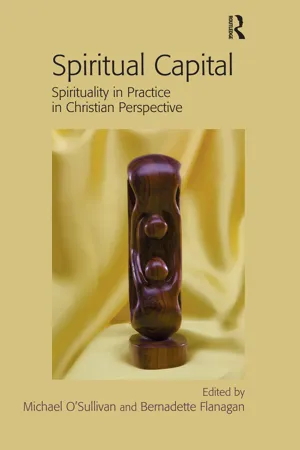
eBook - ePub
Spiritual Capital
Spirituality in Practice in Christian Perspective
- 232 pages
- English
- ePUB (mobile friendly)
- Available on iOS & Android
eBook - ePub
Spiritual Capital
Spirituality in Practice in Christian Perspective
About this book
Information
Chapter 1
Exploring Spiritual Capital: Resource for an Uncertain Future?1
Chris Baker
I want to focus on the different levels of impact or transformation (the micro, meso and macro) associated with the concept of spiritual capital. However, before I do that, it is important that we locate the growing interest in spiritual capital within a wider context that currently includes three dimensions. These are the emergence of the post-secular society or city; the increasing use of the concept of spiritual capital within public policy; and the growing attention to the theoretical relationship of spiritual capital to social capital (and other forms of capital). I want to show that this idea of spiritual capital has not just emerged on a whim. With something as potentially intangible and mysterious as spiritual capital, I want to show that it comes from a solid place and can be used for solid outcomes.
The Context for Spiritual Capital: The Emergence of the Post-secular Society
The idea of the post-secular society emerged towards the end of the last century and has increased in significance as the twenty-first century has unfolded. A number of overlapping dynamics and forces has prompted its emergence. First, at a spatial level, all of us are aware of the growing diversity and plurality of lived space – a diversity largely characterised by the increasing visibility of religion in the public life of our towns and cities. This religious visibility is driven in large part by increased, globalised flows of diasporic communities from the South to the North for whom a religious identity and practice is of high importance. Second, at a sociological and phenomenological level, the search for new religious identities and an increased interest in spirituality from non-diasporic communities in the West reflects a growing re-enchantment of society and the search for immaterial sources of happiness and wellbeing. This re-enchantment is partly occurring as a response to concerns about the environmental, cultural and social impact of unbridled materialism and consumerism. It also represents a desire for more transcendent sources of meaning and stability in a world currently undergoing severe anxieties provoked by global recession and growing distrust of both political and economic institutions. Third, many of these concerns are aired with current debates within cultural and political philosophy arenas. Here the concern is for issues of government and governance of the public square. Namely, how can we in the West create a viable post-secular public square where the values and practices of religion and faith can creatively (if not always peacefully) coexist with what has hitherto been perceived as a secular and therefore neutral space? What, for example, is the role and contribution of religion within civil society and local democracy, public service delivery, welfare provision and social cohesion?
However, the emergence of the concept of the post-secular is not uncontested. t hose on the progressive secular left are inclined to see this current faltering in the ongoing progress of secularisation as a spasm of self-reflection in late secularism. Others suggest that the academic and social policy interest in the public dimensions of religion is largely driven by government initiatives in co-opting the faith sector in the drive to deliver better public services, prevent terrorism, improve local democracy and social cohesion, and so on. In other words, post-secular public space is really a demand created by government policy need.2
But there is a general consensus that, irrespective of one’s acceptance of the term or not, the idea of the post-secular is attracting growing attention as a signifier term for a series of coterminous processes that have philosophical, sociological, cultural and political implications. At one level, this has entailed a partial or complete revision of the classic secularisation theory that emerged from the mid-1960s. Thus, peter Berger used the term ‘secularisation’ to describe a process ‘by which sectors of society and culture are removed from the domination of religious institutions and symbols’.3 Similarly, Bryan Wilson applied the term ‘secularisation’ to ‘the process by which religious institutions, actions and consciousness lose their social significance’.4 Now Berger and others are using terms such as ‘desecularisation’ to describe the resurgence of ‘furious, supernaturalist, fundamentalist or conservative expressions of religion’5 in politics and public life. Jürgen Habermas, meanwhile, refers to ‘a post-secular self-understanding of society as a whole, in which the vigorous continuation of religion in a continually secularizing environment must be reckoned with’.6
This last observation suggests that the idea of post-secularism is not describing the replacement of secularisation within liberal democracies by a resurgent public expression of religion; rather, it suggests that ongoing dynamics associated with secularism now compete within the public sphere with some unexpected expressions of an emergent and confident religion that is perhaps more culturally resilient and adaptable than expected, especially within the experience of disenfranchised minority groups.
The Courtship of Faiths by New Labour: The Policy Dimensions of Spiritual Capital
Like all love affairs, there is a temptation to idolise and put on the pedestal the object of our affections. However, after a few years most relationships settle down to a more realistic assessment of each other’s strengths and weaknesses. This process is perhaps a fair reflection of the long courtship between the faith sector and the UK government that forms the second lens through which we need to look at the idea of spiritual capital.
The election of the New Labour government in 1997 saw a decisive shift away from neoliberal market reforms towards the Third Way approach to political economy, that is, partnerships between state and market together with a heightened role for the voluntary and community sector as a mechanism for delivering public services.7 Within this overall strategy of increased use of the third sector, the political profile of faith groups steadily rose. An early report from this period by the New Economics Foundation called Faiths, Hope and Participation (2001) identified the following attributes that faith groups bring to wider society:
- buildings used by the wider community;
- skilled/professionals in location (e.g. minister/pastor/lay worker);
- transferable skills in the community (e.g. minute-taking, book-keeping, chairing meetings etc);
- connections with hard-to-reach people;
- a tradition of providing volunteers and projects in the local community;
- a long-term presence in the local community – providing a sense of memory, belonging and identity;
- values of caring for neighbours and speaking out against injustice.
However, this somewhat hagiographic view of faith groups in the social policy literature has since been broadened out into a more ambivalent assessment, although it sometimes seems that this more critical assessment is still based on stereotypes rather than detailed knowledge. Thus, for example, a 2006 Joseph Rowntree Foundation report entitled Faith as Social Capital: Connecting or Dividing reported a scepticism amongst regeneration professionals concerning the motives of faith groups and the search for hidden agendas – the so-called ‘P’ or proselytisation question. Not only that, the report claimed, but faith groups often had unrealistic expectations and had undertaken insufficient investigation of their situation, something characterised by a lack of clarity about basic aims, a lack of equalities procedures and provisions, and a tendency towards crisis management.8
Another piece of social policy theory reflects some of the above tensions but also brings in a new dimension of faith-based contributions to civil society and neighbourhood renewal – namely, that of remoralising. Thus, Lowndes and Chapman identify three rationales of reasons why the public sector (and by definition therefore the secular sector) should engage in faith groups. Their three rationales are:
- resources – the resources that faith groups provide in respect of human and social capital (buildings, volunteers, trust, etc.);
- leadership – the leadership and leadership training provided by local faith groups as well as the opportunities to learn leadership skills within faith groups;
- normative – the norms and values that faith groups bring which will be ‘motivated by their theology’.
Lowndes and Chapman continue:
The distinctiveness of these motivations lies in the holistic nature of faith-based value systems ... and the embeddedness of faith groups within communities ... Harnessing and supporting faith-based motivations for engagement can contribute to civil renewal objectives while also expressing the more specific goal of re-moralising public life – asserting the importance of debating and celebrating the values that underpin British society.9
I shall return to the significance of this normative rationale within social policy later on. I now wish to move from social policy to the third dimension of the spiritual capital debate, namely, some definitions and theories.
Spiritual Capital/Religious Capital and Social Capital: The Theoretical Debate
The context for these definitions emerged from research carried out by the William Temple Foundation (WTF), of which I was part. Over a three-year period (from 2002 to 2005), we worked alongside nine different church communities (with a variety of sizes and theological outlooks ranging from a small Baptist community of 12 through to a Black Majority Church of around 300 members) who were working in local neighbourhoods undergoing intensive urban regeneration. We at WTF were keen to reflect on not only how these church groups engaged in partnership with other agencies but also how they engaged in the government rhetoric on regeneration. It became clear that government (at both a national and a local level) was more than happy to take its practical contribution to urban and community regeneration (what Lowndes and Chapman would call leadership and resources). However, when it came to explaining why these churches did what they did – that is, the importance of their faith-based worldview, their theology, their faith-based values – it was more of a problem. Churches were not allowed to put their faith-based rationale for contributing to projects or partnerships on funding forms. Nor did they feel able to bring it to the partnership table. Therefore, what WTF also recorded in its conversations with these churches were feelings of cynicism, disillusionment and being taken for granted – in short, a feeling of disempowerment.
The WTF decided to engage this experience and practice with the prevailing theoretical framework underpinning the New Labour approach to community and neighbourhood renewal: namely, that of social capital. To the concept of social capital, it added the ideas of spiritual and religious capital. What it wanted to do was to unambiguously connect together the what and the why of faith-based engagement. It wanted to re-connect the motivation of religious organisations to engage in public life to the participation of these organisations – a vital connection that, up to this point, the secularised public sphere had tended to separate.
Here are the definitions of spiritual and religious capital and their role as important sources of contribution to social capital as a whole:
- Social capital, according to leading US political philosopher and sociologist Robert Putnam (and whose thinking is profoundly influential on UK public policy) is ‘the importance of relationships, networks and norms [in society] that can be used to enrich individuals and communities’.10
- Religious capital is ‘the practical contribution to local and national life made by faith groups’.11
- Spiritual capital ‘energises religious capital by providing a theological identi...
Table of contents
- Cover
- Half Title
- Dedication
- Title
- Copyright
- Contents
- List of Figures
- List of Contributors
- Acknowledgements
- Introduction
- 1 Exploring Spiritual Capital: Resource for an Uncertain Future?
- 2 A Secular Response to Social Solidarity?: Social Capital, Religion and the Implications for Social Policy
- 3 Spiritual Capital and the Turn to Spirituality
- 4 The Ecological Crisis and Spiritual Capital
- 5 Frederick Ozanam's Spiritual Capital and Today's Consumer Society
- 6 Spiritual Capital in a Competitive Workplace
- 7 Faith-Based Organisations and the Work of International Development
- 8 The Spiritual Dimension to Bereavement through Suicide
- 9 Spiritual Capital at Work in the Shadows
- 10 Pilgrimage and Spiritual Capital
- 11 Gardening as a Source of Spiritual Capital
- 12 Poem-Making, Creativity and Meditative Practice
- 13 Leonard Cohen, Spiritual Capital and Postmodern Seekers
- Index
Trusted by 375,005 students
Access to over 1.5 million titles for a fair monthly price.
Study more efficiently using our study tools.
Frequently asked questions
Yes, you can cancel anytime from the Subscription tab in your account settings on the Perlego website. Your subscription will stay active until the end of your current billing period. Learn how to cancel your subscription
No, books cannot be downloaded as external files, such as PDFs, for use outside of Perlego. However, you can download books within the Perlego app for offline reading on mobile or tablet. Learn how to download books offline
Perlego offers two plans: Essential and Complete
- Essential is ideal for learners and professionals who enjoy exploring a wide range of subjects. Access the Essential Library with 800,000+ trusted titles and best-sellers across business, personal growth, and the humanities. Includes unlimited reading time and Standard Read Aloud voice.
- Complete: Perfect for advanced learners and researchers needing full, unrestricted access. Unlock 1.5M+ books across hundreds of subjects, including academic and specialized titles. The Complete Plan also includes advanced features like Premium Read Aloud and Research Assistant.
We are an online textbook subscription service, where you can get access to an entire online library for less than the price of a single book per month. With over 1.5 million books across 990+ topics, we’ve got you covered! Learn about our mission
Look out for the read-aloud symbol on your next book to see if you can listen to it. The read-aloud tool reads text aloud for you, highlighting the text as it is being read. You can pause it, speed it up and slow it down. Learn more about Read Aloud
Yes! You can use the Perlego app on both iOS and Android devices to read anytime, anywhere — even offline. Perfect for commutes or when you’re on the go.
Please note we cannot support devices running on iOS 13 and Android 7 or earlier. Learn more about using the app
Please note we cannot support devices running on iOS 13 and Android 7 or earlier. Learn more about using the app
Yes, you can access Spiritual Capital by SamuelD. Rima, Michael O'Sullivan,Bernadette Flanagan in PDF and/or ePUB format, as well as other popular books in Theology & Religion & Business General. We have over 1.5 million books available in our catalogue for you to explore.