- 202 pages
- English
- ePUB (mobile friendly)
- Available on iOS & Android
eBook - ePub
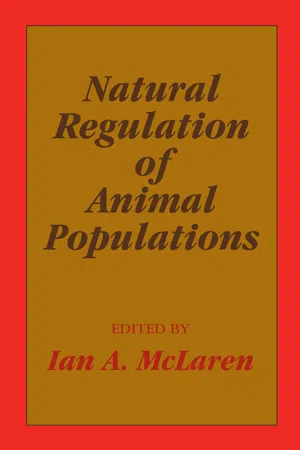
Natural Regulation of Animal Populations
About this book
Surveying an area dense with conflicting observations and ideas, this volume vividly depicts the current state of knowledge as well as the great diversity of opinion in the field of population ecology. Ten papers by outstanding authorities focus on three main issues-the effects of environment and population density on population dynamics, the influence of animal behavior on population growth, and the possibilities of genetic feedback or short-term evolutionary change on control of animal populations. An incisive introduction by the editor establishes a frame of reference and supplies succinct resolutions of some of the important controversies dealt with in these pages.
Information
1 Meaning
of Density-Dependence
and Related Terms
in Population Dynamics
M. E. Solomon
One of the most familiar concepts of population dynamics is the idea of the regulation of abundance by density-dependent factors, which operate more severely at high density than at low density, per individual of a population. But there has been some variation in the meaning and scope of “density-dependent” and related terms as used by different authors, and in recent years this tendency has increased. This has led to some confusion, and poses the question how the application of these terms can be stabilized. Varley1-3 has argued that the meaning and scope of such a term should be determined strictly according to its author’s definition, and that on this basis insect parasites, predators, and disease organisms should be excluded from the density-dependent category. Discussion of this matter with Prof. Varley has not altered my opinion that it is too late to attempt to make a change so contrary to the intentions of the originator of this term, and to subsequent common usage, but has led to various improvements in the present article.
In order to deal with a number of points which are closely interrelated, it is proposed: (1) to look back to the origins of the terms concerned, then (2) to give a brief account, similar in some respects to that given by Varley,3 of the variations in the use of these terms by various authors, and of a number of synonyms, and finally (3) to discuss various proposals for clarifying the position.
(1) Howard and Fiske,4 discussing the natural control of insects with special reference to defoliating caterpillars, wrote that for natural control, or balance, to exist “it is necessary that among the factors which work together in restricting the multiplication of the species there shall be at least one, if not more, which is what is here termed facultative ..., and which, by exerting a restraining influence which is relatively more effective when other conditions favor undue increase, serves to prevent it.” The chief of such facultative factors was stated to be parasitism, “which in the majority of instances, though not in all, is truly ‘facultative.’”
They considered disease as a type of facultative factor which, in their experience, became effective chiefly at a very high level of abundance, and starvation as operating only at the extreme limit. Generally, insects would be controlled at a low level of density “only through parasites and predators, the numerical increase of which is directly affected by the numerical increase of the insect upon which they prey.”
Secondly: “A very large proportion of the controlling agencies, such as the destruction wrought by storm, low or high temperature, or other climatic conditions, is to be classed as catastrophic, since they are wholly independent in their activities upon whether the insect which incidentally suffers is rare or abundant…. The average percentage of destruction remains the same.. ..”
Thirdly: “Destruction through certain other agencies, notably by birds and other predators, works in a radically different manner… it may be considered that they average to destroy a certain gross number of individuals each year, and.. . this destruction .. . would most probably represent a higher percentage when that insect was scarce than when it was common. In other words, they work in a manner which is the opposite of’facultative’ as it is understood.”
In short, Howard and Fiske recognized three types of factors: (a) “catastrophic”; (b) “facultative” and a third type which was later called (c) “inverse.”5 Later, Thompson6 divided controlling factors into two classes. One, which he named “general,” was the same as Howard and Fiske’s catastrophic type. The other comprised “those individualized factors whose destructive capacity depends in some way on the numerical value of the host population;” this definition takes in two of Howard and Fiske’s categories, the facultative and the inverse factors; it is clear from this paper and from Thompson’s later writings7 that he means chiefly parasites, but he considers that, because of their limited reproductive capacities, they generally act as inverse factors.
It was H. S. Smith8 who introduced the new terms “density-independent” and “density-dependent” for Howard and Fiske’s catastrophic and facultative categories. He made the mistake of identifying the facultative or density-dependent class with Thompson’s individualized category; but this designation, “destroying a percentage which increased when the numbers of the host increased,” shows that he did not mean to include inverse factors; indeed, he followed Howard and Fiske in recognizing them as a distinct third category, again citing “many insectivorous birds and mammals” as examples. His examples of density-independent agents included climatic factors, “intrinsic” mortality, and malnutrition due to unsuitable food. Examples of density-dependent factors were, primarily, entomophagous insects, then certain infectious and contagious diseases, quantity of food and competition for nesting sites or protective niches; the last-mentioned process, it was suggested, was a medium through which climatic factors could have a density-dependent action.
Thus Smith and Howard and Fiske agreed in designating facultative or density-dependent factors as those having a greater proportionate influence at high than at low population density, and also in regarding insect parasites, or entomophagous insects (Smith), certain pathogens, and food shortage as examples; Smith added intraspecific competition, and hence (in his view) certain climatic factors. Varley1-3 has insisted that the definition and the examples are at variance, inasmuch as theoretically constructed parasite-host oscillations show a relationship which, owing to the delayed response of parasite numbers to changes in host numbers, is alternately density-dependent and inverse. It may be added that interactions broadly similar to the theoretical ones have been demonstrated in laboratory experiments and in a fragmentary form in certain field populations, though not in others. Nevertheless, the great majority of writers on the subject have accepted Smith’s ideas and terms, presented as they were without formal definition, and have been content to use them in a not too precise way; in particular, most writers have accepted all those insect parasites and predators exerting a regulating influence upon a population as density-dependent factors; whether or not their response to host density might be so delayed as to prevent any consistent and straightforward density-dependence has been little considered.
(2) There have, however, been a number of variations in the application of Smith’s terms, and various new terms have been used by authors wishing to avoid confusion. The term “density-independent” has suffered relatively little misuse. But in his textbook, Odum9 refers to a type of inverse factor as density-independent, and uses a new term, “density-proportional,” for one type of density-independent factor.
With respect to the term “density-dependent,” a major source of confusion is that some authors have taken it to include inverse factors, which Smith specifically excluded. Allee10 and Allee et al.11 did this, and then separated “direct density-dependent” from “inverse density-dependent” factors. Haldane12 did likewise, but called these two subdivisions “negative” and “positive density-dependent.” Thompson7 writes that Smith proposed the new term “density-dependent” for Thompson’s individualized category. This, as already noted, was an error on the part of Smith ;8 for, like Howard and Fiske,4 he explicitly separated the inverse type of factor into a separate category.
Milne13 makes a distinction between “perfectly” and “imperfectly” density-dependent factors: “Perfection here means an exact linear (or curvilinear) relationship between increasing action of the factor and increasing density of the species.” The only perfectly density-dependent factor is said to be competition between members of the population. I do not believe that factors perfectly dependent on density exist except at a high level of abstraction. In nature, the actions of all factors are presumably variable and inexact.
Varley,1’2 in separating parasites, predators and pathogens from the density-dependent category, called them “delayed density-dependent” factors. Lack14 has treated this new category as a subdivision of the density-dependent class.
Some synonyms of density-dependent are “facultative,”4 “controlling,”15 “concurrent,”5 and “density-governing.”16
“Inverse” factors of various types have been called “density-disturbing,”16 “inverse density-dependent,”10’11 and “positive density-dependent.”12 Odum9 refers to one sort of inverse action as an inverse type of density-dependence, and to another sort as density-independent. The terms positive or inverse density-dependent, as we have seen, extend the density-dependent category beyond the limits laid down by its originator.
There is, of course, an important characteristic held in common by density-dependent and inverse factors: the action of both is related to population density, though in opposite senses. Terms (other than density-dependent) which have been used for including both these types of factors together are “individualized,”6 “density-related,”5 and “reactive.”16
(3) Turning now to the question how to standardize the use of the term density-dependent and reduce the confusion which has beset it in the past, there are three main possibilities:
(a) The first is to follow the course advocated by Varley,2’3 and place a strict interpretation on the explanations (scarcely formal definitions) given by Howard and Fiske4 and by Smith.8 What the result of this would be depends upon whether or not many insect parasites and predators do in fact maintain an oscillatory relationship, of the type seen in mathematical theories, with the populations of their hosts or prey. If Varley’s 2 expectations are correct, parasites and predators would generally be excluded from the density-dependent category of which Smith took them to be the prime exemplars. Besides running counter to the intentions of the originator of the term, this would give density-dependence a far narrower meaning than it has been given throughout the extensive literature in which it has been used over the past two decades. (The only exceptions to this, so far as I am aware, are papers by Varley.1-3) I believe such a restriction of the scope of this familiar term would be unlikely to find general acceptance, and that after such a long period it would cause a great deal of further confusion if it were adopted.
(b) The second possibility is to follow the example of Allee,10 Allee et al.,11 and Thompson,7 and take the density-dependent category to include, not only all the types of factors attributed to it by Smith, but also the inverse factors, which he excluded. In support of this course, it may be said that it has been fairly widely favored, and that it interprets density-dependent in the literal sense of “acting in a way which is dependent on density.” But I doubt whether it accords with a majority viewpoint, and am opposed to it because it gives the term density-dependent a quite different scope from that laid down by its originator.
(c) The third possibility is to follow the intentions of Smith as closely as possible, by including, along with intraspecific competition and other straightforward density-dependent factors, those parasites, predators, and pathogens which respond to changes in host population density in such a way as tends to limit these changes (even if the response is delayed as in the theoretical parasite/host oscillations), and by excluding only those factors the action of which wholly or predominantly maintains an inverse relationship with density, and those which are independent of density. Many writers have explicitly or implicitly adopted a similar interpretation. I suggest that, insofar as the term “density-dependent” continues in use, this is the way in which it should properly be applied.
Whichever course is followed, one major difficulty is inescapable for the present: there are very few ecological situations which are well enough known for particular biological factors to be placed with confidence in any one of Smith’s three categories. Still less can we say in general what proportion of insect parasites and predators act as density-dependent, or inverse, or density-independent factors.
The writer on this subject may often prefer to avoid using the term “density-dependent.” One alternative is to use Nicholson’s term “density-governing.” Nicholson16 writes that “its meaning is precisely that of ‘density-dependent factor’ according to definition (Smith, 1935),” and, like Smith, he puts inverse factors in a separate category (density-disturbing). A possible objection to the term “density-governing” is the implication that all density-dependent factors have a governing influence upon density, which seems unlikely.
As a means of avoiding the various difficulties associated with the use of “density-dependent,” and at the same time recognizing the special features of the factors Varley1 called “delayed density dependent,” the following classification may be useful. It sets out some types of relation which the unfavorable action of factors upon a population may bear to the density of that population, the action being measured as an effect upon mortality, the reproductive rate, or the net rate of increase or decrease, and expressed in proportionate terms such as percentage.
(1) “Directly density-related:” showing a positive correlation between adverse action and density.
(2) “Inversely density-related” (or “inverse”): showing a negative correlation between adverse action and density.
(3) “Alternately density-related” (or “alternating”): where a lagging response to changes in density leads to a regular succession of directly and inversely related phases.
This last category is distinguished from the density-independent (or nonreactive16) relationship, where the correlation between action and density would generally vary (in successive short runs of observations) in an irregular manner between positive, zero, and negative, with a long-run correlation not differing significantly from zero.
A single factor might fall in different categories in different circumstances, or at different levels of abundance or (as pointed out to me by Dr. R. F. Morris, of Canada) within a single generation as compared with a series of generations.
Upon...
Table of contents
- Cover Page
- Half Title Page
- Title Page
- Copyright
- Introduction
- 1 Meaning of Density-Dependence and Related Terms in Population Dynamics
- 2 Is the Density of Animal Populations Regulated by Mechanisms or by Chance?
- 3 Status of the Idea that Weather Can Control Insect Populations
- 4 Regulation of Animal Numbers
- 5 Effects of Population Density on Growth Rates of Animal Populations
- 6 Endocrines, Behavior, and Population
- 7 Self-Regulating Systems in Populations of Animals
- 8 On Group Selection and Wynne-Edwards’ Hypothesis
- 9 The Natural Selection of Self-Regulatory Behavior in Animal Populations
- 10 Population Regulation and Genetic Feedback
- Index
Trusted by 375,005 students
Access to over 1.5 million titles for a fair monthly price.
Study more efficiently using our study tools.
Frequently asked questions
Yes, you can cancel anytime from the Subscription tab in your account settings on the Perlego website. Your subscription will stay active until the end of your current billing period. Learn how to cancel your subscription
No, books cannot be downloaded as external files, such as PDFs, for use outside of Perlego. However, you can download books within the Perlego app for offline reading on mobile or tablet. Learn how to download books offline
Perlego offers two plans: Essential and Complete
- Essential is ideal for learners and professionals who enjoy exploring a wide range of subjects. Access the Essential Library with 800,000+ trusted titles and best-sellers across business, personal growth, and the humanities. Includes unlimited reading time and Standard Read Aloud voice.
- Complete: Perfect for advanced learners and researchers needing full, unrestricted access. Unlock 1.5M+ books across hundreds of subjects, including academic and specialized titles. The Complete Plan also includes advanced features like Premium Read Aloud and Research Assistant.
We are an online textbook subscription service, where you can get access to an entire online library for less than the price of a single book per month. With over 1.5 million books across 990+ topics, we’ve got you covered! Learn about our mission
Look out for the read-aloud symbol on your next book to see if you can listen to it. The read-aloud tool reads text aloud for you, highlighting the text as it is being read. You can pause it, speed it up and slow it down. Learn more about Read Aloud
Yes! You can use the Perlego app on both iOS and Android devices to read anytime, anywhere — even offline. Perfect for commutes or when you’re on the go.
Please note we cannot support devices running on iOS 13 and Android 7 or earlier. Learn more about using the app
Please note we cannot support devices running on iOS 13 and Android 7 or earlier. Learn more about using the app
Yes, you can access Natural Regulation of Animal Populations by Ian A. McLaren in PDF and/or ePUB format, as well as other popular books in Biological Sciences & Ecology. We have over 1.5 million books available in our catalogue for you to explore.