- 338 pages
- English
- ePUB (mobile friendly)
- Available on iOS & Android
eBook - ePub
About this book
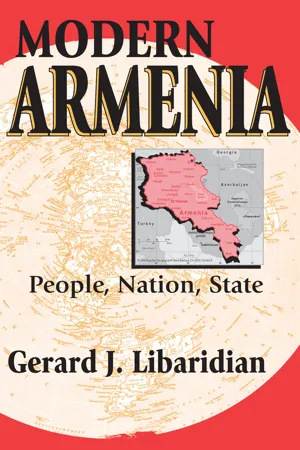
Modern Armenia reviews Armenian politics and political thinking from the mid-nineteenth century to the present, and the evolution of Armenians from peoplehood to statehood. Written by a key governmental advisor in the early years of Armenian independence, this book analyzes the internal dynamics of the revolutionary movement, the genocide, the Armenian Diaspora, its recovered statehood and recent independence, as well as the relationship of these developments to processes in the Ottoman/Turkish, Russian, and Western states. It also explores current dilemmas and future choices independent Armenia faces today.Libaridian concludes with an overview of Armenia and Armenians during the past two decades, including the rebirth of independent Armenia, its foreign and security policy options, its position within the region, and its relations with the Diaspora. Fascinating and timely, Modern Armenia will be of interest to students and scholars of Armenian history, independence movements, the dissolution of the Soviet empire, foreign relations, and political science.
Information
Part I
1
From People to Nation: An Overview from the 1850s to the 1970s
The present border dividing historic Armenia dates back essentially to a treaty of 1639 between the Ottoman and Safavid Empires, which for a century had been contending for the domination of Mesopotamia and Trans-Caucasus. That treaty brought much-needed relief to the Armenian population from the ravages of war, but it also subjugated them to foreign rule, unwelcome because both empires imposed a harsh system of taxation and an oppressive social structure that discriminated against the non-Muslims. Before long, Armenians in both empires started searching for means to alter the status quo. For East Armenians, the growing power of the "Christian King of the North," the tsar, offered a viable alternative.1 Russian expansion to the Caucasus occurred when modern Western imperialism was becoming the most pervasive force in international relations, and when technologically backward states such as the Ottoman and Persian realms were being integrated into the world market system. What once were issues of local significance acquired implications for major power relations, and decisions made in Europe affected the lives of peoples in remote areas of the globe.
Modern Armenian political consciousness evolved as a reaction against the suffocating effects of medieval Ottoman and Persian imperialism in the process of disintegration and as a response to new but problematic opportunities for liberation offered by increasing Western and Russian interests in the area. Thus, when Russia, a more secular and dynamic state, annexed Persian Armenia in 1828, it transformed the region into a lively arena of inter-European conflict, which in turn made the politics of Western powers accessible to Armenians. It introduced new patterns in East Armenian life, and a faster pace of change.2
Yet, despite a growing divergence between the Armenian communities on opposite sides of the border by the middle of the nineteenth century, circumstances made it possible to transform the cultural renaissance of the 1840s and 1850s into the common political program of the last quarter of the century. First, both sectors drew on a two thousand-year-old common history to assert a distinctive national identity. Textbooks and poetry published in Constantinople and Moscow revived ancient personalities whose grandeur and heroism contrasted sharply with the prevailing servile mentality and status of most of the Armenian population. Second, by the 1860s a liberal intelligentsia among East as well as West Armenians won its battle for secularization of institutions and values. Their use of modern Armenian instead of the classical language was most consequential. Although a different dialect was accepted by East and West Armenians as the norm, it now became possible for them all to understand each other's writing without much effort.3
Thirdly, the relative lack of discrimination and oppression in Russian Armenia allowed Armenians to focus their attention on the Ottoman sector, where social and economic conditions had deteriorated considerably and where a clear danger to the physical survival of the Armenian people was seen. This was particularly true during and after the famine that followed the war of 1877-1878. Although the Russian government later decided that another Bulgaria could not be tolerated on its flanks, at the time it did not object to the Russian Armenians' advocacy of West Armenia's liberation, particularly if that meant further tsarist annexations.4
The road to a political program for a new Armenian nation was not straight. Circumstances directly related to Armenia's between-land position—lack of opportunities and protection normally provided by a national government; lack of communication for the joint exploitation of the land's resources; absence of security of property, particularly in the Ottoman sector—produced two Armenian bourgeoisies. In the Ottoman Empire evolved a commercial class, beneficiary of the growing trade with the West; in Russia the bourgeoisie became increasingly industrial and financial. Both flourished in the capitals and in major administrative and commercial centers of the two empires, outside the Armenian heartland where the majority of Armenians lived and which had become backwaters of the Ottoman and Russian territories. By mere economic necessity, and lacking a social basis to exert any political power, affluent Armenians linked their fortunes to the regimes in their respective states. Hence, the two bourgeoisies did not seek, and could not have achieved, a common program solely on the basis of their ethnic background, notwithstanding contacts between the liberal intelligentsias supported by each. Their interest in the improvement of the lot of the common man in Armenia proper did not exceed a mild reformism; under no circumstance did they antagonize the governments that had afforded them economic prerogatives.
Thus, the East Armenian bourgeoisie, which had earlier strongly supported Russian advances into Ottoman territories as a means of freeing the West Armenians, did not protest in 1885 against the closing of hundreds of parochial Armenian schools in East Armenia ordered by the tsar's government. Furthermore, when Russo-Turkish relations improved in the 1890s, and Russia actively opposed the anti-Ottoman activities of Armenian revolutionaries, the latter were denied any assistance by this wealthy class. Similarly, the West Armenian bourgeoisie lost much of its enthusiasm for systematic reforms in the eastern provinces once Sultan Abdul-Hamid II revealed his reactionary attitudes toward social change. The Armenian National Assembly in Constantinople limited its activities in this last regard to formal representations to the Porte. Most well-to-do Ottoman Armenians were only too willing to accept the sultan's occasional paternalistic favors to chosen individuals as a proof that his rule was benevolent and his society harmonious.
In the 1880s it became clear that the reforms advocated by the traditional leadership would not be carried out. By then, the Armenian bourgeoisie and the once powerful Armenian Church associated with them had retrenched from their earlier active participation in the process of political awakening. The Ottoman constitutional movement and Armenian liberalism had failed. Consequently, revolutionary political parties emerged, organized primarily by elements from the lower classes and by the radicalized segments of the intelligentsia.5
The ideologies espoused by the new parties were the first in Armenian history to be rooted in the needs of the masses. They all proposed to struggle against the political despotism, economic stagnation, and social inequality of the Ottoman system. The 1892 platform of the most influential of these organizations, the ARF or Dashnaktsutiune (Hay Heghapokhakan Dashnaktsutiune, or Armenian Revolutionary Federation, founded in 1890), called, for example, for the establishment of a popular-democratic government based on free elections. This government would guarantee security of life and right to work; equality of all nationalities and religions before the law; freedom of speech, press, and assembly; distribution of land to the landless; taxation according to ability to pay; abolition of the military exemption fee and its replacement with general conscription; establishment of compulsory education and promotion of national intellectual progress; and reinforcement of communal principles as a means to greater production and exports.6
The political parties viewed specific demands as means to achieve the larger goal of a dynamic progressive society. The slightly older SDHP (Social Democratic Hnchakian Party, founded in 1887 and 1888) asserted, for example, that "Political freedom for the Armenian people will be considered as only one of the conditions necessary for the realization of a series of basic and radical reforms in its political, social and economic life...that will insure a solid basis and the true path for the moral, intellectual, and material progress of society."7 The ARF too believed that "the liberation of the people from its untenable condition in order that they may enter the mainstream of human progress could only be achieved through revolution."8
One feature that distinguished the new organizations from prior advocates of reform was their use of weapons to force the Ottoman state and the signatory powers of the Treaty of Berlin to live up to their responsibilities. But on a larger scale this revolution entailed first and foremost a campaign against the slavish mentality of the Armenian masses. Propaganda was to be reinforced by living examples of valor and martyrdom in situations of armed resistance to oppression. In addition to their psychological impact, the revolutionary parties viewed the acquisition of arms by the Armenian populace as the best means of defense against widespread lawlessness overlooked by the Ottoman government, and occasional pogroms condoned by it.9
Mass participation in the liberation movement was low despite an apparently widespread sympathy with the revolutionary activities. Many Armenians continued to believe that any opposition to the existing order would constitute an act of insubordination against God's preordained scheme for the world. Others, in areas sparsely populated by Armenians, were apprehensive of the reaction of their neighbors and overlords. Moreover, the Church, fearful of losing the few prerogatives it had managed to retain, remained aloof from the movement, although a few clergymen were involved in clandestine operations. The revolutionary parties considered the Church a lethargic and regressive institution. The Church, in turn, would not cooperate with parties that called for a struggle against patriarchal institutions and advocated a secular society. It is true that in 1903 the ARF had come to the support of the Church when the Russian government decreed the confiscation of Armenian Church properties; and following massive opposition and large scale demonstrations against the decree the revolutionaries had been able to force its rescission. But all of that was forgotten during the days of the first Russian revolution when a general assembly of Eastern Armenians was convened at the Holy See of Etchmiadzin. There most of the delegates elected were members or sympathizers of the ARF; the party felt strong enough to propose the distribution of Church-owned agricultural lands to the peasants who had tilled them for generations. The Assembly was disbanded in two days by the Russian police, most probably at the instigation of high-ranking churchmen.10
Relations between the political parties and the Armenian bourgeoisie had a similarly ambivalent character. Notwithstanding their programmatic antagonism toward all exploiting classes, the revolutionaries, especially the ARF leaders, expected the wealthy at least to provide financial assistance since the struggle undertaken had a national character.11 Their press often criticized the Armenian upper classes for the latter's cowardice and lack of interest in the fate of the common Armenian. The mutual distrust dissipated in the Caucasus during the Armeno-Tatar conflict of 1905 to 1907. Unable to rely on government forces to protect their interests and properties, merchants, financiers, and industrialists turned to the ARF. The ARF accepted the challenge. Its leaders argued, firstly, that Tatar aggression had been instigated by the reactionary Russian government as part of a larger anti-Armenian policy; hence, it was as necessary to defend Armenian-owned property as it was to protect helpless Armenian peasants. Secondly, they argued, given employment discrimination against Armenian workers in non-Armenian concerns, the assistance provided to the Armenian bourgeoisie was tantamount to the safe-keeping of employment opportunities for Armenian laborers.12 Paradoxically, this alliance coincided with the ARF's most intense socialist-oriented propaganda and activities in the Caucasus. It also allowed the flow of arms and financial assistance to the struggle in Western Armenia on an unprecedented scale. Yet the ideological inconsistency provided the best opportunity thus far to the nascent Armenian Marxist group to criticize the now dominant ARF.13
From the beginning, though, the revolutionary parties concentrated their efforts among the artisans, peasants, and petty bourgeoisie of Western Armenia. And here there was no lack of support in provinces and districts where lawlessness and poverty had reached unbearable dimensions. Furthermore, in regions such as Sasun, Mush, and Zeytun, where vestiges of the medieval Armenian feudal system remained subject to constant harassment by regular army troops and by Kurdish chieftains, the response to the appeal of the revolutionaries was immediate and overwhelming. Long before any of the parties were founded, local leaders in these mountainous districts had organized self-defense units and individual fighters had taken up arms to protect their families and villages.
The revolutionary parties provided a direction to those elements and attempted to coordinate their activities with newly organized units and within the framework of an overall strategy. Guerrilla fighters came mostly from traditionally devout families, and lacked the sophistication of urban intellectuals in the parties; but they overcame the impediments of religion by supplanting the God of submission and patience preached by most clergymen with the God of justice and retribution, or simply by deifying local saints who could "understand their situation" better.
Moreover, revolutionary parties were readily supported in cities and towns where educationa...
Table of contents
- Cover
- Half Title
- Title
- Copyright
- Dedication
- Contents
- Acknowledgments
- Preface
- Introduction
- Part I
- Part II
- Part III
- Part IV
- Part V
- Glossary of Terms
- Bibliography of Modern Armenian History
- Index
Trusted by 375,005 students
Access to over 1.5 million titles for a fair monthly price.
Study more efficiently using our study tools.
Frequently asked questions
Yes, you can cancel anytime from the Subscription tab in your account settings on the Perlego website. Your subscription will stay active until the end of your current billing period. Learn how to cancel your subscription
No, books cannot be downloaded as external files, such as PDFs, for use outside of Perlego. However, you can download books within the Perlego app for offline reading on mobile or tablet. Learn how to download books offline
Perlego offers two plans: Essential and Complete
- Essential is ideal for learners and professionals who enjoy exploring a wide range of subjects. Access the Essential Library with 800,000+ trusted titles and best-sellers across business, personal growth, and the humanities. Includes unlimited reading time and Standard Read Aloud voice.
- Complete: Perfect for advanced learners and researchers needing full, unrestricted access. Unlock 1.5M+ books across hundreds of subjects, including academic and specialized titles. The Complete Plan also includes advanced features like Premium Read Aloud and Research Assistant.
We are an online textbook subscription service, where you can get access to an entire online library for less than the price of a single book per month. With over 1.5 million books across 990+ topics, we’ve got you covered! Learn about our mission
Look out for the read-aloud symbol on your next book to see if you can listen to it. The read-aloud tool reads text aloud for you, highlighting the text as it is being read. You can pause it, speed it up and slow it down. Learn more about Read Aloud
Yes! You can use the Perlego app on both iOS and Android devices to read anytime, anywhere — even offline. Perfect for commutes or when you’re on the go.
Please note we cannot support devices running on iOS 13 and Android 7 or earlier. Learn more about using the app
Please note we cannot support devices running on iOS 13 and Android 7 or earlier. Learn more about using the app
Yes, you can access Modern Armenia by Gerard Libaridian in PDF and/or ePUB format, as well as other popular books in Politics & International Relations & European History. We have over 1.5 million books available in our catalogue for you to explore.