eBook - ePub
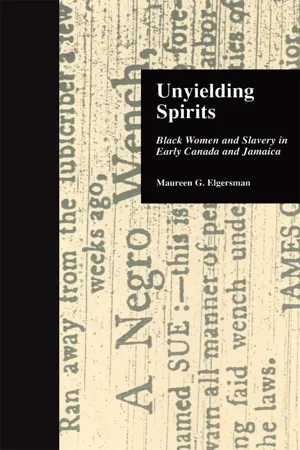
Unyielding Spirits
Black Women and Slavery in Early Canada and Jamaica
- 206 pages
- English
- ePUB (mobile friendly)
- Available on iOS & Android
eBook - ePub
About this book
This comparative study uncovers the differences and similarities in the experiences of Black women enslaved in colonial Canada and Jamaica, and demonstrates how differences in the exploitation of women's productive and reproductive labor caused slavery to falter in Canada and excel in the Caribbean. The research suggests that while the majority of Black women enslaved in early Canada were domestics, the majority of Jamaican women were field laborers, often performing some of the most labor-intensive work on the sugar plantations. While the efforts of the planter class to increase the number of children born to Jamaican women were not completely successful, reproduction seems to have been less of a concern in Canada where many Black women were often sold or freed because there was no use for them. The Canadian slave context seems to have allowed a broader range of material comfort as well. Despite obvious labor differences, Black women in Canada and Jamaica rejected their chattel status and condition, and resisted slavery similarly. This study is unique in its desire and ability to place Black Canadian slave women at the center of research, and then contextualize it with a Caribbean model.
CHAPTER ONE
Introduction: Slavery in New France
Slavery was a Canadian institution, and to recognize it as such is to make a significant historical statement. People of African descent were enslaved during the course of the French regime which lasted until 1760, and during the British colonial era until the institution was officially abolished in 1834. In New France, enslaved Blacks were the personal property of prominent settlers including colonial administrators, clergy, and merchants. In British North America, as Canada was known during its period of British colonization from 1760 to 1867, the chattel status of Blacks was maintained, as they continued to be enslaved in domestic spheres and as general laborers. Additionally, slavery was augmented from outside Canada as waves of British Loyalists, leaving the newly formed United States in the 1780s, brought their slave property with them—a right that was protected for them in colonial law. Even as slavery was on the decline in the early nineteenth century, attempts were made to stabilize the system from within as many Canadians fought to protect their right to have slaves even when the institution had proven unprofitable for others.1
The Canadian institution had its own character, and its outward manifestations were quite different from those elsewhere in the Americas. For example, the absence of elements associated with Jamaican slave society—monocrop production, a plantation economy, tropical or semitropical climate, and a large, concentrated Black population—encourages the deconstruction of any notion that slavery was, or even could have been, present in early Canada.
Admitting slavery as a Canadian institution is a significant political statement that forces a reconciliation of the post-emancipation history of Black status in Canada as one that is anchored in and informed by the sanctioning of slavery in that country. European colonialism and the “attendant collective mind-set”2 that made blackness a badge of slavery and relegated Blacks to inferior status continued to inform the proper place of people of color as domestics, railway porters, and custodians after slavery. The norm continues today as Black women are read as hypersexual exotics, and Black men are read as criminals. This means that contemporary problems are not modern aberrations, but, rather, form part of a continuum of racial privilege. It is not an evil that has penetrated the Canadian border from outside and tainted its culture; Canada has its own history of subjugation with its own investments, privileged rewards, and protections to reconcile.3
The initial phase of slavery during Canada’s French colonial era is shrouded in considerable uncertainty. One thing is clear, however—that slavery was a race-specific status reserved for African and indigenous populations. French Canadians enslaved Panis (Pawnee) Indians as well as Africans, and historian O. H. M. Lapalice suggests that slavery in New France was based on a localized, racial hierarchy that made the Panis the laborers of the middle class and made Blacks the property of the elite. Lapalice argues that the enslavement of the Panis was practiced on a high level in Montreal during the French regime. Panis slaves were found in the houses of the bourgeoisie, while less numerous Blacks seemed to be objects of luxury, and generally served the rich.4
The differentiation in status between Blacks and the Panis and in the appropriation of their labor suggests the presence of two related conditions. First, Canada’s indigenous population comprised a viable labor force in the colony. This is not to imply that the Panis were innately docile, but rather to suggest that the number of Panis who were enslaved kept pace with the demand of most French colonists for their labor. The labor demand may have been small enough that it was primarily satisfied by indigenous laborers without an extensive reliance on the importation of Africans. This can be contrasted with the indigenous labor supply in the Caribbean, for example, where the Spanish demand for labor in the mines of Hispaniola and Santo Domingo outpaced the declining Indian population.5 The comparatively smaller French colonial population in Canada did not appear to face such a labor shortage.
The second condition is that Blacks constituted the slave minority, and, as “objets de luxe,” they served as symbols of wealth more than generators or stabilizers of wealth as were the Panis. Lapalice’s contention is that Blacks were purchased not by residents of average income, but by the wealthy to demonstrate their class standing. As the property of the upper class, then, it is possible that Blacks commanded a high purchase price, effectively keeping them beyond the financial reach of the average French Canadian. Historian Robin W. Winks found that, on average, Blacks in French Canada commanded a price more than twice that of Panis. Blacks cost as much as 900 livres while the Panis cost up to 400 livres.6 Under these circumstances, the ownership of Black slaves would have been cost prohibitive for many colonists who otherwise might have desired to purchase them.
EARLY ARRIVALS
The first few Blacks known to have arrived in early Canada were men and they have been consistently used to define the parameters of slavery in Canada. Because they were some of the first, and although their legal status is not entirely clear, they have received significant scholarly attention. Canada’s first Black resident is reported to have been a young boy named Mattieu da Costa (also “de Coste”).7 Scholars of Black Canadian history such as Robin W. Winks, Leo W. Bertley, and Daniel G. Hill agree that, based on available records, da Costa was Canada’s first Black, and they offer their individual sketches of his role and the nature of his residence in early Canada.8 Hill writes:
Mattieu da Costa, though not a permanent resident of Canada, was the first known Black to set foot on Canadian soil. He came with the expedition of Pierre de Gua, sieur De Monts, which founded Port Royal in 1605. It is probable that da Costa had spent some time in Canada even earlier, for he served as interpreter for the French Habitation with the friendly Micmac of the area.9
Bertley offers a more comprehensive sketch of da Costa and his life in French Canada:
Matthew da Costa, a Black, came to Nova Scotia in the summer of 1606 as a member of the Poutrincourt-Champlain expedition. The group settled at Port Royal, built the previous summer on the north bank of the Annapolis River just below its mouth. Here was established Canada’s oldest social club, The Order of Good Cheer. Da Costa was one of its charter members. This pioneer was an interpreter of the language spoken by the Mic Mac Indians living in the Atlantic region. It is unknown how he acquired this knowledge, but it seems reasonable that he must have visited these shores before and had learned the language then. He died at Port Royal and was buried on the grounds of the habitation.10
Bertley’s conclusion that da Costa lived in French Canada until his death opposes Hill’s position that he was not a permanent resident, and Bertley’s reference to the “Order of Good Cheer” is not corroborated by any of the works of Hill or Winks. The informal format of Bertley’s text and the absence of footnotes make it difficult to trace Bertley’s source.
The account of Mattieu da Costa provides a brief window into the very early Black experience in New France. Winks records that da Costa was a servant, but acknowledges that the French used the term to describe Blacks who were enslaved. However, there is little in the available records to suggest that he was a slave other than the dark pigmentation of his skin. Da Costa’s arrival initiates a trend that would continue for several years, in that Blacks, whether free or enslaved, were not initially found in colonial Canada in large numbers. Also, the initial scarcity of Black females set Canada apart from other, more stable slave societies found in the Caribbean where there was a smaller ratio between the number of Black women and Black men.11
If da Costa were enslaved, his form of service seems to have been atypical for an agrarian society and suggests that there was some fluidity in the early stage of Black enslavement in Canada. Rather than having been a general laborer, da Costa’s reputed value as a French-MicMac interpreter and his alleged membership in the Order of Good Cheer suggest that he held some special privilege or status with the French. What membership in this order entailed or how da Costa gained membership in it is unclear, but it can certainly be suggested that da Costa proved to have some value exceeding the limitations that might have otherwise been put on him as an African in the Americas. This merit may simply have been da Costa’s value as an interpreter where trade between the French and Indian populations was important to the colony. His alleged admission to the Order of Good Cheer could also be evidence that he was seen as intelligent, personable, and not diminished by race. Da Costa’s burial on the grounds of the Habitation, a right usually reserved for French clergy and administrators, could also be used to support the theory that he held a higher status than Canada’s indigenous peoples and is probably an indication that he was baptized.12 It is important to note that the informal model of enslavement that scholars have tentatively assigned to da Costa was not sustained in New France or in British Canada, as a more regulated form of chattel slavery would soon take its place.
Historians have been able to corroborate information and establish that Canada’s second Black resident was a child from Madagascar. Sold a number of times between his introduction to the colony in 1628 and his death in 1654, he is identified as Olivier Le Jeune, having been named for Olivier Letardif, the trading company’s head clerk and his catechism instructor, Father Paul Le Jeune.13 Olivier Le Jeune is said to have been owned by Guilliame Couillard, a farmer with a considerable holding of one hundred acres of land, who received Le Jeune as a gift from Letardif.14 The fluidity of position or status apparent in the case of da Costa is absent in the case of Le Jeune. The transfer of ownership of Le Jeune and the giving and receiving of Le Jeune as a gift suggests a shared belief in the propriety of Blacks’ chattel status between Couillard and Letardif. This transfer also indicates that the enslavement of Blacks in Canada was already starting to mirror that of other slave societies in the Americas, such as Jamaica, where Blackness and chattel status were entwined. The sketch of Le Jeune’s life also demonstrates the complicity of the church in enslavement, and the principle that religious conversion did not nullify chattel status in early Canada.15
The corroboration of accounts concerning Canada’s second Black resident and the lapse of time between his arrival and that of da Costa strongly suggest that Black women remained absent from the institution through its early, formative years. Without women, it certainly would have been difficult for Canada’s seventeenth-century colonists to establish a stable institution based on the labor of enslaved Blacks. Said differently, unless French colonists intended to bring Blacks into Canada on a regular basis to increase the slave population, they would need to have had both male and female slaves in their possession. There would had to have been the means to secure a new gen...
Table of contents
- Cover
- Half Title
- Crosscurrents in African American History
- Title Page
- Copyright Page
- Dedication
- Table of Contents
- Series Editor's Foreword
- Preface
- List of Abbreviations
- 1. Introduction: Slavery in New France
- 2. Slavery in Early Canada: Making Black Women Subject
- 3. The Power Within: Black Women and Jamaican Slavery
- 4. To Be a Woman: Production, Reproduction, and Material Culture
- 5. The Spectrum of Resistance
- 6. In the Space of Freedom
- 7. Conclusion: Race and Gender Considerations
- Bibliography
- Index
Trusted by 375,005 students
Access to over 1.5 million titles for a fair monthly price.
Study more efficiently using our study tools.
Frequently asked questions
Yes, you can cancel anytime from the Subscription tab in your account settings on the Perlego website. Your subscription will stay active until the end of your current billing period. Learn how to cancel your subscription
No, books cannot be downloaded as external files, such as PDFs, for use outside of Perlego. However, you can download books within the Perlego app for offline reading on mobile or tablet. Learn how to download books offline
Perlego offers two plans: Essential and Complete
- Essential is ideal for learners and professionals who enjoy exploring a wide range of subjects. Access the Essential Library with 800,000+ trusted titles and best-sellers across business, personal growth, and the humanities. Includes unlimited reading time and Standard Read Aloud voice.
- Complete: Perfect for advanced learners and researchers needing full, unrestricted access. Unlock 1.5M+ books across hundreds of subjects, including academic and specialized titles. The Complete Plan also includes advanced features like Premium Read Aloud and Research Assistant.
We are an online textbook subscription service, where you can get access to an entire online library for less than the price of a single book per month. With over 1.5 million books across 990+ topics, we’ve got you covered! Learn about our mission
Look out for the read-aloud symbol on your next book to see if you can listen to it. The read-aloud tool reads text aloud for you, highlighting the text as it is being read. You can pause it, speed it up and slow it down. Learn more about Read Aloud
Yes! You can use the Perlego app on both iOS and Android devices to read anytime, anywhere — even offline. Perfect for commutes or when you’re on the go.
Please note we cannot support devices running on iOS 13 and Android 7 or earlier. Learn more about using the app
Please note we cannot support devices running on iOS 13 and Android 7 or earlier. Learn more about using the app
Yes, you can access Unyielding Spirits by Maureen G. Elgersman in PDF and/or ePUB format, as well as other popular books in History & African American History. We have over 1.5 million books available in our catalogue for you to explore.