The tide is turning against environmentalism as the political right, industry and governments fight back.
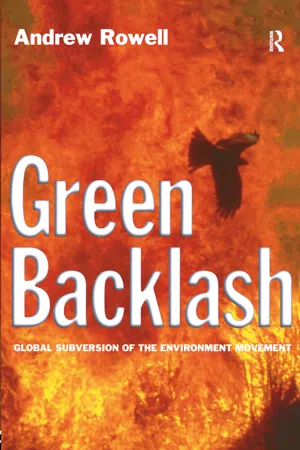
Green Backlash is a controversial expose of the anti-environmental movement. Tracing the rise of the backlash from the Wise Use movement in the USA, the author reveals its rapid spread worldwide: the anti-roads movement in the UK, forestry debates in Canada and Australia, marine resource issues in Europe, South-East Asia, and controversies such as the Brent Spar.
The backlash is set to get worse as the resource wars intensify. This book offers a greater understanding of the challenges and threats facing global environmentalism, concluding that the environmental movement now has a chance to re-evaluate and change for the better to beat the backlash - a chance that must not be missed.
- 504 pages
- English
- ePUB (mobile friendly)
- Available on iOS & Android
eBook - ePub
About this book
Information
1
ROLL BACK THE MILLENNIUM
America leads the way
They have all the money, all the paid staff, what they don’t have is science, truth, or the interests of humanity, or even the environment at heart. That’s why they knowr we’re going to whip their butts.1
Ron Arnold
There are, at the time of writing, four years left until the year 2000. Soon we will begin the preparations for the biggest party of all time, as we celebrate a newr millennium. Those celebrations will not only reflect the past but look to the future and central to this debate will be how we want to live in relation to the earth and each other. Discussions will take place of what kind of society we want to live in for the next thousand years, or even if we believe that the planet can survive that long. America, one of the strongest economic nations, is going to lead the way in this global re-evaluation.
Part of the American millennium celebrations will be Earth Day 2000. This festival will be an environmental extravaganza, funded by corporations who w ant to show that they are the true stewards to steer us into the coming century. Will America’s environmental movement be able to challenge these new corporate environmentalists? Will America still believe in environmentalism, or was it just a passing fad of the twentieth century? Has environmentalism succeeded or are there still challenges ahead?
There are some real reasons to celebrate. The achievements of the environmental movement, over the twenty-five years since the first Earth Day in 1970, should have been a cause for celebration. In the regulatory and legislative arena, Congress has passed twenty-eight major environmental laws, including the Clean Air and Clean Water Acts.2 On the whole, the air, water and land are cleaner. America no longer dumps its sewage at sea. Tens of millions of acres have been added to the nation’s protected wilderness areas. A few species have been hauled back from the abyss of extinction. Environmentalism has gone from a fringe idea to being embedded in the psyche of most Americans. The press have woken up to cover environmental issues — back in 1970 most sent their architecture reporters to cover Earth Day, as there was no-one else interested.
However, there is also real cause for consternation and concern. Numerous pressing problems remain. It appears that the very future of the environmental movement itself is threatened: the messenger may be slain before the message has been broadcast. The environmental movement is under attack both from outside and from within. A growing backlash movement, under the umbrella of the Wise Use movement, has mobilised thousands of people on an anti-environmental ticket. In some instances, they have spectacularly beaten environmentalists at their own game — mobilising the grassroots.
Meanwhile grassroots environmental activists complain about the lack of contact between them and the large environmental groups. They criticise the mainstream organisations for selling out to the authorities and to companies eager to add a green veneer to their polluting activities. The big environmental groups, activists allege, have been co-opted, compromised and corrupted. Furthermore, they have lost touch with the grassroots and forgotten how to work with activists who are increasingly facing a vitriolic campaign of scapegoating, intimidation and violence, all trade marks of the green backlash.
With the election of President Clinton, and ‘Green’ A1 Gore, having spent years attempting to gain political influence in Washington, many mainstream environmental groups thought that their time of political affluence had come. ‘After twelve years out in the cold, when this President snapped his fingers the big environmental groups wagged their tails like lost puppies happy to find a home, any home,’ wrote Peter Montague in Rachel’s Environment Sc Health Weekly} After the honeymoon period ended, these groups realised that a marriage between those in power and those who traditionally oppose people in power, was never going to be easy. In fact, in this case, it was never going to work. ‘What started out like a love affair turned out to be date rape,’ said Jay Hair from the National Wildlife Federation.4 Many of the most effective staff, co-opted into Clinton’s administration, soon realised that they had become another piece of bureaucratic machinery.
Another painful realisation was that Clinton and Gore were not working for them. By the end of the 103rd Congress, the Clinton administration had a worse environmental record than either the Bush or Reagan administration.5 A poll by the League of Conservation Voters reported that the 1994 session of Congress fared the worst in its twenty-five years of environmental ratings,having rejected virtually every major piece of environmental legislation brought before it.6 After the November mid-term elections when the Republicans took control of both houses of Congress, the situation went from bad to worse.
The mainstream environmental groups found themselves slowiy swinging in the cold breeze of political ineptitude. Meanwhile in the warm corridors of power, the Republicans, with the ‘Contract With America’ as their political carving knife, were about to gut many landmark environmental statutes that had spearheaded the new environmental consensus a generation before. The Clean Air Act, the Endangered Species Act, and Superfund were all up for reauthorisation before the Republican anti-environmental chopping block.
Like its successful legislation, environmentalism was in serious danger of being slain as the prodigal advocator of government regulation whose time had passed. In the new right-wing, pro-industry revolution gripping America, environmental regulation is now seen as government oppression not protection, and therefore environmentalists are seen as oppressors not guardians.
‘Environmentalists arc on the run’, reported Fortune Magazine,1 in a headline that could have been repeated across newsstands of the nation. One influential writer, Mark Dowie, even condemned the environmental movement ‘as dangerously courting irrelevance’.8 By the mid-1990s, the critics were already writing the green obituaries. The political Right and a new anti-environmental movement seemed to be growing in political and grassroots strength day by day. Environmental leaders faced a barrage of criticism for failing to respond to the Republican rout,9 for failing to heed the warnings of the grassroots and underestimating the serious nature of the green backlash that is gripping America. If America votes in a Republican president this year, the environmental movement’s influence and effectiveness could be in terminal decline.
‘The only option is to go back to the people and talk to them, to try to find out why these issues don’t seem to resonate,’ said Interior Secretary Bruce Babbitt, w ho had been head of the League of Conservation Voters, before being co-opted by the Clinton administration. ‘To try to find the embers and fan them into life once again.’10 To understand what is happening in the USA, we have to go back some time to see the spark that kindled the anti-environmental movement.
Signs of Trouble
One of the first signs of trouble to appear for the environmental movement stretches back over a quarter of a century to 1971. The event was a speech given to the United States Chamber of Commerce by Lewis Powell, who was to become the Supreme Court Justice in the late 1970s. Powell, a corporate lawyer at the time, warned business that public policy for that decade, including the environmental agenda, would be fought in the court-rooms of America.11 Some landmark legislation on ecological issues had been passed in the previous decade such as the Wilderness Act of 1964, the Federal Wild and Scenic Rivers Act of 1968 and the National Environmental Policy Act of 1969. Policy-makers were considering further fundamental legal reform on environmental issues, that would see such laws as the Endangered Species Act of 1973 entering the American statute books.
Industry was ill prepared to act within this new legislative arena, Powell advised. The answer was simple — to learn from and mirror the opposition. Set up your own independent legal firms, he told industry, that are pro-business, but label them as being in the public interest, and call them ‘public interest law firms’ (PILFs).12
The year before Powell’s speech, on 22 April 1970, hundreds of thousands of people had celebrated the first Earth Day, an event which had helped propel environmentalism into the consciousness of America. In 1969, the year before the Earth Day celebrations, over eighty members of the House of Representatives had proclaimed the 1970s as the decade of the environment. With Powell’s speech, the seeds of the corporate counter-attack against the environmental movement had already been sown.
Within two years, the Pacific Legal Foundation (PLF) had been set up in Sacramento by the California Chamber of Commerce. ‘For nearly twenty years, it has come to the defense of chemical manufacturers, oil producers, mining and timber companies, real estate developers, the nuclear power industry, and electric utilities, to name a few,’ wrote Mark Megalli and Andy Friedman in Masks of Deception: Corporate Front Groups in America in 1 991. H The PLF was quickly followed by other ‘public interest law firms’ and by 1975, a coordinating body, the National Legal Center for the Public Interest, had been set up in Washington.14 ‘What we cannot accept,’ the National Legal Center’s founding president, Leonard Theberge, said, ‘are mindless proposals that would sacrifice the people of the US on the altar of nature.’15 By talking in such religious undertones, Theberge sparked off a line of attack that would be usedtime and time again against the green movement — environmentalists were engaged in a holy war whereby nature was considered more important than humans.
Joe Coors sat on the first board of the National Legal Center.16 The ultraconservative Coors family, the beer barons, who have bank-rolled the growth of the New Right in America, would take pride in being named as champion crushers of the counter-culture. Russ Bellant, a journalist who has studied the Coors family’s activities, believes it to be the ‘most right wing corporation in the United States.’17 Coors have consistently funded key activists in the fight against the environmental movement. Even the conservative Readers Digest magazine has labelled Joe Coors, ‘one of the country’s leading antienvironmentalists’.18
The National Legal Center, in turn, helped create seven regional PILFs, one of which has particular historical and current relevance to the continuing green backlash that is sweeping America the Mountain States Legal Foundation (MSLF) in Denver. The MSLF, a non-profit organisation, is ‘dedicated to the values and concepts of individual freedom, our right to private property, and the private enterprise system’.19 The National Legal Foundation donated S50,000, and Coors $25,000 to set up MSLF. Other early funding came from big oil companies — Amoco, Chevron, Marathon, Phillips and Shell.20 Jo Coors, who sat on MSLF’s Board for three years, appointed a friend of his, James Watt, as the Foundation’s first president. During Watt’s tenure in office, the MSLF
tackled such enemies of western business interests as the Environmental Protection Agency, the Sierra Club, the Environmental Defense Fund — and the Department of the Interior. In the process, the organisation picked up the reputation of being anti-consumer, anti-feminist, anti-government and above all, anti-environmentalist.21
Watt A Storm of Protest
It is as a vehement anti-environmentalist that James Watt is a name that still sends shivers down the most ardent environmentalist’s spine. During Reagan’s early years as President, Watt’s tenure as Secretary of State of the Interior resulted in over 100 million letters of complaint being mailed by environmentalists.22 Described during his tenure at Interior as ‘public enemy No. 1 ’ by the Sierra Club,23 Watt advocated a policy of a ‘free for all’ for mining, ranching and drilling companies on public lands in the USA, wanting to open up vast protected areas for exploitation, as well as opening up the offshore continental shelf for oil exploration. Watt also wanted to reduce the number of national parks and roll back the restrictions preventing industrial usage of such protected areas. In a sense, Watt typified the Reagan years, which were openly hostile to the environmental community and where a right-wing agenda of unrestricted exploitation of natural resources was openly advocated.
‘James Watt: The apostle of pillage’ raged the New York Village Voice in disgust.24 The Sierra Club declared war on ‘Watt-ism’ and the ‘entire Reagan anti-environmental assault’. Senate Congressional Records from 1981 show what the Sierra Club meant by Watt-ism, ‘Watt-ism views our public lands, forests and other resources not as a legacy for the future, but as a bank balance to be drawn down as quickly as possible in the name of immediate development and a fast buck.’25
Watt was also firing back at his critics, calling environmentalists ‘extremists’ and ‘preservationists’, who were ‘a left-wing cult which seeks to bring down the type of government I believe in’.26 Due to his hardline policies Watt was controversial. Part of this unpopularity was due to Watt’s belief of dominion theology, whereby proponents use sections of Genesis in the Bible which state that God gave ‘man’ dominion over the earth.27 If this is the case, they argue, then ‘man’ can basically do what he wants to the animals, plants and resources of the earth, with God’s express permission. This effectively means that there are no limits to exploiting the earth.
‘You can’t really hurt the planet because God wouldn’t allow that. God wouldn’t have given man chain-saws if he didn’t think they were benign,’ says Chip Berlet, a leading expert on the political Right, explaining the thinking behind dominion theology. This belief is also held by many in the Christian Right, in business, and the anti-environmental movement in the USA, who also argue that because ‘man’ was given dominion by God, it does not matter if ‘man’ makes species extinct through industrial activity.
Watt was also one of arch advocates of the Sagebrush Rebellion, a campaign to transfer lands under federal control in the Western USA to the states or to private ownership. Attempts to gain state control over federal lands in the west had periodically occurred throughout the century, but without success. In 1979, however, the Nevada Legislature demanded 50 million acres of federal lands be given over to state control and other states followed suit.28 Described as ‘naive and disorganised’, the Sagebrush Rebellion had fizzled away by the early 1980s.29 This was due, in part, to the realisation that much of the land might be privatised and sold to the highest bidder, if it was given over to state control. This would not suit the average rancher who had originally backed the Rebellion.30 Resentment over federal land ownership and regulatory control issues that had constituted part of the melting pot of the Rebellion would boil over later in the decade.31
Watt was becoming unpopular and in 1982 the Free Congress Foundation (FCF), ...
Table of contents
- Cover Page
- Title Page
- Copyright Page
- Table of Contents
- Green Backlash
- List of Plates
- Preface
- Acknowledgements
- List of Abbreviations
- 1 ROLL BACK THE MILLENNIUM
- 2 CULTURE WARS AND CONSPIRACY TALES
- 3 THE DEATH OF DEMOCRACY
- 4 GET ON THE GLOBAL GREEN
- 5 THE PARADIGM SHIFT
- 6 THE PRICE OF SILENCE
- 7 TO CUT OR NOT TO CLEAR-CUT
- 8 THE FIGHT FOR THE FORESTS OF CENTRAL AND LATIN AMERICA
- 9 DIRTY TRICKS DOWN UNDER
- 10 SOUTH ASIA AND THE PACIFIC
- 11 ‘A SHELL-SHOCKED LAND’
- 12 THE ROAD TO NOWHERE
- 13 A FISHY TALE TO FINISH
- 14 CONCLUSION
- NOTES
- INDEX
Trusted by 375,005 students
Access to over 1.5 million titles for a fair monthly price.
Study more efficiently using our study tools.
Frequently asked questions
Yes, you can cancel anytime from the Subscription tab in your account settings on the Perlego website. Your subscription will stay active until the end of your current billing period. Learn how to cancel your subscription
No, books cannot be downloaded as external files, such as PDFs, for use outside of Perlego. However, you can download books within the Perlego app for offline reading on mobile or tablet. Learn how to download books offline
Perlego offers two plans: Essential and Complete
- Essential is ideal for learners and professionals who enjoy exploring a wide range of subjects. Access the Essential Library with 800,000+ trusted titles and best-sellers across business, personal growth, and the humanities. Includes unlimited reading time and Standard Read Aloud voice.
- Complete: Perfect for advanced learners and researchers needing full, unrestricted access. Unlock 1.5M+ books across hundreds of subjects, including academic and specialized titles. The Complete Plan also includes advanced features like Premium Read Aloud and Research Assistant.
We are an online textbook subscription service, where you can get access to an entire online library for less than the price of a single book per month. With over 1.5 million books across 990+ topics, we’ve got you covered! Learn about our mission
Look out for the read-aloud symbol on your next book to see if you can listen to it. The read-aloud tool reads text aloud for you, highlighting the text as it is being read. You can pause it, speed it up and slow it down. Learn more about Read Aloud
Yes! You can use the Perlego app on both iOS and Android devices to read anytime, anywhere — even offline. Perfect for commutes or when you’re on the go.
Please note we cannot support devices running on iOS 13 and Android 7 or earlier. Learn more about using the app
Please note we cannot support devices running on iOS 13 and Android 7 or earlier. Learn more about using the app
Yes, you can access Green Backlash by Andrew Rowell in PDF and/or ePUB format, as well as other popular books in Politics & International Relations & Environment & Energy Policy. We have over 1.5 million books available in our catalogue for you to explore.