eBook - ePub
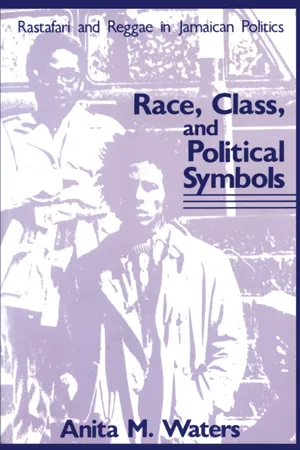
Race, Class, and Political Symbols
Rastafari and Reggae in Jamaican Politics
- 352 pages
- English
- ePUB (mobile friendly)
- Available on iOS & Android
eBook - ePub
About this book
Dr. Waters is one of a new breed of analysts for whom the interpenetration of politics, culture, and national development is key to a larger integration of social research. Race, Class, and Political Symbols is a remarkably cogent examination of the uses of Rastafarian symbols and reggae music in Jamaican electoral campaigns. The author describes and analyzes the way Jamaican politicians effectively employ improbable strategies for electoral success. She includes interviews with reggae musicians, Rastafarian leaders, government and party officials, and campaign managers. Jamaican democracy and politics are fused to its culture; hence campaign advertisements, reggae songs, party pamphlets, and other documents are part of the larger picture of Caribbean life and letters. This volume centers and comes to rest on the adoption of Rastafarian symbols in the context of Jamaica's democratic institutions, which are characterized by vigorous campaigning, electoral fraud, and gang violence. In recent national elections, such violence claimed the lives of hundreds of people. Significant issues are dealt with in this cultural setting: race differentials among Whites, Browns, and Blacks; the rise of anti-Cubanism; the Rastafarians' response to the use of their symbols; and the current status of Rastafarian ideological legitimacy.
Information
1
Introduction: Half the History
Preacher man don’t tell me heaven is under the earth
I know you don’t know what life is really worth
It’s not all that glitters is gold
Half the history has never been told
And now that the children have seen the light
They’re gonna stand up for their right.
—Bob Marley, “Get Up Stand Up”
The report was true which I heard in my own land
of your affairs and of your wisdom, but I did not
believe the reports until I came and
my own eyes had seen it, and behold,
the half was not told me;
your wisdom and prosperity surpass
the report which I have heard.
—Queen of Sheba to Solomon, 1 Kings 10: 6-7
Scanty history, when revealed as such, is oppressive in retrospect. The consequences that the revelation triggers often demonstrate how deeply patterns of social interaction, justifications of dominance and submission, religious ideas, the very meaning of social existence, are rooted in historical consciousness.
Such a revelation, without taking account yet of its relative “truth,” gradually emerged in the island of Jamaica, in the 1930s and thereafter. It became apparent that when the Europeans enslaved the Africans, they appropriated the Amharic history of the African peoples. In their inept fumbling with that complex language, and recognizing the opportunity to deceive the slaves about their true origins and history, the Europeans omitted large and important tracts in the English version. As one of those cognizant of the revelation said, “The white man buck up words that he can’t really translate. So in the Bible only half has been told. Still there’s a half that you never really know” (quoted in Owens 1976, 31).
Deep study of that document and of prophesies made since further revealed that the true Messiah was not Jesus of Nazareth but the Emperor Haile Selassie I of Ethiopia, the descendant of King Solomon and Queen Makeda of Sheba, and thus a living man of the House of David, exactly as the Old Testament foretold. This was the crucial “half of the story.” Given an almost psychoanalytical propensity for discounting coincidences, the fact that Selassie’s forebear herself was the one to hint that there was more than met the eye caused no surprise.
Further corollaries were derived. It became obvious, for example, that the true reason that the British monarch Edward VIII abdicated the throne in 1936 was that he had been present at the emperor’s coronation and had recognized in him the rightful ruler of all Africans, including those in the British colonies. Over time a body of knowledge about Emperor Selassie was codified, gleaned from various, incomplete sources: a few books and photographs, a ragged issue of National Geographic, a rumor, a prophesy.
The reaction to the revelations varied: there was anger at the deception; withdrawal to await Selassie’s call to return to the homeland; an insatiable interest in Ethiopian language, gestures, and artifacts; a growing skepticism about all European “truths” and values; and a deeply felt dissatisfaction with the distribution of power in society. As “yeast in the dough,” the implications of the beliefs, if not the beliefs themselves, shook the society, and a means of disseminating the beliefs eventually reverberated throughout the world.
This book is also a partial history, an examination of the consequences that these revelations and developments had for the politics of one Third World nation, especially its electoral politics. International reportage about these political developments has truly told somewhat less than half the story; raw voting statistics and simple statements of electoral outcomes give no indication of the colorful and complex machinations that determine them.
Jamaica is a postcolonial, “plural” society with a high degree of economic inequality. Its two political parties, the Jamaica Labour Party (JLP) and the People’s National Party (PNP), are highly competitive and enjoy comparable success in the electoral arena.
Beginning in 1972, it has been noted, Jamaican political parties have frequently used Rastafarian symbols and reggae music in their electoral propaganda. The Rastafarians are the millenarian cult that accepts Selassie as the Messiah and constitutes about 3 percent of Jamaica’s population; reggae music is an indigenous popular art form associated with, and frequently propagating the beliefs of, Rastafarians. Two students of Caribbean political science noted this trend after Michael Manley’s electoral victory in 1972. The group that inherited political power after independence, they wrote,
also appropriated very heavily the cultural forms of the Rastafarians, the most alienated group in the society, particularly their music and their terminology. In the 1972 election the PNP came to victory after ten years in opposition using the Rasta language and music in an almost undisguised form. (Singham and Singham 1973, 281)
If the Singhams’ formulation is correct, that the People’s National Party came to victory partly on account of its aligning itself symbolically with the Rastafarians, in the Singhams’ words the “most alienated” group in Jamaica, what made such an unlikely strategy succeed? Why would a political party identify itself with a millenarian cult whose beliefs are sharply at odds with a majority of the electorate, whose membership never exceeded about 3 percent of the population, and whose members exhort each other not to participate in politics at all? How did such a cult take on so much importance that a modern political party felt that it had to be addressed at all, much less embraced in propaganda?
This study explores the reasons that political parties chose to utilize these symbols and music in their campaigns, how such utilization changed over time, how the use of such symbols represents political parties’ perceptions of the nature of relevant social groups in the electorate, and the relative effectiveness of the symbols used.
In this chapter I will first briefly describe the use of lower class symbols by politicians and the nature of social groups in Caribbean society. Key questions will be generated about the use of Rastafarian symbols by politicians. Finally, the sources of data and the methods employed in this study will be discussed and the study’s significance will be estimated.
Although Coleman reported that African leaders in emergent states generally “avoid religious issues or sectarian identification” because “most of them confront a religiously heterogeneous electorate” (1960, 279), many studies of electoral politics in the Third World describe the use of religious or secret society symbols by politicians. In a study of elections in Kenya in 1960, Bennett and Rosenberg reported that Kenyatta frequently used the symbols of Mau Mau and other secret societies of the Kikuyu (1961, 8-11). Martin Kilson reported that the nationalist movement in Sierra Leone made extensive use of the symbols of tribal religious societies; it adopted a burned palm leaf, the Poro symbol of war, to “draw upon Poro obligations” in elections (1966, 257-58).
Examples of the use of religious symbols are also common in Latin America. Primo Tapia, a Mexican leader early in this century, gained support among the peasantry against the national Catholic hierarchy by manipulating folk rituals and symbolism (Friedrich 1966, 192-93). Charles Davis found that Mexico’s governing party’s “symbolic reassurances,” though these were not uniformly religious symbols, were intended to maintain support for the government among the lower class in Mexico City (1976, 656).
In the English-speaking Caribbean, the use of lower class religious symbols and music by politicians is not uncommon. As long ago as 1925, political candidates in Trinidad composed special calypsos to use as campaign songs and organized street parades to sing them (Elder 1966, 126). The earliest meetings of the labor movement in the late 1930s in Jamaica drew upon the rich repertoire of religious song and adopted its best “fighting” songs: “Onward, Christian Soldiers,” “Fight the Good Fight,” and “Those Who March to War” (Sewell 1978, 43).
A journalist who visited Trinidad during its most recent election reported that the lower class Baptists there supported George Chambers of the People’s National Movement. Chambers had said of the rival Organization for National Reconstruction (ONR) that “Them too wicked! Not a damn seat for them!” When the journalist visited Trinidad he attended an ONR rally and noticed that the rally was circled by a large number of Baptists, dressed in white robes, who marched unceasingly around the rally’s periphery. When he approached one marcher and asked what the group was doing there, he received the curt reply: “Not a damn seat for them!” (Smikle 1982.)
Beginning in 1955 with George Simpson’s “Political Cultism in-West Kingston,” an impressive body of literature has been published about the Rastafarians. The major works (Simpson 1955; Smith, Augier, and Nettleford 1960; Kitzinger 1971; Nettleford 1972; Owens 1975. 1976; and Barrett 1977) will be drawn upon in the description of the movement in chapter 2. Here we will confine ourselves to what these works say about the use of Rastafarian symbols by politicians.
Smith, Augier, and Nettleford, in “Report on the Rastafari Movement in Kingston, Jamaica” (1960), reported that some Rasta brethren repeated a story about the 1959 general elections. Agents of the PNP supposedly
promised spokesmen of the Ras Tafari movement repatriation to Africa if the latter voted for the PNP and this Party was returned to power. PNP spokesmen assert that this story is a complete fabrication... Clearly such allegations are politically profitable to those persons interested in discrediting the PNP, and to others who are interested in discrediting both parties and the two-party system with them. (Smith, Augier and Nettleford 1960, 17)
This team of university researchers also discovered resonance between the Rastafari brethren and communism. The brethren did not regard the Jamaican government as their own, and many refused to vote (Smith, Augier, and Nettleford 1960, 21). Some expressed interest in one-party states and said that “the Communist system is far preferable to the present capitalist system of the white and brown Babylonians” (Smith, Augier, and Nettleford 1960, 21). The research found “no evidence that Ras Tafarians as a group are being manipulated by non-Ras Tafarians with violent beliefs such as Communists” (Smith, Augier, and Nettleford 1960, 27) but did encounter groups of Rastafarians among whom “Marxist interpretation and terminology predominated over the racial-religious” (Smith, Augier, and Nettleford 1960, 28).
The researchers warned that the political aspect of Rastafari would spread rapidly “unless Government takes positive steps to meet the legitimate needs of the lower classes, including the Ras Tafari group” (Smith, Augier, and Nettleford 1960, 28). Some of the recommendations made by the researchers address the problems of the lower class rather than the subgroup of Rastafarians. These included improvements in the number of low-cost housing units available and in the facilities available to residents of squatter settlements like Back-o’-Wall, where Rastafarians and other poor Jamaicans lived without water or sewage systems.
In a thoughtful work on Jamaican culture, Nettleford examined the interaction between the Rastafarians and the larger society. His thesis was that Rastafarian commentary on society provoked defensive responses from middle-class observers at first, but was accepted and reiterated by them later:
The wider society‘s conception of a harmoniously multi-racial and stable nationalism is challenged fundamentally by the Rastafari. The movement was objectively to inform the wider society of the inherent incongruities of the Jamaican social system in which the poor grew poorer and the rich more prosperous. By the late sixties these incongruities were to become the stock-in-trade of many commentators on the social system including those who ten years before would have regarded the stating of these as intolerable if not subversive. (Nettleford 1972, 61)
He predicted that the Rastafarians’ philosophy would “in form the thinking and even the public policy of the nineteen seventies” (Nettleford 1972, 111).
One of the interesting parallels Nettleford pointed out between the Rastafarians and the large number of Anglophiliac Jamaicans is that both look outside Jamaica, one to Ethiopia and the other to England, for the legitimation of authority and for inspiration. It was this aspect of Rasta doctrine that led Frank Hill, a journalist, to refer to Jamaica’s upper class as “white Rastas” (Nettleford 1972, 44). Nettleford reported that in 1966, soon after the visit of Haile Selassie to Jamaica, JLP Senator Wilton Hill presented a motion that Jamaica’s constitution be amended to make Selassie king of Jamaica in place of Queen Elizabeth II: “He justified his motion on the grounds of racial ties between Jamaicans and the Emperor and the fact that the people of Jamaica had shown greater affection for His Imperial Majesty than for ‘our alien Queen’” (Nettleford 1972, 64).
After the university report of 1960 was issued, Premier Norman Manley made “bold attempts” to carry out the report’s recommendations, including the most controversial one, which was to organize a mission to Africa to explore the possibilities of repatriating the Rasta brethren (Barrett 1977, 100). Barrett also recognized the gradual acceptance of Rastafarian ideas by others in the society when he wrote that “what Ras (Sam) Brown boldly attacked in 1961 is the same philosophy Michael Manley seeks to destroy at present” (1977, 152).
Owens’s research concentrated on the Rastafarians’ theology more than their political influence. He does point out that Rastas with whom he worked expressed positive feelings for Fidel Castro (Owens 1976, 38, 233).
None of these works directly addresses the problem at hand here, why political parties in Jamaica make use of Rastafarian symbols, but they do link Rastafarians with the majority racial group, blacks, and the majority socioeconomic stratum, the lower class. It will be argued here that these two linkages made the use of their symbols attractive for politicians seeking solutions to a number of key problems that they faced after attaining independence.
The legacies of colonialism and plantation society created a society divided on two closely coinciding axes: race and class. Analysts of stratification in Jamaica and the Caribbean characterize these societies as “plural.” One of the primary proponents of this model defined pluralism as a society in which members are distinguished by fundamental differences in their institutional practices. Two or more groups, because of historically rooted cultural differences, form distinct aggregates within their society and are characterized by deep social divisions among them (M. G. Smith 1969, 27). In a seminal work on the plural character of Jamaican society, Smith discerned three distinct sections that are called White, Brown and Black sections (1965, 163ff.) Membership in one or the other section is not determined by one’s actual racial appearance or genealogy but, rather, is based upon what Smith called “associational color,” the color of one’s associates, or “cultural or behavioral color,” which is defined as “the extent to which an individual’s behavior conforms to the norms associated with one or the other of the hierarchically ranked cultural traditions of the societies, as these norms themselves are associated with color-differentiated groups” (1955, 52-54). Members of each cultural section participate, according to this theory, in qualitatively different sets of social institutions, inc...
Table of contents
- Cover
- Half Title
- Title Page
- Copyright Page
- Table of Contents
- Acknowledgments
- List of Tables
- 1. Introduction: Half the History
- 2. Race, Class and Politics in Jamaica
- 3. The 1967 Election
- 4. The 1972 Election
- 5. The 1976 Election
- 6. The 1980 Election
- 7. The 1983 Election
- 8. Conclusion: Symbolic Politics, Conflict and Democracy
- Bibliography
- Appendix
- Index
Trusted by 375,005 students
Access to over 1.5 million titles for a fair monthly price.
Study more efficiently using our study tools.
Frequently asked questions
Yes, you can cancel anytime from the Subscription tab in your account settings on the Perlego website. Your subscription will stay active until the end of your current billing period. Learn how to cancel your subscription
No, books cannot be downloaded as external files, such as PDFs, for use outside of Perlego. However, you can download books within the Perlego app for offline reading on mobile or tablet. Learn how to download books offline
Perlego offers two plans: Essential and Complete
- Essential is ideal for learners and professionals who enjoy exploring a wide range of subjects. Access the Essential Library with 800,000+ trusted titles and best-sellers across business, personal growth, and the humanities. Includes unlimited reading time and Standard Read Aloud voice.
- Complete: Perfect for advanced learners and researchers needing full, unrestricted access. Unlock 1.5M+ books across hundreds of subjects, including academic and specialized titles. The Complete Plan also includes advanced features like Premium Read Aloud and Research Assistant.
We are an online textbook subscription service, where you can get access to an entire online library for less than the price of a single book per month. With over 1.5 million books across 990+ topics, we’ve got you covered! Learn about our mission
Look out for the read-aloud symbol on your next book to see if you can listen to it. The read-aloud tool reads text aloud for you, highlighting the text as it is being read. You can pause it, speed it up and slow it down. Learn more about Read Aloud
Yes! You can use the Perlego app on both iOS and Android devices to read anytime, anywhere — even offline. Perfect for commutes or when you’re on the go.
Please note we cannot support devices running on iOS 13 and Android 7 or earlier. Learn more about using the app
Please note we cannot support devices running on iOS 13 and Android 7 or earlier. Learn more about using the app
Yes, you can access Race, Class, and Political Symbols by Anita M. Waters in PDF and/or ePUB format, as well as other popular books in Politics & International Relations & Political Campaigns & Elections. We have over 1.5 million books available in our catalogue for you to explore.