- 308 pages
- English
- ePUB (mobile friendly)
- Available on iOS & Android
eBook - ePub
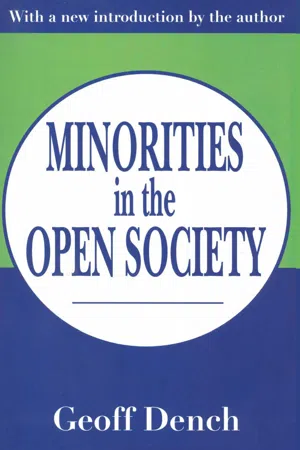
Minorities in an Open Society
About this book
Most accounts of ethnic and race relations in Western states are optimistic at heart.They assume that equal participation by minorities will be achieved because it is a "public good" from which citizens will benefi t. Social justice will prevail. In this topical and disturbing book, Geoff Dench challenges these idealistic commentaries, showing that in many instances they do not produce convincing analyses of the position of minorities. He suggests that analysts neglect to explore the web of real interests behind public affi rmations of commitment to integration.
Information
PART I
THE AMBIVALENT STATE
CHAPTER I
TWO FACES OF MODERN NATIONALISM
The state in theory extends its benefits and protection equally to all its citizens and all equally participate in it; but the inherent personal-community element of the nation works to limit the full participation in the state to those who can establish their national acceptability.
(Rupert Emerson, 1960, p. 111)
It is a commonplace that minorities lose out because of contrary impulses within the modern state. All constitutions with any pretence to civilized status embody some variant of the humanist creed, proclaiming the equal worth and civil estate of every member. But the states licensed by these creeds are controlled by particular and partisan national communities. So there is, as Minogue (1967) put it, a discrepancy between political association based on the rational consent of individuals, and solidarity arising out of involuntary ties of birth and descent. This duality is woven deeply into the fabric of the state system.
This contradiction is not, however, the curse and problem for all concerned which it is so often portrayed to be. It is obviously a curse for minority groups. Few would seriously dispute that. I cannot believe, though, that it is much of a problem for majorities. Universalist and nationalist ideas can prove remarkably complementary when spun together in the service of a powerful community. Public declarations of their irreconcilability have to be seen as part of an establishment’s ruling bluff.
AN ISSUE FUDGED
Analyses of race relations in specific settings often remark on the hypocritical nature of official idealism. Thomas Blair (1977, p. 4) opens his account of white-black relations in the US in this vein.
(America’s) rise to greatness is based in large part on a special blend of materialism and imperfect idealism, low cunning and high-mindedness ... There is an air of pious fraudulence in a nation that still remains the beloved community of white Anglo-Saxon Protestants, of Emerson, Thoreau, Melville, Twain, James, and others, and where the essential social levers of opportunity -education, jobs, housing and political power – are kept out of the reach of the masses of black citizens.
This interpretation is not given much prominence in generalized accounts. Most theories about community relations resolutely fudge the issue. They declare that any co-existence of different principles of association cannot last very long, as it offends against the requirement that social systems possess internal consistency. Nationalist exclusion of minorities from full participation in national life is not just morally repugnant. It is also harmful to the whole of society. Toleration of discrimination gives the lie to universalist promises made by the system; and this must in the end undermine the legitimacy of even those rights enjoyed by members of the majority themselves.
Discrimination is so corrosive of legitimate social order that it threatens the welfare and unity of the whole realm. Majorities and minority groups share an overriding common interest in working to narrow the gaps between liberatory promises and actual national performance.
The consensualist foundation
Propositions like these have been common ground for progressive political thinkers and virtually all social theorists for the last hundrd years or more. They were laid down again, very explicitly and forcefully, by the influential generation including Robert Maclver and Robin Williams during that classic period of sociology at the end of the second world war, when the US was establishing the moral basis of its new hegemony.
Discriminatory practices are sustained by narrow interests and are accepted by a large public that remains unconscious of their more profound import ... The frustrated groups unable to share in and contribute to the community life develop their quotas of racketeers, black market operators, gangsters and so forth, and though these form only a small minority of such groups they suffice to confirm the prejudice of which they themselves are a product... All disparaged groups tend to become disaffected, and when the range of discrimination is so great as it is in the United States the resulting loss to the solidarity of the national life, to its healthful vigor and strength of purpose, must be considerable.
(Robert Maclver, 1948, pp. 244-5)
It is important to notice that such affirmations of the need for a truly open society come both from those with an interest in upholding an existing social order, and from those opposed to it. A ruling, liberal approach proposing that individualism can and will break down group barriers offers the simpler model. But Marx and his followers have expressed opinions on discrimination that are remarkably similar to those of Acton and his ilk.
The socialist variant of the argument differs by interposing an element of class conflict, which must be played out before social justice and individual freedom are accessible to all, and which in the meantime permeates all social life. Socialists therefore insist on pointing out how discrimination is a refraction or displacement of class conflict, and cannot be eliminated independently of it. But they are not blind to the problems that discrimination itself creates in the meantime. They take a similar view to liberals of its likely consequences for national unity and stability.
To a significant extent, universalists of all hues are in agreement on race and ethnic relations. All share in what might be called a ‘consensualist’ idea of society, which regards continuing tension between universalist and nationalist values as a source of political weakness and instability. Moreover, most of them are optimistic about the future. They tend to see history, or specifically ‘modernization’, as working inexorably to weaken communalist bonds.
In passing it might be added that the third major political orientation towards race and ethnicity, namely overt Nationalism, does itself appear to rest on a sort of inverted consensualism. Nationalism is hardly represented at all now in academic social theory. Its ideas are therefore rarely expressed systematically. However, right-wing Jeremiahs prophesying the imminence or inevitability of racial strife do seem to be driven by fear that the whole social order may be collapsing. Their calls for purification of nations through the removal of alien elements imply an assumption that societies need to be based clearly on one set of agreed principles. What makes them different, and deviant in modern contexts, is that it is the communalist principle which they regard as valid, with integrative creeds as the irritant requiring elimination.
Consensualism in its inclusive, universalist forms has dominated conventional thinking in this area for generations now. And it is highly practised in playing down the significance of nationalist aspects of a state. Wherever we look we can see nations failing to provide full citizenship for their minorities. But such observations are easily neutralized and turned into grist for the consensualist mill. This is done by treating them merely as evidence of the aberrant or still imperfect nature of the particular societies under scrutiny – sure signs that they are about to collapse from their own internal contradictions.
The trick lies in taking an idealized model of the state as the operational norm. Commentators confronted by the dual nature of states avoid awkward questions by invoking the spirit of Acton and divining a distinction between ‘universal’ states as they ought to be – and which also happens to be logical and comprehensible to the libertarian mind and nice to theorize about – and ‘national’ states which, although admittedly only too abundant on the ground, are monstrosities defying serious consideration. The latter can best be dealt with by being shunted into anomalous categories outside of the main lines of history and theory. Their inability to live up to expectations can then be turned into confirmation of harmless, subsidiary hypotheses.
This device was used a great deal by those who laboured to produce Pax Americana’s supporting mythology. Wagley and Harris (1958), in their comparative study of minorities in the New World, felt impelled to conclude that the national character of all the states they had looked at in their inquiry rendered them ‘transitional’ between the ideal-types of traditional and modern. They were new vessels indeed, but were still occupied and moved by pre-modern national communities. So it was necessary to regard them as hybrids or mixed types. Handled in this way they created no problems for idealistic concepts of the modern state. Their internal contradictions surely presaged either transformation or speedy extinction. So it was excusable to forego interpretation of them in their own right, and to treat them instead as heralds of the fully modernized article.
A similar equation of inconsistency with instability, coupled with a sterner emphasis on the need to purge would-be modern states of all their traditionalist residues, was made by Parsons (i960). He warned that no further delay was possible in extending full citizenship to blacks in the US. Otherwise the survival of those areas of rational political organization that were already in operation among whites would be endangered. Failure to move forward decisively into a contemporary, post-discriminatory world must mean slipping back into a feudalistic past.
Honouring creeds in the breach
The aroma of sophistry hangs over all such endeavours. What they cannot conceal – merely rendering paradoxical – is that in the most modern of societies ethnocentric practices clearly do survive perfectly well alongside value-systems proscribing them.
How could discrimination remain so prevalent in the most successful states in the world system if it really were so detrimental to national unity and purpose? Clearly the burden cannot be too crippling. Indeed, might not the regular concurrence of these values and practices invite a different and more down to earth interpretation, in which human selfishness, duplicity, and the self-serving nature of morality play some part?
It is possible to come close to yielding this point without leaving the consensualist fold. Wagley and Harris, for example, admit minorities’ continuing exclusion from national life in all the states surveyed. They manage, nevertheless, to draw the conclusion that in spite of this, liberal creeds do operate on their behalf, by providing official validation for their aspirations.
... it is the Brazilian creed that provides the basis for the idealistic policies and efforts of the Brazilian Indian Service ... (and) the very presence of the American creed has had a profound influence in the arena of competition for Negroes and Whites in the United States by providing a legal and moral basis for the Negroes’ struggle.
(1958, pp.280, 284)
A hint of scepticism does, however, find its way into their final sentence.
Although it is often honoured only in the breach, an idealistic creed favourable to minorities has been a common factor present in all of the minority-majority situations studied in this book.
(p. 285)
‘Honoured only in the breach’! It is difficult to say how much deliberate irony there is in this parting shot. What does emerge clearly, though, is that consensualists are disposed to lay down their tools just as the analysis is getting interesting. There are some things they cannot afford to contemplate, for fear of losing their faith.
Uncomplicated belief in the transient nature of communalism is difficult to maintain over an extended period. It has come under increasing strain over the last fifteen years or so. Throughout the western world ethnic minorities have gone through a period of growing assertiveness – challenging ruling myths about integration, and drawing attention to continuing oppression by national majorities.
Some theorists have clung to consensualism by eschewing optimism and taking on a Cassandra role. John Rex has forebodings about a New Dark Age (1974), or at the very least mounting violence and instability (1979), if colonial minorities continue to be excluded from soi-disant ‘open’ societies. This stance seems very widespread at the moment.
It is not, however, the only development. In order to accommodate the increasing visibility of communalist phenomena, theory has branched out in several directions. Three main trends are discernible. Each takes a rather different line on the duality of minority experience. All retain serious limitations.
The sociobiological impetus
One school of thought removes communalism from the province of social theory. This is the orientation usually known as ‘primordialism’, taking its name from Clifford Geertz’s references to communal solidarity as a ‘primordial’ sentiment.
The general position taken by primordialists is that ethnic solidarities are always with us, and have a biological, non-calculative basis in the human need to bond in inward-looking groups. It is admitted that this drive can have socially undesirable results. To deny its existence because of this, however, is seen as throwing away any chance to understand and control it. During the 1940s and 1950s there was ideological pressure to overlook communal sentiments. This did, however, not make them go away. The apparent resurgence in ethnicity since the 1960s can, it is argued, be seen as in part a consequence of this denial, as public opinion and academic commentators together have been obliged to see the error of integrationist prognoses. A convert to sociobiology, Van den Berghe (1981) insists that only through recognizing the vitality and true nature of ethnic cohesiveness can society hope to come to terms with it.
I do not intend to rehearse here all of the arguments against primordialism. On the Left it is seen as the very essence of neo-Conservatism. There are, therefore, plenty of critical commentaries around already, such as Martin Barker’s (1981).
What I must do, though, is point out that methodologically it is a weak instrument for handling the duality in social treatment of minorities. The first article of sociological practice is that it is important to look for social causes of social phenomena. If some social behaviour is allowed to be explained in non-social terms, it becomes difficult to see the interconnectedness of the whole social system. We are liable to end up only bothering to explain that which it is congenial or convenient to explain. There may well be biological drives that coincide with exclusive forms of social behaviour. But equally there may also be biological imperatives promoting universalist behaviour. We hear little about these from primordialists, who contrive to suggest that it is only the desire to belong to small, exclusive groups which is at root non-rational.
Their accounts are therefore lop-sided. The discrepancy between communalism and universalism in modern society is effectively reduced to the Old Adam factor – the tension between Nature and Society. Whatever labels its opponents may have attached to it, primordialism is at bottom idealist. It believes in the power of social institutions to confront and subdue obdurate biological forces. Culture and social organization are represented as rational and integrative; human nature as regressive, stubborn, and posing endless problems for the guardians of social order.
Preoccupation with this type of duality diverts attention away from what is sociologically more interesting – that is the tension between opposed social values and modes of action, and the interplay between these. It is at this level of analysis that a coherent and convincing account of race and ethnic relations must be constructed.
New Left consensualism
For capital requires racism not for racism’s sake but for the sake of capital. Hence at a certain level of economic activity (witness the colonies) it finds it more profitable to abandon the idea of superiority of race in order to promote the idea of the superiority of capital. Racism dies in order that capital might survive.
(Sivanandan, 1976, p. 367)
The most vigorous trend in recent theorizing on race and ethnicity in Britain and most other western European countries consists of an updating of socialist ideas to give a more prominent place to ethnic and nationalist sentiments. Traditional Marxism discounts communalism as false consciousness. Where communal solidarity happens to coincide with the needs of the class struggle, then its existence can be played on strategically. But it is not to be taken seriously as a rational impulse in its own right.
This position has come under great pressure with the decolonization of European overseas empires and the growth instead of internal empires in the metropolitan heartlands. Minority communities have become a visible and highly significant feature of northern European societies. Traditional working-class organization has been reluctant to incorporate them. Their political and emotional ties with their countries of origin have remained strong. All this has strained the credibility of old-fashioned notions of the pre-eminence of class solidarity.
The modern Left has accordingly cultivated those elements of doctrine most capable of embracing the recent unfolding of ethnic consciousness. This has usually involved resurrecting Leninist propositions about Imperialism. The general argument put forward is that because capitalism has been going through a stage in which its main social feature has been colonialism, then class conflict is complicated by communal considerations. These do currently have some realistic basis and content.
Under this revised schema it is possible to take ethnicity much more seriously – even to give it a moral priority that the old Left denied it. Full class consciousness is no...
Table of contents
- Cover Page
- Title Page
- Copyright Page
- Contents
- INTRODUCTION TO THE TRANSACTION EDITION
- PREFACE AND SUMMARY
- PART I THE AMBIVALENT STATE
- 1 TWO FACES OF MODERN NATIONALISM
- 2 SERVING TWO MASTERS
- PART II CAPTIVE LEADERS
- 3 PIERRE TRUDEAU IN THRALL TO CANADIAN INTEGRITY
- 4 THE RED TSAR AS A PAWN OF GREAT RUSSIAN CHAUVINISM
- 5 JFK: MESSENGER FOR SECOND RECONSTRUCTION
- 6 DISRAELI’S TRIBUTE TO BRITISH IMPERIALISM
- PART III TORMENTS IN CAPTIVITY
- 7 THE TREADMILL OF ETHNIC HONOUR
- 8 ON THE RACK OF DEMOCRATIC POLITICS
- 9 TRIALS OF COMMITMENT
- PART IV THE FRAMEWORK OF CONTAINMENT
- 10 THE POWER OF COMMUNALISM
- 11 MINORITY RIGHTS AND NATIONAL STRATEGIES
- 12 DISCRIMINATION AND THE LIBERAL SOCIAL ORDER
- CONCLUSION: THE ROLE FOR SOCIAL THEORY
- REFERENCES
- INDEX
Trusted by 375,005 students
Access to over 1.5 million titles for a fair monthly price.
Study more efficiently using our study tools.
Frequently asked questions
Yes, you can cancel anytime from the Subscription tab in your account settings on the Perlego website. Your subscription will stay active until the end of your current billing period. Learn how to cancel your subscription
No, books cannot be downloaded as external files, such as PDFs, for use outside of Perlego. However, you can download books within the Perlego app for offline reading on mobile or tablet. Learn how to download books offline
Perlego offers two plans: Essential and Complete
- Essential is ideal for learners and professionals who enjoy exploring a wide range of subjects. Access the Essential Library with 800,000+ trusted titles and best-sellers across business, personal growth, and the humanities. Includes unlimited reading time and Standard Read Aloud voice.
- Complete: Perfect for advanced learners and researchers needing full, unrestricted access. Unlock 1.5M+ books across hundreds of subjects, including academic and specialized titles. The Complete Plan also includes advanced features like Premium Read Aloud and Research Assistant.
We are an online textbook subscription service, where you can get access to an entire online library for less than the price of a single book per month. With over 1.5 million books across 990+ topics, we’ve got you covered! Learn about our mission
Look out for the read-aloud symbol on your next book to see if you can listen to it. The read-aloud tool reads text aloud for you, highlighting the text as it is being read. You can pause it, speed it up and slow it down. Learn more about Read Aloud
Yes! You can use the Perlego app on both iOS and Android devices to read anytime, anywhere — even offline. Perfect for commutes or when you’re on the go.
Please note we cannot support devices running on iOS 13 and Android 7 or earlier. Learn more about using the app
Please note we cannot support devices running on iOS 13 and Android 7 or earlier. Learn more about using the app
Yes, you can access Minorities in an Open Society by Geoff Dench in PDF and/or ePUB format, as well as other popular books in Social Sciences & Social Policy. We have over 1.5 million books available in our catalogue for you to explore.