This is a book about the power of poetry to speak about the central themes of what it is to be a human being. The first part is an anthology of specially selected poems. The second part provides detailed notes for teachers on how to use these poems in the classroom. The poems in the book are about morality: how we get on, or don't get on, with each other; how we feel when we are alone; the destruction of the world we live in; childhood; celebration; fear; death; and mystery. Sharing these poems helps us to understand ourselves, and to express ourselves. The poems are selected to help to break down the barriers between curriculum subjects, and to be especially useful for religious education and personal, social and moral education. There is a mixture of the classic, the traditional and the new here, but all of the selected poems show the true power of poetry to express feelings about things that matter.
eBook - ePub
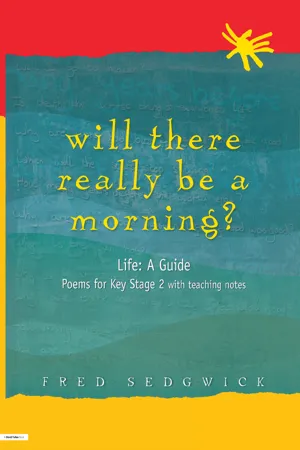
Will There Really Be a Morning?
Life: A Guide - Poems for Key Stage 2 with Teaching Notes
- 80 pages
- English
- ePUB (mobile friendly)
- Available on iOS & Android
eBook - ePub
Will There Really Be a Morning?
Life: A Guide - Poems for Key Stage 2 with Teaching Notes
About this book
Trusted by 375,005 students
Access to over 1.5 million titles for a fair monthly price.
Study more efficiently using our study tools.
Information
Print ISBN
9781853468063
Subtopic
Education GeneralTeaching Notes
Teaching important subjects is difficult. Many teachers have traditionally avoided them. They have taught easy ones – Ourselves, People Who Help Us, the Vikings – subjects that are not, on the face of it, contentious. Now that teachers no longer choose what they teach, the National Curriculum encourages them to play safe. But this difficulty in teaching children about death and love and life – the very essences of Personal Social and Moral Education (PSME), of course, as well as what I have called the big guns in the poet’s armoury – this difficulty, although obviously a problem, is the best reason for trying to do it. We should not be interested in a quiet life, but in the good life: the good life in the philosophical sense, a life that is examined, a life that is curious, a life that is lived by someone who pays attention to the search for truth. Whenever the controversial emerges in the classroom, the chance of real education increases. The temperature rises, and the pupils’ and the teacher’s engagement ensures learning. In Ted Hughes’ phrase, we are working at ‘top pressure’.
Of course there is risk. There is a risk of tears, for example, if the teacher teaches a poem about death when one of the children has just lost a grandma, or a parent, or even a pet. But much as all art involves a risk of distress (among, of course, many other things) it also risks a kind of joy. There is also a risk of controversy. No risk is seriously involved when we teach infants about the people who help us: the nurse, the policeman, the crossing patrol.
What follows are notes on some of the poems in this book, and how we might use the poems to get children writing. I mentioned the risk of tears above: there is also a risk of difficulty when we teach poetry about important subjects, and I hope that in these notes I have succeeded in suggesting ways to help children read poems. Close reading, with the senses alert for rhyme in all its variations, for rhythm, for the power of metaphor and simile, and for the sheer music of verse is the only way to make a poem ours. And when we make good poems ours, we grow mentally, psychologically and spiritually. We enrich our imagination, which in turn helps us to understand people who are different from ourselves, and yet linked to us by our common humanity.
But another, less widely recognised, way of coming to terms with these poems is to write in the grip of them. In other words, children should confront them in an active way and make their own poems. I have included in these notes some examples of children writing in classes that I have taught: I hope that they might be useful in tandem with the main part of the book.
Some advice applies to all reading of poetry, whether by adults or children: read slowly. Don’t just see the words, don’t just hear them: taste them. In other words, let the poem take its time with you, and even move your lips as you read it. When there is something difficult in a poem, slide over it the first time you read it, concentrating on the poem’s music; and then return to it for a second, third, fourth, fifth reading and think about it. If it is a good poem, it will eventually become yours and you will read it hundreds of times, getting something new from it each time. If you have already made poems yours, you will know this. If you haven’t – trust me.
The notes on the poems have one, two or three parts:
- A section on reading the poem, and helping the children to read it. I mean ‘read’ here in the sense of ‘understand’ and ‘enjoy’. To read a poem well is to ‘make it yours’, and to teach it well is to help children to make it theirs.
- A section on helping the children to write in the grip of the poem.
- A section on performing the poem. Most of the poems suitable for performance are towards the end of the book.
With Flowers
Emily Dickinson stands at the beginning to welcome the reader, her arms full of flowers and stars. Ask the children to read this poem to each other, moving their lips, tasting the words. Ask them: does this poem rhyme?
It half-rhymes: these/stars/eyes; them/come/home. The form of the poem – two neat four-line stanzas – looks complete enough. It promises a kind of simple satisfaction: here are two little neatly carpentered boxes. It looks like a nursery rhyme. But the rhymes, which are slant-rhyme, para-rhyme (other words for half-rhyme) deny that satisfaction. Don’t be so sure, they seem to say … It certainly isn’t a nursery rhyme.
Can the children think of other para-rhymes? Look around the room. There is the door. ‘Far’ half-rhymes with ‘door’. The ‘wall’? ‘Well’. Ask the children to find half-rhymes for ‘sun’, ‘moon’, ‘grass’, ‘stone’, ‘chair’, ‘break’. Work out some for yourself beforehand. ‘Fen’, ‘bane’, ‘dross’, ‘stain’, ‘flower’ and ‘creek’ suggest themselves to me. Looking at my bookshelves, I think of ‘word’ and ‘sword’; ‘rhyme’ and ‘home’ – both very suggestive pairs. Thinking in terms of half-rhymes releases a whole new set of electrical connections in a language that is notoriously poor in rhyme (relative to Russian, for example).
I watch the evening sun
Drop over the stagnant fen
Drop over the stagnant fen
One great exponent of half-rhyme was Wilfred Owen. Read the first four lines of his ‘Strange Meeting’, and ask the children to listen for half-rhymes:
It seemed that out of battle I escaped
Down some profound dull tunnel, long since scooped
Through granites which titanic wars had groined.
Yet also there encumbered sleepers groaned,…
Down some profound dull tunnel, long since scooped
Through granites which titanic wars had groined.
Yet also there encumbered sleepers groaned,…
Emily Dickinson’s poem is punctuated eccentrically. Ask the children to read the poem in pairs, pausing at the dashes. Ask them why certain nouns are capitalised.
Get the children to write a poem to give to a parent with another gift: ‘With chocolates’, for example; or to accompany a gift to a baby sister or brother: ‘With a teddy bear’. Suggest a few opening lines:
I bought this today…
I found this today…
I knew about you and sweets, so I…
I have made some notes for a poem:
I found this poem in my garden yesterday.
I’d been looking for another one
all the day before, with lupins
blaring like trombones, but I found this one
with its mysterious scents, and its sly cat…
I’d been looking for another one
all the day before, with lupins
blaring like trombones, but I found this one
with its mysterious scents, and its sly cat…
Ask the children to use half-rhymes, if they can. Do not insist on it.
Ask the children to write a poem beginning ‘Finding our way home’. They could set it in many places:
In the snow (begin with footsteps. Don’t forget the sound and feel of them, as well as their appearance).
In the fog.
In an aeroplane.
They might use half-rhyme; they might use dashes in their poems if they thought they felt right.
Seven Wishes
For reasons implicit in PSME, it is important for young people to hear and read the words of peoples different from themselves. In this poem, inheritors of an oral tradition on the other side of the Atlantic ask universal questions. Indeed, this is a poem made up entirely of questions. They form a love poem.
But children play brilliantly with other kinds of question. Ask them: ‘Can you think of a question that you would love to know the answer to, but you don’t think you ever will?’
When I do this, I impose silence and darkness on them for a minute – asking them to close their eyes and think of three such questions. The following questions came from a group of nursery children. When the questions were read back to them, they were asked to decide which was the most important one. That was used as a refrain in a poem:
Questions
Why do you get older when it’s your birthday?
Why have people got names?
How do people talk
And how does the sun light up?
Why have people got names?
How do people talk
And how does the sun light up?
How does the river move?
Why are beaches by the sea?
Why are there millions of stones by the beach
And how does the sun light up?
Why are beaches by the sea?
Why are there millions of stones by the beach
And how does the sun light up?
How does chicken pox come?
Why do babies cry?
Why does Dad fight with Mum
And how does the sun light up?
Why do babies cry?
Why does Dad fight with Mum
And how does the sun light up?
How come wild animals are not in the street?
How does your heart get inside you?
Is God inside your body
And how does the sun light up?
How does your heart get inside you?
Is God inside your body
And how does the sun light up?
Other questions I have collected over the years from children are:
How can I tell if a man is evil or not?
Does God believe in me?
Why do adults have power over children when children do not have power over grown-ups?
How do you get up to heaven?
Why does gravity hold you down?
Three Muslim children at the Islamic Centre, Stanmore, London composed the following philosophical po...
Table of contents
- Cover
- Title
- Copyright
- Contents
- Acknowledgements
- Introduction
- The poems:
- Teaching notes
Frequently asked questions
Yes, you can cancel anytime from the Subscription tab in your account settings on the Perlego website. Your subscription will stay active until the end of your current billing period. Learn how to cancel your subscription
No, books cannot be downloaded as external files, such as PDFs, for use outside of Perlego. However, you can download books within the Perlego app for offline reading on mobile or tablet. Learn how to download books offline
Perlego offers two plans: Essential and Complete
- Essential is ideal for learners and professionals who enjoy exploring a wide range of subjects. Access the Essential Library with 800,000+ trusted titles and best-sellers across business, personal growth, and the humanities. Includes unlimited reading time and Standard Read Aloud voice.
- Complete: Perfect for advanced learners and researchers needing full, unrestricted access. Unlock 1.5M+ books across hundreds of subjects, including academic and specialized titles. The Complete Plan also includes advanced features like Premium Read Aloud and Research Assistant.
We are an online textbook subscription service, where you can get access to an entire online library for less than the price of a single book per month. With over 1.5 million books across 990+ topics, we’ve got you covered! Learn about our mission
Look out for the read-aloud symbol on your next book to see if you can listen to it. The read-aloud tool reads text aloud for you, highlighting the text as it is being read. You can pause it, speed it up and slow it down. Learn more about Read Aloud
Yes! You can use the Perlego app on both iOS and Android devices to read anytime, anywhere — even offline. Perfect for commutes or when you’re on the go.
Please note we cannot support devices running on iOS 13 and Android 7 or earlier. Learn more about using the app
Please note we cannot support devices running on iOS 13 and Android 7 or earlier. Learn more about using the app
Yes, you can access Will There Really Be a Morning? by Fred Sedgwick in PDF and/or ePUB format. We have over 1.5 million books available in our catalogue for you to explore.