eBook - ePub
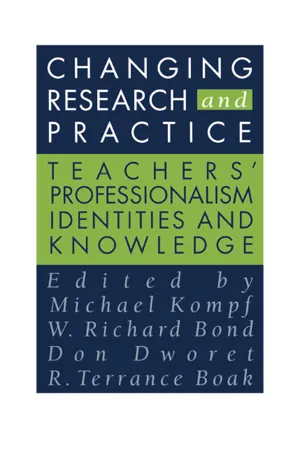
Changing Research and Practice
Teachers' Professionalism, Identities and Knowledge
- 248 pages
- English
- ePUB (mobile friendly)
- Available on iOS & Android
eBook - ePub
Changing Research and Practice
Teachers' Professionalism, Identities and Knowledge
About this book
First Published in 1996. Arising from the 7th International Study Association on Teacher Thinking (ISATT) conference in 1995, this book presents a diverse, yet integrated, approach to understanding how research and practice in classrooms are changing.
Information
Part I
Teachers’ Professionalism: Overview
W. Richard Bond
Defining such a concept as ‘teachers’ professionalism’ in one neatly encapsulated expression is extremely difficult and quite likely impossible as professionalism in any occupational context must be expressed in many ways. In its most elementary form professionalism may mean nothing more than: displaying in one’s public (and private) life types of behaviors likely to meet with the approval of the community in which one practices one’s professional skills. Thus, one behaves in a ‘professional’ manner. Perhaps it is in this form many years ago that professionals such as church ministers and physicians were simultaneously kept in their place, but were able to maintain positions in society which denoted that they were somehow ‘better’ than the masses to whom they ministered in the course of their duties.
Over time, the status of ‘professional person’ and the simultaneous attempt to define and describe those elements which make us so has led to the realization there are many more dimensions to professionalism than the simple matter of socially acceptable conduct. For example, autonomy and the assumption that professionals are highly autonomous. It is unlikely that a person off the street would walk into an operating room from the street and, leaning over the operating table, suggest surgical techniques to the surgeon from a zero knowledge base. Nor would that person walk into a courtroom and argue with a judge over a courtroom procedure or point of law. Again, it is unlikely that a similar person would walk into a classroom and instruct a teacher on pedagogical techniques, although I’m sure a great many individuals would like to do so. People in the aforementioned occupational groups are generally regarded as competent to practice without interference, except, perhaps from their own professional and statutory bodies, or in the event of infringement of a law. By and large, they are autonomous.
Further, it is now accepted that autonomous, professional people may also have monopolies in certain kinds of knowledge. Such is indicated by prolonged and intensive periods of preparation for the professions — usually much more than for most less-professional occupations. For almost all professionals it is necessary to acquire quantities of complex and esoteric knowledge developed by others, and frequently, in turn, to generate new knowledge for others to use.
The combination of autonomy and access to knowledge and information enables professionals to exercise a great deal of flexibility in the practice of their professions. They may rely on their own professional judgment. The more fortunate ones may even command high salaries. Even the less fortunate ones may earn higher than average incomes. And with these privileges there are accompanying obligations to exercise high levels of commitment and responsibility to the client group.
While the elements of professionalism I have described may contribute to an overall understanding of what is meant by professionalism, they are by no means comprehensive. Those of us in the professions are frequently beset with the problem of trying to identify professionalism that we may practice our skills to the best of our ability, fulfill our obligations to our client groups in particular, society in general and to know who we are. Within the context of education (as a noun), the following educators examine the ways in which teachers’ professionalism may be known, and how, in turn, we may know ourselves.
Elliot Eisner (Stanford, USA) has posed a number of questions — and provided some answers — in his examination of the question ‘Is “The Art of Teaching” a Metaphor?’ The manner in which he addresses his question includes highly abstract as well as more concrete definitions related to both the art and practice of teaching, which, while being connected are not necessarily the same thing. Furthermore, he includes discussion on artistry, metaphor and imagination in explaining the meaning of art. Such discussion might seem to be a far cry from the realities of teaching and professionalism in teaching, but he provides a discussion which sets the imagination racing and provides the backdrop against which the other chapters in this section of the book are played out.
In ‘Professionalism and Teachers as Designers’, Ingrid Carlgren (Goteborg, Sweden) examines notions of what it is that teachers should do as compared with what they actually do. She compares the importance of the social versus the didactic dimension and identifies that it is the tacit rather than the explicit elements of socialization and behaviors which define professionalism in teaching. She also includes the increasingly important concept of reflection as an important tool in identifying professionalism.
In ‘Becoming a Trained Professional’, Margaret Olson examines conflicting versions of teacher education and the ways in which these may contribute to teacher identity. In her case study of Susan she relates the confusing and contradictory problems a student teacher faces in attempting to form her own professional identity, and describes Susan’s feelings as she recognizes the differences between her own and others’ expectations and the realities of professional practice.
Per Laursen in ‘Professionalism and the Reflective Approach to Teaching’ has written with his theoretical underpinnings also anchored in reflection, but emphasis is more on how others view teachers as professionals rather than how teachers may view themselves. His perspective, then, is more social and general than the highly focused descriptions of some of the other contributors. He identifies the difficulties in determining the position of teachers in the professional spectrum, particularly in light of teachers’ knowledge base and current European discussion, and proposes further development of the reflective approach as a means by which professionalism may be defined.
In the final chapter in this section of the book, Pam Denicolo uses George Kelly’s personal construct theory as the theoretical basis for her paper entitled ‘Productively Confronting Dilemmas in Educational Practice and Research’ and draws upon student research in defining professionalism. Her focus on addressing dilemmas in research and practice identifies that this is something that only teachers can do to help students develop, and that this activity in itself bespeaks professionalism within the context of education. Further, the highly idiosyncratic nature of adjustment and development is supportive of Kellyian theoretical underpinnings, indicating also that such activities are part of a lifelong process. By association, our professional identities must gradually emerge over time.
The authors of these chapters have provided readers with kaleidoscopic views of educating, teachers, teaching and professionalism. Their varied thoughts, notions and understandings of what it means to be involved in the process of educating may provoke many more questions than they provide answers. Together they help place into perspective the complexities of identifying the profession, the concept of professionalism within the context of the teaching profession, and defining professional identity.
1 Is ‘The Art of Teaching’ a Metaphor?
Elliot Eisner
One of the ironic features of research on teaching is the general neglect of the role that artistry plays in its practice. I say ironic because if teachers are asked to characterize the nature of their work they are much more likely to describe it as an art or a craft than as the application of a science, or even a technology. Yet if you consult the most recent Handbook of Research on Teaching you will find that that four-and-a-half pound tome which has 880 entries in its index has no entry devoted to the art of teaching. To be sure there is an entry on the teaching of art — something I care about deeply — but nothing on artistry in teaching. Both the editor and the authors neglect it, despite the fact that teachers don’t.
The authors and editors of the Handbooks — three have been published — are not alone. Journals such as the Educational Researcher, the Journal of Teacher Education, and Teaching and Teacher Education apparently receive few contributions and hence give little space to artistry in teaching, the topic I intend to address this morning.1 I want to acknowledge at the outset the fact that a number of authors have written about artistry in teaching. Gilbert Highet’s The Art of Teaching. Published in 1950, was among the first. Louis Rubin has written Artistry in Teaching, and, of course, Nate Gage has given us The Scientific Basis of the Art of Teaching. But as you must know Gage’s fine book is essentially about teaching’s scientific basis rather than about artistry in teaching.
Donald Schön has given us his insightful The Reflective Practitioner, a book that is sensitive and wise but not in conventional terms a research study of artistry in teaching. A scholar who uses artistically grounded research methods is Sara Lawrence Lightfoot, but her book The Good High School is not as much about teaching as about schools. Studies of artistry in teaching are rare.
To begin it might be well to speculate about why a concept which teachers warm to would be scarcely mentioned among those who work in schools and departments of education in universities. Part of the explanation might have to do with the position that education occupies on university campuses. In the academic pecking order education is a low-status field. And on many campuses so too are the arts. Universities give their garlands to theory and theory is the darling of the sciences. The arts traffic too closely to crafts and crafts are thought to be more manual than mental. To make artistry central to the study, preparation, or practice of teaching is to marginalize theory and to reduce teacher preparation to apprenticeship. Better to keep one’s distance. But there are other reasons as well.
Artistry not only does not enjoy the privileged place of science, artistry is regarded as unteachable. Those blessed by the muse are thought to be gifted and gifts are possessions that are not widely shared. Being artistic, whether in painting or in teaching, is a talent and since so few have it, it cannot be the basis for building the largest of our professions. So what we have when we try to explain why artistry in teaching is neglected in research on teaching are the following. First, intellectual respectability demands, it seems, a scientific understanding of the practice of teaching; at its best teaching is to emulate medicine. Teaching will have, as Nate Gage has so eloquently reminded us, a scientific basis. Second, artistry depends upon talent. Talent is a gift bestowed on only a few. You can’t build a profession of millions of teachers on so rare a personal trait. Third, even if artistry is present in teaching, it is undependable. It is science, not art, that discovers regularities and makes prediction possible — even control. Fourth, because it is a gift, it is believed that artistry cannot be learned; it’s more than a teachable and learnable skill. To create a profession of teaching demands a scientific foundation, something that leads to learnable principles and procedures.
Everything that I have said so far pertains to the status of artistry in the study of teaching and to some of the reasons for its neglect. But is it true, as I implied, that teaching really is an art, or at least at its best is an art? When we speak about the art of teaching are we speaking literally or metaphorically? When we talk about painting or dancing as arts we use the term art in its literal form. Clearly painting and dancing are art forms. Is teaching? Is talk about the art of teaching simply suggestive or connotative or does it denote? And what difference does it make anyway? Why worry about the matter? To answer these questions we need to examine the meaning of metaphor and the meaning of art in order to determine what these notions mean for our understanding of teaching, especially its improvement.
I spoke of metaphor and suggested a distinction between the literal and the metaphorical. What is the difference? One answer provided by Suzanne Langer, one of the major American aestheticians of this century, is that a metaphor is simply a way of saying something one way and expecting it to be understood to mean something else. To say that this man is a bull while the other a fox is to say something about their respective personal qualities through forms that are not to be taken literally but which, nevertheless, reveal some ineffable common structural features of each. Metaphors, for Langer, are at the very core of our conceptual life. They are fundamental to the beginnings of science and are basic to art itself. Indeed, since, according to Langer, art addresses the ineffable life of feeling, it must rely upon metaphor and the structural properties of form to reveal that life. Langer’s aim is epistemological. What she is telling us is that metaphors create illusions that call our attention to the objective features of ineffable states of affairs. To say that teaching is an art is to use a metaphor to reveal a truth.
Lakoff and Johnson’s view of metaphor shares similarities with Langer’s, but goes beyond hers. For Lakoff and Johnson our conceptual life, in the main, is ineluctably metaphorical and, even more, our comprehension of metaphorical meaning depends not only on the grasp of individual metaphors, but upon an entire network of metaphorical connections, something like a metaphorical field. For example the term ‘teaching’, Lakoff and Johnson would argue, is metaphorically rooted. To grasp the meaning of teaching we must have an experiential base. Our experience, in turn, is shaped by an array of cultural metaphors: in our culture teaching suggests putting into others something they do not have. In a sense, when we teach we are engaged, one way or another, in filling a container. Lakoff and Johnson’s point is that we understand our experience by virtue of something else. The something else they mean is what culture ‘gives us’ to understand.
Perhaps the most vivid example of that principle in the domain of teaching is to be found in Plato’s use of the parable of the cave. In Book Six of The Republic Socrates tries to teach Glaucon an entire conception of reality through a story about light, shadows, and men in weights and chains. Plato apparently knew, long before Lakoff and Johnson, that we come to understand one thing through another. What Plato, Langer, and Lakoff and Johnson share is their conviction that metaphor is a powerful instrument of cognition. To speak metaphorically is the only way we can speak, because it is the only way we can think. In the end Langer and Lakoff and Johnson part company: Langer’s views are closer to philosophical realism. But for both formulations, as I said, metaphor makes it possible to grasp what we wish to understand. We must not forget what we wish to understand: teaching. Our task is to look at teaching from the vantage point of art.
Let us proceed on our journey to explore the meaning of ‘art’. Even If we accept the broad view that Lakoff, Johnson, and Langer share, namely, that a metaphor is a means through which we experience and understand one thing in terms of another, we still confront the problem of knowing in our particular case what the term art refers to when we talk about teaching being one. What can we m...
Table of contents
- Cover
- Half Title
- Title Page
- Copyright Page
- Table of Contents
- Introduction
- Part I Teachers’ Professionalism: Overview
- Part II Teachers’ Identities: Overview
- Part III Teachers’ Knowledge: Overview
- Notes on Contributors
- Index
Trusted by 375,005 students
Access to over 1.5 million titles for a fair monthly price.
Study more efficiently using our study tools.
Frequently asked questions
Yes, you can cancel anytime from the Subscription tab in your account settings on the Perlego website. Your subscription will stay active until the end of your current billing period. Learn how to cancel your subscription
No, books cannot be downloaded as external files, such as PDFs, for use outside of Perlego. However, you can download books within the Perlego app for offline reading on mobile or tablet. Learn how to download books offline
Perlego offers two plans: Essential and Complete
- Essential is ideal for learners and professionals who enjoy exploring a wide range of subjects. Access the Essential Library with 800,000+ trusted titles and best-sellers across business, personal growth, and the humanities. Includes unlimited reading time and Standard Read Aloud voice.
- Complete: Perfect for advanced learners and researchers needing full, unrestricted access. Unlock 1.5M+ books across hundreds of subjects, including academic and specialized titles. The Complete Plan also includes advanced features like Premium Read Aloud and Research Assistant.
We are an online textbook subscription service, where you can get access to an entire online library for less than the price of a single book per month. With over 1.5 million books across 990+ topics, we’ve got you covered! Learn about our mission
Look out for the read-aloud symbol on your next book to see if you can listen to it. The read-aloud tool reads text aloud for you, highlighting the text as it is being read. You can pause it, speed it up and slow it down. Learn more about Read Aloud
Yes! You can use the Perlego app on both iOS and Android devices to read anytime, anywhere — even offline. Perfect for commutes or when you’re on the go.
Please note we cannot support devices running on iOS 13 and Android 7 or earlier. Learn more about using the app
Please note we cannot support devices running on iOS 13 and Android 7 or earlier. Learn more about using the app
Yes, you can access Changing Research and Practice by Terence Boak,Richard Bond,Don Dworet,Michael Kompf in PDF and/or ePUB format, as well as other popular books in Education & Education General. We have over 1.5 million books available in our catalogue for you to explore.