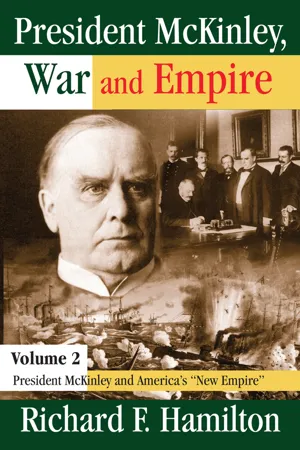
eBook - ePub
President McKinley, War and Empire
President McKinley and America's New Empire
- 217 pages
- English
- ePUB (mobile friendly)
- Available on iOS & Android
eBook - ePub
President McKinley, War and Empire
President McKinley and America's New Empire
About this book
This second volume of President McKinley, War and Empire assesses five theories that have dominated analysis of modern societies in the last century--liberalism, Marxism, mass society, pluralism, and elitism--in accounting for an aberrant event in American history: the Spanish-American War. President McKinley and the Coming of the War 1898, volume 1 of this definitive history, considered the origins of that war. This second volume is concerned with the war's outcome; the settlement in which the U.S. gained an "empire." The book begins by reviewing various expansionist episodes in U.S. history--some successes, some failures--and by analyzing the complexities, support, and opposition involved in expansionism. It then examines the work of expansionist writers, men said to have "driven" the 1898-99 movement, finding these claims to be questionable. Hamilton assesses McKinley's decision-making in regard to the settlement of the Spanish-American War, including the influences that might have moved him, as well as his own justifications. He then reviews the subsequent achievements: the size and character of the new American "empire;" trade flows the Philippine experience and U.S. efforts in China--supposedly the prime goal of the new imperialism. Many contemporary writers anticipated great possibilities in China, but that "fabled" market remained minuscule throughout the following century. Much American trade continued to be with Western Europe, while the biggest change in U.S. exports went largely unnoticed--Canada became the nation's number one trading partner. In much historical writing, McKinley is portrayed as little more than a "front man" for Mark Hanna, the adept businessman-politician who organized and led his presidential campaign, aided by generous financial contributions from business leaders across the nation. Hanna certainly was a leading figure in McKinley's career, but the assumption that his influence was controlling is not justified, as has been shown in recent research. McKinley was far more than a figurehead easily manipulated by representatives of "the interests."
1
American Expansionism: 1763-1896
Expansionism, efforts to acquire new territories, is an ever-recurring theme in American history. A review of the previous history provides some background to the events that occurred during the McKinley administration. Scores of monographs report and analyze American expansion along with hundreds of memoirs and biographies dealing with the participants. This introduction is best seen as a sketch, a brief overview of a complicated subject.
This chapter also provides lessons for the analysis in the later chapters. It covers a series of episodes, some major, some minor. Some of these efforts were initiated by the president, some by members of the Congress, and some were joint ventures. In several instances, the initiative came from voluntary associations and pressure groups. In some cases, the expansionist attempt was the work of individuals, of zealous entrepreneurs. In a few instances the initiators were located outside the nation, the leaders of independent states sensing some advantages to be gained by joining the American Union.
Some of these attempts were successful—as seen from the perspective of the initiators—but some were failures. Many accounts of expansionism are selective, dealing only with the successes. The resulting record of “victories” yields a false portrait of the expansionists’ power. But, as will be seen, opponents were present and active in each case, and in many instances they won the contest. The prime example—if “expansionism” had been an “irresistible force,” Canada would have become part of the United States and Alaska would be a contiguous state.1
As background for this history, one should remember an important pre-revolutionary event, the 1763 Peace of Paris, which ended the Seven Years’ War. It gave Britain a vast territory, all of nouvelle France which included much of modern-day Canada and most of the land between the Appalachians and the Mississippi. That same year, to limit the costs of administering this new empire, King George III “issued a royal proclamation which established a dividing line down the crest of the Appalachian Mountains. No settlers were to locate west of that line.” But that “effort to keep the peace by separating settlers and Indians failed,” one author has written, “for trying to stop the westward movement of American colonials was like trying to make the tides stand still...”2
The costs of army and administration led Parliament to impose taxes on the American colonies. These in turn stimulated a broad-based tax revolt along with contention over constitutional issues, those of appropriate governance.3 One interest, among the many “impulses” that drove the Revolution, was land hunger. The westward drive continued which meant conflict with the indigenous populations. Some Americans, especially those in the interior, people looking to opportunities further to the west, thought “revolution” best served their purposes.4
The Revolution, the work of “the thirteen colonies,” began in 1775 with engagements at Lexington, Concord, and Bunker Hill. Later that year, in a first episode of expansion, an attempt was made to add a fourteenth colony, Quebec. General Richard Montgomery marched north from Ticonderoga and, in November 1775, took Montreal. A delegation, led by Benjamin Franklin and Archbishop John Carroll, arrived shortly thereafter for diplomatic and public relations backup. In a complementary move, General Benedict Arnold marched his troops across Maine in mid-winter to take Quebec City. He attacked on 31 December 1775 during a blinding snowstorm but the effort failed. The approach of a large British army led the Americans to abandon Montreal thus ending the entire effort. Religious bigotry played a role in the defeat. Some vociferous anti-Catholic sentiments had been expressed by members of the Continental Congress, and these statements were used effectively by Quebec’s bishops to counter Franklin’s diplomacy.5
The Canadian venture was supported by John Adams, Robert Morris, and John Hancock. The latter, a “wealthy Boston merchant” and president of the Continental Congress, was “directing the enterprise.” He was “all for making another attempt.” Later attempts were advocated and discussed but not carried through.6
This initial event, the founding of the nation, was in some measure driven by expansionist motives, specifically by the demands of settlers. The American Revolution, in short, was simultaneously a national liberation movement and a struggle for expansion. In the settlement, Britain gave the new nation all of the lands between the Appalachian ridge and the Mississippi River, those extending from the Great Lakes to roughly the northern boundary of Florida. The British leaders recognized the difficulties and the heavy costs of retention. For them it was an easy conciliatory gesture intended to mollify their American cousins, one that would help to restore trade with the former colonies. It would also hinder the possibility of any United States alliance with Britain’s more formidable enemies, France and Spain.
The first episode of American expansion, the plan to take “the fourteenth colony,” Montreal and Quebec, proved a loss. But that was followed by this second event, the significant gain in the 1783 settlement, the grant of the enormous trans-Appalachia region.
Americans who fought in the Revolution were paid with “continentals,” depreciated paper currency. But another reward, a more tangible consideration was involved—those who served were promised payment in land. Vast tracts of the newly acquired western land were given to the states for this purpose. The Western Reserve of Ohio, for example, was set aside for the soldiers of Connecticut. The number of acres given varied with the rank of the combatant.7
A third episode occurred some fifteen years later. Like the Quebec campaign, it too failed and accordingly is largely unknown. Relations with revolutionary France deteriorated during the Adams administration following the XYZ affair and war was thought to be imminent. Funds were appropriated for the nation’s defense and taxes were increased. At this time, Alexander Hamilton, Fisher Ames, the speaker of the House of Representatives, and several others developed a plan for vast conquests. They saw it as an opportunity to take a sizable part of the Spanish possessions in the Western Hemisphere, the immediate targets being Florida and Louisiana. As Ames put it in a letter to a co-conspirator:
Wage war and call it self defense; forbear to call it war, on the contrary, let it be said that we deprecate war, and will desist from our arms as soon as [Spanish] acts shall be repealed, &c., &c., grounding all we do on the necessity of self preservation &c. . . . tell the citizens of danger & bring them to war gradually.
My long letter amounts to this, we must make haste to wage war, or we shall be lost. . . . My faith is that we are born to high destinies.8
President Adams was strongly opposed to the Hamilton-Ames plan, declaring it a “mad” scheme and stating also that “We are friends with Spain.” The threat of war with France, recognized by Adams and other Federalists, forced an increase in taxes that understandably generated opposition. To deal with that and related problems, Congress passed the repressive Alien and Sedition Acts, which generated more opposition. France’s leaders abandoned their provocative policies and sought reconciliation which ended the war scare. This expansionist effort was clearly a failure, its support limited to a faction within the ruling party. Hamilton and Ames were powerful figures within the party but Adams, recognizing the enormous problems the venture would have posed, successfully blocked those ambitions.9
A fourth episode of expansion brought the purchase of Louisiana in 1803, a vast territory west of the Mississippi extending from the Gulf of Mexico northwards to what later would be the states of Minnesota, North Dakota, Montana, and also parts of modern-day Canada. Napoleon had planned to reestablish a French empire in North America and accordingly retrieved the territory from Spain. But then, discovering that he could not maintain it militarily (and also needing money), he arranged its sale. Robert R. Livingston, the United States minister to France, and James Monroe negotiated the terms with the French foreign minister, Talleyrand. The acquisition was enthusiastically supported by Americans on the western frontiers, clearly a boon for prospective settlers. Federalists and prominent Boston leaders generally opposed the settlement. But even in those circles, apparently, a minority favored the move, some sensing political advantage.10
A fifth expansionist effort appeared in connection with the War of 1812. That conflict stemmed from an assortment of grievances with Great Britain, including the impressment of sailors and the blockage of trade with France, the domain of Napoleon Bonaparte. The trading states of New England were the most directly affected but their political leaders, on the whole, were opposed to the possibility of war. Leaders elsewhere called for intervention, and some demanded the taking of territory. Their expressed concern was to suppress Indian attacks on American settlers. Those attacks were supported, allegedly, by the British in Canada and by the Spanish in Florida.11
In 1810, in a speech to the Senate, Henry Clay declared that “The conquest of Canada is in your power. I trust I shall not be deemed presumptuous when I state, what I verily believe, that the militia of Kentucky are alone competent to place Montreal and Upper Canada at your feet.” Then, spelling out the grounds, he asked, “Is it nothing to us to extinguish the torch that lights up savage warfare? Is it nothing to acquire the entire fur trade connected with that country, and to destroy the temptation and the opportunity of violating your revenue and other laws?”12
A year later, as speaker of the House of Representatives and leader of the congressional War Hawks, Clay “used his position to fill important committees with men who were as militant as he.” One of these men, Felix Grundy of Tennessee, served on the foreign relations committee. His reading of the committee’s sentiments in the fall of 1811 was that the “Ruebicon” was already crossed. He wrote to Andrew Jackson declaring “that G Britain must recede or this Congress will declare war. If the latter takes place the Canadas & Floridas will be the Theatres of our offensive operations.” Grundy’s committee recommended enlarging the regular army, calling for volunteers, and the arming of the merchant fleet.13
Congressman John Randolph of Roanoke reported that in the House,“we have heard but one word—like the whippoorwill, but one eternal monotonous tone—Canada! Canada! Canada!” Andrew Jackson, in his call for volunteers, announced that “We are going to fight. . . to seek some indemnity for past injuries, some security against future aggressions, by the conquest of all the British dominions upon the continent of north america.” He elaborated as follows:
Should the occupation of the canadas be resolved upon by the general government, how pleasing the prospect that would open to the young volunteer, while performing a military promenade into a distant country. . . .To view the stupendous works of nature, exemplified in the falls of Niagara. . . to treat the consecrated spot on which Wolf and Montgomery fell, would of themselves repay the young soldier for a march across the continent.14
In March 1812, when the possibility of war was being discussed, Thomas Jefferson wrote to Madison that: “Every body in this quarter expects the declaration of war as soon as the season will permit the entrance of militia into Canada, & altho’ peace may be their personal interest and wish, they would I think disapprove of its longer continuance under the wrongs inflicted and unredressed by England.” In early August, Jefferson wrote a newspaper publisher declaring that “The acquisition of Canada this year, as far as the neighborhood of Quebec, will be a mere matter of marching, and will give us experience for the attack on Halifax the next, and the final expulsion of England from the American continent.”15 From Tennessee, General Andrew Jackson “offered the President his militia division of twenty-five hundred trained men for instantaneous service and promised to have them before Quebec in ninety days.”16 As in the Revolution, those who fought in the war were rewarded with grants of lan...
Table of contents
- Cover
- Half Title
- Title
- Copyright
- Contents
- Preface and Acknowledgements
- A Note on Frequently Cited Works
- Prologue
- 1. American Expansionism: 1763-1896
- 2. The Advocates of Empire
- 3. Acquiring the Empire: 1898-1900
- 4. The New Empire in the Twentieth Century
- 5. War and Empire: On the Various Readings
- Index
Trusted by 375,005 students
Access to over 1.5 million titles for a fair monthly price.
Study more efficiently using our study tools.
Frequently asked questions
Yes, you can cancel anytime from the Subscription tab in your account settings on the Perlego website. Your subscription will stay active until the end of your current billing period. Learn how to cancel your subscription
No, books cannot be downloaded as external files, such as PDFs, for use outside of Perlego. However, you can download books within the Perlego app for offline reading on mobile or tablet. Learn how to download books offline
Perlego offers two plans: Essential and Complete
- Essential is ideal for learners and professionals who enjoy exploring a wide range of subjects. Access the Essential Library with 800,000+ trusted titles and best-sellers across business, personal growth, and the humanities. Includes unlimited reading time and Standard Read Aloud voice.
- Complete: Perfect for advanced learners and researchers needing full, unrestricted access. Unlock 1.5M+ books across hundreds of subjects, including academic and specialized titles. The Complete Plan also includes advanced features like Premium Read Aloud and Research Assistant.
We are an online textbook subscription service, where you can get access to an entire online library for less than the price of a single book per month. With over 1.5 million books across 990+ topics, we’ve got you covered! Learn about our mission
Look out for the read-aloud symbol on your next book to see if you can listen to it. The read-aloud tool reads text aloud for you, highlighting the text as it is being read. You can pause it, speed it up and slow it down. Learn more about Read Aloud
Yes! You can use the Perlego app on both iOS and Android devices to read anytime, anywhere — even offline. Perfect for commutes or when you’re on the go.
Please note we cannot support devices running on iOS 13 and Android 7 or earlier. Learn more about using the app
Please note we cannot support devices running on iOS 13 and Android 7 or earlier. Learn more about using the app
Yes, you can access President McKinley, War and Empire by Richard F. Hamilton,Richard Hamilton in PDF and/or ePUB format, as well as other popular books in History & Historiography. We have over 1.5 million books available in our catalogue for you to explore.