eBook - ePub
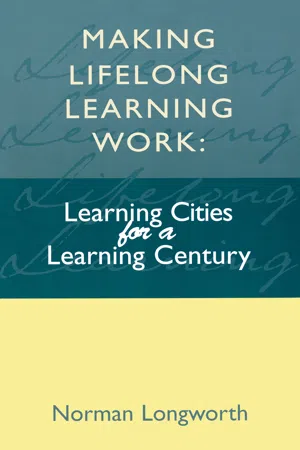
Making Lifelong Learning Work
- 238 pages
- English
- ePUB (mobile friendly)
- Available on iOS & Android
eBook - ePub
Making Lifelong Learning Work
About this book
This text outlines the future roles of schools, business and industry, higher and adult education. Using examples of learning communities that are adapting for the future, the author describes the conditions which lifelong learning can accelerate as an agent for change.
Information
Part 1
New insights into lifelong learning
Chapter 1
Into the learning century

Living with uncertaintyThe reasonable man adapts to his environment and adjusts to the circumstances in which he finds himselfThe unreasonable man questions the environment and circumstances in which he finds himself and tries to change themTherefore, all progress depends upon unreasonable men
(Old parable)
Every new civilization takes ideas from the past and fashions them into the reality of the present. In this respect the times in which we live are little different from times in history. There are those for whom the notion of progress is firmly linked with a burning desire to change outlooks and ideas. They will espouse new causes, new knowledge and new concepts sometimes for their own sake, adapting comfortably to a life of uncertainty. Others, probably the vast majority, seek stasis, a more ordered and prescribed existence in which change takes place more slowly, and where tomorrow will not be too different from today or yesterday. For these, the state of uncertainty is a state of fear, and to be resisted. Similarly there are those whose vision encompasses the recognition that they are living through one of history’s more violent paradigm shifts, and those whose perceptions are more mundane and practical, preferring familiar standards, values and lifestyles. Delors, in The Treasure Within, the report of the Commission on Education for the 21st Century, speaks of ‘the major danger of a gulf opening up between a minority of people who are capable of finding their way successfully about this new world that is coming into being, and the majority who feel that they are at the mercy of events and have no say in the future of society, with the consequent danger of a setback to democracy and widespread revolt’.
Such binary generalizations, dividing people into one or other type, have a superficially observable truth. But often they tend to ignore the complexities across the spectrum of human behaviour, and the schizophrenic thought processes from which individuals often extrapolate their world-view. The enhanced empowerment available to many people, mainly through the applications of modern technology and the changing patterns of the workplace, is changing perceptions rapidly. There is an awareness, albeit inchoate and inarticulate, that world events are affecting lifestyles, leisure styles and work styles in all parts of the global community – a sense of the planet in transition. The question is whether these new perceptions are reaching a sufficient number of people and quickly enough to avoid massive social unrest and disillusionment. In the late 1970s, the journalist Alvin Toffler, expressed it thus. ‘A new civilization is emerging in our lives,’ he said. ‘And blind men are trying to suppress it. This new civilization brings with it new family styles, changed ways of working, loving and living, a new economy, new political conflict; and beyond all this an altered consciousness as well. Pieces of this new civilization exist today. Millions are already attuning their lives to the rhythm of tomorrow.’
More recently Charles Handy, management guru and author of highly regarded books for the business world, has written in Managing the Dream: ‘When the future was an extension of the present, it was reasonable to assume that what worked today would also work next year. That assumption,’ he says, ‘must now be tossed out. The world is not in a stable state. We are seeing change that not only accelerates ever faster but is also discontinuous. Such change lacks continuity and follows no logical sequence.’
Handy and Toffler are not alone. Just about every thinking writer looking at the years ahead uses words in the same vein. Change is endemic in the modern world. Globalization changes the nature of work and our perceptions of nationality. Television, which presents us nightly with often violent images of nations, regions, organizations and people in the process of change, de-sensitizes our brains and re-sensitizes our emotions. New governments, new company leaders, new authors present new ideas, new visions and new goals. While Europe becomes more cohesive and cooperative in response to the global challenge, other national groupings, like Rwanda-Burundi and Yugoslavia, become more fragmented, tearing themselves, and often their people, apart in the name of ethnic unity. The fundamental direction of our societies changes. After 20 years of increasing individualization and less intrusive government culminating in the fall of communism and Margaret Thatcher’s announcement of the death of society in the 1980s, there is now an increasingly strident movement to revive the sense of community and the ‘stakeholder society’. In Lifelong Learning, Longworth and Davies drew attention to Naisbitt’s words ‘the triumph of the individual’. In the past three years, the scene has changed again. The age-old concept of lifelong learning, so well developed in Damascus, Athens and Alexandria thousands of years ago, has again become an icon for educational development into the early 21st century. And so the harmonies and the discords, the cadences and the rhythms of the symphony of our times is conducted once again by a more participative, more contributory philosophy under the banner of lifelong learning.
Change, history and the sense of community
Why is this phenomenon variously called lifelong learning or lifetime learning arousing the interest of governments, organizations and people, not only in the so-called developed nations, but also of those in the developing world? The answer might be encapsulated in one word – change. Change, rapid, all-pervasive and confusing for many, is the basic driving force of the last years of the 20th century, and the progenitor of the need for lifelong learning. It is not an ephemeral trend. New developments in technology will cause it to accelerate over the coming years and affect the lives of more and more people, whether or not they like it. Only a major human catastrophe can slow it down. Educational structures cannot resist its progress, they will have to accommodate it and prepare individuals for it, by themselves embracing and welcoming the new contents, methodologies and approaches.
For many there is a sense of déjà vu about lifelong learning. Historians will argue, and with some justification, that there is nothing new in education. Plato dispensed some very pertinent thoughts on lifelong learning and ‘Dia Viou Paedeia’ – the responsibility of every citizen to educate himself – some 1500 years before Christ. Damascus and Alexandria were true Cities of Learning long before the crusades. In the 16th century, Jan Comenius suggested that ‘Every age is destined for learning, nor is a person given other goals in learning than in life itself.’
More recently, in the 1970s and 1980s, OECD, UNESCO and the Club of Rome were signposting the path to the learning society through reports and actions which were considerably ahead of their time. Original work by Paul Lengrand in a 1970 UNESCO report, An introduction to lifelong learning, was followed up by the Fauré Commission Report of 1972. This was considered by many to be one of the most important educational reform documents of the second half of the 20th century. Among many other things it proposed:
- the development of human skills and abilities as the primary objective of education at all levels;
- support for situation-specific learning in the context of everyday life and work so that individuals could understand, and be given the competency, creativity and confidence to cope with, the urgent tasks and changes arising throughout a lifetime;
- the creation of the sort of learning society in which independent learning is supported and provides an essential part of the continuum of learning as people move into, and out of, education during their lives;
- the involvement of the community in the learning process and the wider social role of education in understanding conflict, violence, peace, the environment and how to reconcile differences.
Certainly present-day lifelong learning advocates would recognize most of those words. OECD was not far behind. Its landmark report Recurrent Education: A Strategy for Lifelong Learning. A Clarifying Report, produced in 1973, was equally forward-looking. Unlike UNESCO, which tended to use the concepts of ‘Éducation Permanente’ and lifelong learning interchangeably, it drew a clear distinction between lifelong learning and lifelong education. The latter, it said, is systematically organized, specific teaching-learning activities usually isolated from other activities and the pressures of life, while the former is the process of learning through life experience.
The standard was raised again by the seminal Club of Rome report of 1979, No Limits to Learning. ‘Innovative Learning’ was the new focus and the new context, requiring individuals to be able to analyse and transform new knowledge and information into creative problem-solving, through which they could develop responsible values and attitudes. A broad-based mobilization of the creative talent inherent in every human being was considered to be the only way to allow him/her to understand, adapt to, and make progress in, an increasingly complex world. Thus more research into human learning processes would need to be carried out as a prelude to the great leap forward in human capability and international understanding.
However, political, social and economic trends during the 1980s and early 1990s changed attitudes considerably. The unfettered visionary idealism of a global, learning-based society became more unfashionable, while the gradual rolling back of the state and the firmer placing of responsibility for personal development onto the individual induced a more utilitarian view. Until the mid-1990s, vision and idealism took a back seat to practical method and ‘back to basics’. But lifelong learning refused to die. Papers were written, rationales rationalized, justifications justified and reasons reasoned. The two philosophies are even now in combat for the hearts and minds of a generation raised on the purely functional and the economically advantageous.
Education and training are dead
The recent renaissance was again led by UNESCO and OECD, though the European Commission and the Council of Europe will also, justifiably, want to claim some credit. The Delors report on Education for the 21st Century was published only months after the 1996 OECD ministerial conference on lifelong learning and its subsequent book Lifelong Learning for All. Meanwhile the European Commission was declaring the same year as the ‘European Year of Lifelong Learning’ and preparing a White Paper on the subject, closely pursued by the European Round Table of Industrialists which collaborated with the Council of University Rectors to produce a booklet on the learning society. Longworth and Davies also published their book Lifelong Learning, spelling out its implications for schools, universities, business and industry, teacher training and the community at large.
All agree that, as the old century dies, the difference is one of the urgency with which these ideas need to be implemented. Governments, business organizations, professional associations are finally catching on and catching up and, at the same time, developing a new set of requirements for the millennium. They are now aspiring ‘learning organizations’. Indeed, in keeping with earlier comments on the speed of change, the momentum of lifelong learning is rapidly accelerating at an astonishing rate. Scarcely an educational, commercial or governmental conference goes by without a mention of lifelong learning as the key to future progress. It is the core of the European Education and Research Programmes for the next five years. Most major organizations and governments are incorporating its concepts into business plans, national strategies and recommended activities.
So where are we now? Change has almost become a paradigm of itself. Small wonder then that uncertainty and confusion reign supreme, and that a proper response to these challenges is unclear. Both Toffler and Handy put the onus on improved education. ‘The responsibility for change,’ says Toffler, ‘lies with us. We must begin with ourselves, teaching ourselves not to close our minds prematurely to the novel, the surprising, the seemingly radical. This means fighting off the idea-assassins who rush forward to kill any new suggestion on the grounds of its impracticality, while defining what now exists as practical, no matter how absurd, oppressive or unworkable it may be.’
At some levels Education and Training perceptions are fast changing into practical learning precepts. Kent – Region of Learning’s strategy suggests that ‘Learning is not synonymous with education and training. It includes the products of education and training, the processes of both formal and informal learning and the various types of learning – skills, knowledge, understanding, values, experience, attitudes.’ And it is evolving strategies to change all of those in the people who inhabit that county.
Lifelong Learning somewhat provocatively and optimistically – and perhaps even arrogantly – announced the demise of the education and training age. ‘It has served us well in the past half-century,’ it said, ‘and it deserves a decent burial, but the time has now come to address a much wider, much more numerous and much more demanding audience. In its place will be the first dawn of an era of Learning, when the focus will be on the needs of all learners and these will take precedence over the power of teachers and trainers. Ownership of, and personal participation in, learning will be the prime motivator. The use of Education Technology and pen and Distance Learning methods will give the necessary forward impetus to such a movement.’
That was written in the heady days of the European Year of Lifelong Learning, when nations, organizations and people struggled to understand and to come to terms with the new educational ideas which lifelong learning plants in the national and corporate mind. And indeed the European Year caught the mood of the changing educational times. More than 800 projects took place and, since that time the European Commission Socrates, Leonardo and Adapt programmes have funded more than 2000 new and larger projects, the Organization for Economic Cooperation and Development (OECD) has initiated vast monitoring and measuring programmes world-wide in response to the demands of its nation members for action, and UNESCO and the World Bank have alerted developing nations to the value of new educational structures. In addition, national governments have published Green and White Papers for implementing lifelong learning in their countries. Finland, the Netherlands and the UK are among the first to do so and others are following quickly behind. The USA policy document makes its appearance in 1999.
Putting it together
In 1995 The Action Agenda for Lifelong Learning suggested the following:
It would not be an exaggeration to suggest that the survival of organizations and societies in an advanced technological world depends on the development of lifelong learning skills and values as an essential part of their culture. The smarter company, the shrewder university, the better school, the more enlightened government, the more perceptive association – they arc already exploring the challenges, implications and opportunities of creating and sustaining lifelong learning organizations for their own long term durability and self-respect.
But it is not only in an advanced technological world that lifelong learning is important. As we have seen, it is equally relevant to the developing world, and to communities and nations as well as to organizations and societies. If this were not so, countries so diverse as South Africa, Venezuela and China would not be spending time and money developing sophisticated lif...
Table of contents
- Cover
- Half Title
- Title Page
- Copyright Page
- Table of Contents
- Foreword
- Foreword
- Dedication
- Introduction
- Part 1 New insights into lifelong learning
- Part 2 Learning cities, learning towns, learning regions – making lifelong learning work
- Appendix 1 The ELLIcities charter for learning cities
- Appendix 2 The Sapporo learning festival
- Appendix 3 ELLI and ELLIcities
- Appendix 4 A learning organization
- References
- Index
Trusted by 375,005 students
Access to over 1.5 million titles for a fair monthly price.
Study more efficiently using our study tools.
Frequently asked questions
Yes, you can cancel anytime from the Subscription tab in your account settings on the Perlego website. Your subscription will stay active until the end of your current billing period. Learn how to cancel your subscription
No, books cannot be downloaded as external files, such as PDFs, for use outside of Perlego. However, you can download books within the Perlego app for offline reading on mobile or tablet. Learn how to download books offline
Perlego offers two plans: Essential and Complete
- Essential is ideal for learners and professionals who enjoy exploring a wide range of subjects. Access the Essential Library with 800,000+ trusted titles and best-sellers across business, personal growth, and the humanities. Includes unlimited reading time and Standard Read Aloud voice.
- Complete: Perfect for advanced learners and researchers needing full, unrestricted access. Unlock 1.5M+ books across hundreds of subjects, including academic and specialized titles. The Complete Plan also includes advanced features like Premium Read Aloud and Research Assistant.
We are an online textbook subscription service, where you can get access to an entire online library for less than the price of a single book per month. With over 1.5 million books across 990+ topics, we’ve got you covered! Learn about our mission
Look out for the read-aloud symbol on your next book to see if you can listen to it. The read-aloud tool reads text aloud for you, highlighting the text as it is being read. You can pause it, speed it up and slow it down. Learn more about Read Aloud
Yes! You can use the Perlego app on both iOS and Android devices to read anytime, anywhere — even offline. Perfect for commutes or when you’re on the go.
Please note we cannot support devices running on iOS 13 and Android 7 or earlier. Learn more about using the app
Please note we cannot support devices running on iOS 13 and Android 7 or earlier. Learn more about using the app
Yes, you can access Making Lifelong Learning Work by Norman (Vice President Longworth,Longworth, Norman (Vice President, World Initiative on Lifelong Learning) in PDF and/or ePUB format, as well as other popular books in Education & Education General. We have over 1.5 million books available in our catalogue for you to explore.