- 320 pages
- English
- ePUB (mobile friendly)
- Available on iOS & Android
eBook - ePub
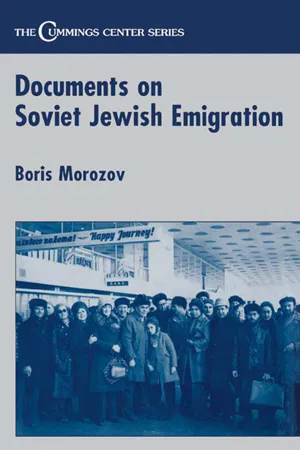
Documents on Soviet Jewish Emigration
About this book
This is a collection of Soviet documents relating to the struggle for Jewish emigration. They reveal those aspects of the problem which most preoccupied the leadership and the factors which had the greatest impact on the decision-making process.
Information
I
THE CHALLENGE OF ZIONIST IDEOLOGY, 1957–68
1
Memorandum from I. Serov to the CPSU Central Committee
Moscow, 31 December 1957
No. 2621-S
Top Secret
Special File
Committee for State Security (KGB) of the USSR Council of Ministers
CPSU Central Committee1
I hereby report that in the process of monitoring international correspondence, the Committee for State Security has noted the arrival of letters addressed to Soviet citizens from individuals who have departed to Israel, which describe the difficult material conditions in the country and express the senders' desire to return to the Soviet Union.2
Typical excerpts from the letters follow:
… Israel is a destitute country. People don't know what to do to earn a crust of bread … People are committing suicide, from scholars to manual labourers … The Soviet Union is the best country in the world, I am convinced of that from my meeting and speaking with people who have come to Israel from various countries. If it were possible to return, not a single person would be left here. Hundreds of people flock every day to the Soviet and Polish consulates because there is no work or housing. I have already submitted [emigration] documents …
Sender: T. Gelikman …, Israel3
… The only available work is manual labour — digging ditches, building storehouses — but it's good that at least there's something
… We really regret that we left you. We're really tormented by this work and the boredom …
Sender: M. Goligaer …, Israel
… I wish you good luck, health and most of all peace. I think we'll live to see the day. We have to do a great deal of work here explaining to people why peace is necessary. But many of them do not understand. I collect signatures against atomic warfare. Often they don't want to sign, and this isn't because they want war, but because they're afraid that tomorrow they'll find themselves without work …
Sender: B. Zaienberg …, Israel
… We submitted documents to the Soviet consulate … explaining that I had given in to the general panic that was created among the Jewish population in Poland and that I had never lived in a capitalist state, and requesting, for the sake of our four children, restoration of citizenship and permission to return to the USSR … I am not afraid to return with only the shirt on my back, if only I can escape from here. Everything that was written in our newspapers, every bit of it, is absolutely true …
Sender: L. Kutasevich …, Poland
… The climate is horrible, and the work situation is difficult. It's hard for the young to find work and for older people, forget it. For nine years we have lived in a horrible damp apartment. In the winter it leaks even onto our beds, but we can't change anything. I've now found work at a school; I go for three hours a day. It's very hard for me to work. I have three children, but I'm forced to do this in order to make life a little bit easier. I'm in no condition to go on living like this …
Sender: I. Rubinfeld …, Israel
… We have gone from one hell to another. Poland was the first hell, and Israel the other. Here they also don't like Russians. At every step all you hear is talk about Russians and jokes about Russia. It's even hard to get work, because Russians here are the last to be employed … Here the rich people, the bosses, have all the power. Here a person is worth nothing. You're 42 years old and they say to you: ‘You're already an old man, there's no work for you any more.’ It's impossible to describe it all on paper …
Sender: T. Shtainkhamer …, Israel
Chairman, Committee for State Security
I. Serov4
2
Proposals of Mukhitdinov Commission and Resolution of the Secretariat, CPSU Central Committee
Moscow, 29January 1958
No. 2–16
Proposals of Comrade Mukhitdinov's Commission:1
Approve the proposals of Comrades Mukhitdinov, Bol'shakov, Grishin, Orlov, Semenov, Tereshkin and Shikin on the implementation of measures in connection with the destitute condition of Jewish settlers in Israel and Spaniards repatriated from the USSR to Spain2 (see appendix).
Secretary, Central Committee
APPENDIX
Top Secret
To the Commission of the Central Committee of the CPSU for Problems of Ideology, Culture and International Party Relations
In connection with the selection of letters presented to the Central Committee of the CPSU by the Committee on State Security from Jewish settlers who left the USSR for Israel3 and from Spanish repatriates who left the USSR for Spain, describing their difficult circumstances, we consider it necessary to report the following:
On Jewish settlers who left the USSR for Israel
In 1957, 1,185 applications were received from citizens of the USSR of Jewish nationality requesting exit visas for Israel.4 By order of the Commission for Departures Abroad, 100 citizens were granted exit visas. Furthermore, as part of the repatriation process, a portion of the Jews residing in the USSR left for Poland and other People's Democracies,5 from which some departed for Israel.6
In Israel, many Jewish settlers found themselves in difficult circumstances which they described in letters to relatives in the Soviet Union. Information about the material straits of Jewish settlers in Israel was used to unmask Zionist propaganda against the USSR and the reactionary nature of the Israeli government's foreign and domestic policies.
In accordance with the CPSU Central Committee resolution dated 3 October 1957,7 directed to the editorial boards of Pravda, Trud, KomsomoVskaia pravda, Literaturnaia gazeta and several republic and oblast', newspapers, articles were published on Israel's economic situation and reactionary policies. Letters from Jewish settlers about their difficult material circumstances in Israel were also printed separately. These materials met with a positive response among the Jewish population of the USSR and the People's Democracies, and also among the population of Arab countries and in progressive circles in Israel.
In accordance with the CPSU Central Committee resolution, a group of Jewish settlers in Israel has now been selected by the Ministry of Foreign Affairs of the USSR from among those who desire to return to the USSR, and after the appropriate verifications they will be issued visas to return to the Soviet Union.
In connection with a new batch of letters and other materials characterizing the destitute situation of Jewish settlers in Israel, it would seem expedient to carry out the following measures:
- Direct the editors of Sovetskaia Rossiia, Komsomol'skaia pravda, Sovetskaia kul'tura, and also the republican newspapers of Ukraine, Belorussia, Moldavia and Uzbekistan to publish in February-March of this year, articles, as well as letters received by local residents from their Jewish settler relatives describing their difficult material circumstances.
- Direct the Department of Propaganda and Agitation of the CPSU Central Committee for the Republics to prepare and organize in Moscow, Kiev and Minsk, in the name of the corresponding republican directorates for Resettlement and Organized Worker Recruitment, press conferences for Jews, former Soviet citizens, returning from Israel, and to use their speeches and declarations in the Soviet press and on radio.
- Require Gospolitizdat to publish in the first quarter of this year a brochure unmasking the aggressive nature of Israel's foreign policy and its domestic situation, keeping in mind the possibility of translating the brochure into other languages.
- Require the All-Union Central Council of Trade Unions [AUCCTU] and VAO Intourist to send to Israel for 10 to 12 days in the second quarter of this year a specially selected group of Jewish tourists consisting of 15 to 20 people, whose expenses will be covered by hard-currency allocations included in the budget for tourist trips to capitalist countries in 1958. Direct the USSR Ministry of Foreign Affairs to prepare a program for the group's stay in Israel so that the participants can convincingly refute fabrications about the allegedly difficult position of Jews in the USSR and, on their return to the Soviet Union, carry out analogous work among the Jewish population to clarify the true situation in Israel. Selection of the above-mentioned group of tourists is entrusted to the Moscow, Leningrad, Kiev and Minsk party oblast' committees.
Counter-propaganda in connection with the increase in Zionist activities
In connection with the fact that Zionist organizations have recently been speaking out actively against the Soviet Union, we would consider it best not to be drawn into a debate with them and not to carry out a campaign or ‘frontal attack’ against Zionist organizations. It would be more acceptable to propagandize the results of the Leninist nationality policy, the friendship of the peoples of the USSR, and the flourishing of the national people's cultures, including that of the Jewish people. In radio broadcasts abroad it is best to emphasize that citizens of Jewish nationality residing in the USSR, together with all Soviet people, are actively participating in socialist construction, as well as in the development of the economy, science and culture.8 This would be the most convincing exposure of the nonsensical and slanderous character of Zionist propaganda on the situation of Jews in the USSR.
At the same time, we consider it necessary:
- to p...
Table of contents
- Cover
- Half Title
- Documents on Soviet Jewish Emigration
- The Cummings center for Russian and East European Studies
- The Agmon Project for the Study of Soviet Jewry
- Title Page
- Copyright Page
- Table of Contents
- Acknowledgements
- List of Documents
- List of Abbreviations
- Introduction
- I. The Challenge of Zionist Ideology, 1957–68 Documents 1–13
- II. Mass Emigration: Context and Impact, 1970–78 Documents 14–66
- III. A New Phase in Emigration Policy, 1980–83 Documents 67–74
- IV. An End to Restrictions Document 75
- Biographical Notes
- Glossary
- Bibliography
- Index
Trusted by 375,005 students
Access to over 1.5 million titles for a fair monthly price.
Study more efficiently using our study tools.
Frequently asked questions
Yes, you can cancel anytime from the Subscription tab in your account settings on the Perlego website. Your subscription will stay active until the end of your current billing period. Learn how to cancel your subscription
No, books cannot be downloaded as external files, such as PDFs, for use outside of Perlego. However, you can download books within the Perlego app for offline reading on mobile or tablet. Learn how to download books offline
We are an online textbook subscription service, where you can get access to an entire online library for less than the price of a single book per month. With over 1.5 million books across 990+ topics, we’ve got you covered! Learn about our mission
Look out for the read-aloud symbol on your next book to see if you can listen to it. The read-aloud tool reads text aloud for you, highlighting the text as it is being read. You can pause it, speed it up and slow it down. Learn more about Read Aloud
Yes! You can use the Perlego app on both iOS and Android devices to read anytime, anywhere — even offline. Perfect for commutes or when you’re on the go.
Please note we cannot support devices running on iOS 13 and Android 7 or earlier. Learn more about using the app
Please note we cannot support devices running on iOS 13 and Android 7 or earlier. Learn more about using the app
Yes, you can access Documents on Soviet Jewish Emigration by Boris Mozorov in PDF and/or ePUB format, as well as other popular books in Social Sciences & Jewish History. We have over 1.5 million books available in our catalogue for you to explore.