![]()
SECTION 1
From birth to toddler
Step 1: Be consistent
Step 2: Use praise and rewards
Step 3: Provide good models
Step 4: Guide the child
Step 5: Ignore bad behaviour
Step 6: Remove from the scene
Step 7: Apply sanctions
Some additional ideas
The birth of a newborn baby is usually a joyous event and that baby is usually born into a family that includes many relations and also a network of friends, each with their own ideas on child rearing.
The first few months will be a time of adapting to a new family member who will very soon establish a personality of her own. Most babies go through a separation anxiety stage at about nine months where they may become very anxious when away from the main carer(s). Babies have emotions and needs from birth and initially express them through crying, but gradually babies gain increasing mobility by initially crawling or rolling and can go and reach out for things and go to things themselves. At this stage the main aim is to think about hygiene and safety for baby.
Gradually as babies become more mobile they become more independent and are more exploratory. This exploration can lead to problems and is the essential stage where parents or carers need to be very cautious and make clear to the child what they can and what they can’t do. A firm, low voice usually works well. Although some of the antics seem funny, it is important not to laugh, as the child will think this is a game and will carry on with the game as long as possible. This would eventually result in the adult becoming very frustrated and very annoyed, sending a very mixed message to the child. Gradually as the child becomes more aware of his environment, the type of behaviour can continue when the child knows it can get a response. It can be at this early stage that parents can begin to feel demoralized so that they are unable to manage their child.
This is also the stage when children want to do more but need more adult help and demand it more if they don’t get the support needed. From about 18 months, as mobility increases, toddlers form stronger ideas about likes and dislikes, often acquiring very strong wills. This is the stage of the ‘terrible twos’ as it is often called. When a toddler wants something she wants it instantly and can feel that others are preventing her from getting it. At this stage the child will not have developed sufficient self control in order for an adult to be able to negotiate with her. Parents can imagine that a child who is able to speak is also able to understand. This is where difficulties arise, as parents may try to reason with a child who has not sufficiently developed emotionally to deal with the frustrations she is feeling. This is certainly a challenging time for parents and carers, as stroppiness and inability to reason often leads to tantrums.
Remember the 3 C’s – be clear, concise and calm
• Be clear in what you say and focus on one aspect at a time.
• Be very concise and use as few words as possible so as not to confuse the child.
• Say everything very calmly and keep repeating things calmly.
What works with toddlers?
• Set very clear boundaries.
• Keep as regular a routine as possible.
• Adults working with children should ensure that they are all using the same approach, as children quickly learn how to manipulate adults.
• Ensure the child is clear that the adults are in control and will not give in to any tantrum pressure, however persevering the child is.
• Some children enjoy a picture representation of what is happening that day. A strip of paper could be placed in a specific place with pictures or photographs of what is happening that day. This can be backed with Velcro or Blu-tack. It can be for the whole day or for specific parts of the day such as bedtime. This particular strip of card could show having a bath, getting pyjamas on, story at bedtime, lights out. Sometimes photographs can be used.
• Young children need clear lessons in taking turns and sharing – simple games like rolling a ball to and fro with one child initially and then extending the game to more children in a small group. When playing a game, show and tell the child clearly what the rules are and play with them until you feel they are aware of the rules.
• As soon as young children appear to be aware of rules, leave them when minor squabbles arise and only intervene if the situation becomes difficult.
• Be careful that you do not offer too many choices to a young child. Simple choices like ‘We are going to visit Aunty Mary today. Do you want your blue or red socks on?’ enable a child to become accustomed to making minor choices. This gives the child the satisfaction of making a choice. Generally a selection of two items should be offered until the child has matured sufficiently to make greater choices.
Good practice in seven simple steps
1. Be consistent.
2. Use praise and rewards.
3. Provide good models.
4. Guide the child.
5. Ignore bad behaviour.
6. Remove from the scene.
7. Apply sanctions.
STEP 1
BE CONSISTENT
Start as you mean to go on and be calm, clear and consistent. Remaining calm and not ‘mirroring’ the behaviour of a child is a useful tactic when dealing with children who are, for example, having a temper tantrum. Reacting to attention-seeking behaviours in a cool, deliberate manner will have the effect of showing that you are displeased while not giving the child the kind of heightened attention he is seeking. If a child is throwing construction toys for instance, the adult might simply walk up to him, very quietly remind him of the rules and swiftly withdraw the toy as a consequence.
Once the rules in your setting have been established and all staff members know how to deal with certain behaviours, it is
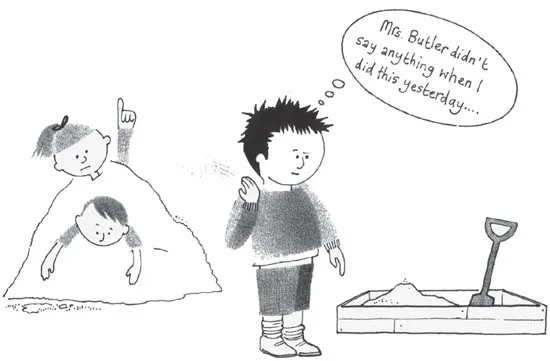
vital that everyone responds in the same way. It is very difficult to backtrack once a precedent has been set. For example, if throwing sand is allowed to go unchecked one day, it will encourage children to keep testing the boundaries. As long as everyone knows the rules and how they are to be applied, it will be much easier to be consistent. Children feel secure when they know and understand what the rules are and what is expected of them.
STEP 2
USE PRAISE AND REWARDS
This is the most effective way of reinforcing good behaviour. Always reward the child who tries, to show that she is succeeding and that succeeding is fun. Show the child how pleased you are.
Rewards can be all sorts of things – praise, hugs, smiles, stickers, stars, smiley faces, favourite activities, computer time, reading stories together, choosing time, certificates, etc. How do you decide which to use? Using rewards is very much up to each individual setting. In some settings, it is policy to use only verbal rewards and to acknowledge rather than to praise wanted behaviours. Some children particularly like certain rewards, for example being allowed extra time at a favourite activity, or a ‘well done’ sticker on their T-shirt. One of the most effective rewards is adult praise or acknowledgement. A simple ‘I really liked the way you helped Jack to carry all those toys to the cupboard’ can be very effective. Recognizing achievements publicly is a powerful tool for raising self-esteem and motivation. Rewards do not have to be ‘big’ to have the desired effect. Varying rewards and changing them when they lose impact is important for maintaining motivation; one type of reward does not necessarily fit all children.
Five simple rules for rewards
1. Reward should be immediate: for example, if Jack has in the past been reluctant to tidy up and he is spotted helping to put things away, you could IMMEDIATELY say something like ‘Thank you Jack for doing such a good job and making things so tidy.’
2. Reward every time at first and less often when the child finds it easier. If the same reward is given when a child has become better at performing a particular task, the impact is lost. This will have the effect of diminishing motivation on the child’s part.
3. Always praise the child when giving rewards.
4. Always say exactly why you’re pleased with him. Instead of ‘good boy’ or ‘well done,’ say ‘I liked the way you waited for Luke to get off the slide before you went down. That was very sensible and grown-up.’
5. Reward children for all different types of good behaviour, so that every child has a chance of being rewarded (see p. 8 for ideas).
Praise
Use the child’s name when praising her for doing the right thing. Children who behave badly often hear their names called out (their surnames too sometimes) but well-behaved children can go for days without hearing their name spoken out loud. If you see someone doing something helpful try saying, ‘Well done, Kayleigh. That was very kind of you/that looks very neat/etc.’ Some children really like to hear their name called for doing the right thing, and this may help to reduce the number of instances of bad behaviour. It also lessens the likelihood that children will be labelled ‘naughty Tommy’ (to distinguish him from ‘reasonably well-behaved Tommy’ and ‘always well-behaved Tommy’).
Positive and specific comments
When praising a child for doing the right thing it is important that she knows exactly what he has done right! Just saying ‘Well ...