Politicians and school officials often argue that higher education is the solution to many of our social, and economic problems. Educating Inequality argues that in order to reduce inequality and enhance social mobility, public policies are needed to revamp the financial aid system and increase the number of good jobs. Exploring topics such as the fairness of the current social system, the focus on individual competition in an unequal society, and democracy and capitalism in higher education, this important book seeks to uncover the major myths that shape how people view higher education and its relation to the economy. Looking to models that generate economic mobility and social equality, this book advocates a broader vision for public higher education to promote universal equality and global awareness.
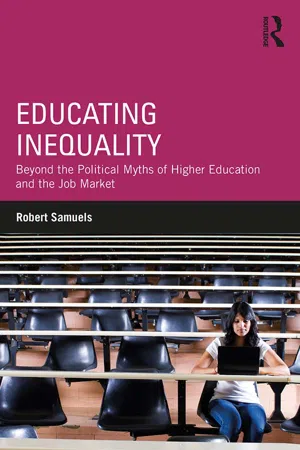
eBook - ePub
Educating Inequality
Beyond the Political Myths of Higher Education and the Job Market
- 182 pages
- English
- ePUB (mobile friendly)
- Available on iOS & Android
eBook - ePub
Educating Inequality
Beyond the Political Myths of Higher Education and the Job Market
About this book
Information
1
THE POLITICS OF HIGHER EDUCATION
Politicians and school officials often argue that higher education is the central solution to many of our social and economic problems; however, at the same moment that college is supposed to reduce inequality and increase social mobility, we find that the opposite is often the case. The focus of this chapter is on the political reasons for positioning higher education as the cure for inequality and poverty. By examining a set of related myths concerning degrees, jobs, and inequality, we will see how politicians often misrepresent the economic effects of higher education.
Class without Class
In his book, Class Dismissed, John Marsh traces the history of the myth that higher education solves the problem of inequality.1 As Marsh highlights, one of the earlier proponents of higher education as the solution to economic issues was Andrew Carnegie, who is known for his generous giving to libraries and universities. What most people do not know is that at the same moment that he was donating a great deal of wealth, he was also doing everything he could to stop workers from unionizing.2 Not only did Carnegie oppose the minimum wage and laws regulating working hours, but he also believed that any form of charitable aid would make workers lazy and dependent. However, he did think that wealthy people should give money to educational institutions because he believed that aid leading to personal betterment is superior to support for people who have not shown that they are hard working.3
Marsh unearths here an interesting dynamic regarding wealth, education, and inequality that still exists today: people resist giving governmental support or even charity to people who do not appear to be trying to better themselves. Thus, while many other countries have a more robust social safety net, America tends to use education as one of the main ways of dealing with poverty and economic inequality. In fact, like Carnegie, many Americans believe that wealthy people deserve their wealth because they have worked hard for it, and since in the land of equal opportunity, anyone can become wealthy, then it must be the fault of the poor if they cannot afford to live on their own.4 Moreover, as Marsh reveals, education in general, and increasingly higher education, is seen as the main system of equal opportunity and advancement.
This preference for education over direct intervention in the labor market turned out to be one of the key aspects of President Johnson’s War on Poverty strategy. As he told Sargent Shriver, “We don’t want any doles.”5 In other words, they did not want to just give people money to help them escape the ravages of poverty; they also did not think that creating jobs through government programs would work because they believed that there were already enough employment opportunities. In short, Johnson and his advisors thought that the problem was that the poor just didn’t have the skills or the will to compete in the labor system. In order to correct this deficit in the “culture of poverty,” the Johnson administration believed that support for education, housing, medical care, and training would give poor people a fair chance in a fair system. Although these were important and needed programs, Marsh points out that this stress on using education and training to prepare people for jobs placed the blame for poor people’s plight on their own lack of skills. At one point, Johnson is quoted as saying: “The answer for all our national problems comes down to one single word: education.”6 Here we see how one of the greatest American efforts to create a more equal society was led by a man who thought that education could solve all social problems.
As Marsh convincingly shows, the only policy that has really reduced the poverty level in America and other countries is government programs that directly transfer money to the poor. For instance, the great reduction of poverty rates in America occurred between the late 1960s and the early 1970s, and during this time, we saw the implementation of public policies like food stamps, Medicare, Medicaid, and supplemental security income.7 Marsh reports that in 1972, these programs lifted half of the people in poverty over the poverty line.8 Thus, even though Americans tend to reject any program that simply gives poor people aid, it turns out that these kinds of policies are the ones that not only help to reduce income inequality, but can also stimulate the economic growth by putting money into the hands of people who will spend it directly in the local economy.9
Since Americans tend to distrust any government program that does not make people work for their support, education is the preferred method for trying to help people escape from poverty. However, as we shall see, wealthy people tend to attend college and complete higher ed degrees at a much higher rate than low- and middle-income people, and so the stress on higher education as the solution to inequality does not work by itself. Of course, one reason why we cannot educate our way out of inequality is that degrees do not produce jobs, and short of creating government jobs for every unemployed or underemployed worker, the federal government has very little control over the private labor market. For instance, in the mid-1970s, between 32 and 38 million jobs disappeared in America.10 These job losses were not due to workers suddenly not having enough education or skills; what happened was that in the face of global competition, companies decided to close down or outsource much of their production. Without any strong government intervention or direct support for displaced workers, the result was a massive increase in unemployment and a decrease in wages from which we have never really recovered.11 In fact, the response to de-industrialization was often a governmental retreat, and the declaration that government was not part of the solution but somehow was the problem itself.12
One of the major economic trends in the twentieth century was the relation between productivity and wages. Up until the mid-1970s, wages and productivity went up together, but starting in the 1970s, productivity quickly increased at a much faster rate than the wages of the average worker.13 It is clear that one of the main causes for this divergence was that managers were keeping a larger percentage of the profits, but another problem was that workers had lost their bargaining power. As Marsh relates, in 1945, 34.5% of all wage earners were in a union, but by 1972, only 26.3% were organized, and in 2012, the rate was 12%.14 Since the mid-1970s, fewer people are in unions, but more people are gaining college degrees, and one of the results is that the wages for most workers have remained flat. Clearly, education is not the main solution to this problem of growing wealth and income inequality.
The Bipartisan Support of the Education Solution
This desire to see higher education as the solution to inequality has been one of the only ideas that liberals and conservatives both support, and so it is interesting to look at why it crosses party lines. Marsh points out that in the case of Bill Clinton and many other new Democrats, the move was made to concentrate on supply-side issues rather than on demand-oriented policies concerning taxes and wages.15 Tired of being seen as tax-and-spend liberals, these Democrats embraced policies like the North American Free Trade Agreement (NAFTA) and the deregulation of the financial markets.16 Moreover, as parties on both sides of the aisle become increasingly dependent on large donors to fund their expensive campaigns, there was little stomach for anyone to try to regulate the companies that funded their campaigns.17 Instead of confronting the issues of corporate greed, Republicans and Democrats turned to higher education as the explanation for why middle-class workers could no longer find secure, well-paying jobs. According to this bipartisan logic, Americans just didn’t have the right education to compete in the new globalized economy. Of course, corporations also like the idea that they can reduce their own spending for training if the government helps universities and colleges provide the needed skills.18
Marsh adds that one reason why people believe that education is perhaps the best way for individuals to become wealthy is that it has worked out that way for many people, especially in the past. He also points out that as other paths for advancement have disappeared, higher education still remains one of the only routes for potential advancement.19 Due, then, to the partial success of education in the past and the present, politicians have found it convenient to see education as both the problem and the solution. According to this bipartisan logic, since everyone wants to get ahead in life, and a college degree can help some advance, higher education is the best way to reduce economic inequality; however, when everyone strives after the same solution, and that solution is rationed, the result can only be more inequality.
Another related issue is that if we see higher education as the solution to social mobility and economic inequality, we focus our attention on the gains of particular individuals and not on the society as a whole. Here we see how a public good is transformed into a private good, which then undermines the public support for that good. Of course, the other side of this logic is that if people are not successful, it must be their own fault.
One reason why politicians from both parties buy into these myths is that these elected officials have almost all been successful products of the meritocratic system, and as Marsh adds, virtually none of them have been members of unions.20 To prove the power of the ideology of meritocracy on the ruling class, he refers to a study indicating that people who have more education believe that more economic opportunity exists than does in reality. Moreover, these same people tend to oppose policies that would reduce income inequality because they believe that wealth is well earned, while poverty is well deserved.21 In what he calls “the narcissism of meritocracy,” people with the most education tend to deny the structural causes for inequality. In other words, people base their view of the world on their own experiences, and if higher education has helped them out financially, they believe it is the answer for everyone else.
As Marsh stresses, higher education allows some people to sleep at night because they believe that we have a fair system of equal opportunity, and thus poor people have only themselves to blame.22 However, while polls show that a large majority of Americans think that income and wealth should be more evenly distributed, virtually the same percentage of people disagree that it is the government’s responsibility to reduce income inequality.23 Interestingly, even a larger percentage of people think that the government should make sure that everyone who wants to go to college can attend. Thus, people...
Table of contents
- Cover
- Half Title
- Title Page
- Copyright Page
- Table of Contents
- Preface
- 1 The Politics of Higher Education
- 2 College and the Myth of the Good Job
- 3 Why Higher Education Reduces Social Mobility?
- 4 The Myth of the Fair Meritocracy
- 5 How College Changed Childhood, Education, and Parenting in America
- 6 Training Undemocratic Capitalists
- 7 The Death of the Liberal Classroom
- 8 Will Technology and the Free Market Save Higher Ed and the Job Market?
- Index
Trusted by 375,005 students
Access to over 1.5 million titles for a fair monthly price.
Study more efficiently using our study tools.
Frequently asked questions
Yes, you can cancel anytime from the Subscription tab in your account settings on the Perlego website. Your subscription will stay active until the end of your current billing period. Learn how to cancel your subscription
No, books cannot be downloaded as external files, such as PDFs, for use outside of Perlego. However, you can download books within the Perlego app for offline reading on mobile or tablet. Learn how to download books offline
Perlego offers two plans: Essential and Complete
- Essential is ideal for learners and professionals who enjoy exploring a wide range of subjects. Access the Essential Library with 800,000+ trusted titles and best-sellers across business, personal growth, and the humanities. Includes unlimited reading time and Standard Read Aloud voice.
- Complete: Perfect for advanced learners and researchers needing full, unrestricted access. Unlock 1.5M+ books across hundreds of subjects, including academic and specialized titles. The Complete Plan also includes advanced features like Premium Read Aloud and Research Assistant.
We are an online textbook subscription service, where you can get access to an entire online library for less than the price of a single book per month. With over 1.5 million books across 990+ topics, we’ve got you covered! Learn about our mission
Look out for the read-aloud symbol on your next book to see if you can listen to it. The read-aloud tool reads text aloud for you, highlighting the text as it is being read. You can pause it, speed it up and slow it down. Learn more about Read Aloud
Yes! You can use the Perlego app on both iOS and Android devices to read anytime, anywhere — even offline. Perfect for commutes or when you’re on the go.
Please note we cannot support devices running on iOS 13 and Android 7 or earlier. Learn more about using the app
Please note we cannot support devices running on iOS 13 and Android 7 or earlier. Learn more about using the app
Yes, you can access Educating Inequality by Robert Samuels in PDF and/or ePUB format, as well as other popular books in Education & Education General. We have over 1.5 million books available in our catalogue for you to explore.