- 170 pages
- English
- ePUB (mobile friendly)
- Available on iOS & Android
eBook - ePub
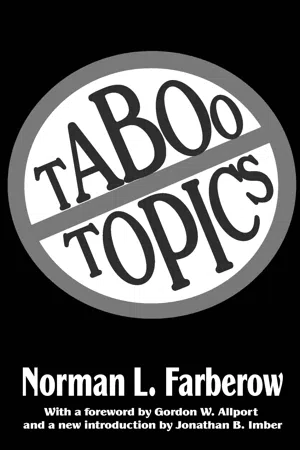
Taboo Topics
About this book
Why is it so hard to investigate taboo topics? A myriad of forces shape and fashion human action, reaction, thought, and feeling, and these are not always well understood. Norman L. Farberow argues that culture itself provides structure for its members, developing in a well-defined way the rules to which they will conform. Such rules find expression not only in written laws and regulations but include, and most often stem from, unwritten folkways, customs, and especially taboos, the subject of this book.The researchers reporting in this volume take no position on the nature of a taboo itself, but concentrate on the difficulty in investigating taboos. As members of society and human beings, they do make judgments and personal investments. Thus, when taboos continue or develop without useful society-enriching functions or facilitate self-destructive activities, they raise questions about why they persist.Such topics include many areas'some social, such as sex, death, and peace; others more academic, such as parapsychology, graphology, religion, and hypnosis. Peace and the public are included in the discussion because they are emotion-laden areas and powerful and important factors in a shrinking world and expanding universe. Peace, especially, has begun to be looked upon with suspicion perhaps a real commentary on our times. This probing collection will be sure to interest sociologists, anthropologists, and all other social scientists.
Information
∎1∎
Introduction
Norman L. Farberow
Man is constantly striving to understand himself and his fellow man. Known, but not always taken into account, are the powerful influences which are constantly at work in his society and culture. These forces, operating in ways of which he is not generally aware, are always present, shaping and fashioning his actions, reactions, thoughts, and feelings. More is meant here than the familiar unconscious, filled with conflicts and dark, repressed drives, or the everyday stream of events filled with habits, apperception, forgotten thoughts, and dreams. Rather, it is the culture itself which provides a many-faceted structure for its members, developing in a well-defined, codified way, the rules to which they will conform. These rules find expression not only in written laws and regulations but include, and most often stem from, the unwritten folkways, customs, and especially taboos. The permitted and the prohibited, the do’s and don’t’s, are developed by society for its members out of self-preservative, tradition-enhancing motives. The most venerable and the most powerful of these are the don’t’s, which are rooted in the mythology of the culture—and these don’t’s are generally the taboos.
Obviously, understanding taboos in their myriad ancient and, at the same time, newly evolving forms is essential. One would suppose that these significant factors in our everyday lives had already been subjected to thorough investigation. One finds instead that taboos are apparently sufficiently powerful to resist not only change but also scientific investigation. Special problems arise within each of the taboo areas of study, problems which do not usually appear in investigations of other aspects of man’s functioning. Yet, it may well be that such problems are more legitimately significant than the subject matter of the research itself. This book reports some of the pioneer efforts by scientific researchers to challenge the quandary of research in emotionladen areas and to venture into the unexplored regions of taboo topics.
But, first, what are taboos? Taboos are primarily backward- oriented, for, by being essentially forbidding and prohibiting, they tend to preserve the past and to control the impingement of the future on the present. Of course, not all taboos are old. New ones constantly appear, taking various shapes and forms as the substance of the culture evolves, but they all serve the same goal —preservation of the status quo.
“Taboo,” also known as “tapu,” “katu,” and “tambu,” as a notion and force in society, was first noted by Captain Cook in describing the Polynesian customs in Tonga in 1771 (Encyclopaedia Britannica, 1947). He outlined the kinds and forms of taboo as they appeared in that culture. Webster’s New International Dictionary (2nd ed., unabridged) defines taboo as something which is “set apart or [made] sacred by religious custom, or forbidden to certain persons or uses; such as may be violated only at the cost of release of evil-working magical force.” It is something “forbidden by tradition or social usage or other authority; strongly disapproved as conflicting with conventions or settled beliefs, often among a particular class….” It is “a sacred interdiction laid upon the use of certain things or words or the performance of certain actions; the action of imposing or state of being subject to such interdiction…. The taboo is commonly imposed by chiefs or priests…. The use of taboos is found among most races of primitive culture.” Taboos are, however, not the exclusive property of primitive cultures. They exist and exert powerful influences in all phases of the most advanced and highly developed civilizations.
The Encyclopaedia Britannica (1947) defines taboos as something which has been “marked off,” implying that certain things are unsafe for casual contact or not to be idly approached. Sumner (1940), in his extensive discussion of folkways, defines taboos as “Things which must not be done…. The primitive taboos correspond to the fact that life of man is environed by perils. … The taboos carry on the accumulated wisdom of generations which has almost always been purchased by pain, loss, disease, and death.” He refers to “four great motives of human action” —hunger, sex passion, vanity, and fear. Other taboos contain interdiction of what will be injurious to the group. Frazer (1922) describes the taboos on persons, acts, words, and things and indicates the common element of danger. It makes no difference whether the danger is real or imaginary, the purpose of the taboo is to protect against and, at the same time, to preserve the imputed spiritual force.
Freud (1913) has written extensively about some of the feelings which occur with taboos. He believes that taboos are primeval prohibitions forcibly imposed from outside and directed against the most powerful longings to which human beings are subject. The desire to violate taboos persists in the unconscious. This last concept is similar to Kierkegaard’s formulation that “anxiety is a desire for what one dreads” (1946).
“Taboo” has two meanings, diverging in contrary directions. The first is “sacred,” or “consecrated”; the second, “uncanny,” “dangerous,” “forbidden,” or “unclean.” The term “holy dread” expresses the feeling accompanying taboos. Freud holds that the earliest human penal system may be traced back to taboo; that is, first the violated taboo took vengeance; then the gods and wronged spirits avenged; and, finally, society took over punishment of the offender.
Taboos are directed mainly against liberty of enjoyment and freedom of movement and communication. In some cases, they have an intelligible meaning and are clearly aimed at abstinences and renunciations. But in other cases their subject matter is quite incomprehensible; they are concerned with trivial details that seem to be of a purely ceremonial nature. Freud quotes Wundt’s statement that taboos follow the rule that anything that is uncanny or provokes dread becomes subject to taboo.
The positive aspects of taboo have also been recognized. Much of the social code which taboo enforces has an obvious ethical value, acquainting man with the structure of the culture in which he lives and reminding him of the obligations he has to the community of which he is a part. Taboos legalize and strengthen morality. Sumner (1940) mentions that some taboos aim to protect and secure, whereas others aim to repress or exterminate. Taboos act selectively, he states, affecting the course of civilization and containing judgments as to social welfare.
Obviously, the researchers reporting in this volume are not against all taboos. In most instances, as scientists, they take no position on the nature of the taboo itself; rather it is the difficulty in investigating the taboos which they concentrate on. But, as members of society and human beings, they do make judgments and personal investments. Thus, when taboos continue or develop without useful society-enriching functions or facilitate self-defeating or self-destructive activities, questions should be raised about them. For example, some taboos on killing oneself help prevent the needless loss of life and support one against the self-destructive tendencies of frustrated aggression and frustrated symbiotic dependency. But other taboos may flood the person with feelings of shame, embarrassment, and guilt and may prevent the person or his family from getting the professional help he needs at this critical period.
The topics of this volume range through many areas—some social, such as sex, death, and peace; others more academic, such as parapsychology, graphology, religion, and hypnosis. At first blush, a discussion of peace and public affairs hardly seems likely to find its way into a volume about taboo topics. However, they are certainly emotion-laden areas and, in these times, powerful and important factors in man’s increasingly nervous functioning in his concomitantly (and paradoxically) shrinking world and expanding universe. Peace, especially, has begun to be looked on with suspicion—perhaps a real commentary on our times. Even more of a commentary is a recent report in a newspaper column about “peace … now a dirty word.” The columnist told of a university professor who had stopped urging his students toward research in attitudes and feelings about peace because of the possibility that their actions would be misunderstood and their reputations sullied. As the reader will quickly note, this is the complete opposite of Osgood’s behavior in the areas of public affairs and peace. Osgood’s presentation does not exactly parallel the others in a specific detailing of the problems of research in a taboo area. But it is very germane in demonstrating, as do the others, the recognition of a need for, and the personal investment in, the furthering of scientific understanding in peace, as well as the conviction that the application of psychological research know-how often provides the best approach to tensionladen subjects.
One of the interesting additional aspects of taboos is the dangerous force of “mana,” which seems to incorporate two powers—first, to remind man of his prohibited wishes and, second, to induce him to transgress prohibitions in obedience to his wishes. Perhaps it is this touch of mana which magically enough has permitted the investigators to challenge the taboos and stimulated the researches discussed in the following pages. More likely, however, is it to be the result of the situation described by E.G. Boring (1961): “Science feeds on its own decay and dissent is the agent that starts new growth.”
The difficulties encountered by each investigator in his studies are outlined in detail in the following pages. Some brief general comments, however, can be made. (1) The subject matter of the taboos itself arouses complex pressures and produces problems of varying depth and intensity of feeling. Death and sex, for example, present widely differing problems in data collection, validity, and reliability; locating subjects and getting their cooperation; and the like than do hypnosis, graphology, or parapsychology. The various kinds of taboos also involve personal, moral, or ethical questions in varying degrees. Investigations of sexuality arouses social reactions, but may be more acceptable to many of the professional community than the investigation of graphology or parapsychology.
(2) As has been noted before, magic is invariably associated with taboos. This magic invests not only the form of the tabooed word, thing, person, or act, but tinges persons who become associated with them, even as remotely as scientific investigators. Culture “protects” its taboos, and its defensive activities are seen in many nearly magical countermaneuvers, such as denial, a magical insistence that the problem does not even exist. People “pass away”; they do not die. Extrasensory perception is just too far beyond credibility, so why bother investigating?
(3) More often, the researcher’s problems stem not so much from the attitudes of the public as from those of his colleagues, the supposed allies in his own professional community. This is frequently a mixed attitude. There is, on the one hand, the generally encouraging statement of interest and agreement on the importance and need for the study, and, on the other hand, there are the snide questions and implications of personal involvement. And this, of course, raises the important question of the researcher’s own abilities to tolerate the questioning, doubting comments, and raised collective professional eyebrows.
This book grew from a symposium which was presented at the American Psychological Association meetings in New York City in 1961. Five of the chapters of this volume were presented at this symposium in papers by Feifel, Hooker, Murphy, Pomeroy, and Shneidman and Farberow. The volume was expanded by contributions from Osgood, Douglas, Watkins, and Anthony. Gordon Allport was invited to write a foreword.
It is hoped that the book serves a fourfold purpose. The first is to indicate the feasibility of research in emotion-laden areas. The second is to illustrate methods and procedures already used in research in some of the areas. The third is to stimulate the interest of the large and growing number of professional research workers—especially the younger, possibly more enthusiastic, graduate student or newly professional person—in the possibility of further research. The fourth purpose is to point out the potentiality of challenging areas in man’s functioning (which is the responsibility of social scientists interested in human behavior) that await scientific investigation by yet-to-be devised techniques.
In all of the topics discussed here, the work has just begun. Much remains to be done in these and other afïect-filled areas, and the opportunities for new, vigorous, enthusiastic, and insightful research are plentiful.
∎selected bibliography∎
Boring, E.G. Psychologist at large. New York: Basic Books, 1961.
Frazer, J.G. The golden bough. New York: Macmillan Co., 1947.
Freud, S. Totem and taboo [1913]. In J. Strachey (Ed.), The complete psychological works of Sigmund Freud. London: Hogarth Press, 1955.
Kierkegaard, S.A. The concept of dread. Princeton: Princeton University Press, 1946.
Sumner, W.G. Folkways. Boston: Ginn and Co., 1940.
∎2∎
Death
Herman Feifel
Nothing in life is to be feared. It is to be understood.
—Marie Curie
La Rochefoucauld, the seventeenth-century French moralist, said that man could no more look steadily at death than at the sun. But the reader will recall the legend of Perseus. He was able, without being turned into stone, to behold the head of the Gorgon Medusa reflected in a mirror given him by the goddess Athena. Thus, he succeeded in slaying the monster.
I have no illusions about our slaying the monster. I feel, however, that, as a result of our miniature mirror, we may be able to look him in the eye somewhat more squarely. When I conceived the study, I knew that the area of death was not quite so popular as Edgar Guest used to be. I did not anticipate, however, that the shade of Semmelweis would start rustling again. In kaleidoscopic manner, I shall touch on what I was trying to do, what occurred, and certain implications drawn from my experience.1
Earlier work of mine in the sectors of mental deterioration (Feifel, 1951), old age (Feifel, 1961a), and time (Feifel, 1957) had guided my attention to the possible importance of man’s ability to grasp the concept of a future and, with it, death. Orientation to future events, I conjectured, might play a more commanding role in our present behavior than we assume (Feifel, 1961b). I reasoned, also, that investigating attitudes toward death in the seriously ill, an “experiment-in-nature,” could provide an additional entryway to how individuals cope with severe threat, thus enriching our understanding of adaptive and maladaptive reactions to stress and of personality theory in general (Feifel, 1959). Experience has shown that certain problems can sometimes be revealingly approached in their exaggerated manifestations. Through study of pathology, illness, and men under stress, we have learned many of our initial truths about normal functioning (Allport, 1960a). Moreover, because of suggested relationships between mental illness and one’s philosophy of life and death (Feifel, 1955), I felt that exploration of this field might serve to broaden therapeutic horizons.2
The avenue for obtaining patients was naturally the physician. At the outset, I was met with: “Isn’t it cruel, sadistic, and traumatic to discuss death with seriously ill and terminally ill people?”—a legitimate enough query. I agreed that a pilot study was certainly in order. I was able to approximate my research idea by being permitted to interview a number of mothers of severely ill leukemic children. These interviews went well, but still no patients were forthcoming. Incidentally, this was in a hospital where a good proportion of the patients themselves recognized that the procedures being carried out on them represented somewhat final hopes concerning their condition.
After “gamesmanship” of an order that would have warmed Stephen Potter and with the valiant help of one of the staff physicians, I was enabled to interview and test eight seriously ill patients. The surmise would have been that the habitual drawbacks accompanying interview-data collection would be compounded here because of the nature of the subject matter. Contrariwise, not only were there no untoward incidents, but an unanticipated felicitous by-product was the seeming psychotherapeutic effect on some of the patients as a result of discussing their attitudes toward death. Still, no cooperation or even a laissez- faire attitude on the part of the hospital authorities was in evidence. I thought that perhaps an extension of the number and type of patients involved as well as the added participation of a consultant and staff psychiatrist might make for more impact. Again, with the support of an understanding oncologist, another ten patients were quarried out and interviewed. Once more, the refreshing frankness and cooperativeness of the patients involved were manifest. Some even thanked me for affording them the opportunity to examine their feelings about death. Characteristic responses were, “You helped me understand my feelings about death,” “I’m grateful because I now have more control over my ideas,” “You didn’t avoid those things that concern me,” “You cleared the cobwebs from my mind,” “Talking to you gave me a sense of relief.” These reactions were undoubtedly enhanced by the prevailing research context of viewing the patient as a human being with wishes, fears, and hopes, rather than as a diagnostic classification case of lung cancer or myocardial infarction.
Most seriously ill and terminally ill patients generally prefer honest, plain talk from physicians and family about the seriousness of their illnesses. They want to voice their doubts, affirm their faith, and communicate what their impending sepa...
Table of contents
- Cover Page
- Title Page
- Copy Page
- Introduction to the Transaction Edition
- Foreword
- Contributors
- 1 Introduction
- 2 Death
- 3 Human Sexual Behavior
- 4 Suicide
- 5 Male Homosexuality
- 6 Parapsychology
- 7 Graphology
- 8 Religion
- 9 Hypnosis
- 10 The Psychologist in International Affairs
Trusted by 375,005 students
Access to over 1.5 million titles for a fair monthly price.
Study more efficiently using our study tools.
Frequently asked questions
Yes, you can cancel anytime from the Subscription tab in your account settings on the Perlego website. Your subscription will stay active until the end of your current billing period. Learn how to cancel your subscription
No, books cannot be downloaded as external files, such as PDFs, for use outside of Perlego. However, you can download books within the Perlego app for offline reading on mobile or tablet. Learn how to download books offline
Perlego offers two plans: Essential and Complete
- Essential is ideal for learners and professionals who enjoy exploring a wide range of subjects. Access the Essential Library with 800,000+ trusted titles and best-sellers across business, personal growth, and the humanities. Includes unlimited reading time and Standard Read Aloud voice.
- Complete: Perfect for advanced learners and researchers needing full, unrestricted access. Unlock 1.5M+ books across hundreds of subjects, including academic and specialized titles. The Complete Plan also includes advanced features like Premium Read Aloud and Research Assistant.
We are an online textbook subscription service, where you can get access to an entire online library for less than the price of a single book per month. With over 1.5 million books across 990+ topics, we’ve got you covered! Learn about our mission
Look out for the read-aloud symbol on your next book to see if you can listen to it. The read-aloud tool reads text aloud for you, highlighting the text as it is being read. You can pause it, speed it up and slow it down. Learn more about Read Aloud
Yes! You can use the Perlego app on both iOS and Android devices to read anytime, anywhere — even offline. Perfect for commutes or when you’re on the go.
Please note we cannot support devices running on iOS 13 and Android 7 or earlier. Learn more about using the app
Please note we cannot support devices running on iOS 13 and Android 7 or earlier. Learn more about using the app
Yes, you can access Taboo Topics by Norman L. Farberow in PDF and/or ePUB format, as well as other popular books in Psychology & History & Theory in Psychology. We have over 1.5 million books available in our catalogue for you to explore.